
I assume our brains are used to stuff which we dont notice conciously, and reject very mild errors. I've stared at the picture a bit now and the finger holding the baloon is weird. The out of place snowman feels weird. If you follow the background blur around it isnt at the same depth everywehere. Everything that reflects, has reflections that I cant see in the scene.
I dont feel good staring at it now so I had to stop.
Like focus stacking, specifically.
I’m always surprised when people bother to point out more-subtle flaws in AI images as “tells”, when the “depth-of-field problem” is so easily spotted, and has been there in every AI image ever since the earliest models.
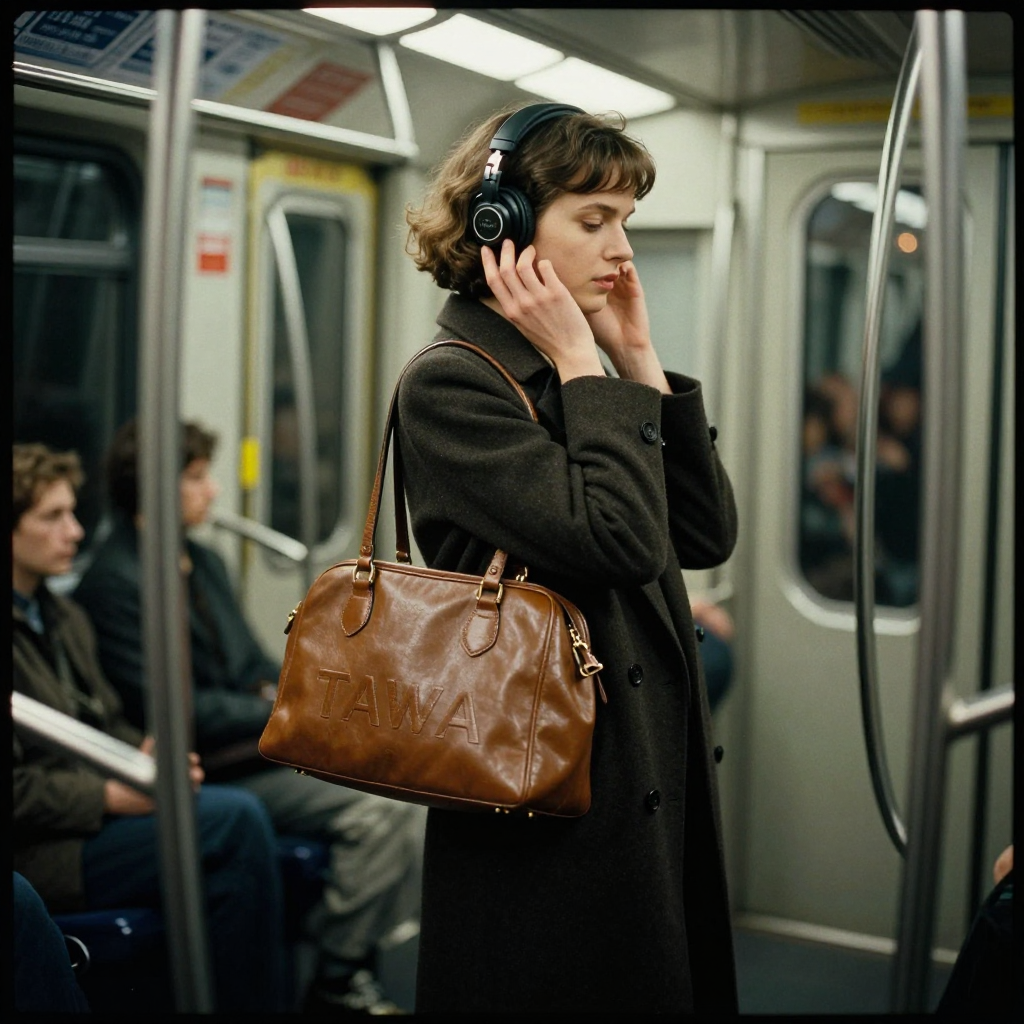
But I found that that results in more professional looking images, and not more realistic photos.
Adding something like "selfy, Instagram, low resolution, flash" can lead to a .. worse image that looks more realistic.
[0] I think I did this one with z image turbo on my 4060 ti
My personal mechanistic understanding of diffusion models is that, "under the hood", the core thing they're doing, at every step and in every layer, is a kind of apophenia — i.e. they recognize patterns/textures they "know" within noise, and then they nudge the noise (least-recognizable pixels) in the image toward the closest of those learned patterns/textures, "snapping" those pixels into high-activation parts of their trained-in texture-space (with any text-prompt input just adding a probabilistic bias toward recognizing/interpreting the noise in certain parts of the image as belonging to certain patterns/textures.)
I like to think of these patterns/textures that diffusion models learn as "brush presets", in the Photoshop sense of the term: a "brush" (i.e. a specific texture or pattern), but locked into a specific size, roughness, intensity, rotation angle, etc.
Due to the way training backpropagation works (and presuming a large-enough training dataset), each of these "brush presets" that a diffusion model learns, will always end up learned as a kind of "archetype" of that brush preset. Out of a collection of examples in the training data where uses of that "brush preset" appear with varying degrees of slightly-wrong-size, slightly-wrong-intensity, slightly-out-of-focus-ness, etc, the model is inevitably going to learn most from the "central examples" in that example cluster, and distill away any parts of the example cluster that are less shared. So whenever a diffusion model recognizes a given one of its known brush presets in an image and snaps pixels toward it, the direction it's moving those pixels will always be toward that archetypal distilled version of that brush preset: the resultant texture in perfect focus, and at a very specific size, intensity, etc.
This also means that diffusion models learn brushes at distinctively-different scales / rotation angles / etc as entirely distinct brush presets. Diffusion models have no way to recognize/repair toward "a size-resampled copy of" one of their learned brush presets. And due to this, diffusion models will never learn to render in details small enough that the high-frequency components of of their recognizable textural-detail would be lost below the Nyquist floor (which is why they suck so much at drawing crowds, tiny letters on signs, etc.) And they will also never learn to recognize or reproduce visual distortions like moire or ringing, that occur when things get rescaled to the point that beat-frequencies appear in their high-frequency components.
Which means that:
- When you instruct a diffusion model that an image should have "low depth-of-field", what you're really telling it is that it should use a "smooth-blur brush preset" to paint in the background details.
- And even if you ask for depth-of-field, everything in what a diffusion model thinks of as the "foreground" of an image will always have this surreal perfect focus, where all the textures are perfectly evident.
- ...and that'll be true, even when it doesn't make sense for the textures to be evident at all, because in real life, at the distance the subject is from the "camera" in the image, the presumed textures would actually be so small as to be lost below the Nyquist floor at anything other than a macro-zoom scale.
These last two problems combine to create an effect that's totally unlike real photography, but is actually (unintentionally) quite similar to how digital artists tend to texture video-game characters for "tactile legibility." Just like how you can clearly see the crisp texture of e.g. denim on Mario's overalls (because the artist wanted to make it feel like you're looking at denim, even though you shouldn't be able to see those kinds of details at the scaling and distance Mario is from the camera), diffusion models will paint anything described as "jeans" or "denim" as having a crisply-evident denim texture, despite that being the totally wrong scale.
It's effectively a "doll clothes" effect — i.e. what you get when you take materials used to make full-scale clothing, cut tiny scraps of those materials to make a much smaller version of that clothing, put them on a doll, and then take pictures far closer to the doll, such that the clothing's material textural detail is visibly far larger relative to the "model" than it should be. Except, instead of just applying to the clothing, it applies to every texture in the scene. You can see the pores on a person's face, and the individual hairs on their head, despite the person standing five feet away from the camera. Nothing is ever aliased down into a visual aggregate texture — until a subject gets distant enough that the recognition maybe snaps over to using entirely different "brush preset" learned specifically on visual aggregate textures.

Also Imagen 4 and Nano Banana Pro are very different models.
But anyway, realistic environments like a street cafe are not suited to test for photorealism. You have to use somewhat more fantastical environments.
I don't have access to z-image, but here are two examples with Nano Banana Pro:
"A person in the streets of Atlantis, portrait shot." https://i.ibb.co/DgMXzbxk/Gemini-Generated-Image-7agf9b7agf9...

"A person in the streets of Atlantis, portrait shot (photorealistic)" https://i.ibb.co/nN7cTzLk/Gemini-Generated-Image-l1fm5al1fm5...

These are terribly unrealistic. Far more so than the Flux.2 Pro image above.
> Also Imagen 4 and Nano Banana Pro are very different models.
No, Imagen 4 is a pure diffusion model. Nano Banana Pro is a Gemini scaffold which uses Imagen to generate an initial image, then Gemini 3 Pro writes prompts to edit the image for much better prompt alignment. The prompts above a very simple, so there is little for Gemini to alter, so they look basically identical to plain Imagen 4. Both pictures (especially the first) have the signature AI look of Imagen 4, which is different from other models like Imagen 3.
By the way, here is GPT Image 1.5 with the same prompts:
"A person in the streets of Atlantis, portrait shot." https://i.ibb.co/Df8nDHFL/Chat-GPT-Image-10-Feb-2026-14-17-1...

"A person in the streets of Atlantis, portrait shot (photorealistic)" https://i.ibb.co/Nns4pdGX/Chat-GPT-Image-10-Feb-2026-14-17-2...

The first is very fake and the second is a strong improvement, though still far from the excellent cafe shots above (fake studio lighting, unrealistic colors etc).
I disagree, nano banana pro result is on a completely different league compare to flux.2 and z-image.
>But anyway, realistic environments like a street cafe are not suited to test for photorealism
Why? It's the perfect settings in my opinion.
Btw I don't think you are using nano banana pro, probably standard nano banana, I'm getting this from your prompt: https://i.ibb.co/wZHx0jS9/unnamed-1.jpg

>Nano Banana Pro is a Gemini scaffold which uses Imagen to generate an initial image, then Gemini 3 Pro writes prompts to edit the image for much better prompt alignment.
First of all how should you know the architecture details of gemini-3-pro-image, second of all how the model can modify the image if gemini itself is just rewriting the prompt (like old chatgpt+dalle), imagen 4 is just a text-to-image model, not an editing one, it doesn't make sense, nano banana pro can edit images (like the ones you can provide).
I strongly disagree. But even if you are right, the difference between the cafe shots and the Atlantis shots is clearly much, much larger than the difference between the different cafe shots. The Atlantis shots are super unrealistic. They look far worse than the cafe shots of Flux.2 Pro.
> Why? It's the perfect settings in my opinion
Because it's too easy obviously. We don't need an AI to make fake realistic photos of realistic environments when we can easily photograph those ourselves. Unrealistic environments are more discriminative because they are much more likely to produce garbage that doesn't look photorealistic.
> Btw I don't think you are using nano banana pro, I'm getting this from your prompt: https://i.ibb.co/wZHx0jS9/unnamed-1.jpg
I'm definitely using Nano Banana Pro, and your picture has the same strong AI look to it that is typical of NBP / Imagen 4.
> First of all how should you know the architecture details of gemini-3-pro-image, second of all how the model can modify the image if gemini itself is just rewriting the prompt (like old chatgpt+dalle), imagen 4 is just a text-to-image model, not an editing one, it doesn't make sense, nano banana pro can edit images (like the ones you can provide).
There were discussions about it previously on HN. Clearly NBP is using Gemini reasoning, and clearly the style of NBP strongly resembles Imagen 4 specifically. There is probably also a special editing model involved, just like in Qwen-Imahe-2.0.
Still the vast majority of models fail at delivery an image that looks real, I want realism for a realistic settings, if it can't do that than what's the point. Of course you can always pay people and equipment to make the perfect photo for you ahah
If the image of z-image turbo looks as good as the nano banana pro one for you, you are probably too used to slop that a model that do not produce obvious artifacts like super shiny skin it's immediately undistinguishable from a real image (like the nano banana pro one that to me looks as real as a real photo) and yes I'm ignoring the fact that in the z-image-turbo the cup is too large and the bag is inside the chair. Z-image is good (in particular given its size) but not as good.
Yes, and it has a very unrealistic AI look to it. That was my point.
> You haven't posted a z-image one of Atlantis.
Yes, I don't doubt that it might well be just as unrealistic or even worse. I also just tried the Atlantis prompts in Grok (no idea what image model they use internally) and they look somewhat more realistic, though not on cafe level.