
I'd bet people would happily trade away the inkling of light they get during their winter commute before locking themselves into their office for some extra daylight when they leave that office.
Daylight is most enjoyable if you can actually make use of it.
https://washingtonian.com/2022/03/15/the-us-tried-permanent-...
> the inkling of light they get during their winter commute
It's not an inkling. Unless you roll out of bed and instantly onto your commute, you're getting natural sunlight through all your windows for hours every morning. That's exactly when you need it.
> you're getting natural sunlight through all your windows for hours every morning
Hah "hours". Not in Northern Europe you're not. My commute is dark on both sides. If I had to choose which side I'd prefer to be brighter I'd prefer the end of the day rather than feeling like my daylight has been wasted in the office. I shift my schedule in winter to make up for this as best I can.
I guess it kinda hinges on this idea of "wasting" daylight. I don't feel like that. I want the sun to wake me up, and have no problem doing whatever I like when it's dark in the evening. Do people generally go on hikes after work? I go out for drinks. haha
> I guess it kinda hinges on this idea of "wasting" daylight. I don't feel like that. I want the sun to wake me up
The problem is that during the darkest parts of winter, even if I postpone my wake up as long as possible, I'm still getting up in the dark if I want to be able to commute into work on time. There's no sunlight waking me up.
> Do people generally go on hikes after work? I go out for drinks. haha
No, but I still have to do things like walk the dog, do the shopping on the way home. I find it a lot more pleasant starting out that part of day with a bit of sunlight.
Also, yes, drinks. This is Northern Europe after all.
EDIT to add: Civil twilight in December where I am starts ~07:40, and I also get up around 06:30 (when not dealing with insomnia like tonight).
If it wasn't for that damn 9 AM Monday meeting (ugh) I would just keep my clocks sent to standard time and start work an hour late in the summer.
I apologize society is inconveniencing you.
In the summer, we already have lots of sunlight regardless, so it doesn't make sense to optimize for that.
I don't think that's very realistic though is it? School times are fixed and that anchors a lot of families to those specific times, and businesses tend to have set hours.
Changing the time to give people more light in the evening frees up a bunch of people to enjoy some sunlight without making it a whole fight to have different hours at work.
If that's what passes for aspiration these days then the labour movement truly is dead.
I understand the argument for having an early sunset, clearly having sunlight when you're awake has an effect. But who cares about having an early high noon, when there's still two thirds of the day left at best?
Switching to daylight time will switch sunrise/sunset to 9AM/515PM, guaranteeing kids will be walking in the dark in the morning.
When we start getting more sun, it’s fine in the morning even with the spring forward.
We go back to standard time in winter because otherwise it stays dark too long.
And all of this ignores the core fact that time zones are way more politically determined than geographically. And that’s a whole other problem
Switching to daylight time makes more sense in Eastern BC than it does in Western BC. But Eastern BC is relatively unpopulated. The population of Penticton is 40,000 vs 3,000,000 in metro Vancouver. Second largest metro (Victoria) is west of Vancouver.
Penticton experiences sunrise/sunset about 25 minutes before Vancouver, so their kids experience approximately equal amounts of sun before & after school on the winter solstice.
Why change the clocks when we could change the definition of school time, business hours, liquor/gambling licensing hours, construction noise hours, etc? Just use standard time and then base our society around the physics of the sun.
I live in Calgary. At a previous grade school my daughter went to, school started early enough that she left in pitch black conditions in winter, regardless of "experts" and their precious daylight savings time.
'You need sunshine when you wake up' is really a ridiculous argument, there is no sunshine even with DST.
Get rid of it. Maybe egg the houses of the "experts" too.
(As for my kids, thankfully, they did remote school during Covid (hence late mornings) and then I moved to a place where the school starting time was later than 8.)
Anyone in the north has seen “winter hours” and “summer hours”.
How many people roll out of bed, rush out the door and jump in the car before they're actually awake? In my circles, that would be a larger percentage that of those that get up with plenty of time to wake up. I'm not sure any time of the day is safer regarding attentive drivers. Especially if we're going to consider idiots on their phones while driving.
Wait, why? Where? I've never heard this. Which driving conditions are you talking about? Rain? Snow?
This makes a few driving hazards more likely or more intense in mornings, including fog, sleet, and ice. Also tires have less traction when they are colder. In the morning it is less likely for snowplows or earlier traffic to have cleared paths on secondary roads.
Driver assist systems tend to have more trouble with sensor fogging, frosting, or icing in the morning.
That's not to say evening is a piece of cake. Evening tends to have denser traffic which increases the risk of accidents. Places that are in shadow for much of the day might maintain ice while most of the morning ice melts, or might start developing new evening ice earlier than places the heated up more in the day which could be particularly bad--if most of the road is ice free in the evening people might let down their guard.
When we change the general time, this applies to school days as well as office hours, so the kids go home to evening traffic relation will stay constant.
If you’re exhausted you shouldn’t be driving. Period. You’re the danger to kids, not light or darkness. (Your headlights are in working order, right?)
The DST changes abruptly made everything visible again. Around that time we were also getting a permanent snow cover. And the whiteness of the snow significantly improved visibility for the rest of the winter.
So I don't think that the concerns are completely unfounded, but they are probably not as dire either.
I’m sure there’s some correlation with the time zone, but it feels like a “think of the children!” argument that ignores much more significant factors (e.g. traffic speed and volume).
Everyone finds arguments that suits them. Some will quote "sleep experts", others will mention economic reasons, others will talk about road safety, each one with studies proving their point, peer-reviewed for the most sophisticated.
My take is that we are all different, and whatever you choose, some people will be better off, others will be worse off. There is a high chance that that variety is an evolutionary advantage, at least it was for our ancestors, as a group where everyone is sleeping at the same time is more vulnerable. Not great for office hours though.
Unfortunately we live on an oblate spheroid what spins around the sun and its a bit tricky when the sun comes on and is switched off. It doesn't help that the basted planet is tilted to the ecliptic too so we end up with daylight/nighttime procession and all that equinox/solstice bollocks. I live quite close to both Glastonbury and Stonehenge. People have some pretty odd ideas about reality, let alone time in these parts 8)
The "perfect" solution is of course moving the clock continuously and keeping 12:00 fixed to peak daylight. Sadly that wont work too well when the time changes every 50 miles or so!
No one will ever be happy when it comes to fiddling with clocks - that is the way of life. There is no right answer for everyone and never will be. I might accept an arguement based on road fatality statistics but not much else and then you'll get some sort of economic based falacy in response.
I agree with everything you write, and in principle I'd prefer just to stay on standard time forever.
However for my selfish individual interests: I work with a lot of people in Europe, and this change to permanent DST will make the time difference once hour less for 4 months a year… until the rest of the world goes this way too, at least.
So would the folks who study circadian rhythms:
> Over much of the highly-populated areas of Canada, the sun would not rise until about 9 am in winter under DST, and the daylight will linger an hour later in summer evenings than under Standard Time. As a Northern country, Canada includes higher latitudes where the effects of late winter dawns and late summer dusks under DST would be felt more profoundly. What long-term effects on health can we expect from year-round DST? As predicted from our understanding of the human biological clock, our brain clock will try to synchronize to dawn and push us to go to bed later. However, our social clock will force us to wake an hour earlier in the morning. Will this have any health effects?
> We have good evidence for the negative impact of being an hour off of biological time, and this comes from studies on the health of populations living on the edges of time zones. We have arbitrarily divided the earth into one-hour time zones, so that people on the east side of a time zone see the sun rise an hour earlier (according to their social clocks) than people on the west side of the same time zone. Researchers have analyzed the health records and economic status of those two populations, and have found poorer health outcomes on the west side: increased rates of obesity and diabetes, heart disease, and cancer (Gu et al., 2017). Moreover, people on the west sides of time zones earned 3% less in per capita income (Giuntella and Mazzonna, 2019). What could account for this? As predicted, people on the west sides of time zones go to bed later than people on the east sides, but then have to get up at the same time in the morning because of fixed work and school schedules. Therefore they lose sleep: about 20 minutes per weeknight, which adds up to a significant sleep debt over the week. We know from other research that sleep deprivation negatively impacts health and workplace performance. We can already see the negative impacts of a one-hour difference across a time zone, and year-round DST would put our social clocks another hour out of alignment with our biological clocks.
I find these explanations to these studies so bizarre. We know that there are large populations living significantly further north, who don't get sunlight in the morning in winter, no matter whether there's DST or not. We also know that they get almost perpetual light during summer. If these explanations were true then you would expect a country like Sweden to have an impact on life expectancy and illness from this. But it's not. It's about as rich as Canada and has about the same life expectancy.
* https://esrs.eu/wp-content/uploads/2019/03/To_the_EU_Commiss...
I would hazard to guess some of those folks have looked at data for northern Europe and took it into account when forming their conclusions.
For other reasons, I also wish we were closer to solar noon though. High noon is actually closer to 2pm here and seems to push the whole day back in the summer. The best (warmest) parts of the day get pushed too late into the afternoon.
And every argument I hear from the pro DST group is really just an argument for ending adult work at 15.30 rather than 17.00 and maintaining a 9.00 start time.
It blows my mind that we are all meant to wrap our lives around bullshit jobs.
Given it one winter season across the solstice and I'd bet a lot of your fellow residents will come around to your viewpoint.
If you take into account places further north than British Columbia it gets even more extreme. Barrows Alaska has the sunrise after 1 PM some days. Do you think businesses, schools, etc are going to start at 1 PM on those days?
Time changes are just a hack to make every business change their effective office hours back when the sign on the door - and coordination - mattered. Today brick and mortar is way less relevant. Way more people are working from home or going to work at random hours. The time change doesn't affect going to grocery store or restaurants or the gym. It's basically just schools, banks, and the DMV.
Why not have a given entity change its hours through the year, if the relation to the sun actually matters?
(And no, I don't buy that there needs to be time coordination between schools, since they are all already slightly different anyway. Different kids have different after school programs different days. Different parents are already going to work different hours. There's no way to coordinate for everyone to be happy, ever.)
http://blog.poormansmath.net/images/SolarTimeVsStandardTime....
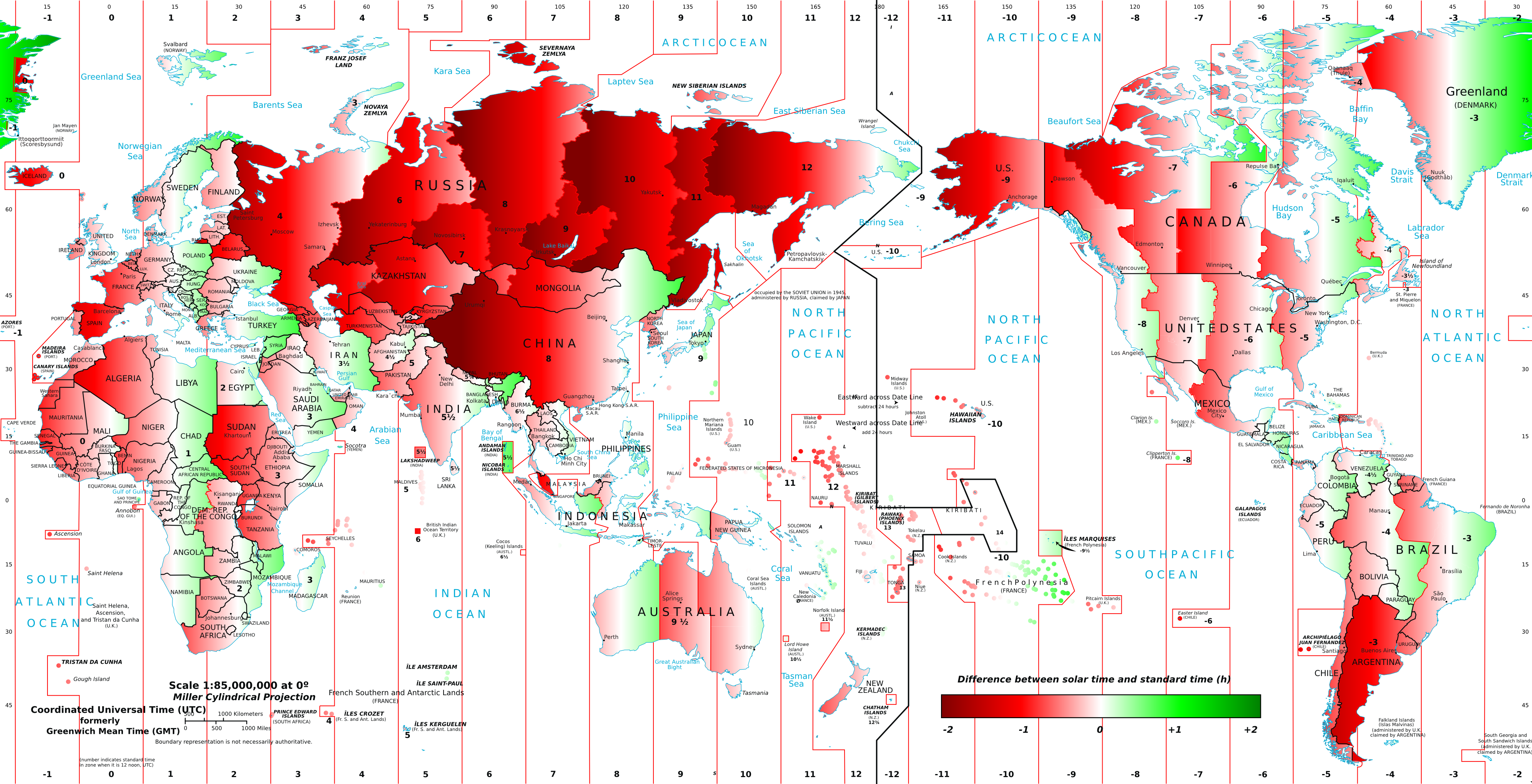
Without the DST offset, Spain much more "red" than England.
It's not so much a "permeant DST" but rather a "we want to change to GMT without moving out of the CET timezone."
https://andywoodruff.com/blog/where-to-hate-daylight-saving-...
Russia is telling since they changed their timezones in 2016. I'm going to note that timezones are also a political identity too. https://www.timeanddate.com/news/time/russia-new-time-zones.... For a map https://commons.wikimedia.org/wiki/File:Difference_between_l... and the Wiki article https://en.wikipedia.org/wiki/Time_in_Russia#Russian_Federat...

China is aligned with Beijing and the rest of the country follows from when noon in Beijing is.
Sudan's history is in https://en.wikipedia.org/wiki/Time_in_Sudan
Argentina is https://en.wikipedia.org/wiki/Time_in_Argentina - My speculation would be that Argentina (the east coast especially) wanted to be economically synchronized with the coastal cities of eastern Brazil. Buenos Aires and São Paulo being on the same timezone makes it easier for the two of them to do business.
Alaska used to have four timezones. In 1983, they were consolidated into two timezones - Aleutian and Alaska. Being in -9 rather than -10 brings Anchorage closer to the Pacific west coast in its business day with the note that it doesn't matter too much when solar noon is if sun is up for 22 hours or 5 hours.
And they still do DST. They're just on a different time zone than they should be because during WWII, they changed to the same time zone as Germany.
It's not 1900s anymore. Cars have fancy headlights and sensor suites for AEB. And generally street lighting is available around schools.