
The drag down of swapping became almost a non-issue with the SSD changeover.
I suppose going from a //e to a IIgs was that kind of leap but that was more about the whole computer than a cpu.
Now I have to say, swapping to an SSD on my windows machines at work was far less impressive than going to SSD with my macs. I sort of wrote that off as all the anivirus crap that was running. It was very disappointing compared to the transformation on mac. On my macs it was like I suddenly heard the hallelujah chorus when I powered on.
Also, going from Sim City to Sim City 2000 was pre-bloat. Over the course of five years, the new version was significantly better than the original, but they both target the same 486 processor generation, which was brand new when the original SimCity was released, but rather old by the time SimCity 2000 was released. Another five years later, Sim City 3000 added minimal functionality, but required not just a Pentium processor, but a fast one.
I guess what I'm getting at is that a faster CPU means programs released after it will run better, but faster storage means that all programs, old and new, will run better.
These days, we value developer productivity over performance optimization, so we have stuff like Electron apps. The reason behind it is that CPUs (and RAM quantity, for the most part) are so far ahead of regular desktop applications that it doesn't matter. In the 80s and 90s, the hardware could barely keep up with decently-optimized software that wanted to do anything interesting.
I think there's a difference between bloat and actually useful features or performance.
For example, I started making music with computers in the early 90s. They were only powerful enough to control external equipment like synthesizers.
Nowadays, I can do everything I could do with all that equipment on an iPad! I would not call that bloat.
On the other hand, comparing MS Teams to say ICQ, yeah, a lot of that is bloat.
Tell that to ScreamTracker!
And we were mostly ripping those samples from records on cassettes and CDs, or other mods.
https://www.c64-wiki.de/images/f/f1/rockmon3.png
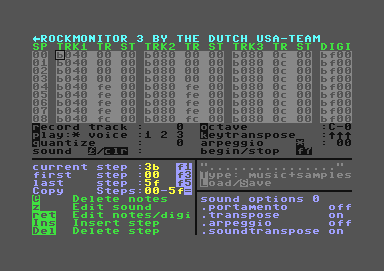
Or also at https://www.youtube.com/watch?v=roBkg-iPrbw&t=400s in the video already linked below. And yes, I had to type in that listing.
For me they were.
I still remember the first PC I put together for someone with a SSD.
I had a quite beefy machine at the time and it would take 30 seconds or more to boot Windows, and around 45s to fully load Photoshop.
Built this machine someone with entirely low-end (think like "i3" not "Celeron") components, but it was more than enough for what they wanted it for. It would hit the desktop in around 10 seconds, and photoshop was ready to go in about 2 seconds.
(Or thereabouts--I did time it, but I'm remembering numbers from like a decade and a half ago.)
For a _lot_ of operations, the SSD made an order of magnitude difference. Blew my mind at the time.
So it was the only way to get that visceral improvement in user experience like CPU and platform upgrades were in the mid 90's to very early 00's.
The experience of just slapping a new SSD in a 3 year old machine was similar to a different generation of computer nerds.
Nothing could really match the night and day difference of an entire machine being double to triple the performance in a single upgrade though. Not even the upgrade from spinning disks to SSD. You'd go from a game being unplayable on your old PC to it being smooth as butter overnight. Not these 20% incremental improvements. Sure, load times didn't get too much better - but those started to matter more when the CPU upgrades were no longer a defining experience.
Would you take the SSD and a 500Mhz processor or a 2Ghz dual-core with a 7200k or 10000k HD? "Some operations are faster" vs "every single thing is wildly faster" of the every-few-years quadrupling+ of CPU perf, memory amounts, disk space, etc.
(45sec to load Photoshop also isn't tracking with my memory, though 30s-1min boot certainly is, but I'm not invested enough to go try to dig up my G4 PowerBook and test it out... :) )
Never witnessed anything before or after with that jump in specs
I'd say software never really "caught up" to the general slowness that we had to endure in the HDD era either. Even my 14 year old desktop starts Word in a few seconds compared to upwards of 60s in the 90s.
The closest I've seen is the shitty low end Samsung Android tablet we got for our kids. It's soooo slow and laggy. I suspect it's the storage. And that was actually and upgrade over the Amazon Fire tablet we used to have which was so slow it was literally unusable. Again I suspect slow storage is the culprit.