
The 1% pockets, this is where the vast majority of the extra productivity computers/internet/automation brought goes to for the last 50 years: https://www.epi.org/productivity-pay-gap/
1) The salaries of corporate employees 2) Shareholders and capital owners
Regarding number 2: "Shareholders" would include anyone who owns any stock at all, including a lot of middle class people with a simple S&P 500 ETF in their portfolio.
And the increase in productivity allowed more people to become capital owners, AKA entrepreneurs. The explosion in software entrepreneurs, for example.
Because no matter what fairy tales you want to believe in your $20 "invested" in palantir won't make you a "shareholder" lmao
Lots of middle class people have graduated into upper-middle class: https://www.aei.org/research-products/report/the-middle-clas...
Wealth inequality is still a problem. But it's not just the people at the very top benefitting.
https://images.seattletimes.com/wp-content/uploads/2017/12/9...

https://www.peoplespolicyproject.org/wp-content/uploads/2020...
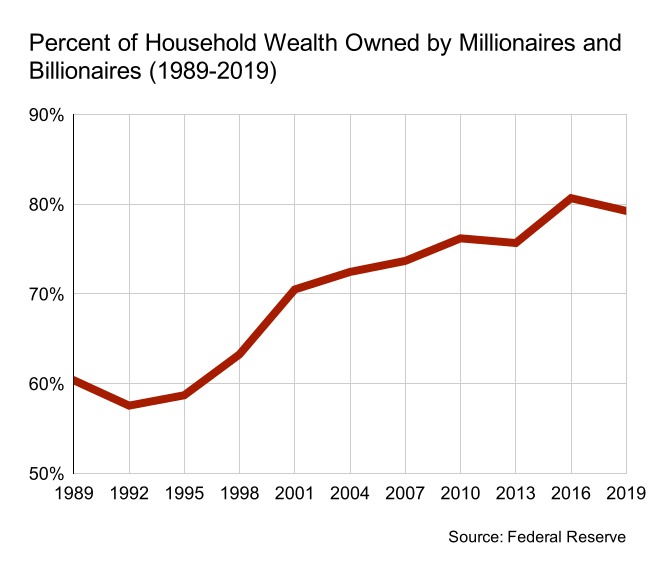
https://datawrapper.dwcdn.net/CvQar/full.png
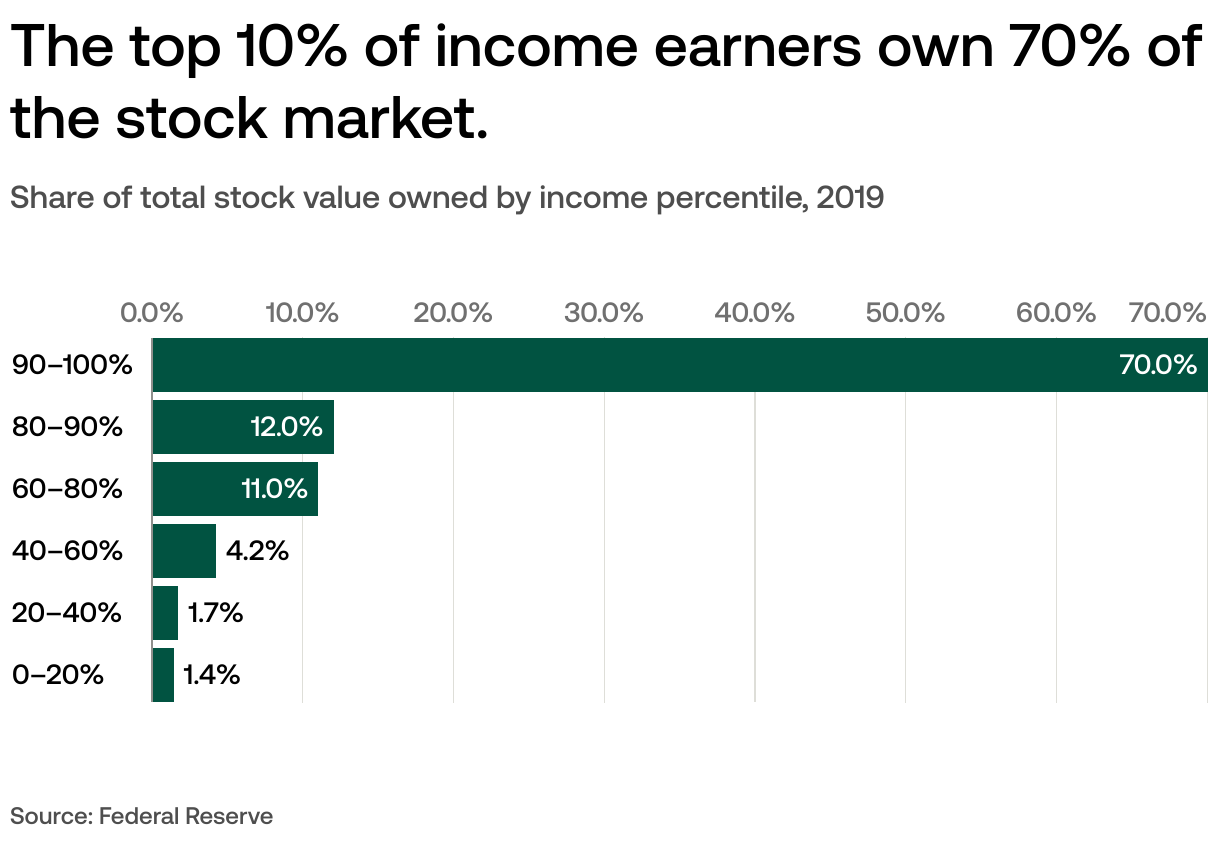
https://static.guim.co.uk/ni/1415721490539/Wealth_line-chart...
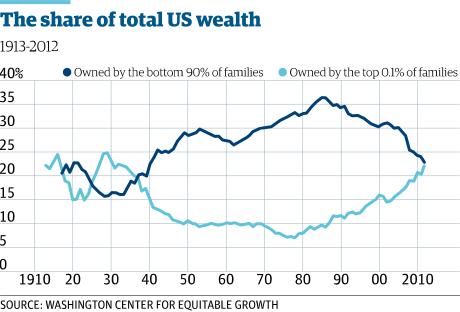
Upper-middle class is people making ~$200k/year.
A lot of people have moved from middle class to upper middle class over the last decade. Both those categories are outside the 1%.
The upper limit and the median of the household income quintiles as of 2022 are:[0]
  Lowest: $ 30,000 / $ 16,120
  Second: $ 58,020 / $ 43,850
  Middle: $ 94,000 / $ 74,730
  Fourth: $153,000 / $119,900
     Top:        - / $277,300
Even the GP, which I directionally agree with, says "upper-middle class is people making ~$200k/yr" but you're deep into the top quintile by that point, probably top 10%. I don't know what percentile I consider "upper middle" but it's definitely lower than top 10%.
[0] https://taxpolicycenter.org/statistics/household-income-quin...
For a business, the question is whether you can make more money by doing more ambitious things.
Agriculture is a good example of that: http://www.johnhearfield.com/History/Breadt.htm
But given that the stock market hasn't panicked, this must mean at least one of these premises is false:
1. Economic activity is relatively flat.
2. AI makes us a million billion zillion times more productive than we used to be.
3. The stock market is rooted in reality.
This was already obvious, the more important question is what are we (collectively, society & our governments) going to do about it?
We (should have) already known most of our jobs were bullshit jobs, especially white collar jobs. The difference is now we might have something coming that will eliminate the bullshit jobs.
But society will always need bullshit jobs or the whole system collapses. Not everyone can go dig ditches, so what do we do?
Does the work you do provide more or less value to the company than your salary? Where does the difference go? If your killer feature closes a $5M deal, who gets that money?
We live as capitalist serfs. Someone else gets all the value you create, and you should be grateful for the peanuts they toss back to you.
I think this is a very important point. The hedonic treadmill means real gains are discounted. The novelty information cycle is like an Osborn Effect for improvements, like the semi-annual Popular Mechanic's flying car covers where there is an enticing future perpetually nearly here and at the same time disappointingly never materialized.
This time the jobs most in the crosshairs of AI are the jobs that constituted the paper pushing overhead of modern society, all the paper pushing jobs. Instead of $1 widgets from China replacing $2 domestic widgets it's gonna be $1 AI services replacing $2 services that require a real human.
This is hard to reason about because people tend to consume these kinds of services in big multi hundred or multi thousand dollar increments but in practice what it means is that when you have to engage an accountant, engineer, having something planned out in accordance with some standard, that will be substantially cheaper because of the reduced professional labor component.
And of course, as usual, the string pulling and in investor class will get fabulously wealthy along the way.