
Anything bigger in scale is prone to being shittified to the limit by public entities.
The inevitability of the energy transition has been obvious for so long, and even when it’s done there will be cranks insisting that it’ll never work.
_grabbing popcorn_
When solar OVERproduces you have to literally pay someone to consume that energy, most probably wind farms, which could be producing energy instead. So you pay actually twice. When the solar underproduces, you need to bring in alternative sources, but those now have to cover all their fixed costs and generate return on investment over this limited timeframe, which means the actual backup prices hit stratospheric levels.
What's the actual cost of solar with actual net-billing?
I did my own battery backed installation. When I'm underproducing I can shed load (I turn off my AC - almost always that's enough, and it's automated by relay). When I'm overproducing (ex - my battery is full and my load is still not enough to consume input) I just don't let the panels generate more current than I can consume.
Managing grid scale power is different concern, and not particularly relevant to small household generation. Especially not relevant in the 800W category for "balcony solar" (which is much smaller than what I'm working with).
Solar is fucking coming, whether you continue to shove head into the ground or not.
It's just way more affordable. Getting easily more affordable as batteries continue to improve.
I honestly doubt I'll still be connected to a local utility grid for electric 10 years from now, and I live in a region of the US that has considerably cheaper grid power than most areas.
When it's too worn out for car use (SoH around 60-70%), it's still perfectly enough to run _everything_ in my house for multiple days - except for the electric sauna, and I'm smart enough to turn it on if there are production issues :D
There's a reason why EV's will never be as cheap as the cheapest ICE shitbox. Just the bare metals in the battery are worth thousands when recycled, even more if the battery is still viable.
I'm somewhat sceptical that used batteries will ever be worth much other than as scrap given the cost and complexity in testing, installing, and managing a mixed set of used batteries in larger installations.
With new batteries halving in price every 4 years or so the value of the raw materials in old NMC batteries alone should make it economical to sell for scrap and buy new batteries for stationary use cases after 10 years or so!
I did mine with it and old leaf 24kwh battery (~60k km). After all the safety margins I get ~15 kwh out of the battery.
I'm curious what your home insurance provider has to say about your installation.
Curtailment is when an energy company has successfully bid on delivering electricity for the next block of time (an hour, for example) but it can’t provide that agreed amount of power because it would overload the grid. There are various reasons why that would happen: faults and unexpected lack of demand, for example. In that case the company is paid for the energy it was contracted to deliver, only for that period of time, even though it did not provide power.
It is wrong to say that overproducers HAVE to be paid. They don’t. They only have to be paid if there was an agreement to buy that power but for whatever reason the grid can’t take it. Normally if there is a generation surplus, the cheapest companies will win the bid to provide power and the others will simply not be paid.
Can't we just throttle the solar panel? In a worst case, you just pull the plug. It's not like a nuclear power plant which needs to be shut down carefully, or am I misunderstanding something?
Not sure how is situation with home installations, factory i work for runs 150kw plant for our own consumption and don't bother with selling, but i know that we can set up how much we want/are allowed to feed back.
You don't have to do this with solar, you can just disconnect the panel and have it go a bit hotter. For producers that have a long-ish bringup time, yes, you might need to do this at time.
Wind farms don't consume energy, but there is a real issue with how often they have to be "curtailed" (paid to turn off). That is to a great extent due to issues with grid connectivity between Scotland and the rest of the UK, which are (slowly) being worked on.
https://www.enlitia.com/resources-blog-post/what-is-wind-cur...
"paid to turn off" Wind energy providers in some countries are compensated for curtailment, this a form of subsidy for renewables. It can be payed directly by the goverment, or it is added to the price of electricity for consumer.
https://www.cleanenergywire.org/news/renewable-curtailment-c...
Here's the thing. That's a rule and not a technical problem. Absolutely no reason to do this other than rules and regulations.
People don't even bother to argue why it's bad, they've just seen so many headlines telling them it's bad they don't question it.
The people who pay that cost to the people using the energy are people running energy generators that suffer wear and tear when they ramp down.
Or sometimes it's a subsidy for the use of clean energy being passed on to ensure the clean energy is actually used, not wasted.
All upside, no problems at all.
I'm also surprised they aren't using batteries to capture overproduction. They've been clutch in the US, and we're not exactly pushing the envelope of green energy nowadays
A few times the price has actually been negative, people got paid for using electricity due to overproduction =)
https://ourworldindata.org/grapher/electricity-prod-source-s...
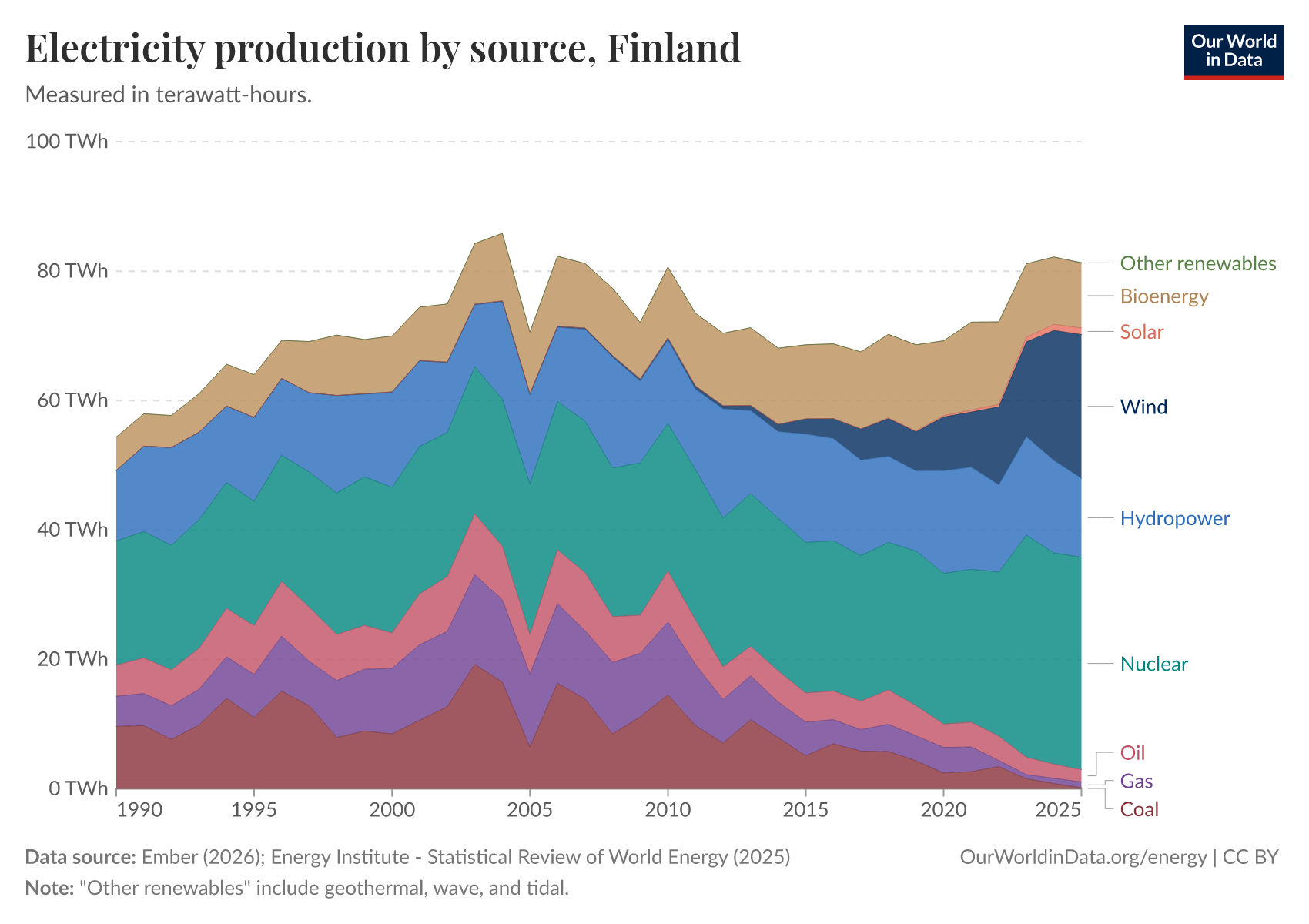
The amounts for year 2025: Nuclear 32 TWh, Wind 22 TWh, Hydro 12 TWh, Solar 1TWh.
In California grid scale batteries have capital costs of around $125/kWh to $155/kWh while a home battery might be 20x that including installation.
It borders on criminal to have abundant energy production be disservice.
Even better though, would be a cheap electrically operated methane plant that you could afford to run intermittently. This, plus a peaker natgas generating plant make, effectively, a battery of infinite size, or you can sell it to any of the many eager buyers of natgas.
Building a small, prefab, plant like this, if possible, would seem to be mainly a problem of scale, and therefore it seems likely that China will get to it pretty soon.
Charge batteries, do electrolysis, or a multitude of other uses (I know some companies do that already)
And when the prices go up, you run that through a grid scale fuel cell and feed it back to the network.
There is no clear path to switching these arrays to Net Metering, as of yet. Prepare for all sorts of unrecycled solar panels and potential loss of renewable capacity that is already installed.
Suppose I have a 100MW gas turbine. And suppose there's 1MW of solar installed in my generation network. I don't really care if I sell 80MW at noon and 90MW around dinner time and 50MW through the night, or if instead it's 79MW at noon and 91MW at dinner and 51MW at night. The gas costs about the same irrespective of when I burn it so a bit of a fuel shift doesn't really matter.
But take that 1MW and turn it into 20MW and suddenly we go from 80MW at noon to 60MW at noon, 90MW at dinner to 110MW at dinner and uh oh. You see the problem? Whatever losses I endured at noon I don't get to make up for at dinner because my plant only goes up to 100MW and now we're not just shifting when we burn how much fuel, we're literally having to shift the power generation to a different plant.
Is this example precisely accurate? Absolutely not. But it helps you get a feel for the problem of net metering at scale. The grid can act as a battery for a few % of total generation, but by the time you hit some number, maybe 20% maybe 40% net metering turns from a cool math trick to a real cost on the grid.
It's like if the grocery store let you give them milk for a credit at full price. (Let's ignore the sanitary/health/quality issues that would come up.) You decide to buy a cow and you drink that milk. Sometimes you need more than your cow can give so you buy extra from the store. Sometimes you need less and you sell the extra to the store. Long term, you use as much as your cow produces on average, so you pay the store nothing. But the store has provided a valuable services to you and has incurred expenses in doing so. They have to keep the lights on and maintain a building and pay workers to handle your transactions but they make no money from you. The only way it would work at all is if they made enough money from their non-cow-owning customers to make up for it, and that can only take you so far.
I know of quite a few places where through net metering you don't get full price, you get the wholesale rate for your production which is significantly less.
Old inverters might not have a second life though.