upvote
> it's better anyways and surely close to a decade after coming out, we'd expect devices to support it well enough.

A lot of people, myself included, are still using quite old hardware. The GPU in my daily driver is ~10 years old at this point. Between crypto, COVID, and this AI craze raising GPU costs by insane amounts, it hasn't made sense to replace it with something newer. I know I'm not alone on that...

reply
For legacy devices, VP8/VP9 is a good option. Intel Added VP8 hardware decoding to Broadwell which was 12 years ago. Nvidia had hardware VP9 decoding 10 years ago on the Geforce 10 series. AMD had hardware VP9 decode support 9 years ago on the Radeon 400 series.
reply
The problem is that open codecs can still be encumbered by patents and the holders will sue. VP9 and AV1 have their own patent pool for that very reason. Google may have open sourced its codecs but if they don’t indemnify users people who think they’re safe might be in for a bad time.
reply
Insane in absolute terms, but not per user. Take look at the actual fee schedule [1]. The most costly is the license for cable TV, which costs 50¢ per year per subscriber. The least costly is social media, which goes up to whopping 4.5¢ per MAU per user.

I very much understand how the licensing alliance likely was bothered by the fact that they are leaving money on the table, when TikTok's revenue per user is $50 a year, and a cable subscription is easily $800 per year, with the high-end reaching $2000. The big players aren't going to notice much. For the small players, nothing changed.

[1]: https://cdn.mos.cms.futurecdn.net/3wzYaofEETCfXdQmREx9BK-120...
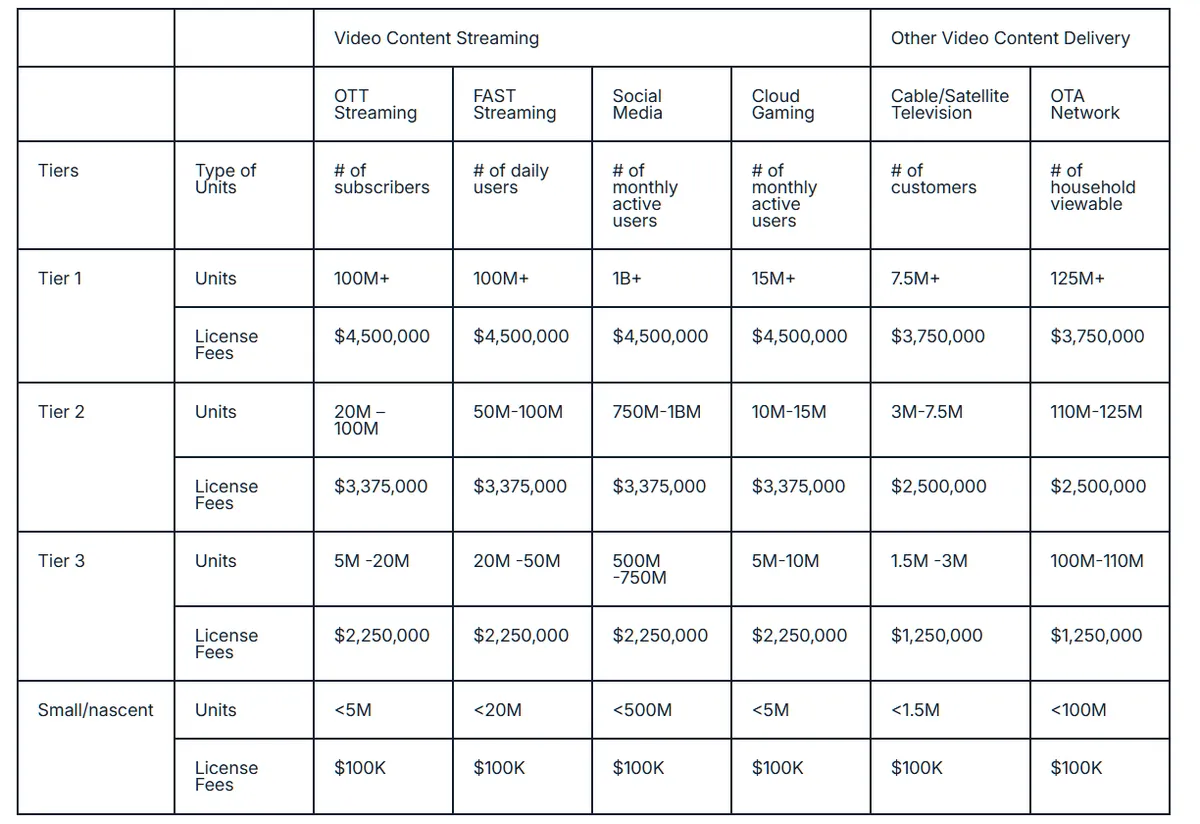
reply
Is it insane at all? The biggest fees are charged to the biggest providers. With short form video now the dominant form of addictive social media content, it doesn’t seem insane at all that large media companies ought to compensate inventors/owners of patented video technology. A company with 100 million or more subscribers is not a company I feel a lot of empathy for if they’re trying to avoid paying licensing fees.
reply
It goes to $2.5m for 5 million users/subscribers and tops out at $4.5m for 100 million subscribers. It’s not staggered evenly at all IMO. So I worry mainly for the small players. This shouldn’t have any meaningful effect on any big player.
reply
AV1 might not be as patent-free as we had hoped: https://arstechnica.com/gadgets/2026/03/av1s-open-royalty-fr...
reply