
There's the same upside as pretty much all other forms of gambling. Plenty of people enjoy it and it can be used to generate tax revenue for the state.
Don't get me wrong, there's tons of harm that can come from it, but the arguments to allow them are essentially the same arguments for allowing sports betting.
Most major online sportsbooks have taken bets on the US presidential election for well over a decade. I can't imagine anyone really arguing that it's okay for DraftKings to offer that market, but not okay for Polymarket to offer it.
I put it somewhere else in this thread, but there are actually two different questions that need to be answered separately. Are prediction markets just sportsbooks by another name and are there certain things that we should not allow people to gamble on.
The argument around prediction markets always seems to squish those two into one which I think does people who want regulation a disservice. I think to most people, the answer to first question (are prediction markets just sportsbooks by another name) is a pretty resounding yes. The second question has a lot more room for debate though. Even if people agree that there should be things we don't allow people to bet on, there's still plenty to argue over where we draw the line. The problem is that as long as we mush these two together, people will use the disagreement over the second question to prevent action from being taken on the first.
I wasn't making any argument above in either way. But the reality is that sports betting is not legal in much of the US. DraftKings is only legal in about half of US states.
Minnesota does not permit DraftKings to operate in their state. They don't permit any kind of online gambling whatsoever, and I don't think they think any differently about Polymarket... and Minnesota's regulators have answered that clearly in this case by enumerating it specifically.
And more generally speaking, laws apply to what someone is actually doing, not what they claim they are doing. If a law bans wagers on the outcome of a sporting event, it doesn't actually matter whether you call it something different. Someone can't sell crack cocaine and call it a "dietary supplement" and get away with it, because the law doesn't depend on the label the actor gave their own actions, it hinges on the definitions of the actions as defined under the law.
And as for the second question, in gambling there's always a risk of harm to the bettors themselves. I don't think most Americans have a problem with that, currently.
But, there's also risk to corrupting the subject of the bet itself. In a casino, this is easily mitigated by regulating the game, and the potential risk is only to the participants. In sports betting, this risks corrupting the games themselves. This is a slightly larger risk, and it risks corrupting sportsmanship for the athletes involved, but ultimately it is still a game.
But wagering on other events up to and including literal war literally poses a much larger human risk than simply spoiling a game.
You could take this "prediction market" laundering of words to an absurd conclusion: "A large binary option that someone will [insert any illegal action]" is just literally a payment for someone to do a crime using different words.
> Most major online sportsbooks have taken bets on the US presidential election for well over a decade. I can't imagine anyone really arguing that it's okay for DraftKings to offer that market, but not okay for Polymarket to offer it.
DraftKings is legal in about half of the US. It is not legal in Minnesota.
On your second point, I don't disagree, but those issues aren't tied to prediction markets. Traditional online sportsbooks have allowed gambling on presidential and state elections for at least a decade now. Kalshi and Polymarket have taken this to the extreme, but they didn't start the fire.
We should be restricting what people can bet on regardless of the technology used. My concern with tying these two points together is that law makers will assume that solving problem one also solves problem two, when it doesn't. I'm worried that law makers will just outright ban prediction markets and go, "job done" leaving the door open to bring them back by creating some new gambling method that technically isn't a prediction market.
I don't want Polymarket allowing bets on whether we're going to war, but I also don't want DraftKings offering that bet. On the flip side, I frankly don't care if someone wants to bet on the Super Bowl, or the winner of Survivor, of how much rain New York will get tomorrow whether it's on Polymarket, or Kalshi, or DraftKings, or anywhere else. Prediction markets are how people are placing bets. I don't actually care how the bets are places, I care what is being bet on and I think most people would agree with that.
I think the answer to that is also the same: if they're the same thing, and both are gambling, then Kalshi should have to be subject to gaming regulations and inspections the same as DraftKings is. Gaming is highly regulated even where it is legal.
Personally I don't have an issue with gambling, and I also don't have an issue with states that decide to ban it.
But I do have an issue with Polymarket, Kalshi, etc, using bullshit language to pretend they're not doing what they are obviously doing. They are obviously booking wagers. And as such, they are subject to the laws that states have outlined regarding those that take wagers.
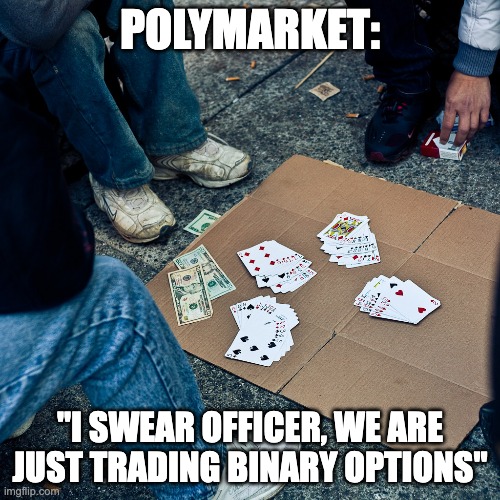
For the record, I'm actually a very active Kalshi user, but I cannot see how anyone can seriously argue that it's not sports betting.
Yes, What MrBeast says on his next video is easy to fix, but so is something like betting on a D3 basketball player to have less than 10 points or some English 5th league soccer player to have a yellow card.
At the very least maybe it would make the advertising (tv, college campuses, etc) of prediction markets illegal in Minnesota?
That alone seems like a good thing.
The law[0] as written is a mess. You could in theory shut down the "legal" Minnesota state lottery that is otherwise carved out from the law by claiming they are providing data on outcomes via the internet if someone outside the state is betting on the outcome of the lottery in a prediction market.
[0]: https://www.revisor.mn.gov/bills/94/2026/0/SF/4760/versions/... (search for "ARTICLE 8")
Predictions markets are just bets: one person wins, one loses.
Prediction markets—forums for gambling on the outcome of a platform-provided referee as to how a proposition about the future will be resolved—do not do that at all.
Now, the legal definition of commodities markets for regulatory purposes in some jurisdictions may be broad enough that prediction markets are legally a subtype of commodities market despite doing a very different thing than traditional commodities markets, but that’s an artifact of a legal definition being drawn in a very broad way at a time when it didn’t matter because nothing like prediction markets existed.
Each market is a community with a financial incentive to think outside of the bubble.
They're just gambling. I'm not trying to argue for or against gambling here, but please stop trying to delude yourselves into thinking these gambling sites are anything other than gambling.
If you cross your eyes hard enough, you could claim that roulette gambling provides economic pressure to ensure that roulette wheels are balanced evenly. But when the roulette wheel is Vanah White’s dress color, what does that mean? Charitably, it’s a fun pass time. Through a dystopian lens, prediction markets pressure all public figures to play a kind of Keynsian Beauty Contest with their own behavior. Like social cooling for the celebrity/owning class.
If harm to the consumer and societal burden are the downsides you're concerned about, you could justify banning smoking, alcohol, and junk food for the same reasons. We don't generally do that because we recognize that where there's demand there will be a market, whether it's legal or illegal. So you also need to weigh the potential harms of a black market against those of a legal and regulated market.