
How?
The delta between 1903 and today in this regard might be small, but the line between them isn't flat, and that makes it even more tragic and frustrating to have this questioned as if it's an impossible problem.
But we cannot ignore that it was truly a unique opportunity:
- The US was the only intact industrial country left after WWII.
- With massive momentum from industrial deployment during the war.
- With a massive optimistic and hardened workforce coming home.
- With plenty of saved wartime income they didn't have a chance to spend due to rationing and shortages, a lot of it saved as wartime bonds just starting to deliver healthy yields.
- With the New Deal that resulted from the horrible Great Depression making sure they got to truly benefit from the fruits of their labour.
- And a wide-open global market to lend to and to sell to for rebuilding the world.
That is not something that can be replicated easily at any time, and if the US makes decisions expecting that that is the norm, there's a disaster coming (perhaps it's why it's a disaster now).
But now we're back to pre ww1 level of inequalities
https://static.guim.co.uk/ni/1415721490539/Wealth_line-chart...
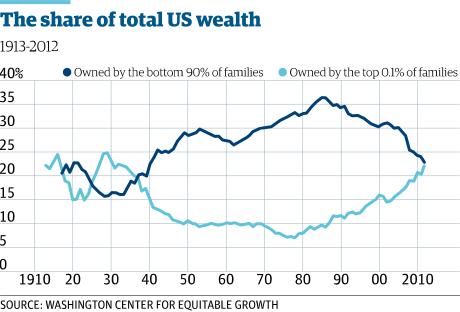
It took many forms: capitalist social democracy, communism, fascism, feminism... Left or right, without making a value judgement, they were all revolutions seeking to empower the working masses.
Of course, when you get rid of kings, it's really really hard to make sure the vacuum is not filled by something even worse. Credit where credit's due, as a European, I do believe that the US is one of the few cases that was somewhat successful in not completely bungling this opportunity (although there's the detail of slave labour, and the conquest of natives...).
And after many-many horribly failed attempts, much of the world did end up in a relatively healthy state around the second half of the 20th century. Fukuyama's end of history and all.
Now we seem to be regressing again. Perhaps it's part of the eternal cycle and it was always coming. Perhaps it's not actually regressing all that much, and it just looks like it to our coddled selves, or we have become more ambitious on what we think is right. Perhaps people have found new loopholes (tech) on how to get ahead and dominate the rest of us, and we just need to catch up and get it under control again.
Perhaps that quote from 1903 is relevant now, but it doesn't mean that it was relevant the whole time since. Perhaps it was, I wasn't there.
Like if the means of production is land, and you are seizing land, sure that makes sense to me.
But most goods are not made by land alone but by machines and factories and transport systems and etc. If you seize those as preexisting entities, what happens after you seize them? If you as a group can operate and expand those things, can’t you just build them yourselves also, and if so there is a way to work within the existing framework to do that, which is to start a company. Is seizing the means of production not equivalent to starting a company and stealing things others have built for the company to get started with? Why is that a good thing?
Like I personally agree that wealth accumulation is bad if it has political power go along with it, and there are huge problems with our system and lots of debt formats should be made illegal, I just don’t get why anyone thinks “seize the means of production” is the answer and I feel like I might be confused about what that really means.
Well, it's rather patronising of of me to call that "the hard part", after all the terrible struggles workers have gone through to earn a seat at the table, but you know what I mean.
> "my favorite, seems the least likely to lead to police state"
That's an important point. It's so hard to think of a better system, if you take the task seriously and actually think through all the consequences of each option.
As a result, as usual, the loud people that ignore all the details end up capturing everyone's imagination with a good story, and we stumble upon yet another century of nightmares.
Do you truly have a answer for a social architecture that is substantially better than a capitalist social democracy, flawed and compromised as it is? Because I really don't if I'm being honest with myself, and I am yet to hear one.
I think the problem I find with arguments that Capitalism is the best/least bad system tend to be that they start from a false premise, in my opinion. I have a friend who makes the joke all the time that any system of government works if people were just nice to each other, but he has a point. I often hear that "oh, communism doesn't work because humans are inherently selfish." That's true, if you believe that humans are inherently selfish, but my counter-point to that is asking how much of it is innate vs. how much of it is trained by our culture and reflects back in those communist attempts because the sudden change in social architecture didn't give enough time to 'train it out of' the culture.
Back to the thing my friend says - if you believe that communism doesn't work because humans are inherently selfish/greedy/etc, I'd say to you also that capitalism is currently not working _because humans are being selfish and greedy_ in a system _that explicitly rewards that_. Which, maybe is worse. Not as in the outcomes are worse immediately than Soviet Russia etc. but for the long-term trajectory of human society.
I don't pretend I have an answer for how we can get from point A (capitalist system) to point B (future space communism) in a way that slowly shifts human thinking towards mutual aid and collective action, but I think it's short-sighted to assume that the way humans act in a system that rewards greed/selfishness is innate.
That's one way to put it. Another perspective (mine) is that capitalism enables anyone to try and make things better, and if you make things better for the right user, they will reward you.
Fun techcentric utopian speculation about this: Cory Doctorow's "Walkaway" and Ruthanna Emry's "A Half-Built Garden."
Essentially, can we leverage our current post-scarcity society to expropriate everything people need in a sustainable way that cuts capitalism and the State out of the loop? For example, why would people buy food if they can get it for free from farming syndicates or similar? (see: Global Village Construction Kit, Food Not Bombs, Food Not Lawns) Why would people buy medicine if they can print it for free from pirated recipes? (see: Four Thieves Vinegar Collective)
I see the Right to Repair and FOSS movements as a foundation to build upon for this. Anarchism (or at least, anti-capitalism) exists right under everyone's noses, in all the FOSS software installed on their computers. Existent example of people laboring without profit motive and contributing to the commons.
My personal life goal is to figure out how to capture that same energy to tackle the bottom layers of Maslow's hierarchy.
I'm not entirely cynical, people generally are very open to be generous with one another and collaborate for a common good, but up to a point.
Currently people spend the majority of their hours doing relatively hard work for the collective's benefit (kinda). Exactly because capitalism makes selfishness into selflessness (very kinda). Also people are relatively civilized to one another thanks to the considerable latent force of the state's monopoly on violence.
People will be nice to each other when it doesn't cost them much and/or when the opposite costs them dearly. But will they work as hard as now for each other just to be nice? Will they not harm each other when there are no significant consequences and something to gain?
A fair free market is far from a natural phenomenon, it needs to be protected and maintained by some external force. If you let things unfold naturally, what you get is kings, and many layers of dominating hierarchy underneath, exploiting the masses, which exactly what we had the whole time.
I suppose that the post-scarcity idea is that people neither need to work hard, nor have significant reasons to harm, if they have everything they want. Sure, let's talk if we ever get there, but until then we have other problems to deal with.
PS: Don't forget that people are able to do FOSS because they have well paid jobs that don't completely drain them of their energy. For others, getting the reputation and/or experience for a better job is the incentive. There's a very different social infrastructure making that work, FOSS doesn't sustain itself, not even close. But yes, it does prove that when people's needs are covered, some of them will do great things for everyone without much incentive, but usually not enough to cover everyone's wants.
What I am weary of is that such experimentation, and the energy it generates, will eventually be overtaken by the next iteration of people who want to stop nibbling at the margins and break a few eggs already, some sort of anarchist revolutionary vanguard. Much like with communism, skilful opportunists with a thirst for power will be all too happy to take over this energy and direct it toward building the next totalitarian regime, one which will of course claim to be rendering the State obsolete, but will be about as anarchist as North Korea is a people's democratic republic.
Being anti-communism is good not only for the individual's health but for their society as a whole.
I don't have the mental power at this moment to write out my full thoughts on the subject so forgive my vague thoughts (an aside- withdrawing from SSRIs is an _unpleasant experience_)
I think the problem I find with arguments that Capitalism is the best/least bad system tend to be that they start from a false premise, in my opinion. I have a friend who makes the joke all the time that any system of government works if people were just nice to each other, but he has a point. I often hear that "oh, communism doesn't work because humans are inherently selfish." That's true, if you believe that humans are inherently selfish, but my counter-point to that is asking how much of it is innate vs. how much of it is trained by our culture and reflects back in those communist attempts because the sudden change in social architecture didn't give enough time to 'train it out of' the culture.
Back to the thing my friend says - if you believe that communism doesn't work because humans are inherently selfish/greedy/etc, I'd say to you also that capitalism is currently not working _because humans are being selfish and greedy_ in a system _that explicitly rewards that_. Which, maybe is worse.
I don't pretend I have an answer for how we can get from point A (capitalist system) to point B (future space communism) in a way that slowly shifts human thinking towards mutual aid and collective action, but I think it's short-sighted to assume that the way humans act in a system that rewards greed/selfishness is innate.
But, to your other point, I think human greed is innate. I can't think of evidence that would suggest that greed is somehow cultural or learned. Boil the system down to the lowest common denominator, you find greed. Scale it up: greed. No matter what you do, you cannot remove human greed systematically.
For example, do you believe the Capitalist system has nothing to do with the eagerness of the United States to drop bombs throughout the world for the past 100 years? Personally I see these actions as unnecessary and evil but pushed to continue by the people who stand to gain the most wealth and influence from them.
Musk and Trump are doing a Holodomor in front of the world's eyes.
I ask because if we can take a country with a communist economy, or striving for one, and blame all its evils on communism itself, I have a few things I'd like to point out as being the horrors of capitalism:
1. Atlantic slave trade - millions dead (many on the ships), millions enslaved
2. Settler colonialism and indigenous genocide - British empire, all over the world
3. Congo Free State, Leopold II - 1 to 5 million dead via colonial extraction regime
4. British India famines - 3 million dead
5. Irish Famine - 1 million dead
6. Opium wars - directly caused by British using the military to defend market access. 100k dead, devastating to Qing China for a century
7. Indonesian anti-communist massacres - 500k-1mil alleged "communists" killed after the USA, UK, and Australian intelligence agencies propagandized against them
And I attribute them to communism because that's literally how history attributes them, though obviously pro-Communism thinkers would disagree.
The 1956 student massacres in Hungary, where my grandma was almost killed. The Holodomor, the various "Russianization" campaigns, the Jewish Autonomous Oblast, The Great Leap Forward, etc.
B) Fine, drop communism altogether -- it's evil and disgusting and bit my finger and should never be tried again. Can we work on a society where the means of production are owned by groups of laborers?
I have good news for you. As someone in my job's ESPP plan and with a 401k, it already is!
Marx and Engels had originally envisioned a liberal democratic society with lots of high ideals but they had allowed the transition to it to be tough. Every self-proclaimed "Communist" state never got through that transition: the people in charge never let it (often never intended to) and instead cemented their authoritarian dictatorships. So let's call those what they were.
Or is this the old hacker news trope again that nothing except full on communism will ever be acceptable?