
We solved pensions. People have defined-contribution plans now. I would expect insurance float to dwarf pensions as a source of PE funding.
The real reason PE exists is because it charges high fees. The financial industry does not make products to serve customer needs, though by happy accident that sometimes happens. It makes products to charge fees. Index funds removed a big chunk of the fees that active mutual funds used to charge, so financiers went looking for a replacement.
Even if you snapped your fingers and all remaining pensions (and insurance float?) disappeared, PE is aggressively going after individual retirement accounts, now. Most insidiously, trying to work their way into the "target date" funds that are the defaults for most plans. So "solving pensions" will not make PE go away.
Like millions upon millions?
They need to be paid out somehow.
Do they have to be paid out in full, though? I remember cases in the past where a company went bankrupt and had to renege on some parts of pensions, so maybe you'll see that again?
I don’t see how it is relevant, unless the rate is close to 100%.
...no. It doesn't even matter what the rest of the words in the question are. Just no, lol.
> They need to be paid out somehow.
No they don't. Lots of pensions, especially the not-gilded ones, go bankrupt.
In fact, that's precisely what happens to pensions of companies that are acquired by PE. The company gets stripped for parts, it goes bankrupt, and PBGC covers a fraction of the affected pensioners' payouts.
In other words, with or without PE, bloated pensions ultimately end up being the taxpayer's burden.
Why are you replying to a comment where you believe the words “doesn’t even matter”?
I find this characterization offensive. Who is to judge if the defined benefit pension if a primary school teacher or fireman, for example, is bloated? It's part of the negotiated pay package, nothing more or less.
Teachers are the easy ones to point to, it is hard to be mad at an underpaid teacher who receives a reasonable pension for life. We certainly can be mad at NYPD scamming the system to get $100-200k/year for life.
[1] https://www.bloomberg.com/graphics/2021-nyc-police-overtime-...
[2] https://www.empirecenter.org/publications/newly-retired-nypd...
I've seen PE make businesses more efficient by reviewing all contracts and dropping or renegotiating ones that no longer align. Closing product lines that aren't profitable. But that is year 1-2. By year 3 they start the squeeze, layoffs, asset selloffs (stripping), and lowering quality, raising prices. That is where the real teeth of wolf are shown.
Currently in PE hell myself. Company I work for was bought out few years ago when the owner cashed out. Right out of the gate it was a numbers go up game. New sales person was hired and their first order of business was - drum roll please - triple prices! Customers balked. Some walked. In addition, some employee benefits evaporated, vacation time cut drastically, shitty health insurance switch, employee perks like the monthly pizza Fridays were canned as if ~$500/mo in pizza was going to bankrupt the company. Meanwhile, employee morale is at an all time low and quality has faded.
Perhaps there is good PE out there. Somewhere. All I see are vampires.
In principle, I don't think there's anything wrong with this. All investment expects a ROI over some time horizon. Public companies do the same thing. Anyone who founds a start-up is doing it too. The only real distinguishing feature of PE is how successful they have become at aggressively optimising for market value.
The issue is that the sale value at the end of the cycle can be massively influenced by cynical financial engineering. This seems to me to be more of an issue with how every institutional investor apparently now prices companies purely on reductive metrics like EBITDA x the industry standard multiple.
The cause of the rot is widespread over-confidence in dumb financialization models shaping the system.
(Or, since it's HN: if your machine learning model is training well, but misaligned with real life: do you blame AdamW?)
They use money to turn value into money, which they then use to turn more value, into more money. And in the end, they have a lot of money, and all of the value is gone.
IFF a company is truly, honest to god, less valuable than the sum of its parts, then it (or the subset that would have more value to someone else) SHOULD be dismantled, and those resources sold and reallocated to more productive use. You probably make these sorts of decisions in the capacity of your own personal finances without even thinking about it.
On the other hand (and what I believe is likely happening is) if cynical financial engineering is allowing you to turn a useful company that's valued poorly by the market into a useless company that's is paradoxically highly valued by the market, in the short term, and that keeps happening over and over again, then the tools used to calculate the market value are wrong.
This is illustrated by how PE commonly trashes trusted brands. A brand doesn't show up in your EBITDA. If you trash a brand quickly enough by cutting costs and quality, some institutional sucker will buy the company because they haven't clocked that the current EBITDA is elevated due to asymmetry in how quickly the costs come off and how quickly the revenue falls off after burning the brand.
They've simply valued the company wrong.
Well… yeah. I mean, it seems clear that the market is pretty bad at valuing companies. At the very least, valuations are based on a combination of (a) measurable attributes, and (b) vibes. (a) will always be incomplete, and runs into all of the same measurement problems that everything else does. And (b) is really unreliable.
Plus, PE companies are not especially interested in long timelines, whereas companies can eventually provide a lot more value that they’re worth right now.
And that’s not even getting into situations where they own enough of the market to not care about losing customers.
...have you looked around? Some of the biggest companies in our economy basically just serve ads...
Huh? Why is there nothing wrong? Yes they wouldn’t make the investment if they didn’t think they had a way to get ROI, but how does that entitle them to one at any cost or make it necessarily moral?
As an extreme example, If I invest to create a company that is clearly exploitive and addictive, nothing is wrong in principle and I’m entitled to my roi?
My view is companies don't have a conscience, and any expectation that they are going to independently act with moral righteousness is unrealistic. Any perceived conscience is either for marketing (green/pinkwashing), or the sum of the morals of their owners multiplied by their willingness to exert any moral authority over the company.
Besides, if you try to imagine a company having an independent conscience, what even would that conscience be based in? I'm vegetarian and think it's immoral to eat meat, but obviously I'd be insane to expect companies to divest from meat based on my peculiar moral position.
In most cases, people do not exert any moral authority over anything they own. Do you actively select your pension investments based on your morality and vote in the shareholder meetings? If you do, I'm genuinely pleased and happy that someone is. But the reality is most people don't give their investments any thought beyond "line goes up", so companies end up acting as ROI maximisers.
So: the main way we enforce morality on companies is ultimately the government. If you want companies to act morally, you set the rules such that an ROI depends on following our democratically agreed set of regulations. Maybe that even harms economic growth but we still consider it worth it (which is typically how we think in Europe, but look at our economies are doing!). However, the company and its investors are still acting as ROI maximisers.
The poster said “I don’t think there’s anything wrong with this” are they a corporation? If they are, apparently they do have consciousness because they say “I think”
And yes some people do in fact try to vote with their dollars. Canadians are doing it plenty right now for an easy example.
That companies’ sole purpose is to maximize shareholder value, usually near term, is basically a toxic social construct and fairly recent. It’s not grounded in anything other than greed.
To play devil's advocate:
Doesn't this also open the market to new entrants?
e.g. young person looking to start a HVAC company in the old days couldn't compete with the established firm that already had contracts and the local market wasn't big enough for two players.
If the established firm gets bought by PE and driven into the ground, wouldn't the newer more nimble firm now have a better competitive market position?
The HVAC for example - the large firms around you do not run HVAC/plumbing/electrical, they run marketing companies that happen to schedule and bill H+P+E service appointments.
That being said I've never heard or encountered a single services company in the US that can't find business, in fact it's the opposite. They're trying not to drown themselves in front of a fire hose.
Or maybe by then nobody trusts the name of the original company and it's just useless
A core function of enterprise sales is figuring out where that opportunity cost threshold is. PE often targets industries that are currently (in their estimation) priced well below that threshold.
AVGO/Broadcom in some way acts like a big PE firm, rolling up other software companies, integrating them into their huge suite of offerings, ousting the new integrated offering's competing tools from the customers environments and selling the increment, and cutting off smaller customers not willing to subscribe to the huge suite.
Moved right in with the same old price so I didn't even have to expand the budget and they threw in training for free!
but there are plenty of other reasons as well.
starting a new venture, whether from the foundation of an existing company or doing a new one takes investment and carries risk. maybe the sales relationships the existing company had were the results of decades of investment. maybe the ownership or the employees had a specific skillset or maybe they used tooling that could be bought easily anymore. maybe they had an important and established relationship with suppliers.
maybe PE moved in because the business was viable, but not really growing and there isn't sufficient upside to motivate investors.
or the business only existed because the owner just loved that thing so much and funded it at a near-loss out of family money.
or the business was based on a huge capital investment or ownership of property in a key location that happened 20 years ago and isn't possible to replicate because of changes in the environment.
there are 1000 reasons why these things aren't spherical cows.
The irony goes way deeper than that.
A large part of PE clients are university endowment funds.
Harvard for instance has close to $60B in its endowment fund, 40% of which is invested in PE. At this point, Harvard is more an investment fund, with a university as side business.
But… if you were to say hey we need to pay our old people and we desperately need some way we can deploy massive amounts of money at higher rates of return, people will say… hmm well it’s broken but the alternative is worse so we’ll ignore it.
But now imagine you have a way to deploy large amounts of money and get large returns off that money. Every large amount of money (endowments basically) will jump on it because why not? That’s literally an endowment dream scenario.
So pension funds are the moral reason these other huge chunks of money to get large returns. PE firms have become a streamlined business model because they continue to improve what they are good at doing, and it’s insane that we haven’t passed laws against it yet. Except of course we can’t mess with it because it touches government workers.
So yeah even if we wanted to policy it out of our society it’s practically impossible from a social point of view.
https://en.wikipedia.org/wiki/List_of_colleges_and_universit...
Effectively it’s burning all of the trust built up with consumers as firewood by tricking them into buying mediocre products at high prices.
Lots of things are profitable but immoral. People will do crazy immoral and illegal stuff for money, but we outlaw and slander the more abusive stuff, like monopolies and such.
If it wasn't pensions that were funding PE, I'm sure PEs would get a lot more criticism and would not be allowed to do what they do.
Slavery is bad economics. If you want your economy to grow, paying workers is not bad. Economic growth isn't zero sum.
Pensions fund PE because PE can do a short term cooking of the books in order to smooth out the growth curve. So the return is usually positive each year, not raising problems.
Also what does significant mean? Pensions are the main mechanism non-wealthy people are investing in PE. Being that millions are involved, you would expect pensions would have a sizable portion of the market, but family offices and high net worth offices dominate. If it offers above average returns, why would they not invest? PE is like every other asset class other than housing, the top 1% own a large chunk, the top 20% own the majority, and the bottom 50% own very little. Decisions are not driven by sone fireman, they are driven by the wealthy like everything else. And the origin and continuation of pushing for retirement to come from capital investment comes from the wealthy as well.
I really appreciate this perspective as It helps fill in gaps in my mental model of where our economy has gone wrong the last 50 years. Unrelated but - I've read an interesting paper on how allowing private banks to create money has led to the infinite profit growth goose chase...
I live in a working-class southside neighborhood. The people who are complaining about property taxes for SFUs in the city are people in neighborhoods with skyrocketing home values.
Those people stand to receive a massive windfall when they sell. And while it may be annoying for them if they find themselves having to sell when they didn't want to, the they're vastly better off than all then renters in that neighborhood who got priced out much faster with no windfall.
The Gold Cost isn't suffering a shortage of landlords.
https://www.psprs.com/uploads/sites/1/AIC_PublicPensionRepor...
Some interesting details:
- "Nearly 50 percent of the private equity investment dollars that make their way into American businesses come from public pension funds", which substantiates OP's thesis.
- "U.S. public pension funds invest 9% of their portfolios in private equity, on a dollar-weighted basis." 46% is in public equity, so obviously the lion's share is in still in public markets.
And like FIRE devotees, maybe they should model a lower withdrawal rate.
He has been in the role over a decade.
Well, yes, that's how any retirement (or any social benefit, really) system works: people who actually do work support the people who don't. Those latter include children, the elderly, pop-stars, politicians, etc. So unless you make people work until the day they die (which is possible, and have been done in the past, mind you — it just severely decreases the average life expectancy), we're going to transfer some of the created wealth to the elderly. The exact form of how this transfer is performed is a fascinating topic for discussion (make their direct descendants care for them! make a state-, or charity-funded fund to feed them hot soup once a day! make them save up for retirement themselves! lots of options, really) but it will still happen one way or another. After all, some people simply do have lots of money (and keep getting more) with doing no labour; some of them are retirees.
The pension people aren't being scored on doing well for their clients. They're scored on money. They don't care.
Ain't no different than some jerk in an insurance/regulator office cooking up a rule about PPE based on first order assessment of a bunch of crappy data. The guy who gets mashed by a forklift he couldn't hear coming doesn't hurt their KPIs. He didn't suffer occupation related hearing loss. MissionAccomplished(TM)
Pretty much every industry that deals at the statistical level whether it's PE making investments or something else runs in this manner.
If a company being purchased by PE meant that they lost the vast majority of their customers as soon as contractually possible, then the possible value extracted by PE would drop off a cliff.
This isn't necessarily the fault of the customers - we're all dealing with a lot of information to process.
And, up until recently, it was reasonable to attach reputation to brand instead of to owners.
And I think that's a lot of what PE exploits - the gap between people's belief about a brand's reliability/reputation, and the fact that the actual reliability has been a function of who the actual owners of the company are for many years - but people are still attached to the old mental model.
(there may also be some value for PE to extract from assets aside from customer relationships and the higher-order "brand value", but I suspect that that's secondary - if I'm wrong please correct me)
How so?
1. If you assume that P.E is uncorrelated/has a low correlation to the stock market (subject of many years of diatribes), then you decrease volatility of your portfolio by adding it.
2. Because a pension fund has a lot of years until they need start to paying out, then it is natural for it to attempt to harvest the illiquidity risk premium.
3. The (edit: removed extra words) "high required rate of return problem" is really a defined benefit problem. A DC plan can (and probably should) just be in mostly straight indices unless it's so big it can negotiate a good fee with asset managers for other classes.
They moved around the year 2000 to accounts that don't have the AT LEAST clause, and they earn what they earn, but due to the backlog of people still retiring that were grandfathered in, its wrecking our state.
My city has a huge budget deficit, but 24% of its total payroll budget goes to the public retirement system to 'catch up' from years when it did not make 8%. Next year or two, that is supposed to jump to 28% of payroll.
Problem won't start getting better until something like 2034 when the boomers start 'leaving the retirement system'
People have to eat. They need water. They need a roof over their head. Nobody has to buy out all the veterinarians in an area at rates they can't say no to, have them sign non-competes and them jack up all the prices by 300% because, hey, you now own all of them. Nobody has to buy up all the trailer parks, which are normally peopple's last stop before being homeless, and then jack up the ground rent because, hey, where else are they going to go? Nobody has to buy up utilities, spend big on capex because legally you can pass on that charge and effectively double people's electricity bills.
Hannah Arendt coined the term "banality of evil" [1] decades ago and, in all honesty, I think it applies to the predatory nature of PE. It also goes for working for Palantir and a bunch of other companies. "I need to pay my student loans", "I'm just doing data science", "I'm just writing AI software that identifies when somebody is home" and on it goes.
PE serves no useful function in society. It's pure rent-seeking and incredibly predatory in many cases. ~15 years ago, there was a story about Goldman Sachs invented a derivative on the price of wheat and then essentially conspired to jack up the price of wheat [2]. This wasn't just manipulating a ticker on a Bloomberg terminal. It had real-world consequences. People starved and died because of this decision.
Yet I'm sure there were people who argued "I'm just doing legally allowed financial engineering here".
[1]: https://aeon.co/ideas/what-did-hannah-arendt-really-mean-by-...
[2]: https://theecologist.org/2011/sep/13/how-goldman-sachs-start...
It's kind of like the university system. It's a (mostly) privately run industry that gets massive injections of cash from the government because of both campaign promises (everyone needs healthcare, everyone goes to college and, bonus, everyone gets a house) and it being an incredibly unpopular position to either remove that funding or make the program entirely public which would, imo, alleviate both problems (but have their own unique drawbacks). The hybrid model we have is the worst of both worlds.
The hybrid system we have now of massive injections of public money into private industry is like blood in the water for do nothing intermediaries. PBMs are just the assistant dean of underwater basketweaving for medicine.
I find it very hard to believe that if pensions didn't exist, nobody would have come along and exploited the same loopholes.
1. Taking advantage of a pricing inefficiency; and/or
2. Using local monopolies, inelastic demand and regulation to jack up prices.
But what powers PE is the LBO (leveraged buyout). That is, you buy csome company with borrowed money and then you borrow against the assets of that company to repay your original loan.. That... shouldn't be allowed. Obviously that company is saddled with debt and it's usually structured to explode at some future point when the buyers won't actually own it anymore. I think of it like subprime lending in a way.
Now passive funds kind of have to buy sufficiently large companies. This has been an issue with the SpaceX IPO because SpaceX is doing a small float (~5%) and NASDAQ has changed the rules to essentially force passive funds to buy SpaceX where up until now that wasn't the case unless at least 25% of the company was available to buy. It's so nakedly corrupt.
Anyway, if a LBOed company saddled with complicated debt gets re-listed it kind of has a captive market of buyers with passive funds.
So going back to (1) there is long historical precedent for pricing inefficiencies. I'm speaking about the corporate raiders of the 1980s. The movie Wall Street was about this era (well that and insider trading). Essentially ailing companies would be trading below their book value. The book value was simply the value of assets (real estate, etc) so you could buy the company, sell it for parts and make a profit. All the lost jobs be damned.
The companies that tend to get targeted for PE own real estate. This has been a competitive advantage because yet other rent-seekers can't exploit them by jacking up rents. But real estate is an easy asset to sell to pay back your LBO and you can even split the real estate into a separate company and lease it back from that company. It's just financial hocus pocus.
[0]: https://fixedincome.fidelity.com/ftgw/fi/FIYieldTable?popupM...
Who do you think is buying .. everything? They're holding substantial fractions of both the whole stockmarket and national debt.
Now... if you mean IRAs then yeah... that's 99% of all private "investors"
It's the corporate businesses that have gotten rid of pensions in favor of 401k plans.
They can also offer some really nice benefits like accessing your pension income at 55 which can be a substantial portion of your last year's salary, and you can keep working elsewhere if you want.
There are also many benefits you don’t notice because they don’t bother you
It's just a ploy for the wealthy to extract even more wealth from the rest of us, while stripping the country for parts and dooming the actual economy for years to come.
On the subject, if you have 50 minutes to waste: https://youtu.be/tyNFosOFUDM?is=hwDH5tFCAYc7soHG
Isn’t this just what happens when you have an inverted pyramid (older population is larger than the younger population)?
> One can argue that PEs make the business more efficient
I’ve never seen it (I agree with you). To improve something they’d have to understand the business and do a bunch of work. Mostly they show up at quarterly meetings and want spreadsheets that measure some number that will go up (regardless if that number means anything).
> if you wanna fix or ban PE, solve pensions
How does one solve pensions?
I was thinking that Covid and widespread antivaxxer mentality would have.
But no. This will be the latest ladder-pull by the boomers and silents to extract the last bit of wealth from all the younger generations. And this will impoverish gen-x and all younger generations even more so than we already are.
It's a shame that even highly educated populations do not understand a basic fact of immunology.
This is what was claimed.
"You become a dead end to the virus." — Fauci, 2021
This was the reality
"[Vaccines against respiratory viruses produce] decidedly suboptimal protection." — Fauci, Cell Host & Microbe journal article, 2023
"The durability of protection against infection and hence transmission was relatively limited." — Fauci, 2024 congressional testimony
Anybody that questioned the religious dogma that the vaccines were super effective and that healthy people needed to get endless boosters were crucified and in many cases, fired from their jobs for refusing an unnecessary medical procedure.
No one ever said the vaccine would prevent transmission. What they said was that it !could! prevent transmission. But no one would know before studies were done. What they did say is that it would lower mortality rates. Which it did in fact do. But the factors of transmission and spread were dice rolls. And everyone with first hand knowledge knew that from day one.
But, you are in fact correct, you were lied to. But not by anyone with knowledge of the vaccines, but by the grifters you hold up has being "a beacon of truth". The grifters who read "Vaccine has a chance it could slow or stop transmission" and turn around and say "They are promising it will stop transmission!" just so they can tear it down later as "another victory for TRUTH!".
Also you don’t know anything about me and what media I consume. You can’t quote me on something I didn’t say. They did say it would stop transmission.
Extremely unlikely is a lot stronger than reduced. Calling it breakthrough implies that the norm is prevention. Obviously nothing is 100%.
I'm willing to accept my memory is wrong here with evidence, but I remember a very strong narrative in the early period claiming that the vaccine did in fact prevent contraction and transmission, to the point where it was supposedly surprising when "breakthrough" cases started being reported.
It's possible there was some loose language around "prevent" as I did see that especially later on, but I have trouble finding reliable information on what they actually believed and if they actually reported this accurately to the public.
There is the unfortunate mark against where they knowingly promoted misinformation around masks - persistent through today - that they were ineffective, in an effort to direct uncontrolled distribution of masks to medical professionals most in need.
And because the capitalists run the show in a lot of countries, https://ruinmyweek.com/wp-content/uploads/2020/07/live-laugh... is a good image that explains why lots of things kept going on as usual.
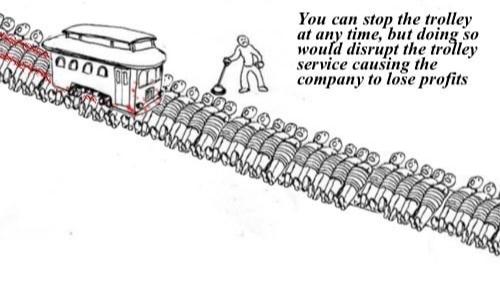
A world-level 6 week pause would have burned covid and a whole lot of other diseases out. But no. Poor capitalists need their 3rd yacht, 13th vacation home, etc etc etc.
As for me, my SO worked in health care. And Covid is a SARS. We have decades of effects and response. The shit's airborne. WHO knew that. CDC knew that. But they lied and lied and lied.
We take our healthcare in our own hands. I'll critically listen to the "experts" and deal with med doctors for prescription drugs. And Im definitely interested in my own manufacture of pharms https://fourthievesvinegar.org/ . But yeah, the wider and general the message, the more propaganda it likely is.
And we also have a good stock of PPE now, including a few tyvek suits. And everclear is 95% alcohol and $30 here for a handle. Best sanitizer you can easily acquire and food safe to boot.
EDIT as comment to WarmWash:
No. The WHO and CDC lied about Covid being an airborne infection. They refused and refused, up to then redefining what an "airborne infection" is.
https://www.bmj.com/content/385/bmj.q985
Covid is a SARS. Airborne. SARS requires BSL3 to handle properly. https://en.wikipedia.org/wiki/Biosafety_level#Biosafety_leve... "Biosafety level 3 is appropriate for work involving microbes which can cause serious and potentially lethal disease via the inhalation route."
I dont need international experts to tell me a stream of bullshit, when I can look at the type of disease and go "wellll fuck, airborne. time to wear masks outside the home and no parties or events. and go to store when its not busy."
Was Covid as bad as SARS? No. But is SARS response something that can be compared to what we should have did for Covid? Hell yeah.
Mass index fund investment is basically socialism but stupid. My retirement money is going to get invested in the SpaceX IPO against my will. The market is not efficiently allocating capital, it's structured to allow elites to skim off the top while forcing middle class people to subsidize them.
(it's a blog summary of a much longer, and rather esoteric, academic article)