
The "Start" button made no sense. The computer was already started, and clicking randomly popped up menus and opened documents in their right programs, so it felt like the natural way to progress. The owner of the computer had to point me to the start menu.
Even now I still think it was a cursed UI. It was the place primarily to close and shutdown the computer (again, when you see that button the computer and OS will always be already started), get to the control panel or run commands. None of it felt like "start", and the current windows logo only design makes a lot more sense.
To your point, small kids get proficient very fast with smartphones and iPads. I'd call their interface a lot more "intuitive"
In practice Microsoft has consistently from the beginning gone out of their way to make the search useless and slow, a policy that is now old enough to vote. How the start menu has now gone nearly two decades without you being able to type "note" and see Notepad just pop up as one of the choices instantly beats me on my ever-more-super super computers, but that's an implementation detail that Microsoft has consistently botched. And more and more over time, Microsoft has thought more about what they want in the menu than what the user wants.
Nevertheless, the general idea of that top-level "here's everything" is a good one. The open source desktop environments do a much better job with it, without marketing trying to figure out how to stuff this half-decade's marketing push on to the user or "monetize" it.
This pretty much describes _everything_ in Windows in the last 15 years.
For example, the reason for the single "Start" button in the taskbar was that they initially had multiple buttons for different specific purposes, and relied on a "Programs" folder on the desktop for launching programs, but found that this design didn't hold up in testing:
> Users had considerable difficulty deciding what each of the three buttons on the Tray was for and later had trouble remembering where to go for a particular command because their functions overlapped in certain contexts (e.g., to find something in Help, do you go to Find or to Help?).
> Users of every type were confused by the Programs folder. We thought that having a folder on the desktop with other folders and links to programs inside it would be a natural transition for Windows 3.1 users accustomed to Program Manager, while being relatively easy to learn for beginners. We were wrong! Beginners quickly got lost in all of the folders and other users had a lot of trouble deciding whether they were looking at the actual file system and its files or just links to actual files.
> The results from these studies and interviews greatly changed the design of the Windows 95 UI. In the early Windows 95 prototype, we had purposefully changed some things from Windows 3.1 (e.g., the desktop was now a real container) but not others (e.g., File Manager and Program Manager-like icons on desktop) because we were afraid of going too far with the design. We were aware that creating a product which was radically different from Windows 3.1 could confuse and disappoint millions of existing users, which would clearly be unacceptable.
> However, the data we collected with the Windows 95 prototype and with Windows 3.1 showed us that we couldn't continue down the current path. The results with beginning users on basic tasks were unacceptably poor and many intermediate users thought that Windows 95 was just different, not better.
Except that... it's no longer in the bottom left corner! Recently, I had to help a relative with a Windows system, and what passes for the "Start" button has now moved to somewhere more in the center (and, of course, this completely confused my relative, who was used to the old place). I also had to rant about Fitt's law (without mentioning its name) and how things were better the way they were before. And I also had to find out and show them where the shutdown button ended up this time, so they could power off the computer normally (as they were used to) instead of having to use the power strip switch.
And the issue I had to help with? Windows was too slow (to the point of nearly unusable). They don't use the computer often (and obviously always power it down after each use), so it's always running some heavy background update (on a mechanical hard drive) whenever it boots up. My advice was to power it up and let it sit for about an hour before using, then it would be back to normal speed.
The new default is truly terrible, though, and this was the first setting I had to change when I was forced to use a windows laptop by the company I work in.
https://www.theverge.com/22684730/students-file-folder-direc...
I remember Steve Jobs saying the last area of complexity they needed to be solved was the filesystem, which is why they made the iPhone the way they did, with apps owning the files, so users didn’t have to deal with it. We’ve seen the Files app introduced and those walls get broken down, so it was clearly the wrong approach, especially when various apps can all perform actions on the same type of files.
Jobs also said death would take care of the problem of people not knowing how to type. I often think he should have taken the similar approach to the filesystem. Required learning for the modern era, not something to hide away so skills never develop.
I was all set for this dark humor, and actually had to double back to then understand the full sentence.
Strong disagree, because:
> Every day there are new young people using a computer for the first time
I can assure you these people have no idea what the start button is or does... it doesn't help that it no longer even says "Start" for the last ~20 years.
On the other hand, I think there were few ideas worse than "My Computer", etc., not the least of which is the fact that it took Windows application software about 10 years to get consistently good at handling paths with spaces in their names.
Of course, the worst UI thing Microsoft ever did was hiding file extensions by default. That might be the worst UI decision in all of history.
The Windows 8 touch-first start menu with a hot corner instead of a button, applied to their Server OS, that I assume most accessed through RDP was pretty horrific.
When Windows 95 first came out, they had to have a giant arrow pointing to the Start menu with an explanation of what that would do: https://a.imagem.app/Ge6OCZ.jpeg
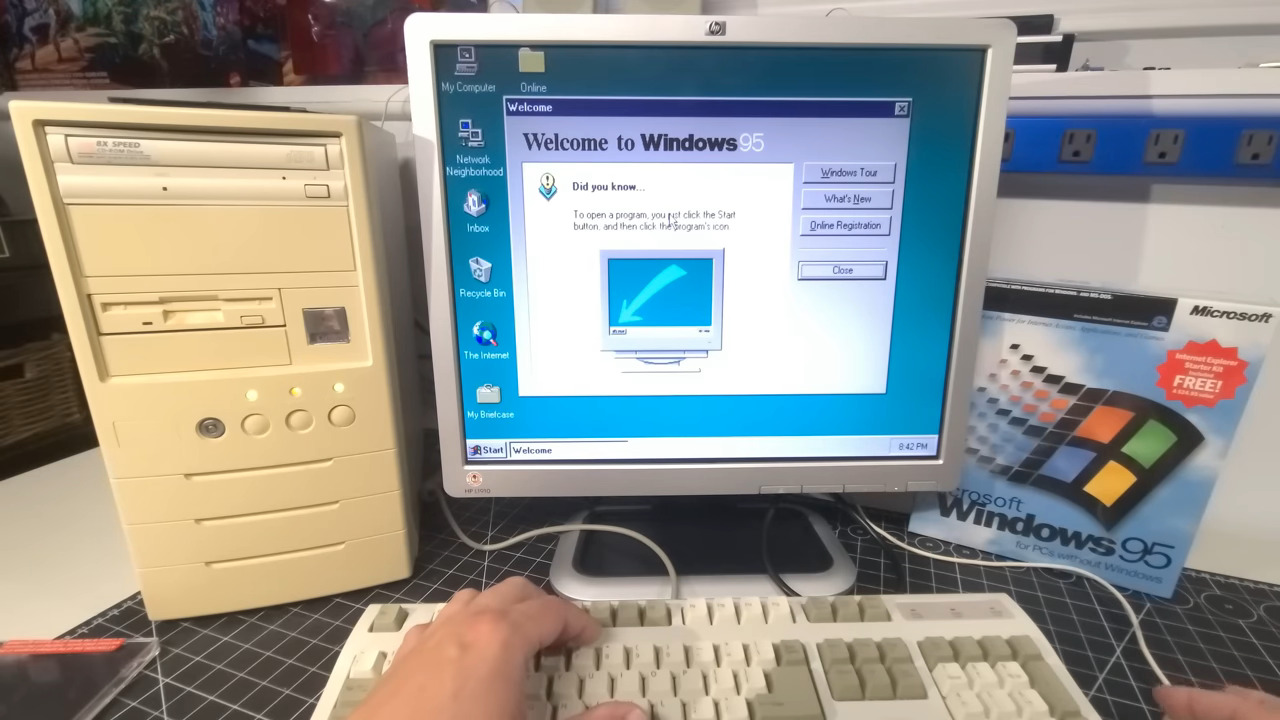
Then they had a scrolling animation with an arrow and some text ("Click the Start button to begin") that slid in from the right side of the taskbar and pointed right at the Start button.
The first computer I used had Windows 3.1, but I never really knew how to use it. I just played some games on it and my dad would have me feed in a stack of floppy disks for him when he had to install something big.
Windows 95 was the first OS I used and explored on my own and made sense to me.