
Could you just place 3 different orders to 3 different vendors? Sure.
Could you just drive to the grocery for 2 bananas and then to Costco for the big discounted paper wipes? Sure.
But likely you will not. Which is why Amazon pulls a Trillion in revenue.
So since I'm 100% definitely going to the grocery store for produce, at minimum, this whole concept fails. May as well pick up the ziploc bags and paper towels as well while I'm there.
I’m not so sure their retail piece is the part that’s making them big money.
Retail has famously razor thin margins.
But their cash flow came in handy when AWS needed 300B in cash for gpus. Nobody could lend them that amount.
My point wasn’t that they don’t do a lot of volume; it’s that their retail business is not what’s driving their profit, and I don’t believe it’s growing.
I wouldn’t be surprised (though have not looked) if DoorDash (with DashMart), Uber Eats (which does more than just food), and Instacart have eaten significantly into Amazon’s revenue by solving the “get it to me” problem even faster.
If you do 2 deliveries per hour (like Uber Eats / door dash), you pay essentially $5/order (assuming a super low us wage of $10/hour and no equipment cost/ gas).
So no in the US, Amazon is not threatened by such delivery services.
Now if you go to China, the equation flips. Which is why Amazon failed completely.
The only order I did for temu, everything arrived completely DOA
Return policy is also pain free. You can pretty much return anything you don't like. Just take it back.
They used to have amazingly generous return policy for electronics. Since some people abused it, bit tighter now.
For me, Costco has good prices, an excellent return policy, and reliably excellent quality. I don't need 15 choices of peanut butter, just a few (smooth and chunky, natural and sugary) good ones.
I also appreciate that Costco employees are always busy, but they seem positive and friendly. Most Costcos I go to, I look for the board that highlights long-term employees. The one nearest me has 8-10 people who have been there for 30 years or longer.
As the article said, Costco pays higher hourly wages than most other people. They also provide extended health benefits (in Canada, so basic health is already covered), paid sick days, paid vacation days (one woman I talked to had been working there for 25 years and had six weeks of annual vacation!), and more.
A wise person knows when to avoid a problem and when to solve it.
It is resolved personally, which is valuable, but most of these things have a larger footprint than that making it a kind of self-prioritizing mindset. There’s some kind of math to the decision involving how much effort, how much personal or short term benefit, how much communal or long term cost. But the math isn’t neutral. So basically choosing to avoid problems is going to correlate with personally better and communally worse. The clever person might be doing the solving, making sacrifices for broader good, and is sabotaged.
They even rebated $100 because it got scuffed during installation :-)
I am not sure if costco's model could allow it but especially for amazon, if they tried to do it or make it their USP like furniture.com, then I can imagine a very different outcome for it overall.
There was also a company I think who spent hundreds of millions of dollars (IIRC) in creating a large grocery website with buying large warehouses then and basically losing a ton of money. That business also failed quite drastically.
Another fun fact: when Amazon was first established, one of the largest loopholes that they had used which one can argue was why they were able to exist in the first place was that although they had selected book for Amazon because books are somewhat centralized (barnes and nobles essentially) but I think that the b&n warehouses required 10 books to be ordered each time.
So within the start, what they did was found out there was 1 book which was consistently out of stock. so they would order 1 book which the customer had ordered and then 9 of those other books. I imagine that if it might not have been for this as well, it might've been hard in the start.
There was also the fact that Barnes and nobles created their website and everyone thought that Amazon would basically die. Logic sort of suggests that it should've.
My conclusion is that Retail works in strange ways and timing matters a lot.
Also there are so many little facts within the book and it might be one of the fastest reads that I had of a book but the dot com bubble does feel quite similar to AI bubble IMO.
Here is a graph that I was making of a very limited connection graph of companies during the dot com bubble. https://files.catbox.moe/xdcxuy.png
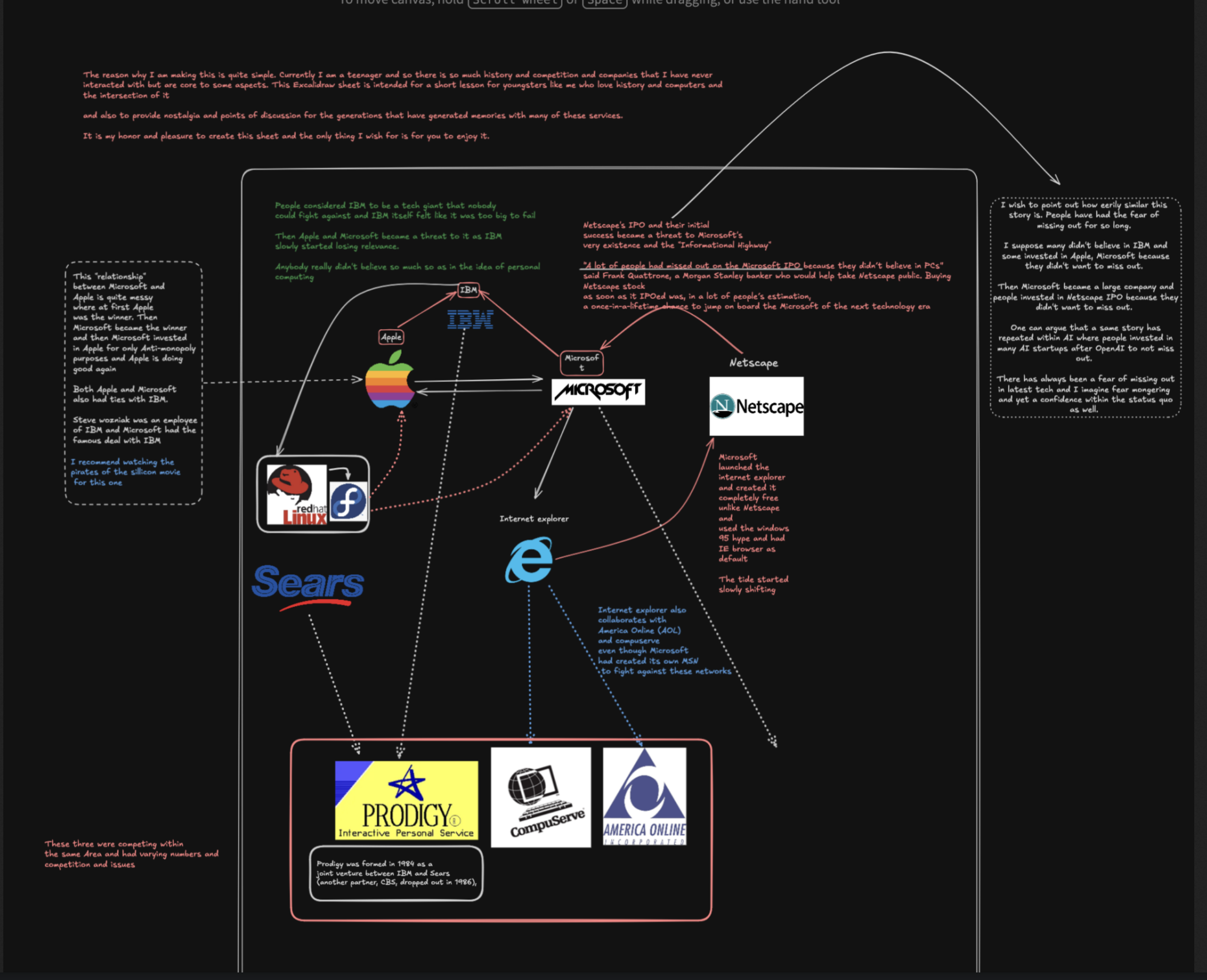
I think that i have gone a bit too afar from my original comment but I sometimes like to chat and share bits of knowledge that I know and then I can't resist myself! :-D
I thought for sure you were going to mention USPS “media” rates which allowed Amazon to ship books very cheaply.
Probably thinking of HomeGrocer or WebVan (which bought out the former and then went bankrupt too)
> (which bought out the former and then went bankrupt too)
ironic, does make you think if the clock has reached full circle in terms of bubbles but there are just so many similarities within the dot com bubble and AI bubble(TM) which are just so hard to ignore.
Not only are prices good, but if i lose my remote or need a shovel for the winter or whatever in 2000 im going to a store for that, that 15m of my time each way+parking+less choice.
Lets say i make $50 an hour, and lets say i value my free time at my working rate (i'd argue most people by definition value it more or they'd be working more hours).
Saving me 10m in the store 15m of driving both ways and 2-3m of transit is worth more than most items i purchase.
Amazons solved the last mile problem by having one vehicle bring each item to each home so its marginal cost of delivery is the distance between each home instead of the round trip between home and return that a customer has.
The more items you buy at one store the less valuable this is, which is part of why costco is well served by having such large product sizes.
It's the opposite for me. The walk to the store, screwing around in the aisles, dragging my dog into the dressing room, the walk home enjoying the sunset, those things mean so much more than cracking open a box I found on my stoop.
[0] - https://www.businessinsider.com/amazon-shoppers-richer-than-...
[1] - https://www.businessinsider.com/how-costco-sams-club-shopper...
Okay you like Tailwind because you seem to think “p-2” is better than specifying “padding: 2rem;” because when it comes time to tinker with things you don’t want to understand CSS, you want to play with Tailwind.
What is the challenge in downloading class names into a style directory?
Then you didn’t understand my point, because it didn’t make or break a project. Making or breaking a project wasn’t my point.
Who works with Tailwind? The dev writing code or the product person demanding that Tailwind be used in code they’ll never maintain or even look at?
Wow, what a great quote!I think that this combined with "there is no free lunch" explains a lot of thing (IMO)
(I like to write and once I write, I like to send it free on the internet in the spirit of how older internet must've originally intended but if you wish to read the TLDR it is: Be wise in selecting the problems to be clever at!)
I think that this holds a lot within career-making as well, in terms of deciding what career that you want. For example, I think that sometimes I get hyper-focused on a topic and basically dig the weeds and every information about a particular topic. My recent obsession was with the dot com bubble and supply chains.
but at the same time I think that although its just good thinking about it and gives me more breath of knowledge which helps me form a more nuanced person, but that doesn't mean that for every interest that I have, I have to become the expert or a genuine professional career at it.
Some problems are worth the risk/tradeoff when thought from short term but they quickly become really painful over the long term whereas other problems are more fulfilling long term but really hurt short term and there is a balance within the middle which I have selected which is what's know as CS :-D
I am a somewhat frugal guy and my philosophy has always been of do it yourself but reading about supply chains makes me realize just how interconnected we are. A toilet making company in Japan is an irreplacable component within the AI industry (They make the ceramics sheets on which the wafers are built and they are the only company that have the genuine expertise, patent and skills for doing so and they aren't alone and there are many many companies within such thing)
and even a single aluminim screw-esque component could take like 4-5 turns from australia (mining) -> iceland (cheaper energy) -> China (making proper aluminum bars) -> Vietnam (cheaper labour than China so China itself is offshoring it) -> Back to China.
All while a software engineer from say India/America/Europe is making the website and handling the customer service and taking ad decisions/marketing while another MNC (Amazon) ships it to your doorsteps, a company can be formed anywhere nationwide, and the product could be gone to LATAM.
Basically, although I have gotten on a tangent, my main point is that not every problem has to be solved by you. the world has lots of money in every fields as its just soo interconnected and as such you should decide on the problems which are best worth your time, your expertise and your interests hopefully and tackling that problem and maybe even being clever at that! and being wise in avoiding many of other problems.
Be wise in selecting the problems to be clever at! but to be wise on selecting the problems you want to be clever at, you should be aware of other problems in the first place so its good to analyze more problems, though it could very well be a justification that I might provide myself when I am studying supply chains and the humble container, I also find it interesting how the concepts of containers become so intuitive once you know it in modern shipping and then we applied that same concept AGAIN in Docker/podman but before that time, we were none the "wiser" :-D