
Point being, it depends on which skills you bring to the table, which ones you are willing to learn and which ones are worth collaborating on.
I still think the term Solo-developer is justified in any case. The one who soley carries the burden of bringing the game from idea to the finish line is the solo developer, IMHO.
So you need the solo developer not to contract out or buy in existing music, graphics, 3D assets, animations, marketing, or you won't call them a solo developer.
Right, so do you also need them to create the 3D engine or are they allowed that off the shelf? Oh, they need to make it themselves. You're strict!
Ok, so they're allowed to write for a platform? Oh, no they're not, that's relying on other people's code.
And writing in an existing language? Tsk tsk tsk. Got to invent the programming language yourself, otherwise you need to list the entire GCC/LLVM team as your collaborators on the game.
They have to create their own silicon too, it's cheating to rely other people's chips, how can you call yourself "solo"?
Are they allowed to sell it on Steam or do they need to build their own store and payment networks? Heck, should they get themselves accredited as a payment network. Oh, and as a bank.
And presumably, if the game needs to be translated to any language other than the developer's own, they have to do that translation themselves, right? Not rely on experts in that language. Can't really be a "solo" dev that way, can you?
And so on.
Building a game involves effort, and millions of decisions. Is the gameplay right? Is the story right? Are the graphics right? Design the characters, the levels, the world. Make the game run. Make the game available?
I can accept that solo developers will sometimes make the graphics/music/"assets" themselves, sometimes buy off the shelf, sometimes pay others. But unless they hire that person full time to collaborate on the game... they're still the solo developer.
They will definitely lean on existing 3D engines, libraries, plugins, font engines... and that reminds me, I've almost never seen a game developer design their own fonts. These reusable components can be used in games, and some are even intended to (e.g. engine plugins). But do they define the game experience? Generally, no. That's on the game developer.
Here is Jonathan Blow's placeholder art for Braid: https://upload.wikimedia.org/wikipedia/en/2/2f/Braid-art-1.j...
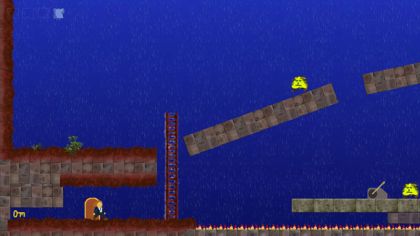
Here is how good David Hellman, the artist he hired, made it: https://upload.wikimedia.org/wikipedia/en/2/2e/Braid-art-2.j...

David Hellman is credited as the game's artist, but it's still effectively Jonathan Blow's game from top to bottom.
The domains of different crafts are ever-expanding, including all of their history and all new developments, of which new developments seem to be coming at an ever-increasing pace as populations grow, internet access grows, and the free time of populations spent doing things other than merely surviving grows. There is a larger and broader base of knowledge necessary for a person to be considered competent in the current state of anything, and the number of disciplines is also increasing. Two decades ago, having a person specializing in frontend development for a specific web browser would have been unthinkable.
All of this work is built upon the backs of other people. Game engines, 3d modeling and texturing and animating, language design and implementation, audio software and sound design, graphics libraries, runtime optimizations, operating system APIs, networking improvements, distribution networks, etc. etc.. To think that any one person could possibly create everything they use to then create these final products, no matter the scale they are, is ignorant.
True, but this also means that the bar has risen for animations in general, so while you might be able to create animations today as an amateur that is even better than the animations just five years ago, it still won't come close to what professionals can actually achieve today.
Your very last point speaks a lot to me though, almost every effort people are amazed by have at least two people involved, indirectly or directly, and attempting things like this on your own would be a fool's errand.
I think for the later stages it's common to contract someone for other platforms, especially mobile.
sits back with popcorn
Yes, if you're also doing game design.
> Is coming up with the game design and hiring programmers "developing" the game?
Yes, so is using LLMs to do the programming.