
Two benchmarks (artificial analysis and vals) show a increase in cost (a insane increase for vals compared to Opus 4.8).
Already posted this before, so here is the link.
Almost as good for half the cost is something I'm very comfortable describing that way.
It's also not unusual in this context - many people describe the Chinese models as "best", because it's 80% as good for 20% of the price (or similar).
Got an endless list of stuff done with Fable, Opus 4.8 was like a flailing braindead idiot in comparison. Maybe this one is a bit better if it's distilled.
Where are you getting cheaper per dollar?
Where 5.6 has optionality to run much cheaper along the same performance curve at lower thinking levels.
There's a later chart that shows Opus 5 ahead, but seems like an esoteric benchmark rather than for common use. (Novel problem solving)
If they had a more efficient model at coding they would lead with that chart.
https://artificialanalysis.ai/models?cost=intelligence-vs-co...
Here is another data point for output token efficiency:
https://artificialanalysis.ai/models?cost=intelligence-vs-co...
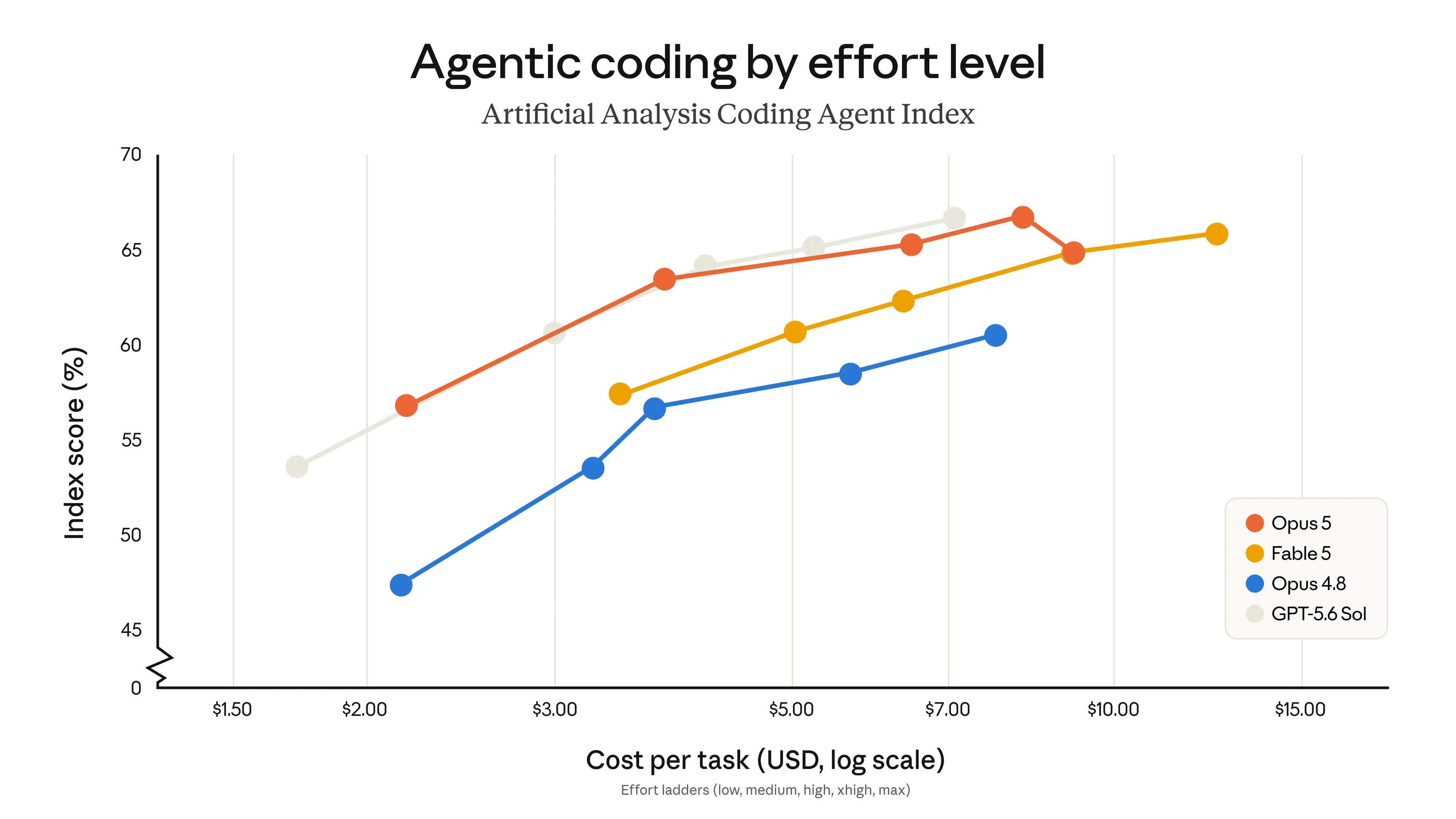
It seems roughly equal according to Anthropic's benchmarks
How big of a lie is too big? Especially when no lie needed to be told at all: many including myself would have noticed the tiny 0.1% deficit and been suitably impressed by the Opus 5 result.
I’ll admit this is a small deception by today’s standards. I’m one of those who believes in truth for truth’s sake.
Edit: typo
Fable is typically used for key planning, architecting, and review tasks.
I think this is a case where you don’t understand the use case, not that the marketing department is making mistakes.
If you bought the $200/mo plan and you don’t use it much, using Fable for everything is fine.
Just this past week Fable was able to figure out a couple of small issues for me where Opus was failing to.
Also both are still somewhat bad at UI implementation. Opus more so
"Use <less expensive or older model> for everyday tasks and <other non-critical stuff>. Use <more expensive or recent model> for complex coding tasks, refactoring large code bases, etc.".
Then, the next model/release emerges and the previous "best for complex" gets demoted to "everyday".
Obviously, it's all relative. But, it does beg the question: was the previous model really good for complex coding tasks or no? I mean, how is it now suddenly only good for the "easy" stuff?
Because your expectations have changed.