
One thing I've found LLMs have a lot of difficulty with is angular cuts / elements that aren't easily representable with CSS. Cyberpunk aesthetics are generally a great test of that, since they have a lot of microglyphs / window decoration.
Design source of truth: https://image.non.io/9d5fed20-b476-49d3-841b-37eb553fb88e.we...
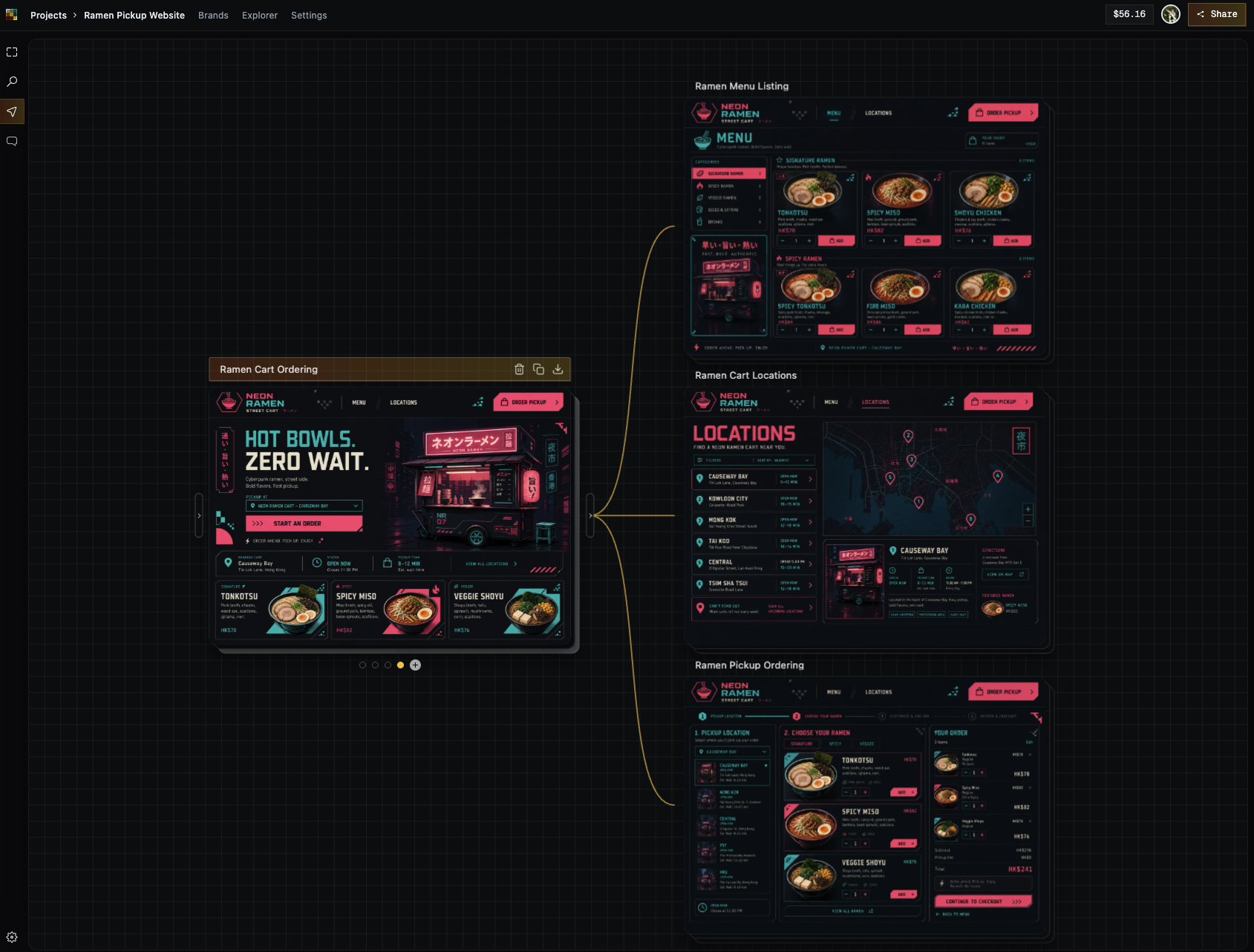
Opus 5 build: https://html.non.io/neonRamen/
Thoughts: It does a really, REALLY good job at these angular cuts / microglyphs. The responsiveness is off, but I'm very impressed at how well it did here. One way I think of it is "how close to a finished product did this get me?". Opus gets you like 90% there.
Personally, I think being able to have these design languages be easily prototypable is fucking awesome. Great tests! (But a tad low-performance/janky, somehow). Though, I also like the cyberpunk aesthetic. Very on-brand(?) that AI generates it, hah.
I love this so much.
Designs like this would never have seen the light of day in the cellphone incrementalism / corporate memphis era of tech. Now people can be weird and awesome again.
This is 1980's cyberpunk / late-90's Matrix / early-00's sci-fi UI. Great ideas that died to frutiger aero (which isn't a bad design aesthetic) and flat design (which is).
This is fun and it's got great colors and I love it.
It's so refreshing to see this.
AI rules. This is the best timeline.
We do things to achieve some end result but it's the journey there that is the most cathartic to me. The "skilled crafts" element of development where careful deliberation and hours of tinkering to get any kind of appreciable output you can admire has been replaced with a one stop dopamine button that skips the whole process that I could find myself getting lost in.
I've taken up carpentry/metal working as a result. Maybe someday we'll have live in robots that do the same for those hobbies that AI did for programmers but I can't see it happening any time soon.
The ramen shop website above is pretty, but it's a veneer. It's not weird and awesome, it's just a representation of a site. I spent about... 7 minutes of my life making it. It's a tech demo, nothing more.
If someone actually poured their heart and soul into a vision for a cyberpunk themed ramen cart, and happened to use this because they didn't have the capabilities or funds to do a proper design, suddenly it becomes less of a veneer, and more just a component in the wider vision of that individual. Their human hours poured into the wider thing that's the business becomes what matters.
Ideally what AI does is it amplifies the hours we do pour into things that are weird and awesome, it doesn't replace them.
This was just from a prompt "A cyberpunk themed ramen food cart website. Should feature menu, locations, and an ability to put in an order for pickup. Simple and clean website with angular cyberpunk microglyphs, pink/teal colors."
I have found myself empowered by AI to tackle all sorts of things that would have too high of a barrier to entry for me to want to spend my limited time on as a busy father who is also working at a small startup.
And when I say that, I do NOT mean that I can crank out a bunch of slop and label it as something I produced even though I don't understand the code. I mean that I can do things like go back to college math that I never appreciated at the time and honestly felt too scared of. I mean having an on-demand math tutor that ask clarifying questions to as I struggle through the problem sets.
I have found that it actually accelerates learning how to code in various problem domains because I can tell it to answer my questions at a conceptual level and be a sounding board, but to never actually write code for me. It can review the code I write and gently nudge me without giving away the answers, so that I still struggle through the learning process and actually gain the knowledge.
And finally, for the first time in like 10 years of feeling overwhelmed and daunted by the prospect of learning game development (I have no background in that), I have found Codex to be an incredible boon for learning with the Godot engine. It helps me understand the terminology so that I know what to search for and what documentation to read. It helps me map my computer science knowledge from other domains into the game world, and to understand why things are structured the way they are. And because Godot saves all of the scenes and geometry and lighting and shaders to the file system as text files, Codex can inspect the results of the work I'm doing in the IDE and help me track down things I'm stuck on, and explain what the issue is. For example, why my pre-baked global illumination lightmap is breaking my ambient lighting configuration.
I know it has never been easier to cheat and skip the hard work that results in actually learning something, but for me, personally, I cannot believe the incredible value that $20 a month has provided me. I have never been more excited and eager to dive into tackling hard things I had previously been afraid of or simply too overwhelmed to attempt.
It has never been easier to quickly prototype and get a feel for some idea you have in your head to see if it even has legs. Simply seeing a quick prototype of an idea is often all of the excitement and fuel I need to then take it and make it a real project.
Btw, if websites would only include the frontend dev's own hand painted images, we would also revolt at the sight of human slop. It's not just AI.
The whole point is that good artists are capable of producing non-slop, and to this day they're the only group of which this is reliably true.
But sure, lets cheer that funky website designs are back on the menu…
In the mean time, I’ll unashamedly continue to cheer for creativity and innovation. Note: I don’t even like this website design.
The "funky" websites of the past were mostly a result of tech immaturity and a lack of profit motive.
Businesses have been able to easily install templates like this for at least a decade. They don't because stuff like this looks cool but isn't very functional.
AI isn't going to make your local restaurant have a funky website, it's just going to make everyone who use to work directly and indirectly for that company unemployable. And even the local restaurant will close down because they can't compete with the multi-national competitor that has automated their kitchen with AI.
Out of curiosity, what app is that Design source of truth screenshot from?
Edit: Generation was down, back up now. Apparently just hit my $1000 cap for the openai api. Upped it to 10k. Growth!
Opus though followed the source of truth better imo. The details are more present.
Fable filled in the gaps for things it wasn't able to do (ie in the design the hero image goes behind the nav), which resulted in a better looking page that was more divergent.
It seemed to me that Fable meaningfully improved on the original design more than just faithfully executing the original design.
> Create a web page implementation from the following instructions:
> https://diffui.ai/build/Spa_Booking_Experience_build.md?auth...
Thank you for sharing this. I was just using OpenAI's Product Design plugin[1] to create designs but it just didn't reproduce it in code faithfully so will need to try this.