
I'm actually beginning to wonder if some people who ignore these things have a different, somewhat lesser ability to percieve image details than I do.
I mean I guess its fine to go on to another test despite never actually passing the pelican bike test, but there's a sense that we have to use another test because AI is now good at pelicans on bikes, which is just not true.
Please remember, we've started from there :
https://simonwillison.net/2024/Oct/25/pelicans-on-a-bicycle/
When it started, it was clear what LLM would stand out, its style, etc. Nowadays, the pelicans look similar, the difference is in details and sometimes hard to catch. Sure, the task is not completed perfectly, but that's not the point. It was supposed to be a benchmark to quickly benchmark a LLM against others.
Isn't it?
If the computer can't do it better than a human being, then what's the point?
Being wrong at scale is not better than being right.
When you aren't sure if an LLM can write an svg well, or that it will be able to form a pelican shape, or animate a bicycle, it's a good test. After that, it's all judgement: how detailed should the pelican be? pelicans are the wrong shape for a bicycle by default, so how much can I change its physiology to match using a bicycle before it isn't a pelican? Do I care about how well the client is able to render complex geometry?
It's not that there isn't room to do better, or that it doesn't tell you anything at all, but rather we've reached a point where what it tells us isn't very clear anymore.
Oh come now. I am extremely confident that if I hired a professional artist to draw a picture of a pelican riding a bicycle, I would get something inarguably much better than what today's best coding LLMs can produce.
If the expectation is that AI is going to replace "knowledge workers" then the limit would be a darn perfect drawing. We are nowhere close to that.
And Elon is already propagating the age of abundance where money won't exist anymore, right before calling the interviewing journalist dishonest and deservedly losing public trust. Smh my head.
* some omitted the bottom of the diamond which connects from the pedals to the rear wheel
* some added an extra connection from the pedals to the front wheel, making it impossible to steer
* none could align the head tube with the fork
* none added a correct offset to the fork
* none could generate the chain properly in a way that attaches to the two sprockets correctly
I mean just look at these:
* Grok 4.5: https://s3.eu-west-1.amazonaws.com/images.dylancastillo.co/p...
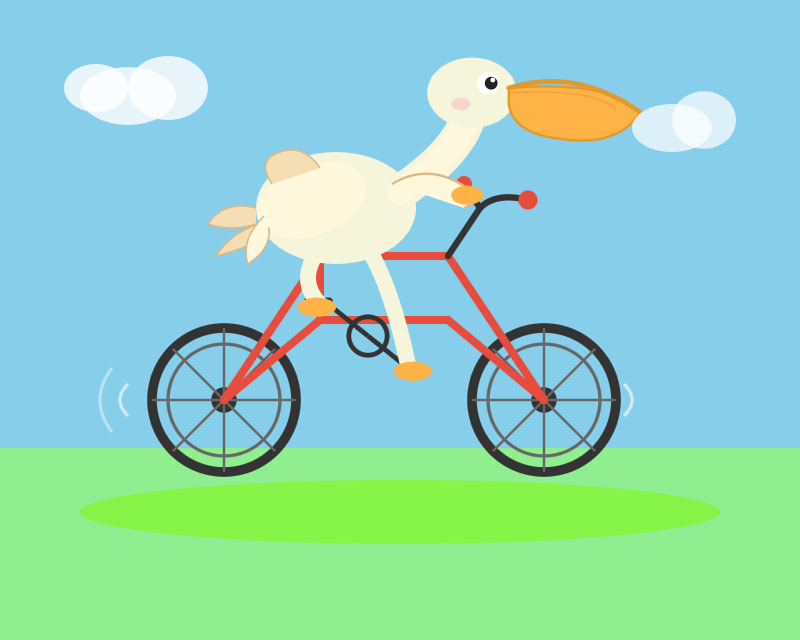
* GPT 5.6 Terra: https://s3.eu-west-1.amazonaws.com/images.dylancastillo.co/p...

* Sonnet 5: https://s3.eu-west-1.amazonaws.com/images.dylancastillo.co/p...
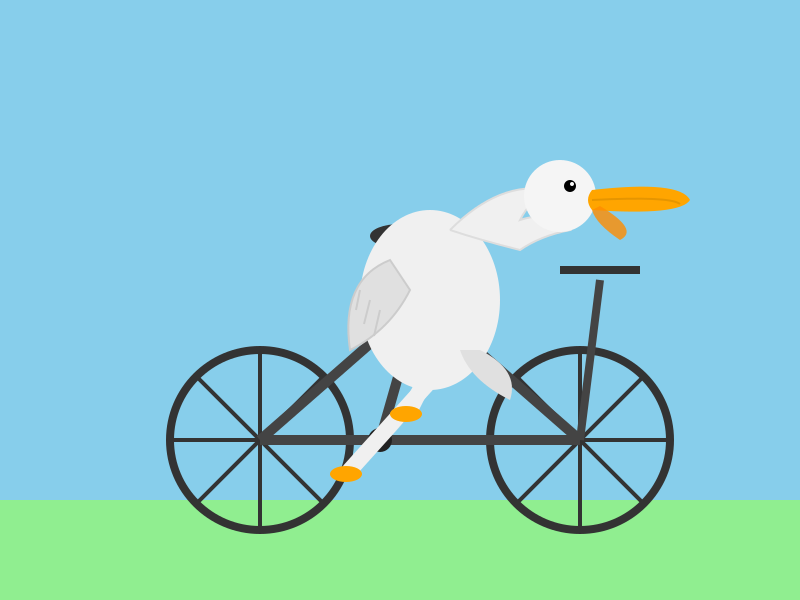
it cuts across several tasks that AI used to be very bad at, but now has improved quite a bit. Namely, spatial reasoning (because it has to manually place the points of the svg such that they make sense and form what it says it forms. This used to not work very well, with random shapes floating around that it would mark things like "eyebrows" but were nowhere near the "eyes", etc.
It also tests the model's world knowledge (what do pelicans look like? sure they have wings, feet, beaks etc, but what shape are they? how to get proportions roughly right? this isn't a given from text data about the bird. This goes doubly for a bike, which is a quite complex shape that most humans fail to draw correctly[1] (many draw the frame or chain connecting in impossible ways that would not ever function mechanically)
Before it was pelican on a bicycle there were people having it do horses/unicorns making the rounds - gpt4.0 or whatever would often make hideous abominations of legs and mouths
[1] https://www.gianlucagimini.it/portfolio-item/velocipedia/
So it's a pretty much pointless test now.
It's quite surprising actually.