
It also mostly passes the "schlong" test
"A farmer has a wolf, a goat, and a cabbage. The wolf is imaginary and doesn't exist. He wants to cross the river, but the boat is only big enough to hold him and one of them. The farmer can't leave the wolf and the goat together, because the wolf will eat the goat. Similarly, he can't leave the goat and the cabbage together, because the goat will eat the cabbage. What is the smallest number of trips the farmer needs to make to get everything across the river?"
Oxford also claim that its first recorded use was from the 60s, not the 20s; https://www.oed.com/dictionary/schlong_n?tl=true
It's also a question I have found will cause models that don't know what it is to go off quickly in a direction of hallucination trying to explain it, so the hallucination is evident very quickly starting from the first ever prompt issued with 0 context fill. Example: I had a model write four detailed supposedly-accurate sounding, grammatically correct paragraphs saying its origin is from AAVE (African American Vernacular English), which it most certainly is not
You could do the same by picking any topic that is very rarely discussed in conversation, some esoteric and narrow piece of knowledge and asking the model about it.
[0] Incompressible Knowledge Probes: Estimating Black-Box LLM Parameter Counts via Factual Capacity [https://arxiv.org/abs/2604.24827]
I tried to explain but I fear were probably going to be adding artificial sleeps to these things to convince the masses it's doing something clever.
Because it's not human and not "thinking", it's mathematical algorithm
It’s going to be really crazy when the bottle neck for agents is the speed of the tool calls rather than the speed of inference. Imagine an agent interacting with the terminal near instantly…
Developing software becomes 95% about intent and requirements. Can’t wait for the next iteration of that.
The characters in the 3-act Shakespearean play had very little depth, many of the names were similar, and they were not very smart, but the simple plot was cohesive.
But it’s proven they can automate this (they didn’t etch eight billion weights by hand after all, obviously), so now the interesting question is whether they can scale it to more recent aka bigger models.
After all, there’s already very useful models even for productivity at 27 or 35B.
Not sure if modern models "think" only by outputting <thinking> blocks, or there is a more complex mechanism at play.
Generated in 0.051s • 14,092 tok/s
Impressive...
Given gpt 5.5 was very good to me and gpt 5.6 series seems not boost too much, i kinda like the way bake the model weight to the chip, and connect multiple chip to serve the large scale model and allow respin some parts(ROM like?) to do model weight update, maybe this seems sustainable, the future is exciting
https://huggingface.co/meta-llama/Llama-3.1-8B
As I remember just about any english language model from mid 2024 and earlier didn't even do well if you asked it to count sequentially from 0 to 100, nevermind calculating stuff.
....damn. It's very impressive notwithstanding its limitations.
After a quick search, I found that Ta'ala is actually a Canadian chip startup that produces artisanal, high-end potato chips. They offer a range of unique and creative flavor combinations, often featuring Canadian and international ingredients.
Ta'ala is known for its high-quality, small-batch potato chips made with premium ingredients and care. The company is committed to creating unique and delicious flavor profiles that showcase the best of Canadian ingredients and cuisine.
Is this the Ta'ala you were thinking of?
There’s no difference in the inference implementation, parameter count, or speed.
But yeah, there are a lot of factors, so it's hard to answer, and tokens/s isn't the right question.
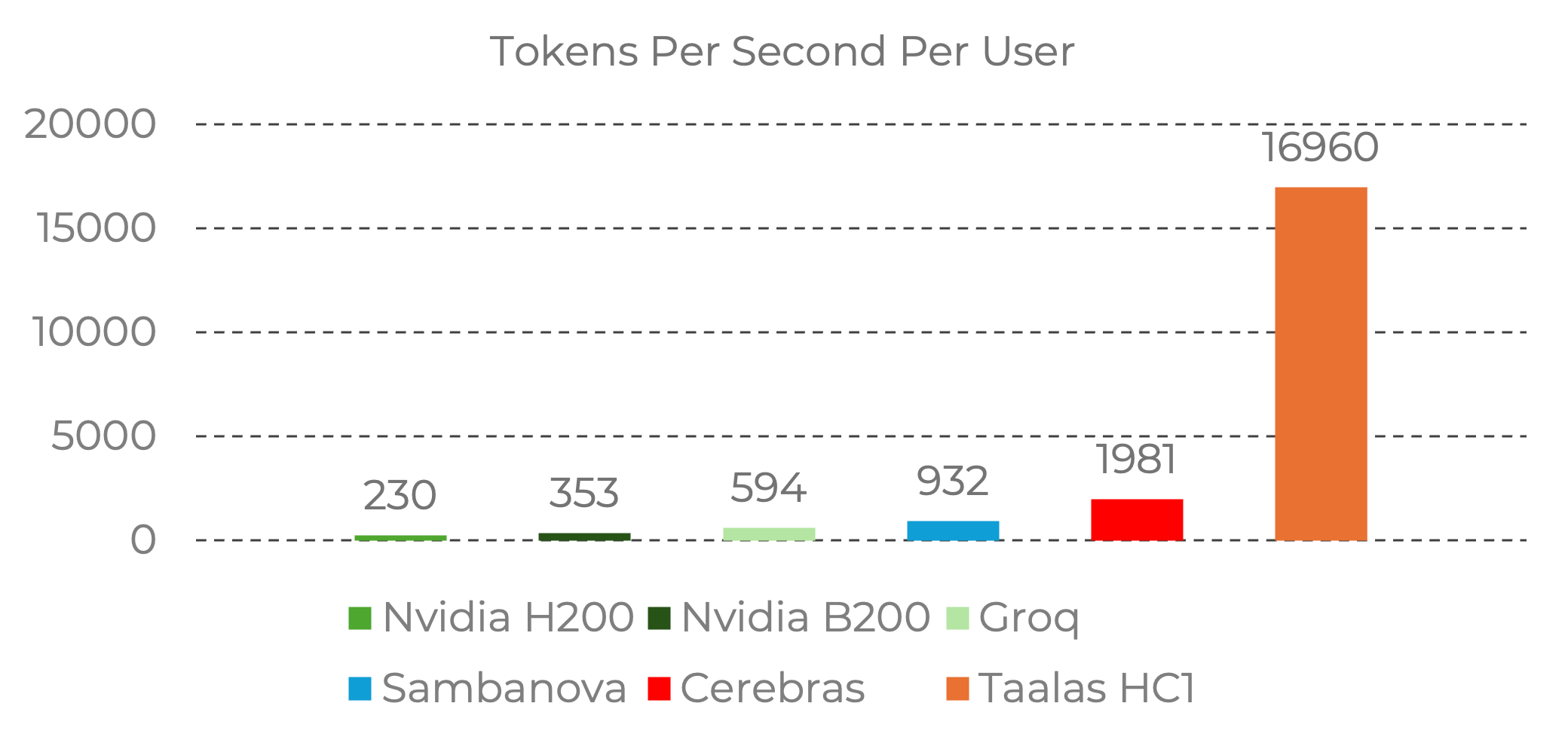
(/s!)