
More like hand-prompted...
> Everything after that is the interface you remember from a 1984 Macintosh: […] and a dock along the bottom with one tile per running program.
In that case I look forward to seeing OS X’s Aqua ported to the IBM PS/2.
If this project is any indication, AI can definitely make that happen too.
> 66,183 lines of hand-written real-mode assembly
Goes to the github - contributers jggonz and CLAUDE. The README.md doubles down on this at the bottom with the license.
> Everything here is hand-written; no third-party code is vendored into the OS, so the whole tree is covered by that one license.
That's what happens when you let an LLM write your ad-copy...
But if people are going to post it on HN, they should consider at least writing the README / main page of their website by hand
It is nice to hear the human authorial voice, at least sometimes
It’s almost as impressive as the “GOS” written for Atari 8-bit running on 6502 at 1.79 MHz. Visually it’s almost identical but has a nicer font. The specs are somewhat similar with 16 task slots, calculator app and task manager, serial mouse support (ST mouse) and Atari’s hardware sprites helping with some of the graphics. The XOR window frame is the same idea. Amazingly, Atari GOS runs in 128K of RAM! One has to admire the work and inventiveness in these projects. See description and videos here:
Visi On[1] was a graphical operating system for the IBM PC that actually existed as a commercial product, though definitely not a very successful one. It was made by VisiCorp, the same company that created VisiCalc (the first spreadsheet for a personal computer).
It was demoed at COMDEX in 1982, before the Apple Lisa was released. It came out after the Lisa but slightly before the Macintosh.
Here's their promotional video from 1983: https://www.youtube.com/watch?v=kc4wFeVvKTI
Fun fact: Bill Gates saw the demo at COMDEX, and at first he was skeptical that it was really running on an IBM PC. But ultimately he was so impressed he decided[2] to start developing a product called Microsoft Windows.
---
The story seems to be more that seeing VisiOn gave MS the nudge to get into action on the GUI due to a sense of competition/urgenbcy from VisiOn rather than learning about the GUI from VisiOn.
Personally, I don't care as long as the end result is good, but a lot of AI software tends to be in the lower end of the quality range.
Similar strategy can help smaller local models achieve greater results too. Small steps + many guardrails.
Here on HN? I don't believe that.
A MacOS-like desktop for the Intel 8086, written entirely in real-mode assembly (with Claude). Verified to run on real hardware, with FAT12/16 support, ported apps, games, Sound Blaster support and upcoming Hard Drive support.
Amazing.
[0] http://runtimeterror.com/pages/iv/images/b869a0cf44a7e7cbc40...
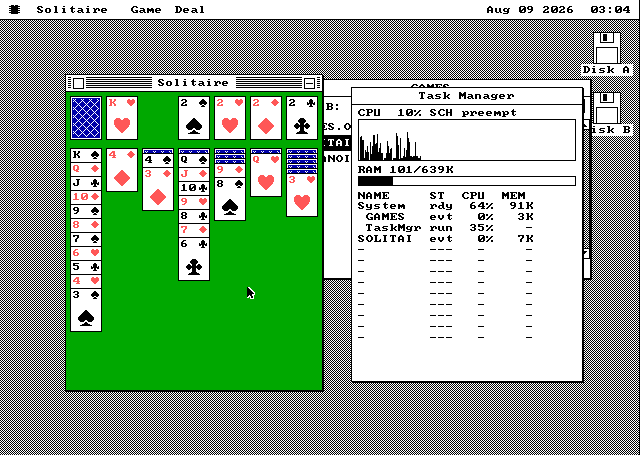
Interesting, it currently says, 'Nobody has yet written the images to 5.25" media and booted an actual XT with them.'
VGA adapter means you have to wait until 1987 to run this, otherwise you'd deal with CGA's non-square pixels. EGA support would only be possible in Oct 1984.
I have a Pocket 8086 - I would love to give this a try next weekend.