
I don't disagree that calorie restriction is effective. I just think that you're dropping appetite from the equation when GLP-1 agonists have proven that reducing appetite is effective too.
I am not anti-GLP, someone who believes using GLP drugs is cheating and people should achieve that with blood, tears, and sweat. I see it as a "tool" in the arsenal. I've no use for GLP as I've no problem sustaining deficits as large as 600-700kcal for long. But I've met people who can't do this, so for them GLP is a valid choice, but I'd recommend they pair it with proper dieting and lifestyle changes.
You want to eat good stuff and avoid stuff not good for you; blanket reducing appetite may result in loss of both good and bad.
Here's what GLP users say about the macrocodex method: https://www.reddit.com/r/tirzepatidecompound/comments/1omfgx...
The guide linked in the above post is macrocodex's prototype method, which was later formalized into an app.
I don't want to make strong claims on this, but using GLPs may increase the risk of developing gallbladder stones, as GLPs make it very easy to eat far less than necessary.
A proper macro and calorie balanced diet can give you better results with a smaller GLP dose.
Use GLPs if your actual problem is staying on a "sustainable deficit." Many people who use macrocodex report they do not feel hungry when on such a small deficit, but there are a few who are hungry even at a deficit as low as 300 kcal; for them, GLPs are more suitable, but not a replacement for proper dieting and lifestyle changes.
I mean, observing the weightloss / gain or lack thereof itself will tell you whether you need more of a calorie deficit or surplus. What does an independent metabolism estimate buy you?
How difficult is it? Just eat below the orange line to lose weight and eat above the orange line to gain weight: https://macrocodex.app/assets/hero-tdee-line.v3.1b8c60c2271f... In the image, you see the app continuously updates maintenance calories from observed evidence; on the homescreen, it provides the calorie and macro targets you need to follow: https://macrocodex.app/assets/flow-targets.v3.edc3f34458a1.p...
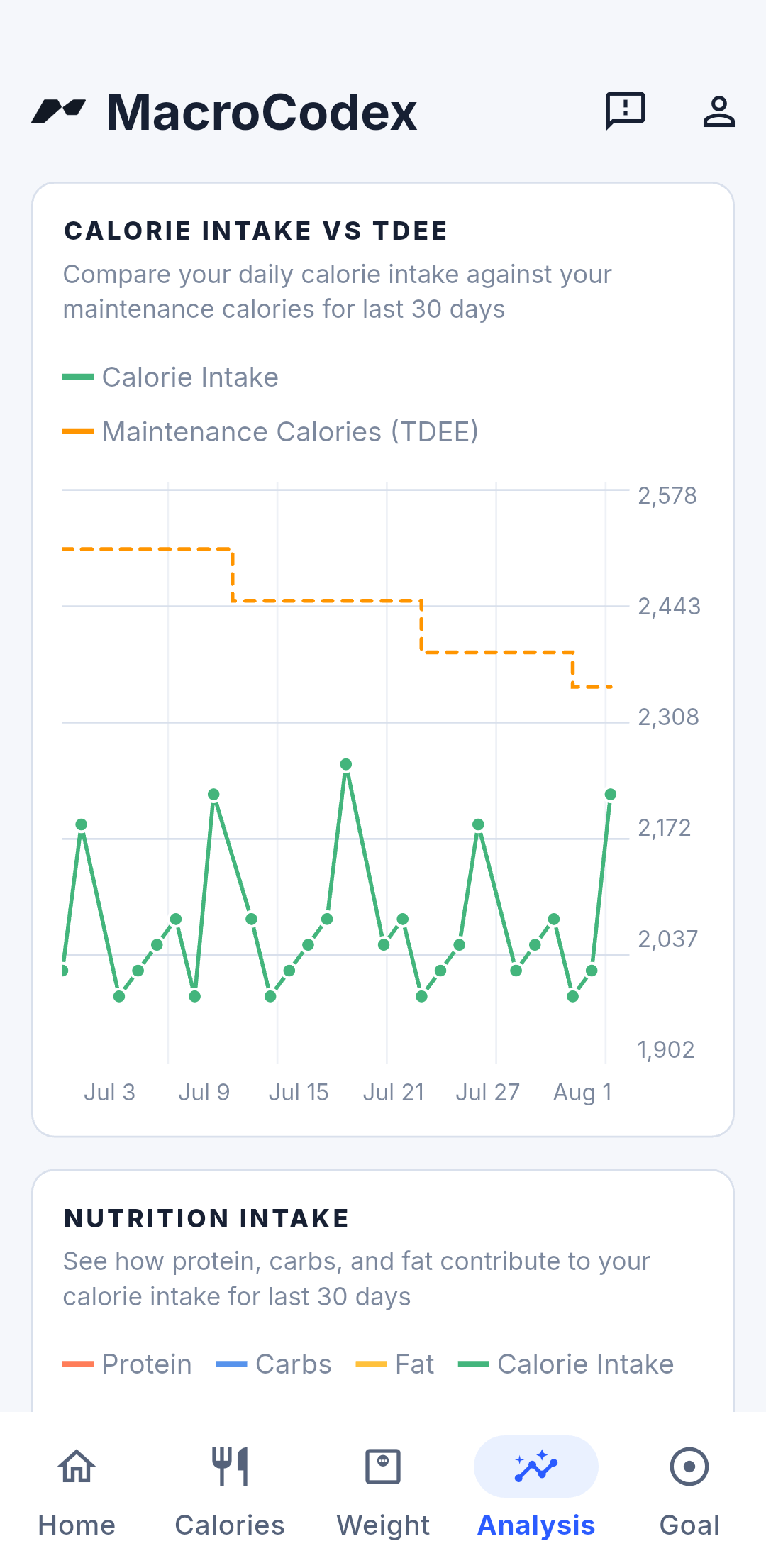
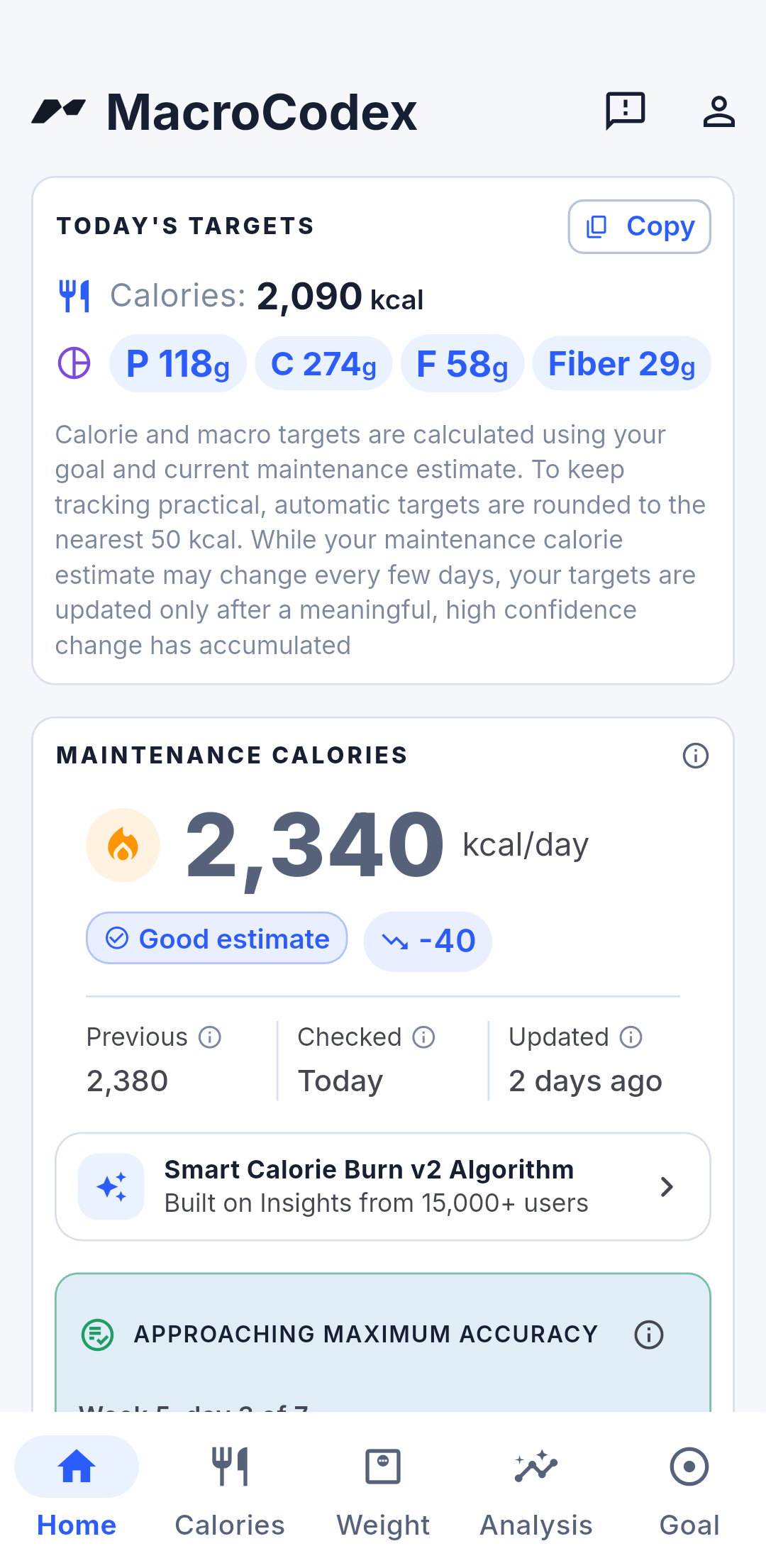
It was never this easy, imho. Many people used TDEE calculators in past, which suffer from the limitation described here: https://macrocodex.app/knowledge/rethink/adaptive-tdee/#tdee...
It's useful for both Newbies and Pros.
When a person figures out their maintenance calories and looks for the average metabolic rate / maintenance calories for their height, weight, and gender, they realize they are not "genetically inferior" or have some serious issue which is stopping them from progressing if their maintenance calories are within average range!
Just knowing that there is nothing wrong with your metabolism gives people enough push to continuously walk on this path and achieve their goal.
>I mean, observing the weightloss / gain or lack thereof itself will tell you whether you need more of a calorie deficit or surplus.
You can read app reviews and these will tell you, complete newbies are having great success with this approach.
If you ask a layman on the street, they'll tell you eat less to lose weight, eat more to gain weight.
The question is: what is less, and what is more? How many calories precisely do we need to eat to achieve 1lb per week of weight loss?
Your total calorie burn for the day changes week to week; people don't know how to make the right adjustments.
Many people crash diet; they lose weight, then they cannot sustain it for long, binge eat, and gain it all back.
What key knowledge are they missing? Sustainable deficit. If you apply a sustainable deficit over a longer period of time, you may not "suffer" as much as you would otherwise
I am not saying drastic deficits are not useful; they are to those who are experienced. Let's say an MMA guy or bodybuilder can do it just fine!
Also, for lean bulking in natural bodybuilding, you need a specific rate of weight gain; let's say for a beginner it's a weight gain of 0.25–0.5% of body weight/week. It's hard for many to achieve this precise range because your maintenance calories are changing all the time!
And if you are an advanced lifter, then the rate of gain you want to target is even smaller: 0.1–0.25%/week.
That's why pro natural bodybuilders use Macrocodex and find it useful.
for those that aren't, you can't actually measure metabolic rates this way.
for a way to actually measure it see: https://en.wikipedia.org/wiki/Indirect_calorimetry