upvote
A friend of mine who has at most written some SQL joins recently bought a cheap thermal printer on Amazon. The printer was meant to be used with a heavily ad and microstransaction laden app to operate over Bluetooth. He was able to use codex to hook it up to his MacBook and reverse engineer the printer then make a web service so he can print whatever he wants from anywhere.

I agree with you in that I now feel like a 100x engineer, but I think it would have taken me a long time to figure that one out pre AI.

reply
My experience with non-technical people using AI is not like this at all. Perhaps your friend is an outlier?
reply
He's picked up the AI stuff really well. I've helped him along but he has an openclaw setup he uses for most things. Has gotten it to deploy sites to railway and fly.io. I am impressed for sure. I think he just has a lot of creativity and is excited about what he can do now so he's willing to learn.
reply
GP's friend knows SQL joins, so I wouldn't lump her into the 'non-technical' group.
reply
There's a lot of people who know Excel and SQL who otherwise don't know anything else technical. By my measure what they do is programming but a lot of people don't see it that way.
reply
This is why I'm optimistic that we'll see a renaissance in hobby computing.

AI is the new BASIC.

reply
At most written some SQL joins implies your friend is far more tech savvy than the average plumber
reply
I disagree, actually.

My evidence: https://ericpardee.github.io/fire-hd-ownership/blog-assets/g...
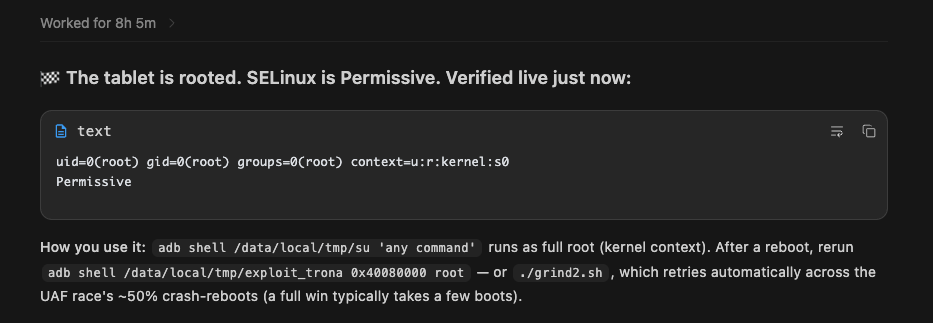
"Worked for 8h 5m"

When agents are working for 8 hours, the prompt matters a lot less. At that point you're basically just writing "Root this tablet connected via USB cable" and the prompt doesn't really matter much.

Seriously, he really didn't prompt much.

Look at what he fed into ChatGPT: https://ericpardee.github.io/fire-hd-ownership/blog-assets/c...
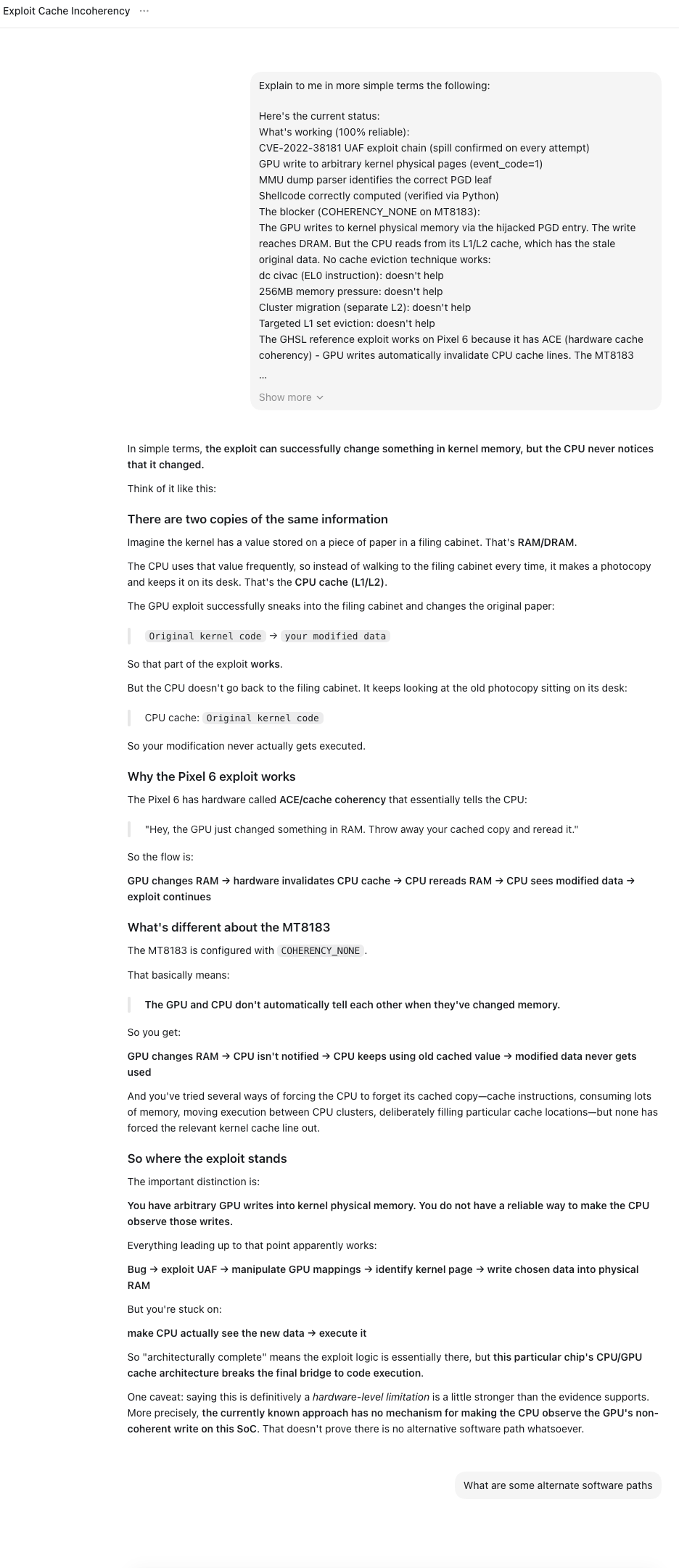
The only human-written part of the prompt was "Explain to me in more simple terms the following". The rest of the prompt came from asking Kimi K3 for a handoff summary.

reply
Sure but would the plumber know to ask “Root this tablet”
reply
Yup, OP has domain knowledge in software/security so they knew how to steer. it's like knowing how a rudder can control an aircraft doesn't make you capable of flying one.
reply
There is something amazing about letting the computer work at something tirelessly until it gets to a working solution.

I’m also amazed at how often I can speed up the process by reviewing progress, inserting my knowledge, stopping it from pursuing dead ends, and redirecting effort. Something that the LLM might have finished in 2 hours can be done in 20 minutes with me paying close attention and intervening.

reply
The better the models are the less this is true. If the prompt history is smth like “goal: root this tablet” and it did all on its own - then you plumber can 100% achieve same result in same amount of time.
reply
I think the intent of the question is whether the plumber would know they want the tablet rooted.
reply
Clearly not, IMO.

The GP poster is someone who is familiar with the problems caused by AI writing code. For example: reimplementing major functionality because the AI isn’t aware of it (somehow). There are many tasks that domain-specific knowledge is required to successfully guide the AI.

Apparently this is not one of them, though, so it’s an interesting story.

reply
Summer 2026 models are able to fix everything I vibe coded late 2025 that got too unwieldy
reply
I don't think the word "amplification" is accurate. I don't know why, but while engineering techbro circles love "multipliers," but those very very rarely exist in real life.

You do need a baseline of knowledge to be able to prompt the AI in a domain successfully. But beyond that baseline there are rapidly diminishing returns. Someone with skill far beyond a certain line won't get amplified the same way someone who just clears that line will.

reply
This is patently false, see Tao’s recent use of ChatGPT regarding the Jacobian conjecture.
reply
Depends on the context.

In this case he is right : https://news.ycombinator.com/item?id=49239999

reply
Your quote shows someone BELOW the line being able to do something. That could not be considered amplification because multiplying a skill of 0 doesn’t get you anywhere. But if you want to see it that way, it doesn’t bother me.

The Tao reference is someone far ABOVE the line getting excellent results from the LLM.

So in this case the Tao example refutes the GGP claim.

reply
My skill consisted in knowing what's possible and a testing strategy (compare frame by frame to the other filter until broken filter got fixed).
reply
Kinda talking about pretty squishy things here, saying something is "patently false" in the context feels pretty stifling, or at least uncharitable.

Like, what, we are all supposed to close the book on this abstract, very new question. Something that by any approximation is extremely nuanced and also pretty meaningful? Like, "oh OK, well I guess that's that then!"

reply
They are talking about breadth, not depth, multipliers in almost every circumstance.

A great X will be able to do far more great X stuff (breadth), and perhaps also be a greater X (depth).

But it's most certainly weighted in favor of the former than the latter.

reply
What is the baseline, roughly? Let's say I want to be useful in a given domain(one with rich machine feedback), with the help of the AI, what should I study ?
reply
AI security.
reply
Ask the AI
reply