
Devil's Arrows: Ancient builders hauled 55k-lb stones 11 miles for UK stone row
(www.sciencedaily.com)
Meanwhile, in Egypt...
replyKen Follett (of "Pillars of the Earth" fame) wrote a terrific semi-historical* novel called "Circle of Days" that portrays a vivid picture of the people and circumstances that could've led to the creation of Stonehenge.
reply*"semi" qualifier bc there's so little known for sure -- but it's at least plausible, and his extensive research doesn't contradict things that can be verified.
Also, Stonehenge was built (partially) from parts of other stone circles, from as far away as Wales: https://www.bbc.co.uk/news/uk-wales-56029203
replyand at least one stone came from Scotland: https://www.bbc.co.uk/news/articles/c207lqdn755o
reply[dead]
reply25-tonne stones for 18km in case you wondered
replyOr 3928 stone stones
replyStones are the Fahrenheit of weight. Useful for the human body but fuck all else.
replyFor anyone confused, British people would generally use tonnes (or tons, but maybe not know the difference exactly) and miles.
replyOr about 3 double-decker buses for the length of 171 footy pitches.
replyThat's not dimensionally correct! Double-decker bus is a unit of length, and footy pitch is too prosaic to be an approved unit: https://www.theregister.com/bootnotes/2026/05/31/the-reg-onl...
replyIt's a shame it's not about area then at least we could agree on Wales as a unit.
replyIt's not too prosaic, it's just too imprecise. There is no standard size, and some regulations even allow a range of sizes.
replyI don't think that's relevant for Register units. Clearly there's a standard brontosaurus somewhere, for instance, otherwise how could we have the conversion table? However, sorry, I was wrong about the football pitch, at least as a unit of area, equal to 194.89nWa per the original article: https://www.theregister.com/offbeat/2007/08/24/so-whats-the-...
replyto clarify for those of a nautical bent - that's about half a blue whale for about 4/5ths of a dozen nautical miles
replydeleted
replyImperial is confusing at the best of times, but couldn't they have said 24.5 tons instead of 55,000 lbs?
replySir ...
replyhttps://en.wikipedia.org/wiki/Long_ton
> he long ton,[1] also known as the imperial ton, displacement ton,[1][2] or British ton,[3] is a measurement unit equal to 2,240 pounds
deleted
replyThat's the way they like it. American road signs have mad shit like "No trucks over 15,000 lbs".
replyThis is an is-ought inference. Americans have not been given an option and use the units they're provided with, which is a frustrating mix of everything depending on context.
replyNobody seems to like it this way.
Surely they don't actually like drill bits measured in fractions of an inch, do they?
replyYes, in USA the bits are in fractions and stuff you purchase will have instructions like, drill 3/8 hole for a wall anchor, or 2+1/4 hole for a door-bolt set.
replyThat's because we measure weight in tonnage.
replyIn the EU and UK the weight of the vehicle is on the signs too [0], or the weight per axle [1].
reply[0] https://hgvlgvtraining.co.uk/wp-content/uploads/2024/11/weig...

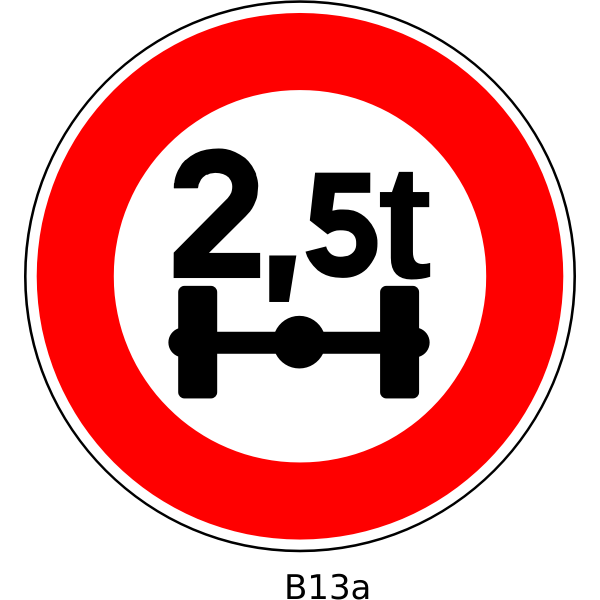
The American thousands of pounds thing is even more weird than that: I buy gravel from the gravel pit. They weigh my truck and dump trailer in lbs and then charge me per ton. Everyone talks about tons: e.g. I'd call a dump truck operator and ask him to deliver 18 tons of rock, not 36,000lbs. But the weighbridge and road signs and regulations about vehicle and axle weight are always in lbs. If you only read things and never talked to other people you'd never know tons existed.
replyA lot of the older "no vehicles over X" signage is denominated in tons.
replyStrange they don't mention how many stones. Image shows two. There are three today and four, maybe five, originally.
replyThe word for this structure is apparently a menhir: https://en.wikipedia.org/wiki/Menhir. The article calls it the tallest in the UK but its Wikipedia page calls it the second-tallest. This is the actual tallest, interestingly also in Yorkshire: https://en.wikipedia.org/wiki/Rudston_Monolith.
replyThis must be the origin of the saying, “People who start stone rows shouldn’t build glass houses”.
replyLovely.
reply[dead]
replyMust have been a contractor. The permies would wait for the procurement process to pick someone to move those stones for them. /s
replyNeed 7 more paragraphes telling us that the stones, weren't in fact, chosen from the nearest location, but were chosen from a distant location.
replyWithout ever telling *how" they were moved of course, that would give out too much
Quite easy. They were moved like this:
reply