
I'm almost cynically happy about Moore's law ending and hardware getting expensive if this is what it takes to improve software in the long term.
I'm sure some storage servers or storage appliances were built with many TB even then but it wasn't really something I saw a lot.
The prices of all those things continue to skyrocket.
Can you? I assume you mean spinning platter, but even then.
Computer parts are unaffordable this year.
“I can't eat an iPad.”
> Best not to cite the price of the new iPad as an example of why inflation isn't a problem when you head into a working-class neighborhood. In Queens, New York, on Friday, New York Fed President William Dudley did just that. He got an earful. After being bombarded with questions about food inflation, Dudley attempted to reassure his audience by putting rising commodity prices into a broader economic context -- but that only made matters worse. "When was the last time, sir, that you went grocery shopping?" one audience member asked. Dudley tried to explain how the Fed sees things: Yes, food and energy prices may be rising, but at the same time, other prices are declining. He then stretched for a real world example. The only problem was he chose the Apple's latest tablet computer that hit stores on Friday, which may be more popular at the New York Fed's headquarters near Wall Street than it is on the gritty streets of Queens. "Today you can buy an iPad 2 that costs the same as an iPad 1 that is twice as powerful," he said."You have to look at the prices of all things." This prompted guffaws and widespread murmuring from the audience, with one audience member calling the comment "tone deaf." "I can't eat an iPad," another said.
https://awealthofcommonsense.com/wp-content/uploads/2020/11/...
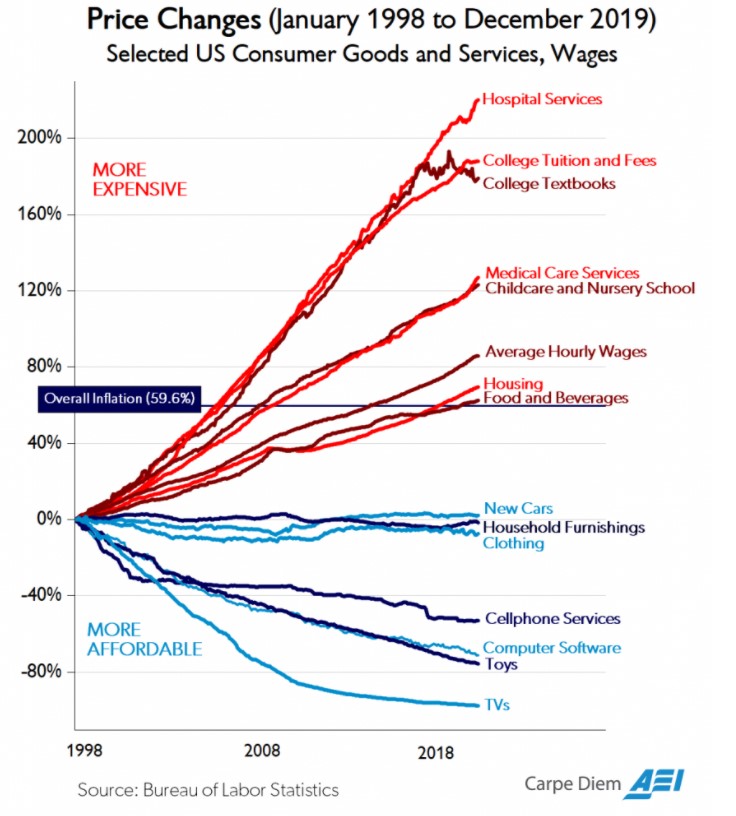
Of course, competition leading to near-zero profits means most competitors collapse, and the remnants get bought up by monopolists or oligopolists who then become rent extractors.
The technology was fundamentally developed with government grants to universities, or corporate labs like Bell Labs that were funded by a legal mandate on its parent corporation. Capitalists can only develop products that are basically ready for market, their margins are thin and planning horizons can only survive about 5 years usually. Their main power is throwing oodles of money at something ready to go and scaling it.
Edit: I will be slightly more charitable and note that capitalist companies can also do incremental research if there is a gentle and obvious hill to climb. Sometimes people do make crazy bets and they pay off, but that's more the exception, in America the dominant driver of technological innovation is government funded research supplied by capitalist scaled technologies (i.e. you research the next paradigm in the lab and purchase e.g. pre-existing computing resources from a company).