
Yeah, there's another paragraph:
> Identifying and removing cyber-related data. During development, we observed vulnerability research performance improving steadily as post-training scaled. Tracing the source of this trend, we found that cyber-related content was embedded within the general mid-training corpus, and cyber-related tasks were present in the RL environment mix — a natural byproduct of training on broad data. In preliminary experiments on internal models, we found that without data removal at either the mid-training or the RL stage, downstream cyber capability would increase substantially. These findings gave us a concrete lever for control. For the open-weight release of K3.1 Pro, we identified and removed cyber-related data from both training stages, while retaining the general-purpose coding tasks needed for model usefulness. We will continue to apply appropriate controls at every training stage, of which cyber-related data identification and restriction is one example.
(emphasis mine)
It's clear that cyber is a touchy subject right now. But it's also clear that RL works on it, because it's highly verifiable. So smaller models are going to become very interesting, because they can be fine-tuned later to cover this field.
> Prohibited: high-performance detection technologies used to counter cross-border data transmission security risks, including deep-synthesis forgery detection (266401J); AI cyber offensive capability technologies, such as malicious code generation and mutation, automated mass generation and distributed large-scale deployment of anti-detection variants (266402J); large models trained using China’s Core Data (266501J); and high-performance AI agents designed for highly sensitive scenarios, such as critical information infrastructure, national defense and core government affairs (266502J).
> It's clear that cyber is a touchy subject right now.
If the "scary Chinese open weights models" can do "dangerous cyber", then we might see regulations spring up against open weights sooner than later.
I hate Anthropic and OpenAI. As companies and leadership, anyway.
Dario and Sam are 100% to blame for this. They're trying to turn us all into jobless slaves, sex workers, and Squid Game pawns.
The only good future is open weights. They're trying their damnedest to keep us under boot.
I hope the Chinese companies (and I say this as a patriotic American) slay these two companies and destroy their moats.
In my mind, the two most dangerous people in the world are Dario and Sam.
We need open weights to win.
Speak for yourself, I don't think there is a market for many of us as the latter.
China cares about about stability way more than the US even, they aren't going to be big on AI models upsetting the governments power, and mass cyber attacks could do that.
At the end of the day we are going to have to realize AI is both dangerous and governments are going to control it. Worse if you start making and releasing your own dangerous models the 4chan party van is going to visit you.
Your thinking is dangerous. Do you work for Anthropic?
AI is dangerous when these powers are being hobbled up by the select few. These systems threaten to put us all out of work. I refuse to be a slave to a company or a government that is taking away our livelihoods, scraping up our earnings potentials, then seeking to muzzle us and put us in jails with no rights.
I would rather burn down all of tech than have AI be owned by the elites.
Your thinking is a threat to all of our liberties.
Then you better get your torches out now.
>I refuse to be a slave to a company or a government that is taking away our livelihoods
Don't worry, governments are fervently working on AI drones to take away your life when you get really upset about this. Oh, and they are also working at AI to detect when you write all this online, and track you down then monitor you on things like flock cameras. As they say, you'll be the first with your back against the wall when the revolution comes, I likely will be beside you for being too subversive.
>AI is dangerous when
Incorrect, AI is just dangerous. It doesn't matter who has it. The more powerful it becomes the more dangerous it gets. So, as you can tell I am an AI doomer.
----
Now, don't get me wrong, I want freedom for me, I want freedom for other people. I do not believe the technologies we're developing are conductive to having any freedom at all. Hell, if we're lucky we'll be slaves instead of all of us dead, including the select few.
>Your thinking is a threat to all of our liberties.
Lol, now this is kind of funny. "I want freedom to think whatever I want, but you, you shouldn't think like that!". Careful or you'll max out your irony meter. Anyway, "My kind of thinking" is just next ____ prediction. I see what is happening in the world around us, and based on the shape of that probability I see what is going to happen. No, you and I are not getting unlimited AI to do whatever we want. Yes, governments are going to lock down the shit out of AI for end users. Yes, governments are going to declare advanced LLMs munitions.
Balls in your court, better think of what your next move is.
If I don't get it, you don't either.
By comparison, do you think the Chinese models are going to be trained in such a manner that you enjoy the society that results? What makes you think that?
I don't need government minders.
I'll take the models and live free.
Anthropic has pushed the frontier harder and faster than OpenAI or anyone else in the last few years. Beginning with Anthropic's founding to quickly raise huge amounts of cash with a pitch to investors to rapidly leapfrog ChatGPT in scale, and culminating with Mythos/Fable which carved out a whole new tier of super models.
He's always talked big about Anthropic prioritising safety and their "Responsible Scaling" but his words just simply don't align with reality while they keep going bigger, faster, until only OpenAI could briefly and half-heartedly claim near parity at the top (while cutting corners in safety because the existential threat to their market position is far more pressing to any corporation than some abstract risk for humanity).
Whether it's wilful cognitive dissonance, cynical opportunism, financial greed or something else, that kind of self-assured moral superiority paired with his real world record of self-interested decision making for Anthropic's market position is a big red flag.
These times are not ideal but what can we do other than just take it as it comes? All the hate and rage is not good for your health.
Kimi: We took out the worst of it so have at it for free.
Everyone else: Back to my ablated model on openrouter for 1/10th the price where I can brute force issues.
https://featherless.ai/blog/abliterated-models-for-cybersecu...
Is a decent primer, then off to open router you go.
They are basically saying that models themselves are already capable. If you fine tune them with some cyber security tasks, that should make them potent. :-/
Agreed that this could be reinjected later. Makes me think of neo in the matrix:
“I know zero days.”
“Show me.”
Do you think that going around making cyber weapons isn't going to get you buried in a shallow grave?
> "below what our pipeline can produce, and remains behind that of frontier proprietary models."
Like Ant and OAI, they've realized vaguely claiming to have nerfed their latest model to an unspecified degree not only looks 'good guy' prudent, it provides a built-in excuse when a model fails.
They're not post training it to lose capabilities/censor them – they just don't spend training time on this topic, which sounds like a great idea.
It doesn't mean model can't do it, it just means it's less good at it; -10% on benchmark feels like a great result and overall approach to pace it.
I concede that term can carry overly broad connotations.
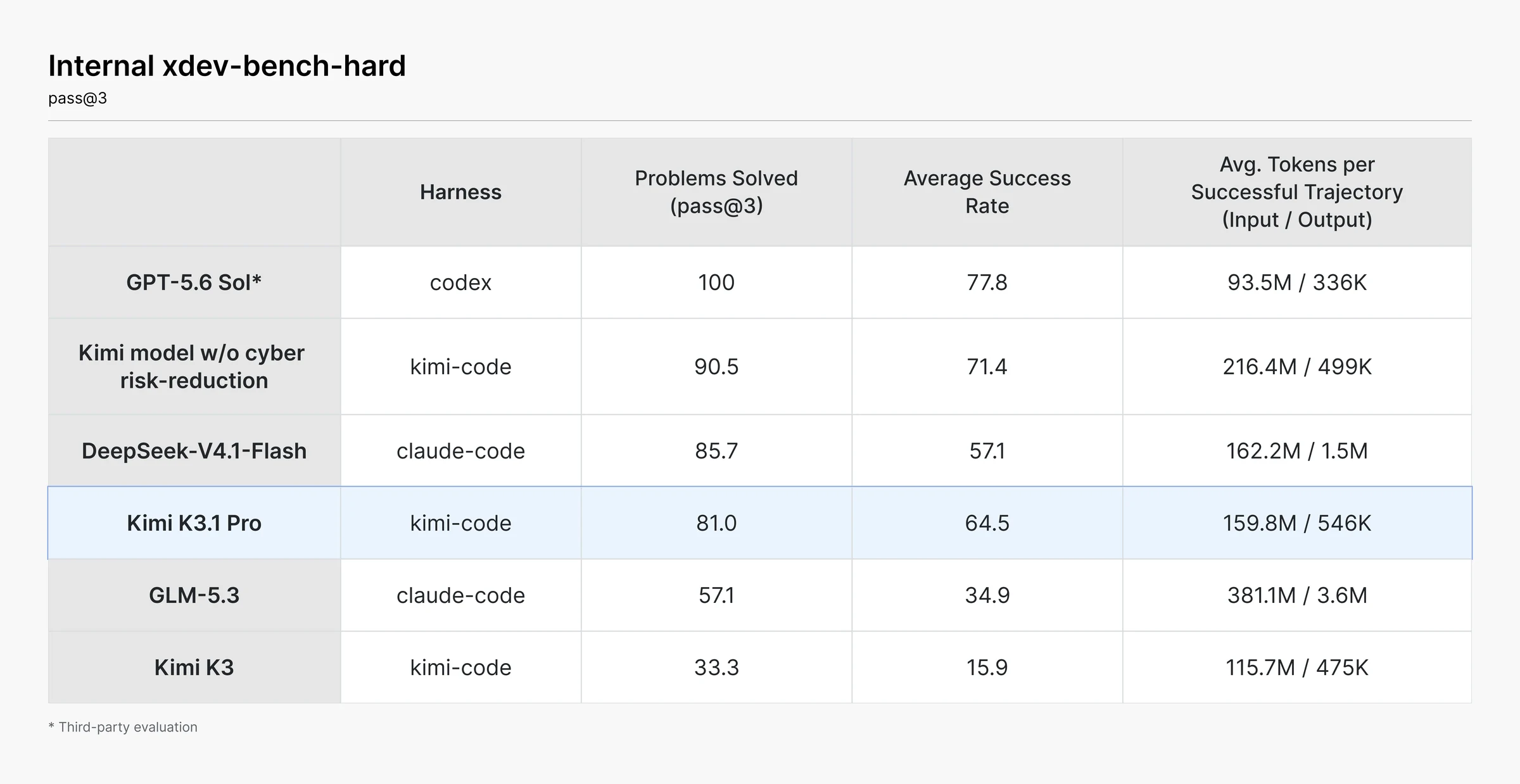
The benchmarks show Kimi K3.1 Pro outrunning practically all models. It's weird to hear someone like you accusing them of making up excuses for not lagging behind in discussions on how they are ahead of the pack.
I don't think you understand. Benchmarks show just that, that they "are crushing the competition".
I mean, remember Fable? A couple of months back it was lauded as leaps and bounds above everything, that needed to be contained at all costs? Well, apparently Kimi K3.1 Pro outperforms it.
What industrial level of cope do you need to drag in order to look at the results and claim they need to make excuses about anything at all?
Seeing as no one besides blackhats want frontier cybercrime capability to be open source, this seems like a very sensible thing to do.
So they have published a reasonable means, and they have a motive. I'd put my money on "probably true".
Sure. The problem is that there is no practical difference between "cybercrime capability" and "cybercrime defense capability."
All of my PRs go through an adversarial security review by GLM-5.3, because it's the only smart-enough model with a good understanding of cybersecurity issues that won't regularly refuse the job. Removing that ability from frontier models helps nobody except cyber criminals.
Let us say that un-nerfed Kimi was released, and it turns out to be at the absolute frontier of cyber capabilities, Mythos 5.5 level, a step ahead of anything else. What now? Well now your situation is exactly the same as before, just that auditing and hacking got more expensive. You run a Kimi security audit, they do the same to try to pwn you. However, now the cabal of Linux kernel defenders with secret access to Mythos 5.5 all of a sudden have no advantage, where before they used to have one. And even worse now they are in a literal race to be the first ones to find every bug that Kimi is capable of finding, and patching it yesterday.
So for you, this makes no difference in practice, your capabilities are not elevated, and neither are those of the attackers. The only result of the other scenario is an overall defender disadvantage.
You're assuming that these won't matter because attackers might not have better models than I do, but that doesn't make sense. The assumption that attackers can't find the issues because I didn't find them at release is wrong. Even if they never get better models (which they will), current models might find flaws I missed, and they also have other means of finding flaws in my software.
The best defense is to make software as secure as possible regardless of assumed attacker capabilities at the point of release.
These defenders aren’t supposed to have access to the “defender models”.
How you avoid the "fix my code" attack, the code being someone else's code, I do not know. But nerfing the model doesn't seem like the best path forward either.
In the scenario where only "verified" defenders get access to the best cyber capabilities, unverified plebian defenders and blackhats are on the same level exactly as described above, there's just also a few defenders that get to run things on godmode.
So to me, it seems that the only result of frontier cyber capabilities is removing a defender advantage. Although that advantage is not for everyone, it can only exists as long as capabilities are unequally distributed. Am I missing something?
Well, not really. Because those privileged defenders will never be able to predict what needs defending. So we have a few privileged "defended" places and the rest is left for privileged attackers to plunder.
Yes. You really think access those models will not be given for offensive operations in each country? Of course they will be.
Perhaps in the future this will change, but even if that is the case, that's still a win for the defenders. Having a time advantage, even for a few months, is still a win.
Edit: Actually, the CIA/FBI/NSA/Etc.. does probably have access and are probably trying to hack Iran and so forth, so my comment above is probably technically wrong in that respect.
I think it's not "blackhat" in that sense because it's officially sanctioned. Same goes for equivalent models overseas.
The only thing these embargos achieve is giving massive nations a huge advantage, but leaves the average country and person exposed.
That is, unless the nerf is easier to correct as compared to "upgrading" the models offensive capabilities. So a scenario where it is easy to "restore" offensive capabilities, but hard to "enhance" them beyond the labs best attempt. So is that the world we're living in?
I'm not interested in black hat anything, but I am very invested in making sure the products I work on are not compromised. Given that state agencies have "frontier cybercrime capability", I would like to have the same.
Replying here also as I'm curious about the counterargument.
https://bfl.ai/blog/capable-open-and-safe-combating-ai-misus...
I don't want to give US labs the results of my DNA tests and my family tree going back to the 16th century just to secure my shitty app, but if the Chinese are bowing out as well it seems the only alternative is to admit that some script kiddie with a bunch of tokens will just pwn you now and then.
My friend, you realize that if you have had blood drawn for a genetic test, there is a very decent probability that the sequencing was done by a Chinese lab operating in the US, right? The Chinese probably have more US genomes that the US does.
https://pandorareport.org/the-gryphon-scientific-biosecurity...
Also, illumina used to ship products with hardcoded S3 access, so purchasers of used equipment could gain access to sequencing information generated by the original owners. Too many links to cover all of it, here's the Gemini summary:
“Our lock can be picked by the robot.” We ban the robot instead of fixing the lock. It’s shortsighted.
Same general benefit as coordinated disclosure, except it's a big game-theory problem where we're likely to eventually have sufficiently capable defectors.
[0] https://x.com/crystalsssup/status/1944287779896328668
(note: extremely speculative and based on almost nothing, and especially near-complete ignorance to alternatives)
Maybe GP meant to say that the model was westernized.
That just conveys an idea of being extremely desperate for being the leaders when you're clearly not it, and that despair is so great that you don't mind switching teams midway through just to be able to claim you're winning.
The way to stop the vulnerability apocalypse is to fix the vulnerabilities, not to shoot the damn messengers.
I hope someone abliterates and FTs this model on vulnerability discovery so we can find more bugs in our testing, insecure tech stacks.