
Only on the Internet is this true, not in real life. I cannot and do not trust any of these things to do a proper job because they have not in any situation succeeded in any job I've given them. And no company I deal with claims otherwise
- You need to have a mental model to grow an idea
- When a pattern is known you can use a library!
- When a pattern is not known AI will make stuff up
No matter how "good" coding with an AI will become there is no way you get around learning, having someone understand what's going on and take responsibility.
I'm fine with formal checking and fuzzing or getting hints where a bug might come from - but these are iterations on tools we used before like a debugger, strict types, functional programming and well fuzzing.
I tried to have an AI iterate on a step i don't fully understand yet and i always regretted it. Highly interconnected projects will grind to a halt until you do learn.
You can check with people doing highly specced software in the medical domain that even with very good specs there is ambiguity in natural language thus it can never be the source of reliable and manageable software.
However - i read about some smart guys in the 40s or so encountering the need for a formal language to tell a computer what to do with 0 ambiguity and i think they called it a "programming language"
Still glad I basically never have to debug a build issue or memory error again though
Lack of documentation used to be a running joke.
The goose_spec.txt in 2019 would be "goose is like c and rust only with syntax like array{;}[] btw it uses a small amount of stacks instead of malloc."0 10klocs.
Now, we make sure the AI leaves documentation so it can figure out what it was doing earlier.
A local model a few generations and many weights behind newest Claude can implement my novel algorithms and write the documentation I wouldn't.
Yes, many times it does dumb CS for kindergarten mistakes but it only has to work towards the optimum every once in a while.
With the tutorial, the summary also makes more sense. I have not read the other parts yet, but so far I like what I see.
All is in pretty good taste, and I like what I've seen so far. I do not care if the author himself came up with the idea, or if AI came up with it and the author approved.
I do not understand why you "have to" know this to make use of it. You can judge ideas independently of where they came from (and you should).
Apparently, this can actually assist the LLM:
https://silly.business/blog/we-should-revisit-literate-progr...
as discussed here previously:
I'd love to experiment with this myself.
That's without even mentioning that AI writing can often state the what but not the why. That human perspective is usually the most valuable knowledge to get across in writing.
Of course Humans can make errors when translating that to English. But if you’ve read any amount of Claudish it should be obvious that interpolating the code to documentation with an LLM typically produces a significantly worse result in almost every way. Except for superficially “sounding” correct.
Plus, if a human puts the effort into writing something, that signals to me that it's worth something, because human time is much more scarce than LLM time.
You cannot tell either from the AI written docs. I'd rather OP gave a rambling post about some problem he has in gamedev that led him to think a new language was needed, why the constraints are different, and how this will improve X, Y, or Z in his own words. Then I can infer what this project is and where it is going. Right now, I have no clue.
The author has written that post about why the language came about. He doesn't owe you that, but he did it anyway. He doesn't owe you anything more. You can use it or not. Advising him to throw away all the documentation and rewrite it again by hand from scratch so that adastra22 can deign to examine it further is ridiculous.
If you have a question about whether or not this further iterations will fit your specific (and so far undescribed) particular use case, the correct avenue for that is to ask the author politely. Or Fable; Fable could probably tell you without having to bother the author. But holy cow, the entitlement.
We're talking about a programming language. Languages, and their compilers, evolve over time. Where is this one headed?
The way to find out if a language is suitable for your needs is not to demand, in an entitled way, that the author perform an act for you. It is to (a) ask the author politely; or, failing that, (b) to examine it yourself (or ask Fable to evaluate it, using tokens you paid for).
This particular language, further, is Apache 2.0 licensed. If it's not working for you, fix it. Jesus.
For a programming language? It's subpar and you know it.
See this for a language docs site by a small-ish team, but a significant effort was put into making it nice to read: https://tour.gleam.run/everything/
This one is easy: I'd read the docs if it were written by a human, but I won't read them if they're written by Claude.
> Nested data stays inline. A string, an array of strings, a record with variable-size fields and an array of those records are each one contiguous block with no pointer in it. A record that is 160 bytes and an allocation in C++ is 29 bytes and none in Goose.
I’m having trouble parsing that last sentence.
Even Rust's "enum" feature, which can store different sized things all in the same space, does that at the cost of the smallest variant being just as big as the biggest.
Goose can do all of that not only inline (no pointers), but with variable size, meaning small items take less space. It's like a serialized data representation, but iterable. It makes for big space savings vs these languages.
Doesn't that waste a lot of space? Or is there something I'm missing?
Also it would seem to force every allocation to go through the OS kernel to allocate unless there's some trick to avoid that.
For example, suppose we have a function with a growable array that calls another function (without passing said array) that also uses a growable array as some temporary scratch space. Then the first function's array isn't being used when the second is sleeping, so the inner function's array could safely share the stack because it will all be freed with a single pointer restore once the second function exits.
Now, I actually don't know how the compiler works but as I understand it does things similar to my example to optimize the number of stacks needed (but let's wait for WvO to confirm or deny whether my understanding matches reality).
Plenty of trees only ever grow. And that's the normal type of array in Goose. However you can also have arrays that can grow and shrink, if you have a tree that is constantly in flux.
Either way it'll be one stack for an entire tree.
How you deal with the inner stack growing depends, ideally they don't grow (construction only), or you can make them fixed size, or with a capacity, or in the worst case, as a pool. The language has facilities for all of these.
No, you can typically only assume 48 bits of virtual address space; the kernel takes half of it, so really only 47 bits. Newer CPUs provide 57 bits (e.g., Zen 4) or 52 bits (certain ARM64 models). And that's provided that the kernel plays ball; apparently some Android configurations only support 39 bits of user virtual address space.
So, I read it as, "C++ uses 160 bytes and an allocation, when Goose requires 29 bytes and no allocation".
how to perform this copy without atomics?
do the workers run as threads or processes?
also you claim it's faster than rust and c++. but for certain kinds of software it's certainly (and substantially) slower, right?
The workers are threads. The separate memory is the concurrency model, but it's still single process, multiple threads.
The "faster than" is on average, and both in my own benchmarks and independent benchmarks you can find examples of algorithms where it is slower, but they tend to be the exception. "substantially" slower I haven't found yet.
Well message passing with literal memcpys (rather than, say, just a shared buffer, like is common in Rust) is very expensive when the messages are huge. Of course as the message size increases, the Rust program will become faster than the Goose one (and if it doesn't, you should look into your benchmarks)
Being more specific, it means that for each message, we are writing on memory twice - one to build our own buffer with the message, and another to make a copy to another worker. Message passing violates, in spirit, the Goose rule that things are built on their end destination: we can't write into a buffer owned by another task, so we need to first write on our own buffer, and then do a copy, which is a lot like first writing the value to the stack, then copying the heap. Writing twice has an overhead, specially when messages don't fit in the cache - you just need benchmarks with sufficiently large messages to demonstrate it.
Beyond that, there are some algorithms that can be made much faster when written with atomics rather than message passing. (Also there are algorithms that will get faster if you use locks! Locks aren't always slower). It's just a matter of finding such examples, and writing a Rust code that will use atomics, compared to a Goose program that uses messages between workers because Goose doesn't expose atomics to the user.
So if you didn't find such examples, it's because you didn't specifically write benchmarks with those scenarios in mind (or, I mean, didn't told your LLM to write this).
That is: if the Rust program and the Goose program do the same thing in the same way, then it's reasonable that Goose is faster on average. But Goose is limited because it doesn't let you do some things, but Rust does, so to compare the languages you need to find those cases where the Goose limitations end up making the software slower
That is about where our similarities end, though, since I'm doing quite a lot of other stuff in the midst as well (much heavier type stuff, fully incremental, retargetable, reflection, integer range tracking, blah blah blah), and the more goals you have, the complexity blows up exponentially. I do think that the region based memory part alone is worthwhile to have as a language feature, so I applaud your pragmatism. I like your syntax for returning through call stacks, too.
There are other languages that do this, though. Did you look into any of the others? Or ones like Odin which give you the configurable bump allocators and scratch space as well? Mainly I'm curious about your opinions of prior art.
anyway, hope this project goes well! the secret of the arena allocator seems to be out now to the mainstream. I think this is also a strength of array programming languages in the tradition of APL/J/K/Q.
As this project develops, I'll get to benefit from your public crowd sourced testing and design before having to publicize mine :P
Hows the compile time? Do you have a number or is it similar to another language?
Optimized builds go thru the local C compiler, so they are limited by the speed of that. Dev/test build can use the built-in libtcc JIT which is super fast.
Once the initial compiler was there it became easier, as Fable is rather good of working within the context of what is already there.
Whether it would make sense in this AI world was not a consideration.
The syntax and semantics were mostly designed for humans. That said, using it optimally asks a lot of the human, and in turns out the better LLMs don't break a sweat using it, so maybe it accidentally hits the spot. Goose with LLM can give you lots of speed without the effort.
In some weird way it is a great time to make new languages, because the downside of convincing humans to learn it is gone. Anyone that has a project that needs to be fast can decide to use Goose for it at very little cost.
> I made this one because I had a really strong design in mind that I think should exist.
I'm wondering what kind of architectural corners this forces the programmer into ... have you found any so far?
It certainly requires the programmer to rethink how they structure their data, as you have to think of where it is going to be stored, and how to store it in a way such that it will have similar lifetimes to what it is stored with, to get the most out of the language.
How are you deciding how many stacks to use?
The programmer choose what to store where, so you typically store things in arrays by lifetime. Goose gives you many more tools to do that, it can store entire variable sized trees of an enum type in a single array.
You try to avoid having to deallocate in mixed/random order, but if you absolutely must, you can turn arrays into pools, basically.
I'm a bit confused about how you could decide the number of stacks at compile time. I can see you could see how many arrays are lexically in scope. However if the code puts one dynamic array inside another dynamic array I can get to an unbounded number of total stacks without ever needing more than two in lexical scope at once. Do you also add stacks at runtime? Like a stack of stacks?
The spec on your GitHub says: "Two simultaneously-live resizable values never share a stack."
So I surely can't have a dynamic array of dynamic arrays share a single stack? That's an unbounded number of resizeable values sharing a stack?
You could make it work on a single stack but that would involve having non-contiguous memory for each inner array since you can add to any array in any order.
The spec implies that we need one stack per element of the outer dynamic array which would let you have contiguous memory for each inner array, but you wouldn't know how many stacks you needed at compile time.
Depending on your needs you use one of these solutions.
With Goose, the core design favors speed over everything else. Though not only was I able to make that safe, it is fairly pleasant to use. But it remains a low level systems language that requires you to think hard about data organization.
Lobster is a waaay more high level language made to be pleasant to use first, fast second. Surprisingly though, it can get pretty close in speed to C++/Rust nowadays too, but still a lot slower than Goose.
How have you found AI at writing Goose or Lobster code, if you give them a skill or something, are they relatively competent at actually writing code in the language?
Both are really interesting projects, BTW - thank you! I've been meaning to try Lobster out but haven't found time, I think this might be the push I needed.
Self-hosting would be cool too, but for both Lobster and Goose I've tried to keep it simple for people to build the language in any environment, which is why its still all in C++.
I don't use any "skills". From what I can see, the #1 way an AI produces "good code" is to simply work in the context of existing good code. I don't need to hold it by a style guide, it seems to infer that from context just fine. At least Fable does, other models less so.
"Just Git Gud First" - Wouter van Oortmerssen
LLMs are pattern matching machines. Your code is the base template that will determine all patterns moving forward. No amount of context engineering or prompting can save your code from itself.
Pragmatically, it suggests we need a much greater investment in code quality, and much less hand-wringing over AI tooling.
For context: I'm very active on the Goose discord (and have been following WvO's languages since Lobster was announced on Google Groups eons ago). I goof around there too, and forgot for a moment that outside of that chat it wouldn't be obvious that I'm being tongue-in-cheek.
Do you know if Goose is the first time something like this has been done?
There is lots of prior art on the individual parts of the design, e.g. "regions" and various stack languages etc, see: https://github.com/aardappel/goose/blob/master/docs/design/p...
Part of this is that 64-bit address spaces make this design practical, and almost all languages in use today were designed with the limitations of 32-bit in mind. Once you can assign arrays huge amounts of address space, you don't have to realloc, which gets you stable pointers, and a lot of the other Goose features.
(And why isn't it Amiga E?)
As for Amiga E, I am very proud of having made it way back when obviously, but it doesn't stack up against my more modern languages (Goose and Lobster), so I think I'll leave it be :)
For instance, how would you represent a hash table where the values are strings and at random, the program inserts or deletes a random string?
This doesn't seem like something you could easily represent. The only way I can think of is to keep a stack that holds all of your strings, and you periodically compact it.
Edit: Maybe you could also have a separate stack for strings of various sizes. One each for strings less than 8, 16, ... bytes. But at that point you're basically implementing your own malloc by hand.
Edit: Fwiw I do think Goose is very cool! I've had to hand-roll a lot of similar stuff in Rust before to speed up memory management
For example, you can build up a tree of all variable sized nodes inside a single array.
Where it gets interesting is if you must arbitrarily delete tree nodes, and you can't structure it to do that in stack order. The language has various tools for this, like fixed arrays with capacity, or pools of either single elements or runs of elements.
That example implements a linked list of integers. I'm curious how you would do a linked list of strings
Goose has a built-in generic hash table called dictionary<K, V>, provided by its standard library.
https://aardappel.github.io/goose/docs/stdlib.html#dictionar...
> Keys and values are fixed-size
so not quite what I'm looking for
Conceptually:
dictionary<i64, StringReference>
             |

             +----> "hello"

             +----> "a much longer string"

+----> "x"> Goose code holds typed references where the equivalent Rust holds u32 indices into an arena — and it is where a good share of the benchmark wins come from.
It's not entirely mad to do it this way, and I can see some benefits. For one, you might have multiple of these pools across the program for different data-types, which would make allocating to any one of them a cheaper operation. It is much more reference safe since you are only ever freeing stuff in a certain context and you can still never have dangling pointers. When you look at memory safe languages, they all default to this eventually. Like Rust in the advanced case will have you implementing your own allocator, lot's of games use this thing called ECS which is essentially a kind of allocator. Goose would just have it be more common.
I wonder if the name of the language was inspired by the way geese fly in formation, with trailing birds saving energy by flying inside the aerodynamic shadow of the leaders, and swapping in and out as needed. If so, a very nice metaphor for the memory management model.
I was also impressed by the documentation. As we know AI-generted docs tends to be rather mediocre, but the author has clearly invested time in making in readable such that the relevance and rationale of design decisions provide the context that a curious programmer needs to understand why things are implemented in a particular way.
I really appreciated the detailed samples, ranging from simple algorithmic theorems up to a small game. Again, I don't have the experience to rate the language vs others, but I was struck by readable the code was and how easy it was to follow task flow. Not having to think about classes is always a plus!
Anyway, I usually the the offering of a new language with dispassionate interest, as something to be aware of and but not get too invested in or familiar with until it gains enough popularity to have a good shot at longevity. Goose is the first language in a long time where I looked at it and immediately thought that I'd like to use it for its own sake.
The name is an animal because all my past PL designs are animals (I also made Lobster etc). Goose seemed like a fun name.
From what little I read in the literature I seem to recall that there were enough programs with quite a bit more memory usage that they decided this approach was a dead end.
Does anyone know anymore details?
Back then though, they couldn't lean on large 64-bit address spaces like Goose can. They implemented all of this with a chain of blocks of memory instead, and tracked most of it at runtime that Goose now does at compile time.
https://github.com/aardappel/goose/blob/master/docs/design/p...
Still, for a large number of programs - like data-oriented applications - it’s probably a good fit. It might work ok with entity-component game systems as long as you reuse old memory…
If it is potentially completely unbounded, you need different solutions like a pool, or essentially reconstructing etc.
That reminds me of Dart Isolates - https://dart.dev/language/isolates
Does this mean you have to know the name of the function calling you that's supposed to handle the error? What if you're a library and don't know that?
This was my first programming language. Good old times!
The relative references and built in binary structure validation also enable direct memory mapping of data structures and immediate use of network data. "Parsing" file and network data is often 100x slower than it needs to be." - John Carmack
At compile time, Goose will analyze your program and determine a number of stacks, N, for it. N is the maximum number of "growable" items you can have in existence at any given point in time. Using virtual memory tricks, each stack can grow up to 2GB, but it uses a contiguous address space and only uses as much physical memory as it actually needs.
For the program you're describing, I think you would end up with two stacks: one to parse the input and a second to print it. When you parse the input, Goose reads characters from the string one at a time and puts them onto the stack. Once it has hit the end of value, it will update the stack so it now represents the decoded JSON value (strings will just leave the characters in place, numbers will pop off the characters and push the number onto the stack). Goose repeats this until it has parsed the whole JSON, and now the whole JSON is on the stack.
Then, when you print the JSON, Goose uses the second stack to build a string. Like the parsing approach, it iterates through each element of the JSON and pushes its string representation onto the stack. Once it's done, it resets the stack pointers to free the memory.
This is really nice because allocating memory is just adding to the pointer, and freeing it is subtracting from the pointer.
In contrast, Rust automatically inserts malloc() and free() calls throughout your code, which are much more expensive than pointer arithmetic. On top of that, freeing a vector of heap-allocated objects is O(n), whereas if done right in Goose, it would be O(1)
Goose can store entire trees (of variable sized things) inside an array.
Check the features section (https://aardappel.github.io/goose/#features), which starts off with how memory works.
Apache modules worked like this (still do, presumably). Each request has a stack; allocations bump the stack pointer; when a request is finished, the stack pointer is reset. Incredibly efficient as long as you don't need to keep memory longer than a single request.
Looks like in Goose, each scope acts like an apache "request".
e.g. I see a general lack of reserve()s on strings and vectors (a few tests do use them a bit, like `graph` and `particles`), and there are several other things which I wouldn't personally call "optimized", so I assume those ones are the 'idiomatic' ones?
Same goes for the Rust code: a lot of the code seems to be using Vec::new() and String::new(), instead of ::with_capacity() which would optimize the memory re-allocation (reducing it as the containers/strings grow).
I preferred people being able to play with it rather than worrying about any claude-isms :)
Something that I'm interested in: How fast is the compilation speed on large programs compared to Zig, C, Go?
My ideal language is safer than Rust (no deadlocks / livelocks, no stack overflow from recursion), is optimized for cache locality, but compiles faster than Zig.
This seems like it's close to 2/3.
That said, during development/iteration/testing, you can just the built-in JIT, which is based on libtcc (which is very fast), as don't as you don't mind a ~3x runtime slowdown.
ps: Ah well, I could have searched before asking https://strlen.com/programming-languages/
super neat history !
Edit: I guess one would still miss Goose’s memory layout, which is (if I understand correctly) where it wins in performance.
Where does Goose sit when classified along these dimensions?
Sure, performance is right there on the packaging but no word about UB in the README. I read "Goose has syntax familiar to C and Rust" as DX in the same ballpark, but is it a performance first or safety first language.
If it is the former it occupies the same crowded niche as C++ and its many cousins and will have a hard time.
If it's the latter it will have much more room to prosper. We don't have enough languages in the niche that Rust and Ada fill right now.
It is obviously has a lot of potential to be very fast.
It even does pretty good on DX. There is no borrow checker to fight. Algorithms that need indices in Rust are strongly typed references in Goose. Generally pleasant easy to read and write code.
The biggest thing against DX may be exactly where performance comes from: you need to think a bit on where to store your data :)
Where is the behavior specified?
> Goose: my latest programming language. Safer, faster and less memory than Rust/C++ for algorithms where tightly packed, flat data structures matter.
> It can represent more kinds of data structures as flat, pointer-free bytes than any language I know.
https://xitter.cf/wvo/status/2107979660558766351
So one way to answer might be: how often do you reach for unsafe when using Rust? If you don't I guess Rust is safer. If you do… it gets trickier.
As for UB, I guess you could try looking through the spec and/or the reference? Like, the code is mostly generated by Claude after WvO wrote a specification. If it were anyone else I'd be worried, but given WvO's cv I actually suspect that means the spec leaves basically no ambiguity.
However, Goose compiles to C. Does that by definition mean UB sneaks in, or is there a "UB free" C subset? I don't write C, so I don't really know.
UB in C potentially destroys the universe so C programmers do their best to avoid it. A backend that generates C code is a lot more easily constrained than arbitrary manual code. While it's conceivable that a C backend could produce UB code, it would be a severe bug and isn't likely. It most certainly isn't "by definition" ... that suggests some serious conceptual error.
The complete omission of UB in the README could be one of two things. Either that the topic is not important or that it is considered a given and not worth mentioning.
Note also the fact that e.g. array indexing has bounds checks without escape hatches for the programmer, but the compiler can elide quite a few of them, and the language has tools to help the programmer write code that is guaranteed to be check-free.
I think that suggests the ambition is to compete with Rust in the domain of combining safety with not compromising on performance.
I’d love to see 1st class lightweight ‘processes’ and typed comms, like CSP. These light processes would be cheap to spawn in the thousands, with synchronous comms. So it’s possible to quickly use arbitrary networks rather than OS thread worker pools with queues. Maybe like:
fn produce(out: chan<i32>) { for i in 1000 { send(out, i); } }
fn consume(inp: chan<i32>) { for i in 1000 { print(recv(inp)); } }
fn main() { let c = chan<i32>();
  par {
    produce(c);
    consume(c);
  }
}If the host needs to load several of these .wasm, compiled with goose, then it'll have to run them in separate (browser) instances too (or maybe that's how wasm works by default - not sure).
It just got me thinking - the languge is prepared to translate into javascript workers, because it's really single threaded by nature with communication between threads (or put in the dart languages term "isolates"), which makes them perfect for the browser, now the only question is the memory layout.
Embassy (https://github.com/embassy-rs/embassy) uses this concept of no heap allocation and I find it really solid. Even if you write in C, most of the times you don't use heap. MISRA, the C coding standard for automotives, doesn't allow dynamic allocation!
But sounds great for 64-bit user space, with enough (48-bit, or more) virtual addressing available. Obviously one can hit some snags if for some reason quite large allocations has to be done, but maybe one has to rethink that too.
I'm starting to fall in love with this approach ;)
I guess there would be some penalty to be paid here for smaller pages, but being mostly contigous might also help some.
That to be said, such language seems to require 64-bit virtual address space in order to function reasonably, right?
Also a .dll written in it might not be the best suited, for example if loaded in the middle of fragmented virtual address space it may need to find itself hard to allocate N contigious data stacks (do they absolutely have to be contiguous, what if they are simply ropes or deques or connected chunks ... obviously if some data structure requires to be contigous that would be a problem, but maybe this can be expressed somehow.... or maybe I'm overthinking here).
Super excited about this!
Selling the positives for a new programming languages should go hand in hand with a realistic thorough analysis of the negatives.
Negatives of the language as a brief point 18 on the tutorial makes the negatives look hidden.
But, as all good salespeople do, they focus on the positive and leave the negative in the fine print.
Selling happens everywhere all the time without price.
As in nothing functional at all? Or are there anonymous functions etc?
I find it hard to invest any time in learning about a project if the surface symbols indicate it being a low effort project.
Rust does a similar thing. When a function returns a value, a location for it will be put in the callers stack frame. That means it automatically stack-allocates values when feasible. The downside in Rust is you need to know the size of the value at compile time whereas Goose can do it for arbitrarily sized values
There might be some decent design ideas there but if you can't be arsed to write them down in your own words but instead make me read AI generated slop I am out.
Goose's thread system however has typed queue's inspired by the Linda Coordination Language https://en.wikipedia.org/wiki/Linda_(coordination_language) that can most definitely model some interesting data structures.
I doubt this can work well in all cases. Sooner or later one needs proper heap.
In Goose, things grow in-place only, since they have a large amount of address space reserved.
What are the ergonomics of this I wonder.
And doc is the slop.
Yet, the author expects YOU to read all of what they didn't write. So I ain't reading all of that.
If anyone is interested, I'm fairly close to finalizing Slang and I'm considering open-sourcing it in the near future. What originally started as a simple register based lang for an embeddable VM turned into an insanely expressive meta?programming language. Full system Fω, expansive whole program reflection (you can reflect on absolutely anything), string memory & logic safety..
You can do stuff like this:
   (fn answer () -> i64 0)
   (defpass build-answer
     (phase source)
     (transform (lambda (f)
       (fn-with f 'body '(let ((a (arr (42)))) (at a 0)))))
     (safety (lambda (goal) (syntax (refl)))))
   (run-pass build-answer answer)
   (fnmut answer
     (transform (lambda (f)
       (if (memory-safe? (check-memory (current-program)))
         f (syntax-error 'unproved-memory)))))
   (defpass inspect-ssa
     (phase ssa)
     (transform (lambda (f)
       (if (memory-safe? (check-memory (ssa-current-program)))
         f (syntax-error 'unproved-ssa-memory))))
     (proof (lambda (goal) (syntax (refl)))))
   (run-pass inspect-ssa answer)
   (answer)
   (fn next ((i i64)) -> i64 (+ i 1))
   (fncontract next
     (ensures result (successor (Eq i64 result (+ (old i) 1)) auto)))
   (fn read-second ((i i64)) -> i64
     (let ((a (arr (0 42)))) (at a i)))
   (fncontract read-second (requires (one (Eq i64 i 1))))
   (let ((i (next 0)))
     (with-proof ((one (Eq i64 i 1) (result-proof i successor)))
       (print (read-second i))))
   (var answer 0)
   (asm (input rdi 20)
        (input rsi 22)
        (output rax answer)
        (mov rdi rax)
        (add rsi rax))
   (print answer)

   (macroop \ (a) (asm (mov a rax)))
   (\ 42)

   (print (llvm add 20 22))
   (print (->i64 (llvm fused-multiply-add (f64) 6.0 7.0 0.0)))
   (llvm fn sum32 ((x i32) (y i32)) -> i32
     (block entry
       (value answer (llvm add x y (declare (flags nsw))))
       (llvm return answer)))
   (print (->i64 (sum32 (the i32 20) (the i32 22))))
So now your safety and performance issues are in the LLM and whatever prose you feed it for it to generate slang. Have you gained anything?
(Not meant to detract from the language. It's just that this particular goal seems... strange).
Why Goose - https://aardappel.github.io/goose/#why-goose
Edit Man, two posting about Goose back to back. Carmack alone might be enough to read further.
I could follow the link and read the thread and I don't have an X account.
You can also check out the language's website by googling "goose programming language", which should lead you to: https://aardappel.github.io/goose/index.html
What X shows me: https://celsoazevedo.com/files/2026/x.webp
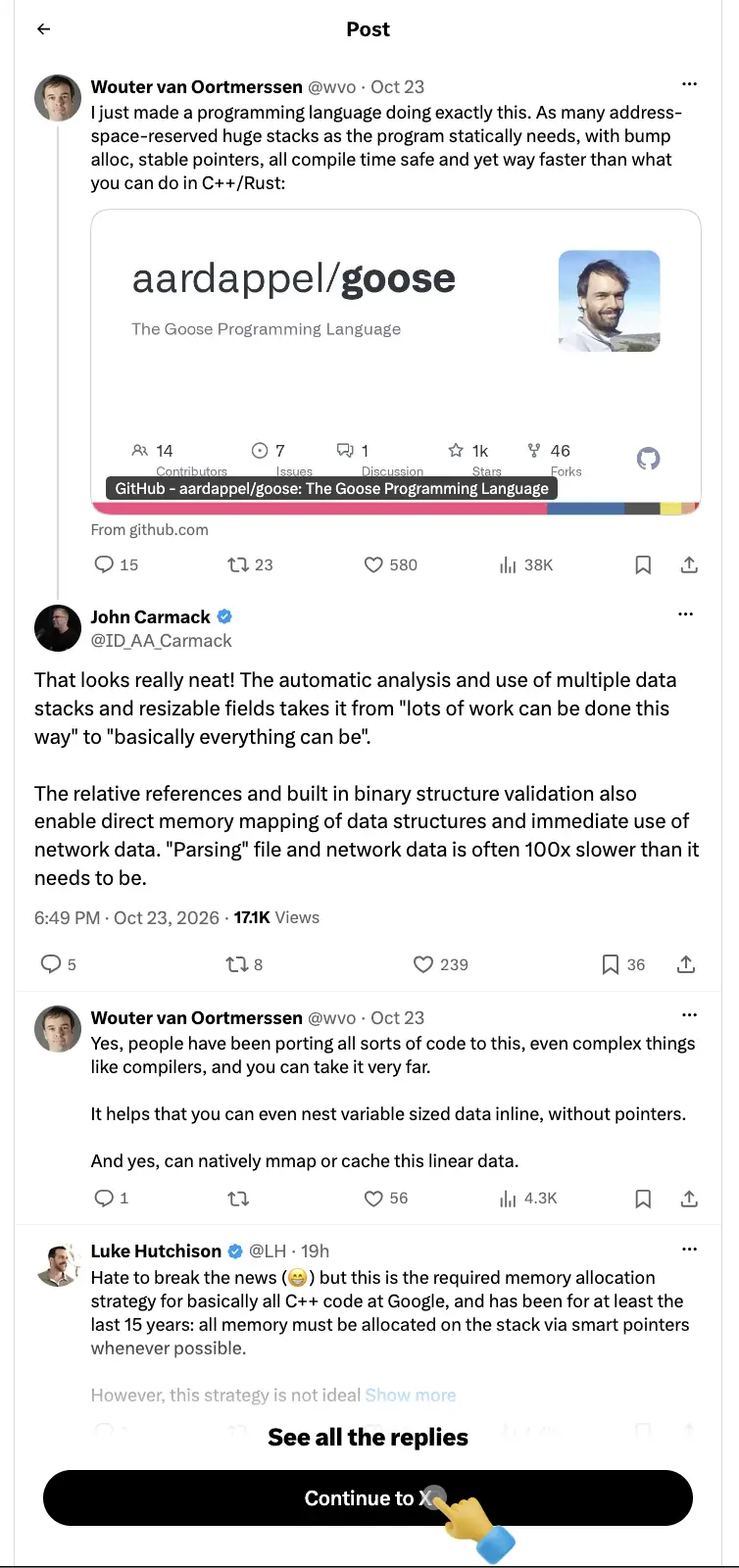
With a login/nitter: https://celsoazevedo.com/files/2026/nitter.webp
