
Roughly 31% of Japan’s budget goes to social security. They don’t have problems keeping their high speed trains safe.
Cutting pensions won’t make trains safe.
I will also point out that on its own without further context, a high percentage of government spending going toward something doesn’t make that spending irresponsible or misappropriated. In the United States, a very high percentage of federal taxes are spent on Medicare and Social Security. But it should come as no sirprise that a very large percentage of federal income tax revenue is directly appropriated to pay for those things.
https://elequidistante.github.io/graficos-jongonzlz/pensione...
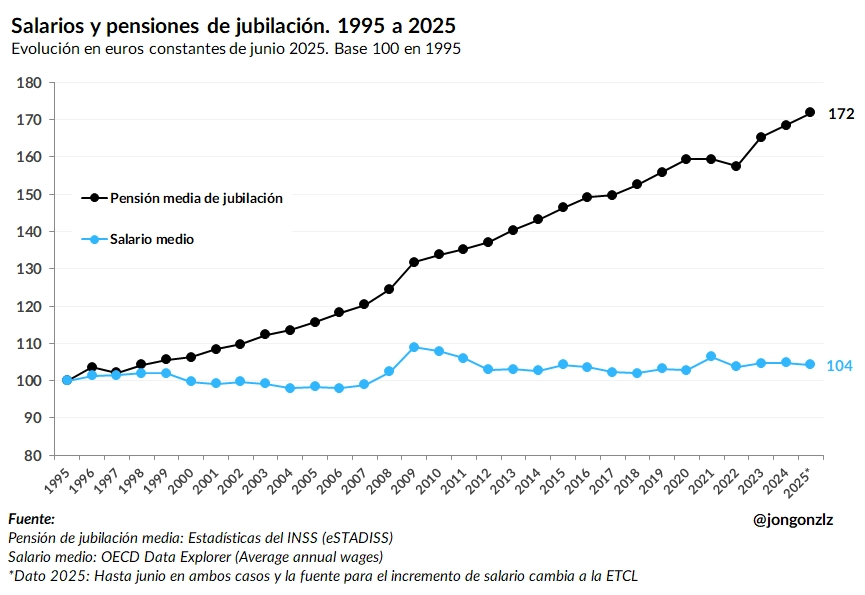
https://elequidistante.github.io/graficos-jongonzlz/pensione...
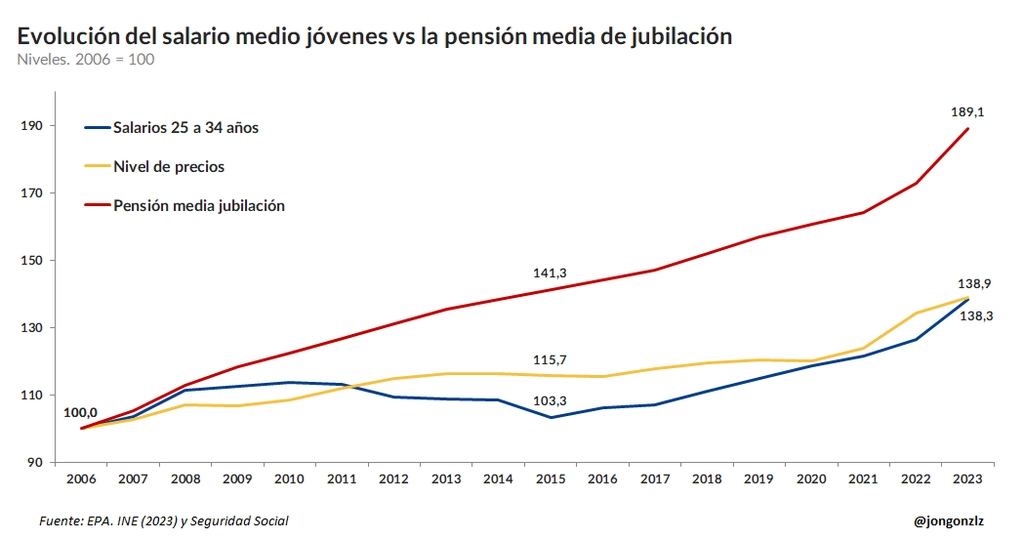
https://elequidistante.github.io/graficos-jongonzlz/pensione...
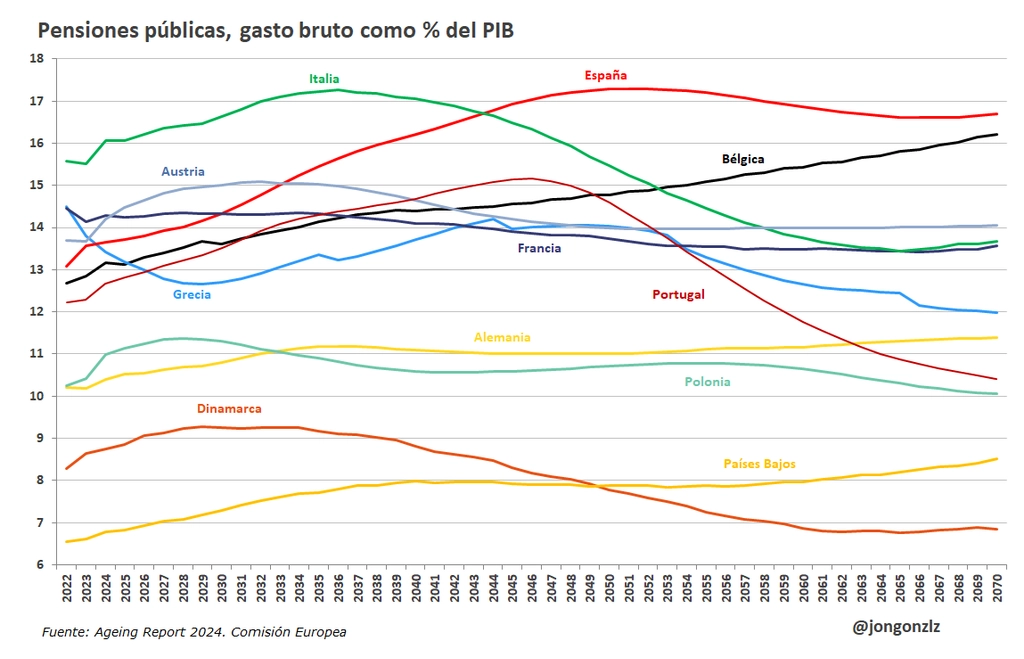
And maybe this is the most illustrative:
https://i.redd.it/uwvgxycxhjeg1.jpeg

So yes, the reason why we are underinvesting in pretty much everything is basically pensions. GDP is up, tax collection is up, debt to GDP is sligthly decreasing... but pension expenses keep growing at a fast pace so there's less and less money for everything else. And I say this with both of my parents earning the maximum pension, so I don't have an axe to grind, but it's just reality.
At the same time, medical advances make it so that retirees live longer than before: https://relojpublico.es/poblacion/esperanza-de-vida
If someone has solutions that would not cause widespread riots, I'm sure most goverments of countries in a similar situation would be all ears.
I am giving an objective explanation in all honesty: Spain needs a pensions reform probably at some point bc it is 40% of the expenses in the yearly budget, with a deficit and a demographic deficit. This will explode.
If it can be taken from elsewhere, better.
But you know how much are pensions in Spain and know our pension system in detail (it is literally a Poncy system...)? They are often higher than people working!
Whether we like it or not, we need to reform or collapse in the future. I wish it could be taken from elsewhere, but 40% is a lot...
There is a lot of useless expenses in public work in our "federal system" (comunidades autónomas).
I agree that good reforms that involve realistic budgets and high levels of accountability are very good things. However, I encourage a lot of caution and skepticism around ideologies that inevitably lead to cuts to benefits.
The USA's pension system replaces a lower percentage of the average wage than Spain's system, and its universal healthcare for pensioners has higher exposure to out of pocket costs. Despite this, the debt to GDP ratio in the USA is higher than Spain, and there is a grand total of one government-operated high speed rail line which is barely high speed despite being 5x more populous.
That's why I encourage caution: cutting pensions won't necessarily lead you to better outcomes, it might just leave you to cut pensions with no improvement in other areas.
I know you are not suggesting cutting pensions directly but what I'm saying is that these types of comments contribute to people "voting against their own interests" so to speak.
Their trains are safe, but they also have 2X the national suicide rate as Spain, which amounts to about 17000 more deaths per year. I'd attribute a big chunk of that to their work culture treating people like machines, whereas Spain's work culture tends to lean towards treating people like humans.
That isn't an excuse for railway mishaps, of course, but I'm just trying to de-romanticize Japan as some kind of magical perfect place. It's not. They might have gotten their railways right, but they have massive safety issues around mental health.
You clearly have not worked for the average Spanish employer.
But under-maintenance causes trains to stand still and be late. It does not cause them to crash.
Crashes are caused by running at speeds higher than the (under-maintained) rail can support, or (against all rules and every regulation) no cap on speed when the signalling system is down.
The latter can not be solved with more money and resources. It is a culture problem. Rules can not routinely be disregarded for arbitrary reasons, especially not when they are completely in line with common sense.
The Iryo train was stopped and unable to restart, because it's safety system did not allow that until the signalling issue was corrected. The AVE was commanded to move again like normal (200 Km/h or more). When the Iryo reported to be stuck, all the trains in the line should have been notified to stop once more, or go at line-of-sight speeds (40 Km/h). Both options are bad for delays. Current news is that five minutes after the Iryo call, the AVE rammed its back at 160-200 Km/h.
CEO of Iryo company complained 3 weeks ago about LZB being problematic, their trains taking a long time to recover connection. Safe but old, he said. It should have been replaced by ERTMS by 2024-2026.
That would have meant that the dispatcher would have been aware that they already ordered a collision before. If a train stops no accident will happen, unless it could have happened regardless. Yes, such a decision would have prevented the accident or lessened it's impact, but the absence of it has not caused it. The error was already done before.
What do you mean? "Everyone crash now"? Makes no sense. "Tried to solve"? There was no collision before.
The situation seems to be that they stopped the trains due to a problem somewhere. When they thought it was solved, they commanded all of them to move again. And when one reported to be unable to do so, they failed to stop those that were around it. Or that is what the leaked conversations suggest. Do not discard this was tactical leaks to blame a scapegoat. The newer system should be running.
I say around, because news mention that a third train could have crashed into the wreckage of the other two. It was moving in the other direction, towards Madrid. Luckly it stopped when the electricity failed. It would have been like the accident early this year, when a train hit other that just had a derailment.
And pretty sure that if some stopped pocketing 3% of public contracts, or whatever amount is now, competition among companies would be better and money would achieve more.
Pensions is 13%PIB which is on the European median.
The problem is demographic. Also take into account that retired people have paid for their retirement.
Your rhetoric is not what I'd like to be promoted as the first answer entering. Just reading the title of the news I knew what kind of messages I'd see promoted.
No, they have not. It's a pyramid scheme. Whatever they put into the system when they worked probably doesn't even cover 5 years of retirement.
If you choose that (or if your legal system determines that), you need to be proactive with keeping the pension system in balance. While you can change what you promise in exchange for future contributions, substantial changes to what you have already promised can easily require constitutional amendments.
Paid contributions should only ensure that you get a part of that, a bit more if you paid more, less if you paid less.
If workforce/economy halves when pensioners double, you will get 4x less than you "expect".
Still I agree, pension systems in most EU countries are unsustainable.