upvote
Show HN: Vegetable Gardening for Engineers

(jrcpl.us)

Watering is easy but one can overcomplicate it. Each plant has different water needs. Screw it up, you get likely get root rot or dry soil.

An engineer might analyse the soil and the plant water needs. Inject water to right levels, or set a timer. These settings need to be readjusted constantly without a hydrometer.

I found an ancient solution that worked incredibly efficient and required no electricity and far cheaper than spending hundreds on electronics. Ollas. The science is called capillary action.

I went a step further as an engineer, and did DIY terracotta pots + silicone. Added a testing stage, of course. Filled pots and sealed it over night. If leaking from seal, more silicone. For filling them up, I used irrigation fittings hooked up to a tank. If I wanted to, I could use rain water into tank (with overflow). That way watering is a fully automated pipeline.

I don't have a picture on hand but others have done it like this: https://www.abc.net.au/gardening/how-to/olla-watering-pots/1...

Other fun topics I looked into:

- Companion plants (avoid spending on pesticides)

- Crop rotation (avoid spending on fertilisers)

- Composting (for compost)

Those are not easy to automate but other topics to make it far cheaper to grow crops without trips to nurseries.

reply
Gardening is near and dear to me, so I love to see it show up on HN. Thanks for sharing :).

A couple points of feedback that I noticed so far:

1. I wrote a comment here in response to what you said about the tradeoff between growth rate and growth quality: https://news.ycombinator.com/item?id=50415982

2. In your section on photoperiodism (https://jrcpl.us/contrib/2020/gardening-for-engineers/#photo...), it seems the examples are backwards. Ie, lettuce is a long-day plant that flowers when days are long, mung bean is a short-day plant that flowers when days are short.
reply
You mentioned apps like Korona as a low-cost alternative to a quantum meter. Have you tried one? How different were the readings from a real meter?
reply
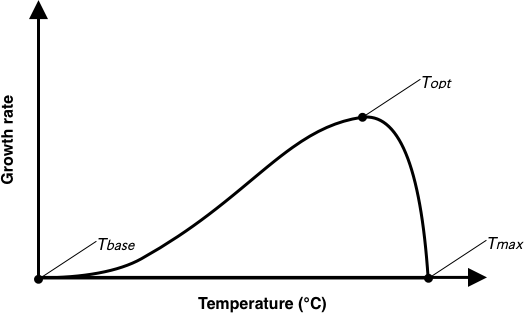
https://jrcpl.us/contrib/2020/gardening-for-engineers/img/te...

  >Crucially, there is a tradeoff between growth rate and growth quality. Higher temperatures can result in faster growth but also thinner stems, weaker roots, and less flavor.
Doing the calculus graphically, we should expect this "quality optimum" lies just uphill of the inflection point of the curve (between T_base and T_opt), yes?
reply
I think the quote taken at face value is misleading, or may just be wrong.

In my own experience (quite a bit over the last ~8 years), if high temperatures (T_opt, not T_max) are accompanied by longer and more intense daylight as well as adequate water and nutrition, it will consistently result in thicker stems, stronger roots, and better flavor. And since higher temperatures in the summer typically coincide with longer days and more intense sunlight, this is the most common outcome. Lacking water or nutrition under these conditions, plants will usually stall their growth rather than grow thinner or weaker.

The only times I can think of that the quoted statement is true is with, eg, indoor seed starts that are given a warm environment with plenty of water and nutrition, but that lack sunlight or artificial light, or light-adapted plants grown outdoors in too much shade.

The clearest counter example that comes to mind is tomatoes, which IMO taste their best, and are by no means thin or weak, when they are growing the fastest.

reply
Growing food is very complex, probably too complex for our brains. And I believe we will have to learn again how to grow food without our current support systems one day. I'm building projectcanopi.com toward that goal.
reply
> Growing food is very complex, probably too complex for our brains.

Can you expand on this?

I'm no expert, and I fully agree that growing food at scale can be difficult. It also requires a lot of space.

But what do you mean by saying it's "too complex for our brains"?

reply
To grow food in a truly sustainable way, we need to really understand the laws of biology at a macro and micro level (soil biology, water cycle, carbon cycle, etc...). Our scientific systems are not working efficiently towards that necessary understanding. 2/3 of life forms by mass in soil are microbes and we know nothing about 99% of them. We just know that soil biodiversity and food production/quality are highly correlated. If we don't work on this correctly, in the end, we will end up in a dead end and join the 99% of species that disappeared since life exists on earth in the long term. Odds are against us but I'm working with scientists and professionals that are having incredible results.
reply
> truly sustainable way

What do you mean by that?

> If we don't work on this correctly, in the end, we will end up in a dead end

We have over 10.000 years of agriculture already behind us so I think that's proof that it works well enough to support small communities in a sustainable fashion. It's simply not necessary to understand all the microbes etc..

If you are hinting on optimization so we can feed all of humanity, then I mean we are definitely not resource and knowledge limited but rather by more mundane things. I'd wager just the US defense budget is enough to feed to world without a problem.

reply
I don't really agree with the person you responded to, but there is a lot of agriculture that is dependent on mined input, having long depleted the soil of whatever nutrients were there when we started. There are many places that are abandoned and barren because we did agriculture there. Land is still being dramatically degraded by many types of agricultural practices.

Meanwhile there are forests that were forest (and other ecosystems as well) 10s of thousands of years ago and just as lush and fertile (if not moreso) than they were to begin with.

Sustainable generally means we can maintain the fertility of the land indefinitely without mined inputs. Whether or not it's a completely achievable goal, it makes good sense to strive for it... Mines will become spent, theres only so much land to degrade, etc.

Often when people talk about sustainable agriculture they are talking about systems that mimic biological systems that keep those forests lush for millennia. These types of agricultural systems frequently look similar to agricultural systems of the past with more human labor involved, but less damaging waste products and fewer externalities. (Reducing pollution of the water downstream and minimizing ecosystem impact).

reply
> There are many places that are abandoned and barren because we did agriculture there.

Totally but I'd argue nowadays it's not because we are missing the knowledge but rather ignorance and short-term economic gains.

Imo sustainability goes hand in hand with population (and lifestyle). We want a diverse ecosyaystem, this simply doesn't work if there are 10 billion people wanting to eat meat or produce tons of plastic. Our problem is not knowledge in agriculture that prevents us from sustainable living.

reply
maybe he means it's too complex for science to rediscover. maybe rediscovering/using ancient wisdom regarding this domain is better. but this is just intuition
reply
> I believe we will have to learn again how to grow food without our current support systems one day

You've AI generated an application. How are you executing your mission statement?

reply
I'm working with scientists and field practitioners to improve the tool to help them. And now it's growing thanks to my network: https://youtu.be/lC5ixsaGx-4 No one wanted to build that before AI because it was not cost effective.
reply
I appreciate that your site even includes a bibliography. The UI is similar to the companion planting mini-game from Palia and that's appealing. The link between resilience and your project is still unclear to me. Is my perspective myopic or cynical? Thanks for clarifying.
reply
No worries. I have no ego in this project. The goal is to help future generations have food on the table even in countries that will have less access to oil and its byproducts like fertilizer. There is a growing movement in my country and others of people that are working towards being more robust. And they missed a tool to speed up design, sharing, learning and collaboration between researchers and field practitioners. They were mostly using pen and paper and custom excel sheets. I'm trying to fill that gap with a research approved database of plants, field oriented design tools, and now I'm starting to add algorithms to help improve hydrology using lidar data as this is one of the top features requested by users.
reply
Thanks for walking me through the project. I was myopic. I was focused on "Can any future generation use this tool?" which is not as pressing as "Will we have arable soil?"
reply
So you read an entry-level college syllabus on farming and decided that makes you an expert on regenerative farming techniques?

That's some hubris you got there.

There are millions of farmers around the world that use traditional/regenerative farming techniques because they don't have access to the "current support systems" that make modern farming possible, and thousand in the U.S. and Europe that do so because they can.

And worse...you couldn't actually be bothered to build the website yourself so you outsourced it to an AI....

reply
every engineers loves gardening for the end of career
reply
The brain asks:

> I am currently exhibiting overwhelming stress from deeply technical work being part of my every day life, and feel I am missing the 'nature' element of life. What should I do?

The brain responds:

> Gardening! A wonderfully complex system that will just 'live' without me! A delightful escape!

The brain asks:

> Yes, gardening! But how? There are so many variables! What are the parameters? Where is the specification outlining the success criteria? What defines a living organic system?

reply
Just pick one thing, learn to grow it for a season or two. It's incremental learning, a bit of making mistakes and learning from the mistakes and research along the way. The knowledge accumulates over time, and after a while you can manage food crops, flowers and timber if you want.
reply
Sometimes, life is better as a complex, chaotic and misunderstood system that just happens to work out OK or not.
reply
To engineering! The cause of, and solution to, all of life's problems.

https://imgflip.com/i/b5dvkg

reply
Hehe. I recently donated a whole bunch of plants to a school. It was amazing to me how naïve the principal and staff were about plants. I had to explain that, no, no 'ground preparation' was necessary (in fact it was probably harmful) and yes, these plants would be fine once stuck in a hole without any attention: in fact they had evolved for millions of years to live right here!

Standard veggie gardening has very low ROI. Basically you need land (hyper expensive in cities), time, patience, and when you do get a crop it's in peak season and ~free at the shops. That's not to discount the experience or the cleanliness or the taste benefits of organic home grown veg: but from an engineering standpoint, you're better off not bothering. Hydroponics are a completely different beast. We're all lucky our society is no longer agrarian in nature. Hunter gatherers lived far better lives than agrarian peasantry.

reply
Gardening is expensive. Good I stopped at plants and didn't go for chickens. Every year is different. First you fight the snails on the strawberries. Then the aphids on peppers and roses (this is each year). Next the mold attacks the tomatoes. And if you don't have enough, the starling will eat your blueberries.
reply
Which is why the next time I go into gardening, will be a fully or mostly automated (the fun part) greenhouse. Snails stay outside.
reply
I grow indoors. peppers, herbs, strawberries, tomatoes and cucumbers. snails might not get in, but once you get mites, and whiteflies and stinging gnats, its pretty much a constant struggle and a tradeoff between using really aggressive insecticides and chasing down infected plants. mites have been the worst, managed to stomp out the whiteflies and the gnats though.
reply
Ideally I automate that part as well, with HD image processing and finding the source and either alerting me to do something or do it on their own (it probably will be a while, till I get to that level).
reply
When people discover that I work in tech they ask me what they should buy. I tell them that they should buy seeds.
reply
How many of them have gone and bought a torrent seed-box after this?
reply
I went down exactly that path with an outdoor bed: 8 soil probes, a weather station, a camera, and a drip valve. The fun part turned out to be not the automation but letting an agent decide the watering every morning and write down what it expects, then check the probes the next day to see if it was right. Fixed schedules kept being wrong in ways that needed context (forecast, last week's response, leaf wetness).

It's still humbling: it missed caterpillars on the broccoli until I made it look at full-resolution photos. Wrote it up here: https://jatorre.github.io/garden/

reply
[dead]
reply
[dead]
reply