upvote
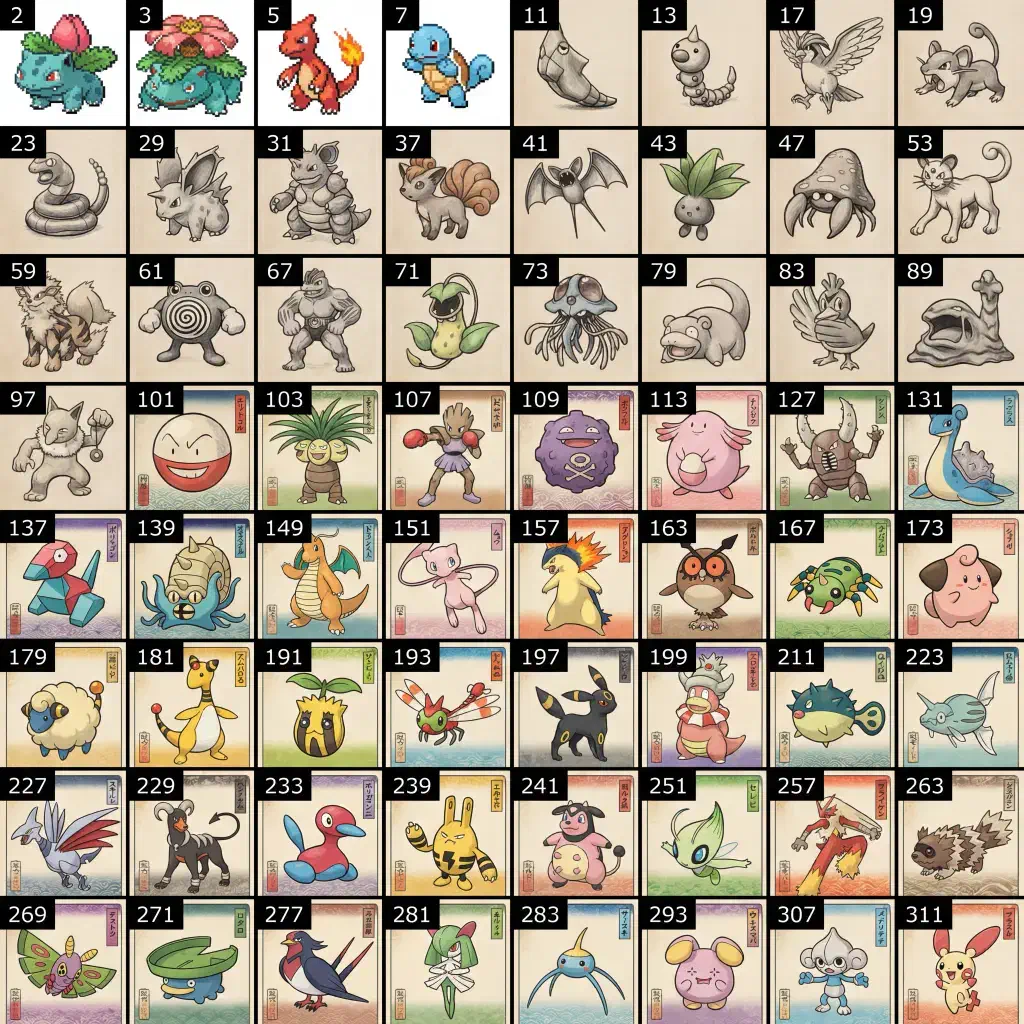
I think it's more impressive that it managed so much coherence in a single image than anything else. Very few problems with each of the pokemon anatomically speaking. Mew's kind of a mess but the rest are pretty accurate.

That being said, the ukiyo-e artwork looks more like a standard colored pencil illustration, and it sort of tried to cheat by adding some vaguely Japanese natural scenery.

See this Kickstarter all the way back in 2013 for a great example of what Pokémon might actually look like as ukiyo-e woodblock prints.

https://www.kickstarter.com/projects/1499165518/ukiyo-e-hero...

https://ricedigital.co.uk/this-japanese-ukiyo-e-pokemon-art-...
reply
I remember that Kickstarter. I follow the woodblock carver who worked with the artist. His name is David Bull and he has some great videos on woodblock carving on YouTube: https://m.youtube.com/@seseragistudio
reply
Oh, thanks for showing me these videos! The way that he presents is so calm - he's like a woodprint Bob Ross.
reply
deleted
reply
deleted
reply
Wow. Are those the correct Pokemon and everything? Quite cool.
reply
Yes, the Pokemon are correct. Compare to my attempt a year ago with Nano Banana Pro, which plagiarized the images, didn't do interesting things with the background, and got 271 wrong: https://minimaxir.com/2025/12/nano-banana-pro/pokemongrid_hu...

When I did a similar prompt with ChatGPT 2.0 it was worse, so interesting to see improvement.

reply
On the back end a language model is effectively writing a long detailed prompt describing this image exactly right? The image model can't know this.
reply
ChatGPT Images (and some others like Nano Banana) are autoregressive models, and the text model generates the tokens in the same way which are then passed in the correct form for an image model to decode. That is how it can reason the prime numbers + Pokemon + art style conditional.

It is different from earlier image models which just use a simple text encoder and struggle with conditional logic if not explicitly trained for it.

reply
If you look at the thinking steps it clearly includes:

> * Mapped Pokémon primes > * Organized the grid

before generating the image.

So really it is first figuring out the exact specification of the layout, then prompting the image generation tool with this specification - perhaps unless you do it with an "instant" model.

reply
Yes it thinks about it and then calls the image tool with the detailed prompt with exactly what to include in the image
reply