
Per unit area, the radiators dissipate a similar amount of energy as the solar panels do, so they'll be a similar size. That's doable.
The upside is there's no land and power generation or grid connection issue; you get solar power 24/7 and the latency to earth is just a few ms.
It would also be possible to fly the individual satellites close together so that you can do high bandwidth optical links between them, i.e. you're not limited to single rack workloads.
A single GB200 rack costs about $3M, transporting its 1.4 tons on a Falcon 9 would cost a similar amount, around $4-5M.
That's got to be too expensive for now, but it's also not in a range that's totally off.
The idea is essentially a bet on land and power continuing to be a big issue and launch costs getting a lot cheaper, which they very well might with Starship. The rest is engineering challenges that are probably solvable.
Not at the same time. To have few-ms latency you need to be in/below LEO, but then earth blocks the sun half the time.
Assuming that orbital data centers make sense, it will be an interesting challenge to figure out how to best mitigate that. Short tasks that require little data will be easy, but everything else needs rethinking. Can you tolerate variable latency? Should you duplicate the data across many satellites? Or should the data constantly migrate from satellite to satellite?
Probably still fine for most applications though.
A normal satellite runs something similar to 1U worth of computer and costs roughly what you quoted in total...
They take all of the bits you guys are talking about into account in the article. You might disagree with some of the numbers, I guess, but that doesn't seem to be what you guys are talking about.
Why use a satellite to do what your IT closet can already do?
A non-trivial number still think that the hard part of colonizing Mars is the rocket to get there. What can you do?
And putting things in the ocean is only marginally less idiotic due primarily to sea water being corrosive, wet, and full of creatures that tend to want to grow all over anything.
I presume the cost of setup, teardown, lead-time, low power density when scaled up, and lack of convenient access for mid-life repairs made it not worth the trouble
The moderate improvements in cooling we're not worth the extra complexity.
So it just didn't make sense to do outside of a single media stunt project.
Data centers in space don't even get the cooling benefit.
The whole idea just doesn't survive modest consideration. Data centers aren't particularly dangerous. There's no forcing function to put them away from where people live. The best location for a data center is going to be a decent sized urban center with existing utilities (power and network) and acceptable land costs.
There are nearly forty of them in Atlanta, people walk by them every day with no idea what they are.
Everything about storing a DC underwater is easier than it is in space (except corrosion).
It's easier to access, cheaper, easier to cool, easier to get enough power, easier to update.
Heck, doing a second story data-center resolves a ton of issues with today's data-centers (while being a bit more expensive due to additional structural support requirements).
There are so many options for terrestrial DCs to overcome whatever problem space might supposedly solve, and they are all cheaper than the space solution.
Spacecraft in LEO deal with corrosion from - among other causes - atomic oxygen atoms up there, which are eager to cause oxidation in almost anything they come in contact with. The rate of this can be greater than on Earth's surface, though I'm not sure how oceans compare for corrosion.
Overall it's probably true that it's less of an issue than with sea water, but it's not a nonissue either.
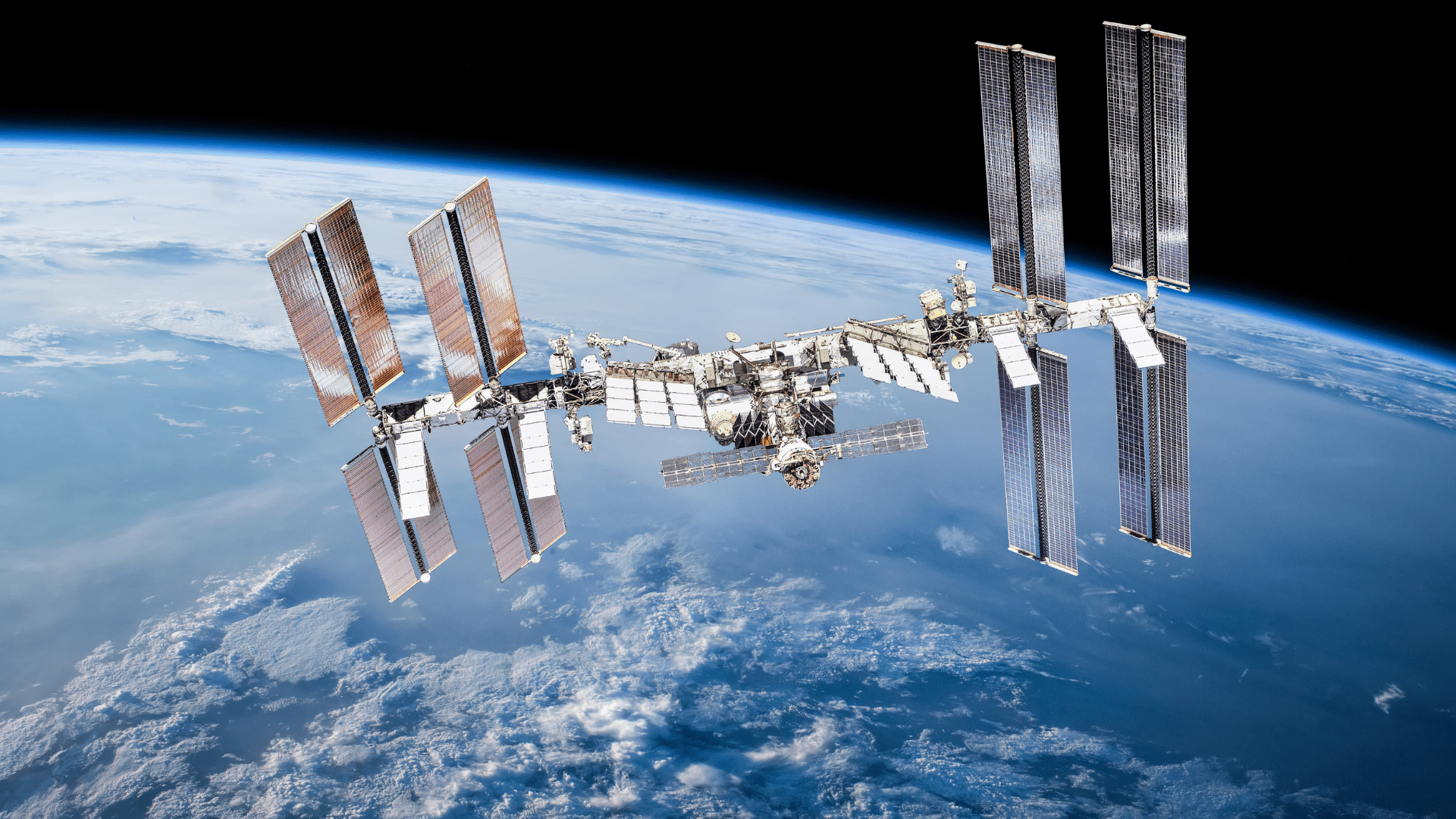
A single B200 can consume up to 1200W. A single GB300 system needs 14.5kW. So, you can only have ~15 (incl. satellite's energy needs) GB300 with ISS' solar panels, which is absurd. See [1] for the size of the panels we're talking about.
People dream about Starlink-style close flying systems to aggregate them to a single data center. With these power requirements, it's more like an AI hallucination. If we can build way more efficient chips or run smaller models on modest hardware, etc. We may go there, but needing ISS sized solar panels to run frontier models in space?
Also, don't forget the radiators. You also need those to pump that heat out of these systems.
The outlook doesn't look good at this point.
[0]: https://en.wikipedia.org/wiki/Solar_panels_on_spacecraft#Spa...
[1]: https://www.sgmk.edu.pl/wp-content/uploads/2025/10/iss.png
On earth, you can build a power plant miles from the DC. And you can use all sorts of different sources of power, tidal, wind, nuclear, solar, fossil fuels. All options. And like the DC, if there's a problem with any of those sources, you can go fix it or replace it with different power sources. If there's a problem with the solar panels in space, your DC is dead.
That's both easier and a lot more flexible.
That's an automatic off switch.
Even with an intelligence explosion guiding the development of all these technologies, it’d take many decades.
We’ll need to develop base industries from scratch for these environments, but, eventually, we’ll get there. The downside is that it’ll take at least multiple decades, if not more than a century.