
Clown is Rachel's word for (Big Tech's) cloud.
was (and she worked at Google too)
> "clowntown" and "clowny" are words you see there.
Didn't know this, interesting!
You may not owe clown-resemblers better, but you owe this community better if you're participating in it.
We ban accounts that keep posting in this sort of pattern, as yours has, so if you'd please review https://news.ycombinator.com/newsguidelines.html and stick to the rules when posting here, we'd appreciate it.
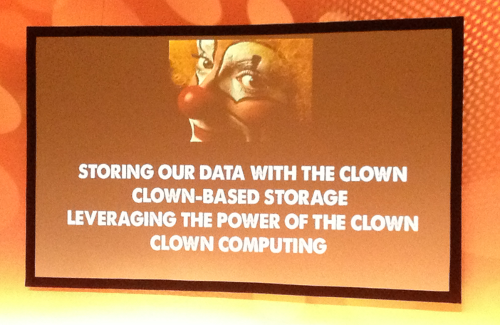
It feels pretty hacker jargon-ish, it has some "hysterical raisins" type wordplay vibes.
I use a localhost TLS forward proxy for all TCP and HTTP over the LAN
There is no access to remote DNS, only local DNS. I use stored DNS data periodically gathered in bulk from various sources. As such, HTTP and other traffic over TCP that use hostnames cannot reach hosts on the internet unless I allow it in local DNS or the proxy config
For me, "WebPKI" has proven useful for blocking attempts to phone home. Attempts to phone home that try to use TLS will fail
I also like adding CSP response header that effectively blocks certain Javascript
It sounds like the blog author gave the NAS direct access to the internet
Every user is different, not everyone has the same preferences
For example, I have seen a freshly installed Firefox Nightly try to connect to sentry.io on startup
For me, these attempts never succeed
FTFA:
  Every time you load up the NAS [in your browser], you get some clown GCP host knocking on your door, presenting a SNI hostname of that thing you buried deep inside your infrastructure. Hope you didn't name it anything sensitive, like "mycorp-and-othercorp-planned-merger-storage", or something.

  Around this time, you realize that the web interface for this thing has some stuff that phones home, and part of what it does is to send stack traces back to sentry.io. Yep, your browser is calling back to them, and it's telling them the hostname you use for your internal storage box. Then for some reason, they're making a TLS connection back to it, but they don't ever request anything. Curious, right?

  This is when you fire up Little Snitch, block the whole domain for any app on the machine, and go on with life.
It's not impossible that the source of the problem has been misidentified... but it's extremely unlikely. Having said that, one thing I do find likely is that the NAS in question is isolated from the Internet; that's just a smart thing that a savvy sysadmin would do.
[0] I find it... unlikely that the NAS in question is running OSX, so Little Snitch is almost certainly running on a client PC, rather than the NAS.
The term has been in use for quite some time; It is voicing sarcastic discontent with the hyperscaler platforms _and_ their users (the idea being that the platform is "someone else's computer" or - more up to date - "a landlord for your data"). I'm not sure if she coined it, but if she did then good on her!
Not everyone believes using "the cloud" is a good idea, and for those of us who have run their own infrastructure "on-premises" or co-located, the clown is considered suitably patronising. Just saying ;)
I have a vague memory of once having a userscript or browser extension that replaced every instance of the word "cloud" with "other peoples' computers". (iirc while funny, it was not practical, and I removed it).
fwiw I agree and I do not believe using "the cloud" for everything is a good idea either, I've just never heard of the word "clown" being used in this way before now.