
This has been a common practice in physics, especially the more theoretical branches, since the inception of arXiv. Senior researchers write a paper draft, and then send copies to some of their peers, get and incorporate feedback, and just submit to arxiv.
It works for physics because physicists are very rigorous. So papers don't change very much. It also works for ML because everyone is moving very fast that it's closer to doing open research. Sloppier, but as long as the readers are other experts then it's generally fine.
I think research should really just be open. It helps everyone. The AI slop and mass publishing is exploiting our laziness; evaluating people on quantity rather than quality. I'm not sure why people are so resistant to making this change. Yes, it's harder, but it has a lot of benefits. And at the end of the day it doesn't matter if a paper is generated if it's actually a quality paper (not in just how it reads, but the actual research). Slop is slop and we shouldn't want slop regardless. But if we evaluate on quality and everything is open it becomes much easier to figure out who is producing slop, collision rings, plagiarist rings, and all that. A little extra work for a lot of benefits. But we seem to be willing to put in a lot of work to avoid doing more work
Junior researchers don't have these typically. They also benefit more from anonymous feedback, which enables the reviewers to bluntly identify wrong or close to wrong results. So I think open journals should continue to exist. They fill an essential role in the scientific ecosystem.
I think when you think about publishing as what it actually is, researchers communicating to researchers, what I said makes much more sense. I do think formal review does help reduce slop but I think anyone who has published anything is also very aware of how noisy the system is and how good works get rejected or delayed because they aren't "novel" enough.
Honestly, my ideal system is journals with low bars. We forget this prestige bullshit and silliness of novelty (often it's novel to niche experts but not to others) and basically check if it looks like due diligence was done, there's not things obviously wrong, no obvious plagiarism, and then maybe a little back and forth to help communicate. But I think we've gotten too lost in this idea of needing to punish fast and that it has to be important. Important to who? Tons of stuff is only considered important later, we've got a long track record of not being so great at that. But we have a long track record of at least some people working on what we later find out is important.
I think both sides could learn from the other. In the case of ML, I understand the desire to move fast and that average time to publication of 250-300 days in some of the top-tier journals can feel like an unnecessary burden. But having been on both sides of peer review, there is value to the system and it has made for better work.
Not doing any of it follows the same spirit as not benchmarking your approach against more than maybe one alternative and that already as an after-thought. Or benchmaxxing but not exploring the actual real-world consequences, time and cost trade offs, etc.
Now, is academic publishing perfect? Of course not, very very far from it. It desperately needs to be reformed to keep it economically accessible, time efficient for both authors, editors and peer reviewers and to prevent the "hot topic of the day" from dominating journals and making sure that peer review aligns with the needs of the community and actually improves the quality of the work, rather than having "malicious peer review" to get some citations or pet peeves in.
Given the power that the ML field holds and the interesting experiments with open review, I would wish for the field to engage more with the scientific system at large and perhaps try to drive reforms and improve it, rather than completely abandoning it and treating a PDF hosting service as a journal (ofc, preprints would still be desirable and are important, but they can not carry the entire field alone).
The current balance where people wrote a paper with reviers in mind, upload it to Arxiv before the review concludes and keep it on Arxiv even if rejected is a nice balance. People get to form their own opinion on it but there is also enough self-imposed quality control on it just due to wanting it to pass peer review, that even if it doesn't pass peer review, it is still better than if people write it in a way that doesn't care or anticipate peer review. And this works because people are somewhat incentivized to get peer reviewed official publications too. But being rejected is not the end of the world either because people can already read it and build on it based on Arxiv.
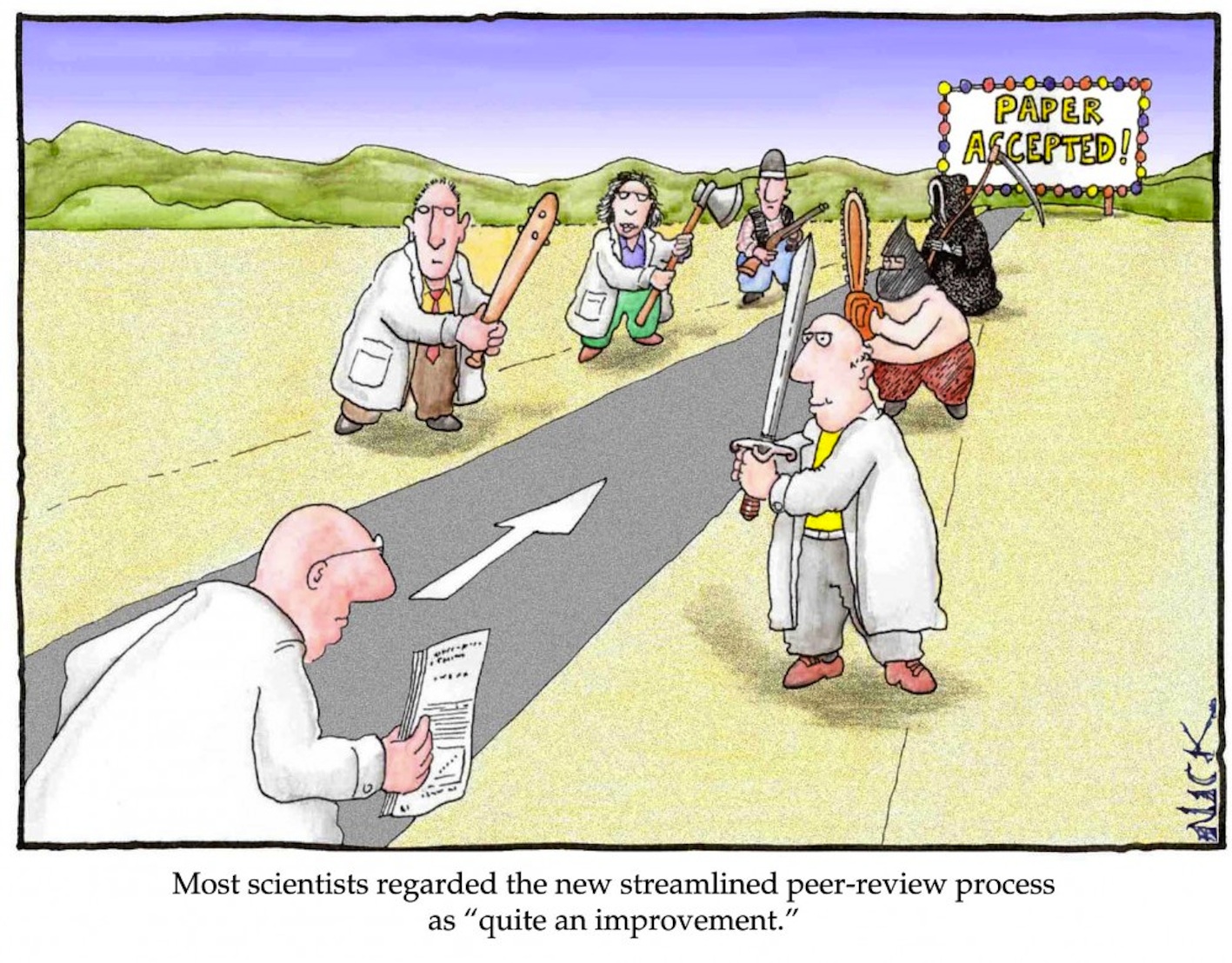
The problem is that "optimizing for peer-review" is not the same thing as optimizing for quality. E.g., I like to add a few tongue-in-cheeks to entertain the reader. But then I have to worry endlessly about anal-retentive reviewers who refuse to see the big picture.
If peer review were to go away, this whole academic system would get into a crisis. It's dysfunctional and has many problems but it's kinda load bearing for the system to chug along.
Maybe we can go back to very opinionated “true” academia,
where there are institutional gatekeepers,
but they mostly get it right on who to award (and not),
vs the current game of
“whoever plays ball with funding sources the best = the best academic”,
which is obviously bullshit.
in much earlier institutions of knowledge and excellence,
the only transparent metric was whether or not they approved you.
The arXiv vs journal debate seems a lot like 'should the work get done, or should the work get certified' that you see all over 'institutions', and if the certification does not actually catch frauds or errors, it's not making the foundations stronger, which is usually the only justification for the latter side.
Others (at least in chemistry) will accept it, but it raises concern if a paper is only available as a preprint.
It is an interesting instance of the rule of least power, https://en.wikipedia.org/wiki/Rule_of_least_power.
People think, for instance, that RDFS and OWL are meant to SHACL people into bad an over engineered ontologies. The problem is these standards add facts and don’t subtract facts. At risk of sounding like ChatGPT: it’s a data transformation system not a validation system.
That is, you’re supposed to use RDFS to say something like
?s :myTermForLength ?o -> ?s :yourTermForLength ?o .
?s :lengthInFeet ?o -> ?s :lengthInInches 12*?o .
Similarly the problem of ordered collections has never been dealt with properly in that world. PostgreSQL, N1QL and other post-relational and document DB languages can write queries involving ordered collections easily. I can write rather unobvious queries by hand to handle a lot of cases (wrote a paper about it) but I can’t cover all the cases and I know back in the day I could write SPAQL queries much better than the average RDF postdoc or professor.
As for underengineering, Dublin Core came out when I worked at a research library and it just doesn’t come close in capability to MARC from 1970. Larry Masinter over at Adobe had to hack the standard to handle ordered collections because… the authors of a paper sure as hell care what order you write their names in. And it is all like that: RDF standards neglect basic requirements that they need to be useful and then all the complex/complicated stuff really stands out. If you could get the basics done maybe people would use them but they don’t.
In my experience as a publishing scientist, this is partly because publishing with "reputable" journals is an increasingly onerous process, with exorbitant fees, enshittified UIs, and useless reviews. The alternative is to upload to arXiv and move on with your life.
I've read papers in the chemical literature that were clearly thinly veiled case studies for whatever instrument or software the authors were selling. Hell, I've read papers that had interesting results, only to dig into the math and find something fundamentally wrong. The worst was an incorrect CFD equation that I traced through a telephone game of 4 papers only to find something to the effect of "We speculate adding $term may improve accuracy, but we have not extensively tested this"
Just because something passed peer review does not make it a good paper. It just means somebody* looked at it and didn't find any obvious problems.
If you are engaged in research, or in a position where you're using the scientific literature, it is vital that you read every paper with a critical lens. Contrary to popular belief, the literature isn't a stone tablet sent from God. It's messy and filled with contradictory ideas.
*Usually it's actually one of their grad students
But yes it’s a people problem, not an arxiv problem.
arXiv has become a target for grifters in other domains like health and supplements. I’ve seen several small scale health influencers who ChatGPT some “papers” and then upload them to arXiv, then cite arXiv as proof of their “published research”. It’s not fooling anyone who knows how research work but it’s very convincing to an average person who thinks that that they’re doing the right thing when they follow sources that have done academic research.
I’ve been surprised as how bad and obviously grifty some of the documents I’ve seen on arXiv have become lately. Is there any moderation, or is it a free for all as long as you can get an invite?
I've been using it as one of 9 data sources in a market research tool — arXiv papers are a strong leading indicator of where an industry is heading. Academic research today often becomes commercial products in 2-3 years.
Bibliometrics reveal that they are highly cited. Internal data we had at arXiv 20 years ago show they are highly read. Reading review papers is a big part of the way you go from a civilian to an expert with a PhD.
On the other hand, they fall through the cracks of the normal methods of academic evaluation.
They create a lot of value for people but they are not likely to advance your career that much as an academic, certainly not in proportion to the value they create, or at least the value they used to create.
One of the most fun things I did on the way to a PhD was writing a literature review on giant magnetoresistance for the experimentalist on my thesis committee. I went from knowing hardly anything about the topic to writing a summary that taught him a lot he didn't know. Given any random topic in any field you could task me with writing a review paper and I could go out and do a literature search and write up a summary. An expert would probably get some details right that I'd get wrong, might have some insights I'd miss, but it's actually a great job for a beginner, it will teach you the field much more effectively than reading a review paper!
How you regulate review papers is pretty tricky. If it is original research the criterion of "is it original research" is an important limit. There might already be 25 review papers on a topic, but maybe I think they all suck (they might) and I can write the 26th and explain it to people the way I wish it was explained to me.
Now you might say in the arXiv age there was not a limit on pages, but LLMs really do problematize things because they are pretty good at summarization. Send one off on the mission to write a review paper and in some ways they will do better than I do, in other ways will do worse. Plenty of people have no taste or sense of quality and they are going to miss the latter -- hypothetically people could do better as a centaur but I think usually they don't because of that.
One could make the case that LLMs make review papers obsolete since you can always ask one to write a review for you or just have conversations about the literature with them. I know I could have spend a very long time studying the literature on Heart Rate Variability and eventually made up my mind about which of the 20 or so metrics I want to build into my application and I did look at some review papers and can highlight sentences that support my decisions but I made those decisions based on a few weekends of experiments and talking to LLMs. The funny thing is that if you went to a conference and met the guy who wrote the review paper and gave them the hard question of "I can only display one on my consumer-facing HRV app, which one do I show?" they would give you that clear answer that isn't in the review paper and maybe the odds are 70-80% that it will be my answer.
In the typical "experimental report" sort of paper, the focus is typically narrowed to a knifes edge around the hypothesis, the methods, the results, and analysis. Yes, there is the "Introduction" and a "Discussion", but increasingly I saw "Introductions" become a venue to do citation bartering (I'll cite your paper in the intro to my next paper if you cite that paper in the intro to your next paper) and "Discussion" turn into a place to float your next grant proposal before formal scoring.
Review papers, on the other hand, were more open to speculation. I remember reading a number that were framed as "here's what has been reported, here's what that likely means...and here's where I think the field could push forward in meaningful ways". Since the veracity of a review is generally judged on how well it covers and summarizes what's already been reported, and since no one is getting their next grant from a review, there's more space for the author to bring in their own thoughts and opinions.
I agree that LLMs have largely removed the need for review papers as a reference for the current state of a field...but I'll miss the forward-looking speculation.
Science is staring down the barrel of a looming crisis that looks like an echo chamber of epic proportions, and the only way out is to figure out how to motivate reporting negative results and sharing speculative outsider thinking.
On one hand I'm the person who implemented the endorsement system for arXiv. I also got a PhD in physics did a postdoc in physics then left the field. I can't say that I was mistreated, but I saw one of the stars of the field today crying every night when he was a postdoc because he was so dedicated to his work and the job market was so brutal -- so I can say it really hurts when I see something that I think belittles that.
On the other hand I am very much an interested outsider when it comes to biosignals, space ISRU, climate change, synthetic biology and all sorts of things. With my startup and hackathon experience it is routine for me to go look at a lot of literature in a new field and cook it down and realize things are a lot simpler than they look and build a demo that knocks the socks off the postdocs because... that's what I do.
But Riemann Hypothesis, Collatz, dropping names of anyone who wrote a popular book, I don't do that. What drives me nuts about crackpots is that they are all interested in the same things whereas real scientists are interested in something different. [1] It was a big part of our thinking about arXiv -- crackpot submissions were a tiny fraction of submission to arXiv but they would have been half the submissions to certain fields like quantum gravity.
I've sat around campfires where hippies were passing a spliff around and talking about that kind of stuff and was really amused recently when we found out that Epstein did the thing with professors who would have known better -- I mean, I will use my seduction toolbox to get people like that to say more than they should but not to have the same conversation I could have at a music festival.
[1] e.g. I think Tolstoy got it backwards!
This just isn't true. arXiv is not a venue. There's no place that gives you credit for arXiv papers. No one cares if you cite an arXiv paper or some random website. The vast vast majority of papers that have any kind of attention or citations are published in another venue.
The paper you link to counts as a publication, but its reputation stands on its own, it has nothing to do with arXiv as a venue. Ideally, that's how it is for all papers, but it isn't, just by publishing in certain venues your paper automatically gets a certain amount of reputation depending on the venue.
Good riddance! But not relevant in the least.
Personally I think this resource mismatch can help drive creative choice of research problems that don’t require massive resources. To misquote Feynman, there’s plenty of room at the bottom
There were quit a few off them--by number of starts per year per person Caltech was actually generating startups at a higher rate than Stanford. But almost none of those Caltech startups were doing anything that would bring them to the public's attention, or even to the average HN reader's attention.
For example one I remember was a company developing improved ion thrusters for spacecraft. Another was doing something to automate processing samples in medical labs.
Also almost none of them were the "undergraduates drop out to form a company" startup we often hear about, where the founders aren't actually using much that they actually learned at the school, with the school functioning more as a place that brought the founders together.
The Caltech startups were most often formed by professors and grad students, and sometimes undergraduates that were on their research team, and were formed to commercialize their research.
My guess is that this is how it is at a lot of universities.
You get ahead as an academic computer scientist, for instance, by writing papers not by writing software. Now there really are brilliant software developers in academic CS but most researchers wrote something that kinda works and give a conference talk about it -- and that's OK because the work to make something you can give a talk about is probably 20% of the work it would take to make something you can put in front of customers.
Because of that there are certain things academic researchers really can't do.
As I see it my experience in getting a PhD and my experience in startups is essentially the same: "how do you do make doing things nobody has ever done before routine?" Talk to people in either culture and you see the PhD students are thinking about either working in academia or a very short list of big prestigious companies and people at startups are sure the PhDs are too pedantic about everything.
It took me a long time of looking at other people's side projects that are usually "I want to learn programming language X", "I want to rewrite something from Software Tools in Rust" to realize just how foreign that kind of creative thinking is to people -- I've seen it for a long time that a side project is not worth doing unless: (1) I really need the product or (2) I can show people something they've never seen before or better yet both. These sound different, but if something doesn't satisfy (2) you can can usually satisfy (1) off the shelf. It just amazes me how many type (2) things stay novel even after 20 years of waiting.