
https://www.youtube.com/watch?v=F74LLDhAhhI
It also very much ties in with the shared SCP universe, which itself has a number of Backrooms-like anomalies, such as SCP-3008 (https://scp-wiki.wikidot.com/scp-3008), which is like a typical IKEA, except its maze of twisty passages run to infinity.
Just seeing a few images of the book's pages in this video, yeah it seems like a really interesting book that plays with the novel format directly.
And then from there back to another game: MyHouse.wad, https://en.wikipedia.org/wiki/MyHouse.wad
https://en.namu.wiki/w/The%20Backrooms%20With%20Guns
I see others have mentioned Superliminal too, which was great.
If we want to go deeper, then I really think its Earthbound's absurdist take on childhood adventures with cultists, ghosts, dreamscapes, etc. but I think at that point I might as well say dice games influenced things.
You cannot grasp the true form of Giygas' attack!For the 4 people on HN who don't know, "maze of twisty passages" is a reference to the this (the?) text adventure game:
I’ve worked in a place like this that was well past its prime and though uncanny, it’s certainly not creepy.
The illusion of infinitely twisting, identical corridors simply doesn’t hold up when you’re actually in a space like this, but only works if you’ve only ever seen these kinds of spaces from a still photograph on the internet (which is why the audience for this sort of thing is too young to have ever experienced it themselves).
Yes, it looks exactly like the stifling, sprawling suburban office complex I once worked in, but then I also remember the feeling of walking out the exit into a beautiful spring day.
For me, the feeling these “back rooms” evokes is more akin to being in school waiting for the bell to ring so you can go outside and play.
It’s strange when your own mundane experiences are fodder for a new generation’s horror fiction. Sort of takes the bite away from it.
For me, I've always called it the "school at night" phenomenon. The horror, or unsettling feeling, one gets from seeing a place at night that's usually only seen in the day. Had that constantly as a kid when going to school at night for performances or teacher meetings. A place bright and loud that's now quiet and dark. You know where everything is, but it all seems like it's just an inch or two out of place.
It's funny, I've always loved that kind of environment. Quiet high school hallways after everyone's left, empty university buildings late at night, offices after hours, even empty offices that haven't been moved into yet. For me it evokes feelings associated more with watching a rainy day from inside, or lofi-girl with headphones studying.
I understand why it can evoke horror or unsettling feelings for people, but for me the first word that comes to mind is just "peaceful".
Even the environments in the Backrooms trailer - minus the obvious horror elements - look like they would be a lot of fun to explore!
The other aspect of "creepiness" stems from the idea that the Backrooms represent an endless, malevolent labyrinth. One of the scarier aspects of being trapped in the Backrooms (for me) is that you would just wander around until you died for lack of water and food, in a bland corporate office corridor with fluorescent lights buzzing overhead.
When you have assigned desks, people personalize their spaces. It feels lived in (at least a bit). A more contemporary open office feels more liminal, even when it's full of people. And after hours it's even worse: there's no trace of human habitation.
You could look from one end to the other, seeing a series of doorways, and then walk through them all; every time I walked from one room to another, by brain would do a little power cycle as it tried to deal with the sensation of having walked into the room I'd just exited.
The deeper-in I got, the more I couldn't shake the feeling that something was "off" about the whole set-up; there were windows, but looking out them, the view felt... fake? It's hard to describe.
This was a few years after SCP became popular, but before the Backrooms - which was why I immediately understood the appeal.
I think this is just how things evolve. Creepy is a very strong sentiment that is somewhat aligned with uncanny, so it isn’t that surprising to see uncanny collapse into it over time.
But having spent a lot of time in empty classrooms, auditoriums, and hallways, waiting for students to show up, it’s more of a nostalgic feeling to me.
I'm not sure if that's true. I've definitely been to places that feel intentionally confusing; the basement of my college, several hospitals, etc. Where you walk between two buildings, and suddenly go from Floor 4 to Floor 6, or where you're sure you entered facing north, but after making three right-hand turns, you exit a building facing south.
I developed a fondness for 1970s interior decor/styling even though I was born in 1988 because most of the places in my town, such as the library, were last renovated during that time.
Also, many people in my life, such as uncles & aunts, were still living in the homes they purchased in the 1970s and some design choices just can't be easily/cheaply changed.
I grew up within and around a ghost of 1970s architecture and design. As an adult I wound up moving into a suburb built in 1968 for this reason.
It's less nostalgia and more like a vague sense of familiarity that you can only scratch the surface of in your mind.
Also, the infinite corridors is only part of the appeal. There are other ways in which such spaces can become eerie. I remember how I used to often be the only person still working in an open floor plan office in the evening. There was no sense of infinite corridors, but the dimness with one area alone illuminated by motion-detected light was spooky, and so were the sounds of the HVAC system and of doors and elevators somewhere in a different part of the building. There was also an uncanny empty feeling of seeing all the chairs and desks with no humans at them.
My teenage daughter is really into this genre but has never actually been in a mostly abandoned 90s mall or fluorescent-lit business park office space herself.
But don't underestimate how much history bleeds forwards in time in various bits of cultural ephemera that can still be absorbed by younger people. She doesn't have much first-had experience with spaces with this vibe, but there is ample second-hand media of it and enough bits and pieces of it still in the real world for it to be both somewhat familiar and enticingly exotic to her.
That's kinda more what the german concept of "unheimlich" is like. Even though it usually gets translated to English as "uncanny", it's more literally "un-homelike", when the familiar (home) turns unfamiliar (un-homelike) in an unexpected way. A common idea in that would be something like the discovery of a hidden room in your house, especially in some weird non-euclidean way ("it's bigger on the inside" for example, like a tardis).
I think it is something that people are aware of, perhaps subconsciously, from cultural exposure. But, I also think many (most?) people have at least some personal experience of a similar sort. Not the full-blown delusional state, but an anxious moment of having feelings of recognition or safety turn inside-out as they realize things are not as they first appeared.
During the 60s and 70s, in order to accommodate baby boomers, new buildings were built on existing school grounds, and while they were not cookie cutter copies of each other, they followed the same architectural and civil engineering principles: identical ceiling height, same fixtures, same walls, same classroom door arches, same bathroom stalls, toilets, similar fire exit paths, identical heavy steel and steel wired glass external doors, staircase layouts...
But given every location had its own available surface and urban/terrain/attendance needs, they were anywhere from 1 to 4 floors, straight corridors, or in L, or rectangular with inner courtyard, with and without basement, and overall significant practical deviations from some common standard blueprint (though I never found the common denominator) but keeping everything else the same. It was extremely eerie and disorienting visiting a different school, or getting used to another school when you moved, especially after hours when they're empty.
It's probably similar to the khrushchyovki/stalinki residential buildings in post-Soviet countries, though I've only visited them well after the collapse and they've evolved on their own. Meanwhile these schools I mention, look actually frozen in time.
https://www.sciencefocus.com/the-human-body/anemoia-nostalgi...
I watched the film Asteroid City last night, and the setting gave me this exact emotion.
Like when I go into my basement at night, I can give myself the scare of "what if someone's watching ..." then go "nah" and I'm fine.
I worked at a Target in an old mall and there was a corporate office in the basement that had been abandoned years before due to black mold. I was responsible for doing a once a week check, just making sure nobody had been down there, that place majorly creeped me out even though I had the key and had a high degree of confidence nobody else was going to be down there. Also “black mold” evokes an image of a creeping horror even though rationally I know just going down there once a week isn’t going to give me some horrible respiratory illness.
So I like how the movie's plot seems to be similar as well.
House Of Leaves is similiar to Backrooms in a way - they represent the same kinds of horror but it's more like how Weird Fiction converged and inspired in the same way. There's a level of early slenderman there as well (in terms of a lot of the early slenderman horror being more about the horror of dreaming this entity into the real)
I'd argue SCP Foundation is probably one of the main initial examples of internet occult, the Backrooms have more in common with a few SCPs.
To go wider there's probably a convergent horror - It's the classic aspect of horror stories of the age represent subliminal fears of the age (e.g, bloodsucking vampires mean very different things across the past thousand years). I think liminal horror is a representation of a lot of our fears, so multiple different effective horrors have converged on these feelings of discomfort with spaces.
I'm not really smart enough to know what it means - probably something about modern society dissassociating people from the space, but don't know much more.
I think it has something to do with the controlled comfort of modern life. And how even a small disruption can become unsettling.
Like in HoL, the most chilling scene isn't anything that happens beyond the door imo. It's when the book falls because the house changed size ever so slightly. I think the classic haunted house trope is at play there too - home is comfort but those stories frequently involve a move, which is inherently stressful. I remember when I bought my house..every new noise or small change was disturbing. Potentially a hidden horror lurking in the house (like a water leak).
edit: Another thing I will say is that I've noticed both HoL and Backrooms seem to act like a kind of shibboleth for a particular demographic (not even really the same demographic) and you often see this in how people write/talk about both. I think it maybe stems from how dense/unapproachable the two works are, how innocuous they seem on the surface such that you really have to sink some effort to get at them.
I don't have any real proof for this, but it feels like House of Leaves inspired a lot of the people making "found footage" and "creepypasta" stuff one the internet in the 2000s and early 2010s (SCP, Marble Hornets, Slender Man), and then that stuff came together to inspire the Backrooms.
Ironically enough, I first read this book when I worked at Disneyland, at an attraction with tunnel access, that no longer exists, and I no longer have the book because I loaned it to a girl I worked with there who never gave it back. She and I hung out in those tunnels during breaks.
Also interesting to me seeing other responses about found footage, given the guy who first recommended this book to me was a friend from college who covered his dorm room in bizarre free-form prose that switched between play style and novel style during a manic episode, then tore it all down later, set it on fire, and pieced together what survived as the strangest pseudo-poetry that somehow still had a lot of real words in it, kind of nature's "found poem." This book was probably written around the same time Blair Witch Project first came out and this guy also lived next to the real Greenway Trail in Burkittsville, which was also not particularly scary to see in person. I kind of doubt that was really the first example of a found footage film but it's the first I'm aware of. Wikipedia is saying The Connection from 1961 is the first.
On a technical level, his work is brilliant. With no budget, he puts me in a CGI space that I really can't tell is CGI, and invokes all of the feelings that are familiar to anyone who has snuck around where they really shouldn't be.
At a meta level, there’s something amazing about fiction that feels like it ought to be constrained in what it can do by its budget/production capabilities and then constantly surprises you in execution.
>suggests a humanity at the brink of becoming digital objects themselves.
>But one can imagine a different version of this scene: a future humanity similarly excavating remains of corporate hallways that have since crumbled, wondering what life could have been like at the turn of the 20th century.
Relevant, and as spoiler-free as I can make it: I cannot give a stronger recommendation to play NieR and NieR:Automata.
I don't have anything interesting to say about how the backrooms phenomenon has evolved in recent years, but I do find it mildly amusing that I have a very different, but equally horror-themed, reaction to seeing "players" poking around in the original backrooms. Because it immediately gives me flashbacks to the feeling that players have found spots where collusion detection has had a nasty issue (because of bad geometry, or floating point precision errors in the physics system or a NaN, or players abusing the physic system to climb to areas they weren't supposed to), and now there's some awful-to-track-down bug to be fixed during a death march crunch time... all of which actually was a somewhat common occurrence during development at the time, of course.
Obviously, that makes me a lousy target audience for this art movement. But it's been vaguely fascinating watching people enchant, essentially, spaces that were experienced, from our side, as an very brittle (but useful!) optimization hack that we were all too aware could be easily broken.
"Backrooms" are liminal spaces that exist outside the geometry of our world. It comes from video games, where if you enabled developer modes to let you pass through the normal level geometry, sometimes you'd find leftover/unused rooms and hallways that players cannot normally access.
I think we can argue that real world places that inspired our fantasy Dungeons were similar liminal spaces: the creepy basement hallways that connected staff/crew (servants) access to other parts of the building(s) above. The multi-use spaces below that are most remembered in pop culture for such uses as torture and imprisonment, but were also often staging grounds for much more boring household logistics tasks (storage), and even equivalents to conference rooms, janitor closets, and "offices".
It's where the concept originated.
Wikipedia has a good writeup here: https://en.wikipedia.org/wiki/The_Backrooms
Yes it did. "noclipping out of reality" is a metaphor that is nonsense outside the context of videogame worlds. The 4chan copypasta that popularized the Backrooms meme doesn't mention video games but that particular post is not the origin of the backrooms concept.
There are literal backrooms you can noclip into existing in games that that predate that 4chan post by several years
The article has it wrong, this was a archetype of the human collective unconscious well before 4chan turned it into a meme.
How many stories were about hidden worlds below our own? Isn't even that much different from "turtles all the way." Heck, even the Minecraft movie played with a literal mine going into a magical world.
I wrote a computer game where a paper airplane flies room to room… It occurred to me that I was not indirectly surfacing this "endlessly scrolling building" that has recurred so often in what I suppose are nightmares(?).
At the same time, memory being what it is, I worry that the reverse is true—that the game I write inspired the nightmares (and that I now miss-remember when they began, misattribute them to my teenage years).
There is at times a feeling of infinite possibility when I find myself in these places while dreaming. I always enjoy exploring new places and so a place with infinite rooms, hallways, floors is going to keep me busy.
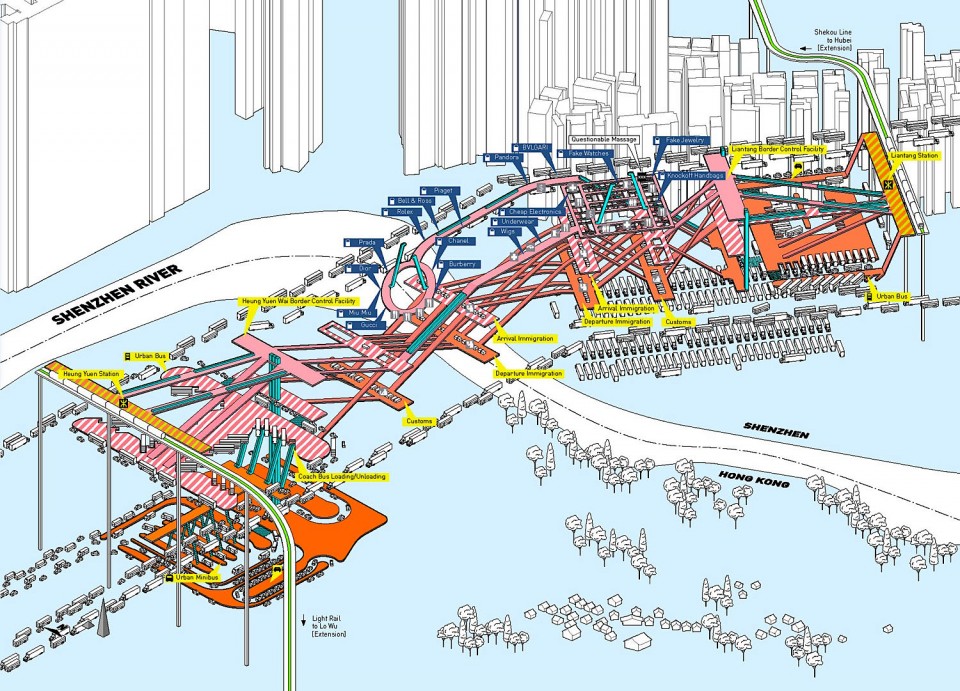
When I learned of Kowloon Walled City [1][2], that caught my attention. I've seen too descriptions of the underground portions of Hong Kong [3] that let you move from place to place without every stepping outside. The movie "Chungking Express" gives off that vibe [4]. The imaginary prisons of Giovanni Battista Piranesi [5].
[1] https://www.visualcapitalist.com/wp-content/uploads/2017/09/...
[2] http://lh5.googleusercontent.com/-xI_c78etYDc/T61_qAwHWFI/AA...

[3] https://weburbanist.com/wp-content/uploads/2014/05/hong-kong...
Of course, it may be influenced by the fact that I spent ~15 years in the Boston area, and while New York is the city that never sleeps, Boston can get hauntingly empty late at night, or even on Sunday afternoon when most everything's closed...
For a great Kowloon-influenced atmospheric game, check out Stray.