
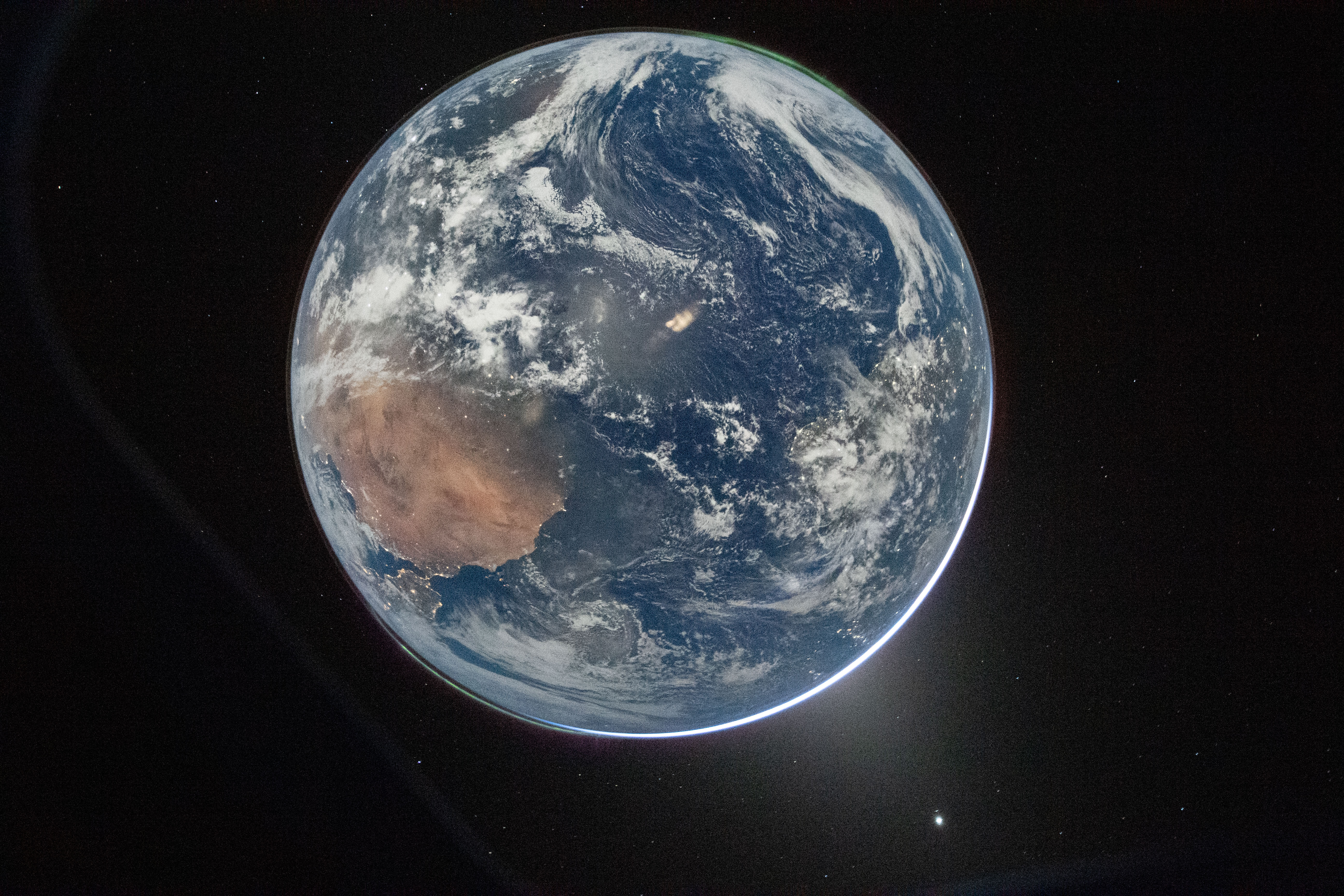
(To be clear, the bright dots are stars [except the brightest one, in the lower right, is Venus I think], which makes this photo also a great demonstration that of course you can capture stars in space, you just have to expose properly!)
replyWho said you can't capture stars in space? What do you think the purpose of Hubble, JWST, etc are? There's also plenty of imagery taken from ISS that clearly show stars. I've definitely seen Orion in some of that imagery and it put a different perspective on the size of the constellations when seen from that angle.
replyI referred to the common question (or accusation) of why there are no stars in, say, the Apollo photos taken on the moon. The answer is, of course, that you can't see stars if you're exposing for something bright and sunlit, like the day side of Earth, or the lunar surface.
replyOf course. But they are not visible in the Chang’e photos on the dark side either. I think in the interview of the astronauts following the first Apollo Mission, a reporter asked for a confirmation that the stars were not visible because of “the glare” (an interesting question in itself). The explanation given was that the stars were not visible with the eye, but were visible with “the optics“.
replyPhotos from the moon landings don't have stars in them, because they are exposed for full daylight on the moon.
replyI’m assuming the people who complain that there aren’t stars are the “moon landing faked” crowd… it’s hilarious to me that they think this vast conspiracy came together to fake that whole thing, and that they literally forgot to put a bunch of tiny 25-cent flashlight bulbs up poking through the black backdrop on the sound stage. Like, no one thought about the stars, or they couldn’t figure out how to do those “special effects” and just prayed no one would spot the error.
replyJust answered my own question to my satisfaction; they are stars.
replyThe same specs, which match star charts, show up in two images taken a few moments apart at different exposures (links were given down-thread).
How do you know that they're stars? I believe they probably are stars as well (by visual comparison with a star chart, suitably rotated), but I've found no source for either claim.
replyI did find multiple sources, including TFA, for the brightest being Venus.
They're much brighter than the noise floor. Photographic noise doesn't really have such outliers.
replyWhy would you think they are not stars? Not really sure the confusion on the matter. Are we leaning towards this being shot from a soundstage?
replyWell one of them is obviously Venus. How did you determine the others weren't stars?
replyI’m talking about the grainy noise over all the black parts (actually over the Earth disk as well), including beyond the window edge. The window edge itself looks like a denser and brighter stripe of stars.
replyZoom into this higher-resolution version: https://www.nasa.gov/wp-content/uploads/2026/04/art002e00019...
Yep, that's definitely noise.
reply