
(www.the-independent.com)
His past research was already cited by Leonardo DiCaprio on Sept. 23 2014, during opening of the UN Climate Summit.
“The good news is that renewable energy is not only achievable but good economic policy,” DiCaprio told the more than 120 world leaders assembled. “New research shows that by 2050 clean, renewable energy could supply 100 percent of the world’s energy needs using existing technologies, and it would create millions of jobs.”
https://cee.stanford.edu/news/what-do-mark-z-jacobson-leonar...
The 100% renewable papers by Mark Z. Jacobson were subject to strong criticism. Jacobson filed a lawsuit in 2017 against the Proceedings of the National Academy of Sciences and Christopher Clack as the principal author of the paper for defamation. In February 2024, Jacobson lost the appeal and was required to pay defendants more than $500,000 in legal fees.
https://en.wikipedia.org/wiki/Mark_Z._Jacobson
Jacobson is also very strong critic of nuclear energy. In calculating CO2 emissions from using nuclear energy, he includes carbon emissions associated with the burning of cities resulting from a nuclear war aided by the expansion of nuclear energy and weapons to countries previously without them.
Jacobson assumes that some form of nuclear induced burning that will occur once every 30 years.
Let's head to electricitymaps.com !
Albania (https://app.electricitymaps.com/map/zone/AL/live/fifteen_min...)
- On 2026-04-12 16:45 GMT+2, 22,67% of electricity consumed by Albania is imported from Greece, which generates 22% of its electricity from gas. Interestingly, Albania exports about as much to Montenegro as it imports from Greece.
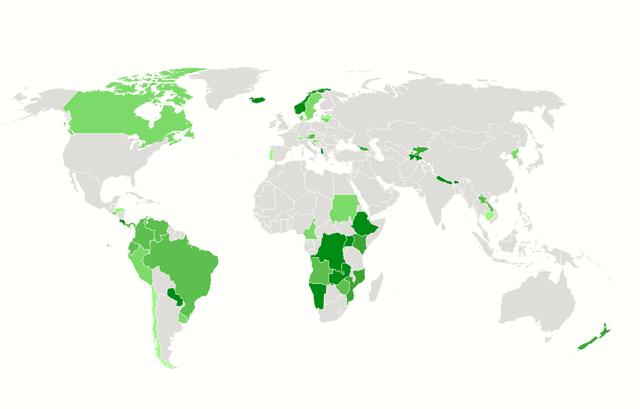
Bhutan:
- 100% hydro, makes perfect sense
Nepal:
- 98% hydro, a bit of solar for good measure
Iceland:
- 70% hydro, 30% geo
Paraguay:
- 99,9% hydro
Ethiopia:
- 96,4% hydro
DRC
- 99.6% hydro
So, the lessons for all other countries in the world is pretty clear: grow yourselves some mountains, dig yourselves a big river, and dam, baby, dam !!
(I'm kidding, but I'm sure someone has a pie-in-the-sky geoengineering startup about to disrupt topography using either AI, blockchain, or both.)
Being powered almost entirely by hydro means that the system is highly susceptible to droughts, so then they either have to spin up those oil plants from time to time or import electricity from abroad. I think it's also worth pointing out that nothing really changed because of climate change, the decision to rely on hydro was made in the 90s. The country used to have its own oil power plant that it heavily relied on before that decision, which slowly produced less and less until it was shut down for good in 2007. Some images of it from 2019: https://www.oneman-onemap.com/en/2019/06/26/the-abandoned-po...
Why do you think it is worth pointing this out?
I wonder how many other countries are increasing non-renewable output?
The global average to build one is ~7 years. People have been saying they take too long to build as an excuse for not building them for what, two decades or more? It seems to be taking longer to not build them than to build them.
> By the time a new plant is ready, alternate sources (likely solar + battery and long-distance HVDC) will have eaten its lunch.
Neither of those have the same purpose. Solar + battery lets you generate power with solar at noon and then use it after sunset. It doesn't let you generate power with solar in July and then use it in January. More than a third of US energy consumption is for heating which is a terrible match for solar because the demand is nearly the exact inverse of solar's generation profile both in terms of time of day and seasonally.
HVDC is pretty overrated in general. It does nothing for the seasonal problem and it's expensive for something that only provides a significant benefit a small minority of the time, i.e. the two days out of the year when the local grid has a shortage but a far away one has a surplus. It's also hard to secure because it inherently spans long distances so you can't have anything like a containment building around it and you end up with an infrastructure where multiple GW of grid capacity is susceptible to accidental or purposeful disruption by any idiot with a shovel or a mylar balloon.
The worst nuclear accident involving a nuclear plant (Chernobyl, which occurred in a country without regulation for all intent and purpose) killed less people than the food processing industry cause every year (and I'm not counting long term health effect of junk food, just contamination incidents in the processing units leading to deadly intoxications of consumers).
In countries with regulations there's been 2 “major accidents”: TMI killed no one, Fukushima killed 1 guy and injured 24, in the plant itself. In any industries that would be considered workplace safety violation, not “major accident”… And it occurred in the middle of, and because, a tsunami which killed 19000!
I'm actually happy this regulation exist because that's why there ate so little accidents, but claiming that it's still hazardous despite the regulations is preposterous.
The chernobyl was poisoning Russian soldiers by the start of Ukrainian invasion when they were dumb enough to sleep there.
The Hinckley Point C EPR reactor would have produced electricity at a rate below £20/MWh instead of a planned £80/MWh if it was financed by government bonds.
Exactly what "storage" means there is the key, especially at high latitude. Do not assume just batteries.
You can't quickly change the amount of power it generates. Which is what you need if you want to use it together with dirt cheap solar.
It's very expensive. In fact, noone knows how expensive it will end up being after a couple thousand of years.
It's dangerous. For millenia. Vulnerable to terrorism. Enabler of nuclear weapons.
It takes a long time to build and bring online.
It doesn't scale down.
Finally, Kasachstan is the major producer of Uranium. Yay?
You always need something in the grid that can change the amount of power it generates regardless of what you use in combination with it, because the demand from the grid isn't fixed. All grids need something in the nature of storage/hydro or peaker plants.
The advantage of combining solar with nuclear is that their generation profiles are different. Nuclear can generate power at night and doesn't have lower output during the peak seasonal demand period for heating. Nuclear is baseload; it doesn't make sense to have more of it than the minimum load on the grid, but no one is really proposing to. The minimum load is generally around half of the maximum load.
> It's very expensive. In fact, noone knows how expensive it will end up being after a couple thousand of years.
If you actually reprocess the fuel there is no "couple thousand of years". If you instead put it in a dry hole in the desert, you have a desert where nobody wanted to live to begin with that now has a box of hot rocks sealed in it. It's not clear how this is supposed to cost an unforeseeable amount of money.
> Vulnerable to terrorism.
Nuclear plants are kind of a hard target. The stuff inside them isn't any more of a biohazard than what's in a thousand other chemical/industrial plants that aren't surrounded in thick concrete.
> Enabler of nuclear weapons.
The US already has nuclear weapons and would continue to do so regardless of how much electricity is generated from what sources. The argument against building nuclear reactors in Iran is not an argument against building nuclear reactors in Ohio.
> It takes a long time to build and bring online.
Better get started then.
> It doesn't scale down.
Decent argument for not having one in your house; not a great argument for not having one in your state.
> Finally, Kasachstan is the major producer of Uranium. Yay?
The country with the largest uranium reserves is Australia. Kazakhstan is #2 has about the same amount as Canada. Other countries with significant reserves include Russia, India, Brazil, China, Ukraine and several countries in Africa. The US has some itself and plenty of other places to source it. It can also be extracted from seawater.
See https://www.jlab.org/news/releases/jefferson-lab-tapped-lead...
> Partitioning and recycling of uranium, plutonium, and minor actinide content of used nuclear fuel can dramatically reduce this number to around 300 years.
Let's not pretend like the track record of energy production is free of externalities.
We CAN also produce almost all of our plastics from recycled ones. We don't, because those are more expensive than new.
"Base load" is just some nonsense from nuclear fans to get the cost per GWh down.
You need solar. Make hydro the backup, fill reservoirs as your reserve and sell extra energy when they're nearly full.
https://en.wikipedia.org/wiki/Grand_Ethiopian_Renaissance_Da...
Maybe you are confusing with 2022 when half of french fleet was shut down to check for potential pipe cracks/corrosion esp in one of their reactor designs due to poor geometry. But that's unrelated to droughts
And of course, there is the what to do with the waste dilemma. And at least with current French park, there is a dependence on the rarer kind of uranium.
A lot of NPPs in France are cooled with river water and they need to be kept at low output if the rivers are too warm.
Brazil, a continental country, has more than 80% of its energy from renewables
Largest chunk left is transport which can mostly be electrified now. Industrial and home heat too. There are hard to electrify sections in both but overall it's fairly obvious what to do next.
And the easy parts eliminate 3 or 4 units of primary energy for every one they replace, so even 40% primary energy is way over 50% toward the finish line of electrifying all the useful stuff.
I think it's also an interesting question as to whether countries that use a lot of electricity have lower per kWh prices because they spread the fixed costs further.
But would it be easy or obvious what to do next? Absolutely not. Everything is simple if you have pockets full of money, live in temperate climates and do not rely on energy intensive (and hard to electrify) industries like the Nordic countries.
For example, about 25 per cent of the total energy consumption in Finland is used to heat buildings. Wood burning is about half of the total heating in distric heating systems which account about half of the total heating for buildings. Also heat-storing fireplaces are still a small but a crucial part of the total picture. A lot of extra energy capacity is needed just make sure you stay alive during the coldest months even if some of the systems fail.
Nordic countries have cheap electricity mostly for two reasons: very stable interconnected electric grid and lots of different renewable energy sources. Arguably, hydropower is the most important because it can stabilize the intermittent wind power which in many places we have more than enough already. Nuclear energy is also a major part of electricity production in Sweden and Finland.
And yet our electric grid or electricity production capacity is far from ready to handle even the more realistic dreams of "full electrification" we are told in the media. It will take many years just to get the grid ready.
And what happens if the stablest renewable, hydropower, fails? We might find it out this year as hydropower reserves in Norway are at the lowest level in 20 years. Hydro generates about 90% of Norway's total electricity.
Most homes are hundreds or thousands of miles from a datacenter.
The trick of course is that if you electrify heating and transportation they'll need much less energy. Your average car with an ICE has an efficiency of 20-40%, electric cars have 60-80%. Heating your house with gas has an efficiency of around 100%, heat pumps have 300%-500%.
To hit 90% the boiler needs to be designed to condense water vapour out of the exhaust gases, this way we'll get back the energy needed to turn water into a vapour which is a large portion of the energy embodied by the exhaust gas. And to do that the vapour needs to pass a low temperature fluid, so we use the input fluid we were about to heat with the boiler anyway, we want this fluid to be cooler than about 55°C but that means if we're using the boiler to heat a home with radiators, rather than to make fresh hot water for cleaning etc. we need our return temperature from the radiators to be less than 55°C which means we need our flow temperature to be lower (than the typical 70-80°C programmed by builders, not lower than 55°©) or else the radiators can't possibly radiate enough heat to hit that number, which means we're actually doing much of the same heating efficiency work we'd have to do to use heat pumps anyway...
But: 7 isn't the number that matters, what matters is that next year it will be 8 or 9. That would be worth documenting.
[1] https://www.nve.no/energi/energisystem/energibruk/stroemdekl...
[2] https://www.nrk.no/tromsogfinnmark/norges-siste-kullgruve-pa...
I wrote about that in 2016, https://jacquesmattheij.com/the-problem-with-evs/ , and even though the situation has improved it has not improved as much as it should have.
This is quite frustrating because it is blindingly obvious to me that we will need to do better but given the profit angle it remains to be seen if these private entities will now do what's right for all of us. So far the signs are not good. Instead of embracing small scale generation utilities are fighting netmetering laws where ever they can (usually under the guise of not everybody being able to have solar, which is true, but which is not the real reason behind their objections). They're dragging their heels on expansion and modernization of grid infrastructure and the government(s) seem to be powerless to force the now out-of-control entities to live up to their responsibilities.
Couple that with the AI power hungry data centers and the stage is set for a lot of misery. Personally I think privatizing the electrical grid was a massive mistake. The market effects have not really happened, all that happened is that the money that should have gone into new infra has been spent on yachts and other shiny rock goodies.
I'm a small step away from going off-grid again, the biggest stumbling block is that - predictably - you can't do any practical small power windmill installations. I've considered a windlass in the basement but my kids wouldn't hear of it ;)
It is a relief that Environmentalists have decided that hydro counts as "renewable" energy! When I was in school, hydro was considered really bad for the environment, and projects like the Hoover dam and Yangzie River dam were "not helping"
But it's extremely renewable none the less.
https://en.wikipedia.org/wiki/1975_Banqiao_Dam_failure
(This is the worst disaster, but could put Chernobyl to shame?)
Full list here:
https://en.wikipedia.org/wiki/List_of_hydroelectric_power_st...
https://ourworldindata.org/grapher/death-rates-from-energy-p...
And that's before you bring into the deaths due to climate change
Came to say that, every time you'll see a country running on 100% renewables for an extended period, it's going to be hydro, because it's the only controllable supply among renewables (with geothermal as well, but it's been so niche so far I put it aside, but I hope it will change).
Unfortunately most of the hype and investments go to solar and wind power, which fundamentally don't offer the same capabilities. (Solar is fine as long as you're in q sunny place that is not in Europe though because it can be predictable enough to be relied on, but Solar in above 40° North and wind are borderline scams at this point).
Or then they talk about how some countries have miraculous levels of an energy independence and social services and then look at their total population.
Most data you find will be using data that's massively out of date and be off by at least 2x though...
I had another facepalm moment when I read about EU planning to go nuclear again. That would've been amazing and smart in 2015 - but now? Yeah, it's dumb af. And that's coming from a German living at the northern end of the country.
Going nuclear was sane in the past and sane now. If Germany wants to prove expanding nuclear is dumb it should try first to have lower annual emissions, while spending less than double the cost of entire french fleet.
France is the biggest winner in EU- it'll build both nuclear and renewables achieving deep decarbonization
In all seriousness, thereis of course a list on Wikipedia of countries by renewable electricity production [1]. China leads here but also has 1.4B people and still has significant coal usage and oil and gas imports. But they're working really hard to wean themselves off of fossil fuels while still rapidly industrializing.
China does have mountains and has built the Three Gorges Dam, which is just massive and produces ~22GW. They're building a dam that'll produce almost three times as much power, the Medog Hydropower Station [2], which is planned for ~60GW.
The part that annoys me about a lot of developed nations is that they engage in greenwashing by simply exporting their emissions to poorer countries eg [3]. Let's at least be honest about what fossil fuels we continue to use and the emissions we indirectly create.
[1]: https://en.wikipedia.org/wiki/List_of_countries_by_renewable...
[2]: https://en.wikipedia.org/wiki/Medog_Hydropower_Station
[3]: https://www.vox.com/energy-and-environment/2017/4/18/1533104...
- California: 83% renewable, dominated by solar
- Spain: 73%, dominated by solar & wind
- Portugal: 90%, dominated by wind & solar
- The Netherlands: 86%, dominated by solar & wind
- Great Britain: 71%, dominated by wind & solar
There's real momentum happening.
California's grid is pretty decently balanced. Solar isn't even close to 50% - so saying that it "dominates" is pretty misleading.
It's like ~30% solar, ~12% hydro, ~10% wind, ~10% nuclear, all other renewables ~8% (~70% renewable, including nuclear) -> ~30% fossil fuels.
Are you maybe only counting domestic production and not total consumption? Or are you looking at the best time of the year and not the full year?
Or am I looking at sources that are >1 year out of date and in one year they've jumped from ~70% renewable to ~83%?
2022 - 48% gas power on grid
2025 - 25% gas power on grid
What insane progress.
The Dutch bureau of statistics reports 50%, of which a plurality (one third) is biomass. The Netherlands is also famously gas-dependent. Natural gas isn’t converted to electricity for heating and many industrial applications. Can’t quickly find stats on production here, but renewables are only 17% of total energy usage. Renewables without biomass are ~12% of total energy usage.
https://www.cbs.nl/nl-nl/longread/rapportages/2025/hernieuwb...
The Netherlands: 50%, of which one third is biomass.
As someone living in the Netherlands, I would love to live in energy utopia, but stats reported by people who can’t read Dutch government reports are usually wrong.
You can also see Texas (ERCOT), New York and a few other operators.
Right now in a dark and not very windy UK w/ 10GW of gas burners running the spot price for electricity here is almost £150 per MWh, but at 10am it was sunny with a brisk wind and sure enough that spot price was about £25 per MWh. Gee, I wonder whether the wind and sun are cheaper...
Not to downplay the positive steps that are being taken towards using renewable energy worldwide, but one must point out that all those countries except one are almost exclusively using hydroelectric power, whose availability at such scale is a geographical lottery. As for Iceland, which also relies mostly on hydroelectric power but not in such great a proportion, it makes up for it thanks to easy and abundantly available geothermal power (which, though environmentally friendly, is arguably not technically renewable).
Other countries will have to be more reliant on interconnects, diverse renewable mixes and batteries. Luckily this is now almost always cheaper and more secure than fossil fuels and the trend lines point towards that continuing to be more and more true over time.
Not to downplay the positive steps that are being taken but we are conveniently skipping over the denominator here at least in the case of Ethiopia and DRC who both have a grid that is only serving their full population at a fraction of the level needed to make this story one about geographical lotteries and abundance instead of one about poverty preventing them from access to the traditional carbon power generating routes to server the rest of the population.
https://en.wikipedia.org/wiki/Solar_irradiance#On_Earth's_su...
However, given that there's no downsides to cooling down a hotspot other than, well, no longer being able to extract energy from it, geothermal is a bit of an honorary "renewable".
Actual renewables ultimately all come down to recent[0] solar energy, which will never deplete their source however much they are used. All the energy in wind, hydroelectric and biofuels has recently originated in the Sun.
[0] I say "recently" because fossil fuels are all also derived from the Sun, but their rate of regeneration is a bit too slow compared to the speed at which we use them.
We have a lot of uranium and nuclear is fairly renewable at least in the span of a few centuries. The waste issue is a problem.
Does this effect occur in lets say 10-20 years or is this longterm like 50y+?
This is due to the physics reality of the ground itself: Power of a Geothermal well will decay over time to a point where the well become unusable and need to be closed.
It is due to the fact underground water is rich in minerals and raw elements. This soup will slowly but surely cement the well itself and its associated underground.
There are techniques (similar to 'fraking') to extend the lifetime of a well but only to some extent.
If the topic interests you (and you can bear artificially translated English), a French content creator did a pretty good video on the topic:
https://m.youtube.com/watch?v=q4xZArgOIWc
Additionally, Geothermal plants can emit CO2 (even a lot of CO2) in some geological configuration.
All of that makes Geothermal (for electricity) a bit controversial as "Renewable".
I precise that there is absolutely nothing wrong about low temperature Geothermal energy for residential heating and we should do more.
Solar is powered by fusion of Hydrogen in the Sun.
I'd use the same classification for both.
Most of the radiogenic heating in the Earth results from the decay of the daughter nuclei in the decay chains of uranium-238 and thorium-232, and potassium-40.
https://en.wikipedia.org/wiki/Radiogenic_heating
Potassium is more or less distributed in the body (especially in soft tissues) following intake of foods. A 70-kg man contains about 126 g of potassium (0.18%), most of that is located in muscles. The daily consumption of potassium is approximately 2.5 grams. Hence the concentration of potassium-40 is nearly stable in all persons at a level of about 55 Bq/kg (3850 Bq in total), which corresponds to the annual effective dose of 0.2 mSv.
https://www.nuclear-power.com/nuclear-engineering/radiation-...
Geothermal hotspots do not reheat by fission or otherwise at the same speed that we extract their energy (if they did we'd be in trouble if we weren't extracting it!).
As I mentioned in another comment, build a Dyson sphere of solar panels around the Sun and it will last just as long. Build an all-Earth geothermal plant and the heat will be depleted.
But if we're open to applying a quantitative timescale threshold to the thought experiment, at which we can argue geothermal is renewable, that raises the question for nuclear. If we could access all fissile uranium and thorium on Earth, how long would it take for us to deplete its stored energy? Does that mean nuclear energy is renewable?
This is because using it cools the hole slowly and after a few decades (depending on how quickly ground water can dissipate heat gradient) a new hole need to be drilled a distance away.
Geothermal is renewable.
That is not the case for geothermal. It could in theory be cooled down if exploited at a massive scale.
Saying geothermal is not renewable is not an indictment nor a criticism. Geothermal is great and we should use it more. It's just technically not renewable, but that doesn't matter.
You are still technically correct, which is the best kind of correct.
But if we follow that rationale, in a long enough timeline, solar and wind is also not renewable.
Just because a country generates 100% of its energy from renewables, it doesn't mean that its enough to power the entire or even majority of the country. Case in point: DRC. I believe only half of the population has access to electricity. It's been a while since I've looked into continental stats, but a quick Google search suggests the situation hasn't changed that much in the last few years.
One state is considered to be fully 'renewable' if the means of transport (excluding Airplanes since I can't find a suitable alternative ) for land is done via electric cars
This map says hydro share is like 8%. https://app.electricitymaps.com/map/zone/JP/live/fifteen_min...
https://www.nytimes.com/2026/03/23/climate/offshore-wind-gas...
[1]: https://web.stanford.edu/group/efmh/jacobson/WWSBook/Countri...
The best way to go green is still going green yourself. Get some panels, batery, inverter and go where no government wants you to go, off-grid. (And a gas generator, too, just in case...)
Why is it that those are reserved for ultra-big utility companies and I cannot buy those for my home or even my balcony?
Might be experimental and unavailable, but just for small orders? Come on ...
Hydro, wind and solar. Hydro is often even more important because it runs more steadily than the other two.
Geothermal and nuclear are neither fossil nor renewable, they are their own category.
The only countries with <100 g CO2/kWh and >10TWh/y are using nuclear. Large scale batteries are exciting for the future but need more development. The 2 biggest battery investments in the world are being made in Australia and California, yet still produce 4x the g CO2/kWh of France.
Bhutan: 99% Hydropower, $ 4700 GDP/person
Nepal: 23% Imported $ 1381 GDP/person
rest Hydropower (2/3 of energy: firewood etc.)
Iceland: 99% Hydry/Geo, $90000 GDP/person
Ethiopia: 88% Hydropower, $ 1350 GDP/person
DR Kongo: 98% Hydropower, $ 760 GDP/person , 13% of country has electricity
Not sure how this is applicable (and in many cases: desirable) for countries that do not have significant hydropower potential or maybe want a GDP greater than $760 per person per year.
On the other hand, balcony solar power will be a game changer for the world, provided your neighbors won't steal the panels like they do the catalytic converters in my neighborhood.