
It is my understanding that this is not possible. I would be happy to be shown to be wrong, but to me it seems like you can either prevent people from lending out their credentials, or you can preserve the anonymity of the user, but not both.
You can use 0KP to prove you have a signed certificate issued by your government that says you are an adult, but then anyone with such a certificate can use it to masquerade as however many sock puppets they like and act as a proxy for people who aren't adults. You can have the issuing government in the loop signing one-time tokens to stop Adults-Georg from creating 10k 18+ attestations per day, but then the issuing government and the service providers have a timing side-channel they can use to correlate identities to service users. Is there some other scheme I'm missing that solves this dilemma?
This is not designed to prevent adults from coöperating with minors; that makes no sense as a design goal because any technical measure can always be bypassed with “download this for me and give me the file”. This is designed to prevent minors from being able to access systems without an adult.
Nothing prevents an adult from buying alcohol on behalf of minors; that doesn’t mean laws that prevent minors from directly buying alcohol are useless.
If the proof of adulthood scheme is truly anonymous, one adult with some technical chops who thinks "kids should be allowed to watch porn if they want" would be able to, say, run an adult-o-matic-9000 TOR hidden service that anyone can use to pinky promise that they are an adult without fear of repercussions. If such a service comes with a meaningful risk of being identified and punished, it is by definition not anonymous.
I suppose I'm just not convinced giving up some basic liberties for a law that converts into sternly worded advice if just one adult chooses to break it is a great idea.
I also don't think you'll find many ISPs terribly keen to fight for the neutral treatment of TOR connections when the reason for this fight is explicitly to serve porn to minors.
For example, in the UK it’s only illegal to give alcohol to a child younger than 5 years old.
France has no limitations, giving a toddler wine is not explicitly illegal. Getting a child drunk would be.
Multiple accounts must be supported, because e.g. personal and work accounts must be separate to not mix them.
The certificates in question can use a few mitigations: short lived, hardware stored (in a TPM, making distribution harder), be single use, have a random id which the service being accessed can check how many times has been used.
> but then the issuing government and the service providers have a timing side-channel they can use to correlate identities
That's not reallya concern, IMO. That would always exist as a risk - most people would probably have a flow of trying to do something, having to prove ID/age, doing that step, continuing with the something, which means you'd probably be able to time correlate the two sides quite often. The solution here is legal with strong barriers, not technical.
I think a zero-knowledge system here would be quite desirable. But a centralized repository that is e.g. maintaining tabs on every single adult-authorization for every single person with verifiable details of them is, by contrast, a dystopic disaster waiting to happen because it will be hacked, leaked, and abused, sooner or later.
Basically you can prove that you have an identification document and that a certain property is true without revealing anything else.
For some contrast this [1] is an infographic from NASA about the Apollo program in the 60s. Enough details to inform one from a technical perspective, but also organized well enough that even if you know nothing about space or space flights, you could walk away with a pretty good idea of what's going on, and it might even spark your interest enough to research some things you didn't follow.
[1] - https://assets.science.nasa.gov/content/dam/science/psd/luna...
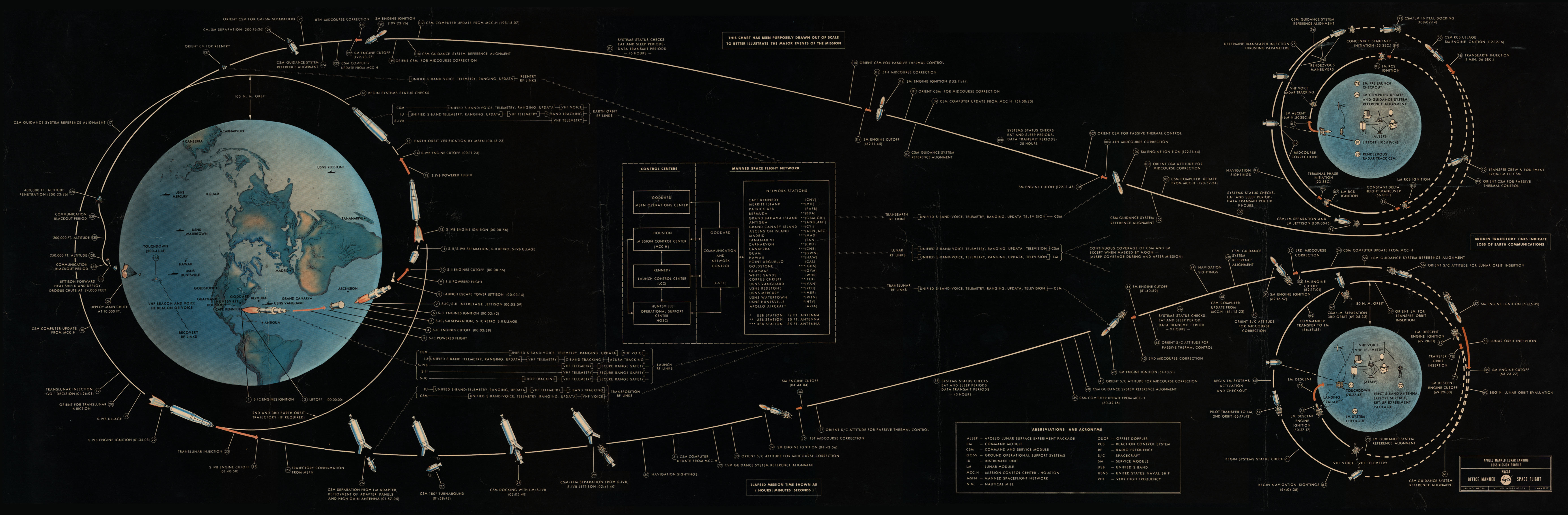
Many countries in EU already have electronic identity documents and delegate authentication to mobile apps one way or another.
eID or mobile identity application operating over QR codes and used to log into websites and apps is a commodity here.
This has nothing to do with age verification.
The article links to the source code repository here:
https://github.com/eu-digital-identity-wallet/av-app-android...
That links to the tech spec:
> The solution leverages the existing eIDAS infrastructure, including eIDAS nodes and the trust framework for trusted services, to ensure a high level of security and reliability. By aligning with the technical architecture of the EU Digital Identity Wallet ARF, the solution delivers secure, reusable, and interoperable proofs of age.
> The solution enables users to present their Proof of Age attestation to Relying Parties, primarily for online use cases. The system is optimised for secure and privacy-preserving online presentation, allowing users to prove their eligibility without disclosing unnecessary personal information.
— https://github.com/eu-digital-identity-wallet/av-doc-technic...
Annex A includes details on the ZKP:
> AVI SHOULD support the generation of Zero-Knowledge Proofs using the solution detailed in: "Matteo Frigo and abhi shelat, Anonymous credentials from ECDSA, Cryptology ePrint Archive, Paper 2024/2010, 2024, available at https://eprint.iacr.org/2024/2010".
— https://github.com/eu-digital-identity-wallet/av-doc-technic...
And the linked paper:
> Anonymous digital credentials allow a user to prove possession of an attribute that has been asserted by an identity issuer without revealing any extra information about themselves. For example, a user who has received a digital passport credential can prove their “age is ” without revealing any other attributes such as their name or date of birth.
Without exposing my citizenship, I was able to use by EU-nation issued ID to confirm only my year of birth.
The website supported this country's national ID login method, in the login challenge asked the server to provide my age, before I signed in to confirm (scanning qr code with my mobile app) I was informed what data was requested, then I consented to them confirming my data.
Not very sensitive things work without my physical ID present, sensitive have additional step with me providing my physical ID (to the NFC reader) and unlocking my key (stored on the ID) with a pin.
All in all it's really very sensible and fast.
Not necessarily the EU ID apps we're talking about but some of the existing implementations.
And yes, even sending an age bracket exposes the age over time as you can observe a repeat visitor changing brackets and compute the actual age from that. With the server sending the info instead you can't really tell if the browser blocked it, or if the user just didn't navigate further on the page. (The browser still need to fetch all the CSS and other resources though, otherwise that would be possible to tell apart.)
That's the theory. How is it in practice?
In my opinion, it just means there is a single government database to hack to get copies of all IDs...
By the way have the "security experts" checking this app evaluated that part? Or they're just worried about the app users cheating?
That doesn't make sense, all IDs are already in a single government database. Kind of by definition in fact, for IDs to be useful they need to be emitted by a central authority with associated security and revokability guarantees.
The implementations I've seen rely on an app reading your physical ID and its NFC chip, comparing that with a selfie to ensure it's the same person, and being able to provide anonymous proof you are of age based on that, or proof that you are indeed who you say you are.
Yes and those databases are decently protected. However for an "app" someone will do a web 4.0 or 6.0 bridge to access these databases. Maybe even vibe code it. That's what I'm worried about.
It's the RESTLESS api being hacked I worry about.
The app checks your physical ID you have, and provides a certificate that you give the third party you're proving yourself to. The app knows you requested proof, but not what for. The third party knows you're proven to be 18+, but knows nothing else.
This open source and transparent ZKP-based approach is extremely surprising to see, publishing a draft in advance and inviting the public to break it so it can be improved? Are you kidding me? What about the billions of private investment in all the companies that offer centralized ID checks like Persona, Socure, ID.me and more? Thats a growing billion dollar industry. They all counted on this as a future market opportunity that the EU just seem to have destroyed at least in the EU?
People fighting against this age id app might be paradoxically useful idiots for billion dollar investments and lobbying efforts. The demos is once again dragged into the trenches to fight a war they don't understand.
- MUST use either Google or Apple account - must not be banned by the provider or sanctioned in the USA
These issues have been flagged to the devs working on the blueprint since the inception, only to be handwaved away.
Getting banned can happen randomly even if you're not doing anything illegal or wrong (it's enough for a robot to decide you're within the blast radius), getting sanctioned can happen if you're an UN lawyer investigating human rights abuses USA actually likes.
So I do see a problem here.
Or just give parents easy to use parental controls. But that wouldn't grow the surveillance state.
No it isn't.
Literally that is not the scope document, and such a solution would not be permitted by the EU as compliant with the legislation.
The app isn't zero knowledge. A prototype workflow has been designed for a one way transfer to sites that is zero knowledge, but it doesn't actually deliver zero knowledge because it you have to verify your age with an external provider to get the credential (which is not zero knowledge), the app has to be secured with either Apple or Google's attestation services (which are not zero knowledge), and the site has to be able to check with the original external provider that the credential hasn't been revoked (which is in no way zero knowledge).