
There's a cycle that is needed for good system design. Start with a problem and an approach, and write some code. As you write the code, you reify the design and flesh out the edge cases, learning where you got the details wrong. As you learn the details, you go back to the drawing board and shuffle the puzzle pieces, and try again.
Polished, effective systems don't just fall out of an engineers head. They're learned as you shape them.
Good engineers won't continue to be good when vibe-coding, because the thing that made them good was the learning loop. They may be able to coast for a while, at best.
A complex system that works is invariably found to have evolved from a simple system that worked. A complex system designed from scratch never works and cannot be patched up to make it work. You have to start over with a working simple system.
When there's a lot of complexity, it's often repetitive translation layers, and not something fundamental to the problem being solved.
We mocked these "architects" from experience. We knew that if you weren't feeling the friction yourself, you wouldn't learn enough to do good design.
Maybe you don't care about engineering great systems. Most companies don't. It's good for profit. This isn't new, though AI enables less care.
In my experience, in a lot of organizations, a lot of people either lacked the ability or the willingness to achieve any level of technical competence.
Many of these people played the management game, and even if they started out as devs (very mediocre ones at best), they quickly transitioned out from the trenches and started producing vague technical guidance that usually did nothing to address the problems at hand, but could be endlessly recycled to any scenario.
People who care about craft will care about the quality of what they produce whether they use AI or not.
The code I ship now is better tested and better thought through now than before I used AI because I can do a lot more. That extra time goes into additional experiments, jumping down more rabbit holes, and trying out ideas I previously couldn’t due to time constraints. It’s freeing to be able to spend more time to improve quality because the ROI on time spent experimenting has gone up dramatically.
I couldn't get exercises done where there were tricks/shortcuts which are learned by doing a lot of exercises, but for many, these are still the same tricks/shortcuts used in proofs.
This was indeed rare among students, but let's not discount that there are people who _can_ learn from well systemized material and then apply that in practice. Everyone does this to an extent or everyone would have to learn from the basics.
The problem with SW design is that it is not well systemized, and we still have at least two strong opposing currents (agile/iterative vs waterfall/pre-designed).
- I've taken a controversial new pill that accelerates my brain.
-- So you're smart now?
- I'm stupid faster!
That being said, being stupid faster can work if validation is cheap (and exists in the first place).
Turns out "eh close enough" for AGI is just stupidity in an "until done" loop. (Technically referred to as Ralphing.)
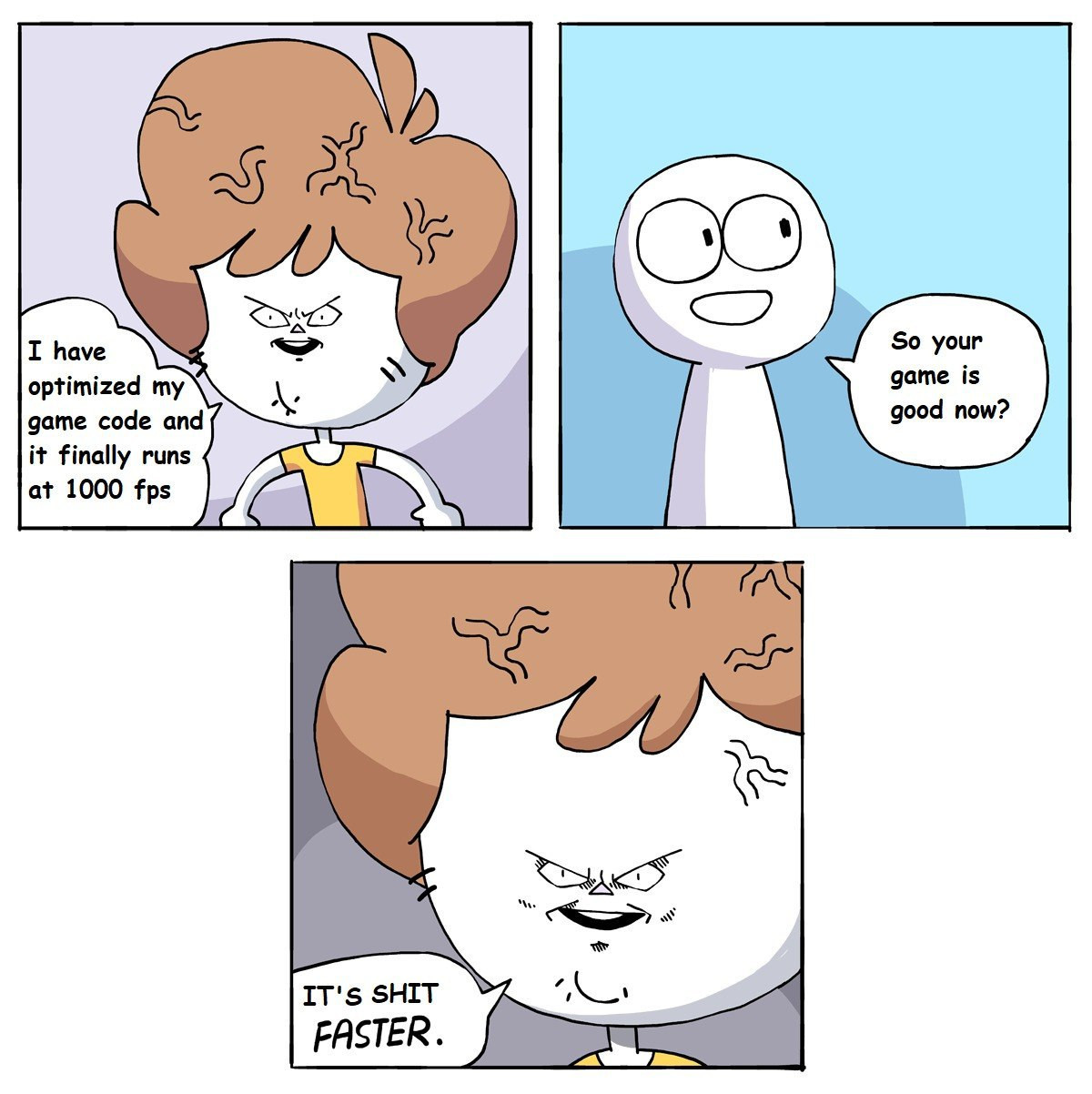
I've optimized my game's code and it finally runs at 1000 FPS.
--So your game is good now?
It's shit faster.
That has always been the case. That is why weeks or even months of programming and other project busy work could replace a couple of days of time getting properly fleshed out requirements down.
Good engineers are also capable of managing expectations. They can effectively communicate with stakeholders what compromises must be made in order to meet accelerated timelines, just as they always have.
We’ve already had conversations with overeager product people what the ramifications are for introducing their vibe coded monstrosities:
  - Have you considered X?
  - Have you considered Y?
If that’s not the situation where you work, then unfortunately it’s time to start playing politics or find a new place to work that knows how to properly assess risk.
I estimate that I'm now spending about 10 to 30 hours less time a week in the mechanical parts of writing and refactoring code, researching how to plumb components together, and doing "figure out how to do unfamiliar thing" research.
All of those hours are time that can now be spent doing "careful consideration" (or just being with my family or at the gym or reading a book, which is all cognitively valuable as well).
Now, I suppose I agree that if timelines accelerate ahead of that amount of regained time, then I'm net worse off, but that's not the current situation at the moment, in my experience.
What you said: "figure out how to do unfamiliar thing" -- is correct, and will get things done, but overall quality, maintainability or understanding how individual pieces work...that's what you don't get. One can argue who care about all that as AI can take care of that or already can. I don't think its true today at-least.
What I find is actually necessary for me to have a mental model of the system is not typing out the definitions of the classes and such, but rather operating and debugging the system. I really do need to try to do things, and dig into logs, and figure out what's going on when something is off. And pretty much always ends up requiring reading and understanding a bunch of the implementation. But whether I personally typed out that implementation, or one of my colleagues, or an AI, is less important.
I mean, I already had to be able to build a mental model of a system that I didn't fully implement myself! I essentially never work on anything that I have developed in its entirety on my own.
10 to 30 hours saved on not learning new things! Hurray!
What do you mean by "barely working"? I can now put more iterations into getting things working better, more quickly, with less effort. That seems good to me.
10 to 30 hours a week is 25% to 75% of my time working. Seems like a pretty good trade?
I do understand that the calculation is different for people who are new to this. And I worry a lot about how people will build their skills and expertise when there is no incentive to put in all the tedious legwork. But that just isn't the phase of my career that I'm in...
My time is spent more on editing code than writing new lines. Because code is so repetitive, I mostly do copy-pasting, using the completion and the snippets engine, reorganize code. If I need a new module, I just copy what’s most similar, remove everything and add the new parts. That means I only write 20 lines of that 200 lines diff.
Also my editor (emacs) is my hub where I launch builds and tests, where I commit code, where I track todo and jot notes. Everything accessible with a short sequence of keys. Once you have a setup like this, it’s flow state for every task. Using LLM tools is painful, like being in a cubicle reading reports when you could be mentally skiing on code.
Or at least, the limit is increasing by the day.