
I loved my Pixelbook, fantastic piece of hardware. When that ended, I went with an Acer Chromebook. Works fine, just not the same.
I would go for a Mac Air or Neo, but only if I could install ChromeOS.
I will most likely get a Googlebook, and would be more likely to do so if it was not named Googlebook and did not have Gemini built in.
To each their own, but this is absolute insanity.
I now have a machine that boots almost instantly and just works without maintenance, upgrades, or compatibility issues. I can throw it in the river, and for $300 get a machine that will be up and running in about one minute. I can use multiple machines (small/cheap to bring on a trip, laptop for casual working, larger machine for more serious work, even at the same time. I have full access to everything from my iPhone, or access to some computer anywhere. I use remote VSCode via Crostini to do development work (terminal, vi, Codex, Claude Code) on a bunch of beelink boxes and Hetzner servers.
I cannot run installed software and I am dependent on Google for email, files, photos. For the latter, I have backups of my email and files (photos are not as easy).
Life is simpler this way.
I cannot remember the last time I wanted internet access but could not find it. Cell coverage is pretty good and reliable these days.
But for optimal DX it can still be preferable to VSCode tunnel into your big powerful dev box that has everything configured just right.
Do you still use vi or were you meaning vi(*) and actually use something else? I've been on vim for a while but happy to go back to vi
While I think Chromebooks are great, I would consider that if your company grows, not everyone is comfortable with vi/m, and a Mac does give you some nice options for higher end dev systems.
I have multiple Chromebooks and an extra monitor, and use Google for files, email, photos. I can grab my cheap Chromebook and throw it into my backpack, don't bother with a case. I have learned to live without using installed apps.
I have a couple of beelink boxes at home that I stash in the corner of a room, connected to my home wireless. I use Crostini to remote into these boxes to do any development. I treat these boxes the same way I treat my Chromebook - disposable. I have scripts that will reconstitute my dev environment from GitHub and my backups.
If I trash a chromebook, I grab or buy a new one. I can do pretty much anything (except dev work) from my phone if needed. If I trash a dev server, I use another one. I also have some virtual machines at Hetzner. I keep my backups there, as well as any apps I want public.
My only concern is my Google dependence. That is the trade-off for being 100% cloud based and treating my devices as disposable.
I take more risks with my Chromebooks than I do with a MacBook, such as mountain-biking with it or leaning it in a car when visiting sketchy neighborhoods. Chromebooks offer a good-enough on-the-go, full-Unix experience, with an all-day battery. Sure, M-series Macs have higher performance and >20h batteries, but those nice-to-haves re well in excess of what most users need, most of the time.
They've won the netbook market and they'll have existing contracts and education market to always account for. With messaging that the ChromeOS experience will change and may have some things removed to refocus it I think the assumption is that it continues within it's specific use currently.
We are way out of context window, occupied by OS chores.
Life was simpler when we were dumber, but now, no. Stop lying.
Windows is a hot mess and frankly I wouldn't recommend it to anyone outside of gamers. For the technically competent, there's nothing to gain on Windows, and it will just get in the way. For the those less technically inclined, Windows means complexity and viruses. Also most Windows laptops suck major ass.
MacOS is better, especially if you have an iPhone. But even MacOS is a bit too complex for the less technically inclined. If you have an android phone, then a chromebook is 100% the way to go for those people. Also, chromebooks get crazy software support these days, on par with macbooks.
It also locks you into the cloud services of an advertising company that loves harvesting your data to help find new ways to sell you things.
>It also locks you into the cloud services of an advertising company
this is pretty much any company these days. microsoft is guilty of the same.
What it actually appears to be is we have a market where undemocratic business leaders are deciding the direction of technology in a country that only seems to benefit them and not the population.
What a terrible mindset to have and I sincerely hope you never have any capacity to yield power in your life.
Great attitude that goes well with voters.
If you think I’m not mad about it, you’re not reading between the lines. I’m just a realist. This is what Peter Thiel meant by “free email was not enough”.
If you use your own Ubuntu/Debian or even RMS certified disro same can happen. An upgrade and you see only a xorg blinking cursor.
This can be fixed yourself, whether that's hopping into a TTY or having to boot a live environment and chroot in. You aren't at the mercy of some major company's support people.
Even without fixing it you should be able to get at the files on the drive for use on another machine, or backing them up if you're gonna reinstall.
You don't learn or understand modern bootc?
"Get Start and Personalize Your Apple Store Visit" and a big button "Share Now"
Under the button in small text was a link to "customize" which said they were going to harvest your contact info, your carrier account, your phone model and applecare info, the list of all devices you own, the list of all your subscriptions, your purchase history, your reservation history.
They said all of it was for ads (to make more customized recommendations)
So much for "Apple = Privacy"
And when it's brought up where people do know, there's always these attempts at gatekeeping by speaking for the average user like a priest would speak for God.
The person who asked that cares, and didn't ask "the average, realistic user", because you can't ask an abstract concept questions.
Like them I think I am also surprised not because that isn't the case, but because it's wild to see that take on HN, which skews way more towards privacy/owning your compute.
I've also run multiple user studies on privacy during my time doing a master's in privacy at CMU. almost 10/10 times users will choose, easy to use and accessible over complex and more control over their data.
In fact, for one of the Mag7 we proved that, users only want to have the feeling of safety and don't really care what gets done with the data.
very unfortunate, but this is the world we live in.
If you care about privacy, Linux and BSDs are the only options, but actually good out-of-the-box Linux laptops are few and far between.
Except for Chromebooks, of course.
The only restriction to 3rd party apps are unsigned apps. Very rare these days, mainly small hobby projects. You can still activate them through the System Settings.
(I just installed Windows a week ago without an MS account, and it was a 30 second step during setup to skip an MS account. The steps to get rid of the macOS nag are daunting enough that I just live with it permanently.)
But as long as you accept that everything you do is in a browser; which is reality for the vast majority of computer users, there's no real lock-in. You can just as easily use the browser version of Microsoft Office as the browser version of Google Docs.
You're certainly locked into Google for the browser and for updates, unless you do a lot of work. But it's been a while since it was common to get commercial OS updates from a 3rd party.
[1] https://www.xda-developers.com/how-use-chromebook-without-go...
But, we need to pick our battles. For most people the reality is they have a Google account anyway, and they will log into and sync on any device. So, it makes no difference.
Your friend using Android or iOS may have typed your exact address, phone, signal id, gps, etc on her Google/apple account. And now?
If you fly to use you are giving more info.
Are you running your own bank? Pepper are you? What happens when you join job (tons of papers?)
I use Linux CLI all the time but every time I've tried to use a Linux desktop as a daily driver, it's stopped working one day for reasons that are beyond my ability to care enough to figure out.
It's not the wild wild West like Windows. There are structural reasons why Linux desktops are less susceptible to malware, as well as the obvious marketshare issue.
see guidelines https://news.ycombinator.com/newsguidelines.html
Tell that to my partner's grandfather, who managed to find and install malware chrome extensions on his chromebox.
For certain use cases, a computer that can do nothing whatsoever except run the absolute latest version of production Chrome is better than any other device.
I wish Framework would keep supporting ChromeOS but alas. You could put ChromeOS Flex on one - it doesn't have Android apps, which is fine for me, and it does support the Linux environment, which is excellent.
I have used Linux for 20 years, but only for development, and I will only develop on Linux.
For everything else (email, files, photos), I want a browser. Used to be Mac/Osx, but got tired of being managed by it.
Just my preference. You can do everything on Linux, just never felt comfortable with it.
...basically, I have "nerd cred" and run linux on my desktop, but for my laptop I wanted: disposable (no leaky hard drive), zero maintenance (no kernel modules for sound drivers), battery-portable.
90% of the time I'm wanting `vim` + `git` + `ssh`, and 20% of the time i'm wanting to run some random stuff locally. Chromebook is basically zero friction and 1/10th the price (and 1/10th the capabilities) of a "very nice mac laptop", plus you can pop into a very capable linux VM (w/ passthrough GUI support) without a lot of ceremony.
Windows laptops are out of the question, and pure linux laptops (until only very recently) were of marginal support and low battery capabilities (especially "close it and stuff it in a backpack for 3 days").
What century did you write this in?
"""last week: Pop!_OS 22.04: kernel 6.17.9-76061709 — module BTF validation cascade boots system to emergency mode #3961
Thanks for taking a look,
Quick update — I'd already recovered before seeing this comment. The path that worked: boot Pop_OS-oldkern, run sudo apt install --reinstall linux-image-6.17.9-76061709-generic linux-modules-6.17.9-76061709-generic && sudo kernelstub, reboot. 6.17.9 came up clean. The reinstall's postinst hooks ran update-initramfs automatically; /boot/initrd.img-6.17.{4,9}-* are both freshly dated 2026-05-06 (~11:44 / 11:46), and kernelstub copied them to the EFI partition. Verified: journalctl -k -b 0 | grep -iE 'btf|failed to validate' | wc -l → 0. """
lsmod | cut -f 1 -d ' ' | grep snd | wc -l
Dell has sold laptops with first-party Linux support for nearly fifteen years, to say nothing of other smaller OEMS.
As for the battery issues during sleep: that actually has to do with a combination of the BIOS settings + downstream ramifications of secure boot (and how the old-fashioned "hibernate" used to work). Unfortunately, that isn't specific to Linux. My MBP has the same problem, and so do the same laptops running Windows.
It's nice to run Linux on a machine that was built to run Linux. No silly windows key, no fighting with firmware that was built for windows first. I have a Chromebox that was a great mini desktop and the pricing was nice. My first Chromebook ran FreeBSD pretty well once it was no longer needed for ChromeOS, etc.
You have to shop carefully, you want something that's easy to put a MrChromebox firmware on and doesn't have any known issues with the OS you want to run. It's been a while since I purchased a ChromeOS device and the current state is different than it was then; I'm not sure how easy it is to find reasonable options now, but there were plenty of good options in the past. You also want to be sure that it has enough ram and storage for you needs or that those are expandable, but I think soldering ram and storage is pretty common across the range.
It feels like the wrong tool for the job in both directions. If you wanted a host platform for Ubuntu you'd choose something else, and if you wanted platform software for a Chromebook ChromeOS is the right choice.
My <$200 ARM Chromebook got around 12-14 hours battery life new (though as with my M1 Macbook has degraded to probably 70% capacity after 2-3 years). It draws essentially no power in standby (ChromeOS will enter an ultra low-power hibernate-like state seamlessly after a while). I've opened it up a month after last using it and it turns on in <10 seconds having lost a couple percent.
Updates are seamless and add like 5 seconds to boot time when they apply during a restart (thanks to ChromeOS A/B update model there's no loading spinner or anything, you reboot and it's done. Update countdown extortion a la Windows isn't a thing either, you can stay on an non-updated Chromebook for months without a reboot and the most you'll see is the same passive "Click Restart to Update" button in the notification area.
I use the built-in Linux VM all the time, it runs GUI apps like VS Code without any issues, and my ARM Chromebook runs all sorts of regular Arm64 Debian builds for GUI or terminal out of the box. I turned off the Play Store for Android Support, in the past when Linux support was weaker and web APIs in general weren't as capable I needed it for some specific apps but don't really have a need at this point.
The security model on ChromeOS means that untrusted scripts/installers running in the Linux VM are completely isolated from anything on the browser so you (or your proverbial Grandma) don't have to worry about credential stealers/ransomware/malware. You can copy files between the ChromeOS filesystem and the LinuxVM filesystem but a process running in Linux can't cross that boundary and are confined to the sandbox.
Plus, very much unlike my Macbook, I can actually install an app from Github or compile myself without 7 clicks and three different dialogs each time (as is the case with Apple's aggravating security hassleware on MacOS Sequoia). Proving you can have a heavily locked down, secure model without actively making the user experience as miserable as possible (to "encourage" use of the built-in app store).
It's easily the least intrusive OS experience of all the major OSes, and completely gets out of the way without drawing attention to itself. And sure, Google is an advertising company, I get it, but my Macbook advertises iCloud products and Apple TV shows to me more than anything on my Chromebook.
With the 10 year Chromebook support policy, I've got a crazy amount of life out of all of my Chromebooks. It really is liberating having an OS that de-emphasizes its own existence in a world where I have to fight ever changing MacOS deprecation and security restrictions and Windows bloatware being thrown over the fence in every other update.
I'm going to need a citation on that, especially performance. Doubly so if Crostini is put into the mix.
> [...] updates things like peripheral firmware that Ubuntu isn't even aware of.
Like what? WiFi cards, etc.? Isn't that generally in kernel already? What kind of updates do you think are not done by Ubuntu or another Linux distro?
Last I tried ChromeOS was on the Pixel Slate way back when. A buggy, unstable, clearly not properly tested, unperformed mess that I would not wish upon my enemies. Glad to see it has improved to usable now, but that it is better than any other Linux distros, I can't say how considering even being on par with e.g. Fedora would have been a miracle not to long ago.
Happy to admit that purely on the UI/UX, ChromeOS is very solid in my opinion, arguably and subjectively the most consistent and user friendly designed desktop environment I know. Far more consistent than anything MSFT or Apple have provided in quite some time, everything looks like it should, placement is easy to grasp and reliable with a clear identity. Consistency wise, only Gnome can hold a candle to the strictness with which the ChromeOS team execute their vision, though there is the clear divergence in the Gnome team pushing new UX innovations and concepts even if they are controversial and may need to time to learn, whilst the ChromeOS team seems purely focused on the most clearly easy to master approach one can take.
Just google: Mathew Garrett On The State Of Boot Security implement everything and comeback.
Maybe slate with android? If you disable android in ChromeOS it a dream to use. Everything just works.
And remember normal people (i.e outside USA) already have Android phone. They just login and use. All passkeys etc. synced and running. All these are a pain in fedora etc.
Multiple reasons. ChromeOS ships an optimized, platform-specific kernel, built using LLVM with LTO and AutoFDO. No other distro even attempts this. The only one that has even considered it is CachyOS that offers optional LTO, or Gentoo, where you can DIY LTO, but neither supports FDO.
Another reason is that Chrome GPU acceleration actually works on ChromeOS. IPU webcams work, too. On Fedora, Arch, and others you'll be patching and rebuilding kernels to get IPU.
> Like what? WiFi cards, etc.? Isn't that generally in kernel already?
This is another aspect where the ecosystem is the advantage, not the technical details. Chromebook makers are required to furnish firmware updates. ChromeOS will update (silently, without user intervention or notice) everything in a Chromebook: SSD controllers, battery management, radios, touchpad, USB PD controllers, the Titan security chip, the CPU, whatever. This is very different from the situation on random Linux+hardware combinations where the only source for many of these updates, if they are available at all, would be to reboot to Windows.
Ok. How significant is the difference they gain from that? If this yields such major gains, there must be benchmarks showcasing it. At the same time, there must be reasons why something isn't widely adopted if it can provided tangible upsides. Would be very surprised if Clear Linux (rip) and similar in spirit distros didn't go far beyond those optimisations, if they can yield measurable benefits. Even then though, there are measurable performance tradeoffs for anything running via Crostini which I know for a fact any compile time optimisations won't make up.
> [...] where the ecosystem is the advantage, not the technical details. [...] SSD controllers, battery management, radios, touchpad, USB PD controllers, the Titan security chip, the CPU, whatever.
I just checked and I think you are confused. ChromeOS uses fwupd [0] for those things, literally the same toolset and even sources (LVFS) to e.g. Ubuntu [1]. There is no difference in ecosystem, there is no advantage for ChromeOS here. I have to also point out that these are not "silently, without user intervention or notice", Google says so themselves [2] (except for UEFI/firmware but that was the only one you excluded in that list). Fortunately too, you wouldn't want ChromeOS (or any OS really) to do such major changes silently for many good reasons.
The "technical details" are important here. They are the same, they are not automatic, they can't be superior one way or the other. It is really neat that these solutions are so robust and reliable users of ChromeOS can start to think they must be some special secret sauce, when in fact they are just FOSS solutions we have had for a while. Heck, even the verification/testing isn't unique to ChromeOS.
> [...] random Linux+hardware combinations where the only source for many of these updates, if they are available at all, would be to reboot to Windows.
This does both Chrome OS and the FOSS projects it is built around a disservice and is not true. And not just because I can tell more than one instance where using Windows on a newly released laptop during the early Renoir days yielded driver issues which were unresolvable because Windows Update found it necessary to force a faulty AMD driver onto my system every time I provided a network connection, even after I manually tried to suppress that specific update and had already installed the proper driver, all while Renoir support in the then current Linux kernel was flawless out of the box along with Wifi, touch screen, etc.
It is great if everything feels polished and I feel the UX is great on ChromeOS, which may lead someone to think it is better than alternatives even where it can't be. But in regard to updates, how could they be, they are literally using the same solution with the ChromeOS team being happy to give credit and admit such.
[0] https://developers.google.com/chromeos/peripherals/fwupd-gui...
[1] https://documentation.ubuntu.com/project/SRU/reference/excep...
[2] https://developers.google.com/chromeos/peripherals/fwupd-gui...
You answered it yourself (last paragraph). The main point is everything is in FOSS but not packaged like chromeos.
I strongly want bluefin/silverblue/bazzite etc to succeed but even installation is PITA. UI is not really that polished. Whether or not great one like proper integration (a.k.a like Apple) like passkey in Google Chrome/Android etc.
- Installer of bluefin etc takes super long - issue with btrfs - no idea. Dev says upstream issue - not us. - flatpak is still pain for normies - we wanted to deploy it to a large compter pool - ecosystem is controlled by Google. So fewer failures with hardware.
- And polish (like you say). Why can't <distro> make it so that uefi etc is hidden?
- Normies expect sleep to work. This is still not perfect with distro (not their fault).
Many including me - want OS to be like an appliance. Just works.
In the end, after hours of frustration, my solution was to print the document from my (amusingly, Google Pixel Android) phone.
Where ChromeOS shines is that it has never been affected by severe and numerous CUPS security vulnerabilities like CVEs 2024-47175 through 2024-47177, which were unauthenticated remote vulnerabilities, while Ubuntu and Fedora (and all other major distros) were affected. Why? ChromeOS sandboxes the hell out of these kinds of subsystems. CUPS runs in a PID namespace, network namespace, mount namespace, on a read-only filesystem, with seccomp filters. It cannot use the network, ever. It can only communicate over a pipe with a network proxy. The proxy is only active if and when a user tries to print. The proxy is also in a seccomp jail that prevents it from doing anything except enumerated network traffic and the pipe. The proxy is written in a safer language than CUPS itself, and protects CUPS from malformed, malicious inputs by validating both PPDs and print requests.
It's a great stopgap OS for older hardware.
Similarly, but I would extend that to mac mini/studio, but I would like Linux on it. I like hardware, but I hate the OS there.
Is this satire?
/s
A reasonably large chunk of the world use a computer for "googling" information and sending/receiving emails. For them, opening "the internet" means clicking the Google logo (Chrome).
This device could be perfect for them.
Emphasis on AI and connecting to your phone. How many Iceland trips do students make?
Presumably school districts are just going to see different marketing.
Source: My wife works IT for our school district.
I used to work for an ed-tech company that was specifically focused on software for chromebooks and in talking with customers the biggest selling point of chromebooks for schools what their price. The school issued devices get absolutely beat to shit and they just expect a certain number to be decommissioned at the end of the year. Most schools are looking to buy the cheapest thing that does the job and the small group that have the money to actually buy premium devices are going to gravitate toward Apple products.
If Google is selling these for less then $500 then maybe there's a place for them, but like we saw it with the Pixelbook, there just isn't really demand for an $1000 chromebook
If it is both, then all the Neo needs to do is have a browser only mode and goodbye Chromebook market.
I think that the appeal of this product is that the Wintel monopoly of years ago is dying. If the Googlebook is well executed (as the Apple M1 line was), it can be an option for Android users who wish to move away from Windows but are not knowledgeable enough to use Linux. I think the only problem here is Google's track record of abandoning product ideas. A new product like this requires multiple iterations to get it right, but if Google abandons it as soon as the results are not what was expected, it will not have the time to mature in areas like gaming or app support.
It's hard to explain to normal people that if you have a stable internet connection and live relatively near to a data center and you buy a dongle and a cat6 cable to avoid any Wi-Fi interference and you enjoy playing certain genres of games but not other genres of games, then you can get a good gaming experience.
You have to be a technical person to understand the failure modes and most people aren't technical, get frustrated, and just say that it sucks. Cloud gaming is not a mass market product.
They used to have something called the pixelbook, which is the most generic name you can possible have. Neither of these names are unarguably better than the other.
If this ends up being great for developing android apps, and running them on the desktop, plus having 15+ hour battery life, it could be interesting. Knowing google, it probably won't though.
Until other manufacturer step up their game, there will be years and years.
My suggestion, if they really want to go this route, is to shorten it to "gBook".
8GB of RAM for MacOS is a concern. ChromeOS is probably more RAM efficient..
Based on? Chrome tabs taking up gigs of RAM would make me think ChromeOS isn't going to be very light on memory.
i'd hate for my computing choice to lack fashion forward qualities -- I wouldn't want to be embarrassed at Gate A-13 with my new Apple perched on my lap proudly while waiting for the next question from my adoring fans.
I hope they appreciate the new color!
real talk : my favorite excuse for using an Apple product throughout my life is the tried and true "my company stuck me with it and I hate this piece of shit.", so I find it kinda fascinating that they're such cult objects -- and to be fair I am sure i'd say exactly the same thing if I was ever stuck in a company stupid enough to try to make me be productive on a fancy chromebook, too.
Seriously, what’s the draw? The 8 gigs of ram? The 200 gigs of storage? The major lack of ports?
A phone has great battery life and standby power management. What’s the problem with running a different OS on it if it works just fine?
Different stuff for different folks I guess. At work all files are on the cloud, I have a NAS and a computer I can remote into for development. A Neo is just perfect to make all of that mobile.
As for tablets, I’d only recommend one if you need a stylus for drawing or a smaller form factor. I think that is the market where the Neo is competing, that is where you have a point.
A 13" iPad Air with 8GB RAM, 256GB storage and a Magic Keyboard is $1648.
The iPad has a notably more capable CPU, for over double the price.
An Android tablet isn't a capable replacement for a MacBook/iPad. (And I don't know that you can get even get any 13" Android tablet with a reasonable keyboard case for a discount over a MacBook Neo.)
Of course their market size is going to be smaller when you're leaving out the sub $1000 dollar market.
Jokes aside, there are some games with competent Mac ports and if you only have an M-series Mac, you can find some titles that play nice. But most of the stuff that you’d play on a PlayStation or on Windows is simply not available.
And pracically _nobody_ does native Linux games, they're all just running Windows games through Proton, and faster. So fast actually that Proton is Microsoft's performance target :D
But yeah, Proton is so good now that I don't think there's much impetus to port. Test on Deck/Steam Machine/Proton, sure, but not so much port. Steam Play also handles runtime container stuff for native Linux games so that can be pretty good and stable itself, but I've definitely had situations where switching over to the Windows version via Proton is a better result than the native Linux one.
Even games which used to run on mac mostly stopped after 32bit support was killed.
And Apple GPUs have only gotten better.
[0]https://techjourneyman.com/img/blog/m1-ultra-vs-rtx-3090-ben...
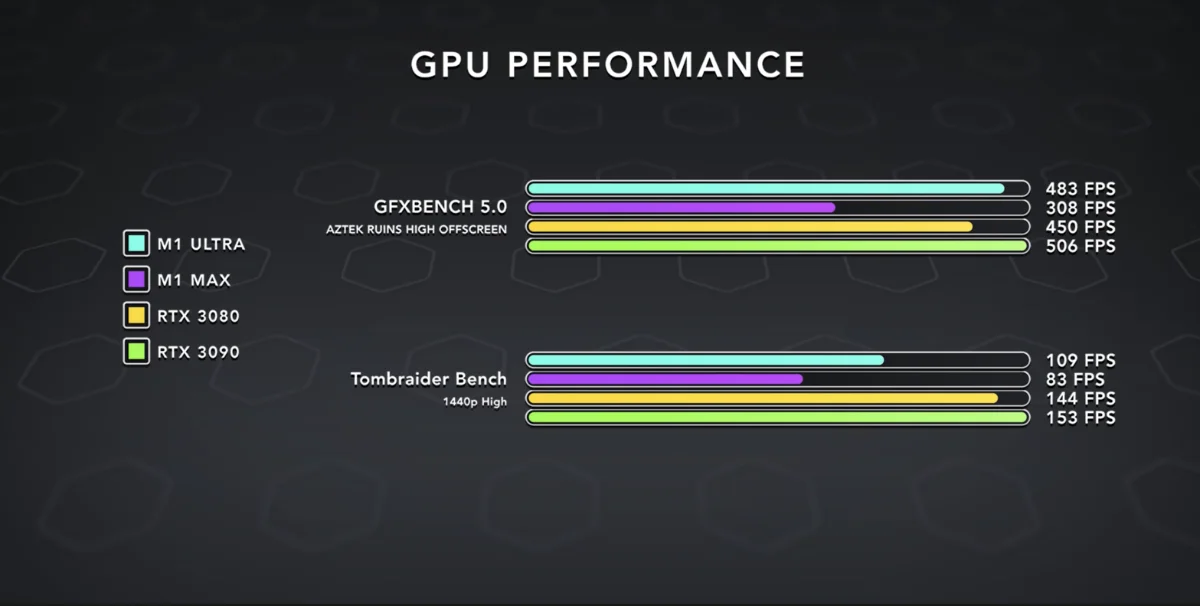
My question is, what games are people playing on Mac? Tomb Raider is one of ~6 AAA titles that was ported to Mac in the last decade. All the other big-ticket games - GTA V, Arc Raiders, Elden Ring - are all hamstrung by Apple's terrible translation software and don't run much better with Crossover either.
Apple Silicon, strictly speaking, is the least adept hardware that you can own for gaming. If you are a gamer, almost every single other GPU on the market would perform better for your needs.
Slay the Spire 2 is in early access and has some major issues running but I suspect that’s some issues in the game engine because it’s not framerate but some sort of hitching that makes button presses not register.
YapYap which is an intentionally retro ugly 3D style runs barely in a playable state on the M1, but it got me through in a pinch when my kid wanted us to both play.
If I want to play AAA I fall back to my desktop, you can stream using Moonlight or Parsec but unless both sides are wired it isn’t great.
My 16" M1 Max is kinda crap at running games - I'd put it somewhere around cheaper laptops with 3050 series GPUs.
My 2013 MBP was going strong with Debian until the battery started puffing up last year, and I finally had to recycle it.
I get it, I know I'm not their market, but it still pains me because it was a great laptop.
> I'd die of cringe if someone asked me about my laptop and I had to say "googlebook"
A "GBook"? "Goog"? "Gook"? "Glook"? "Boogle"?
I would recommend the same. I absolutely love my Neo. It's such a nice machine for the price.
Why pay $500-700 for Mac Book Neo for the same low processing power experience that you can get on a Googlebook for half the price? Especially considering you can install linux on it natively.
Other then that, Gemini is the biggest advantage. Google can offer Gemini for free because its TPUs are orders of magnitude more efficient than Nvidia stuff. Even free tier Gemini is really good considering it can integrate with a bunch of your stuff like google docs, and the lower last gen models have pretty generous usage limits.
Overall, if you are in Android ecosystem, you don't really even need a cheap laptop anymore, considering things like Samsung Dex exist.
What makes you think a googlebook will be half the price of a macbook neo?
Also, a used M1 macbook air is $300 on swappa/ebay and will be even better than the neo anyway. It's still more performant than every other non-Apple ARM based laptop/chromebook on the market and will have far superior build quality.
Lol. There is zero chance the low end mobile phone SoC shipped in those is remotely as fast as a six year old M1. Even flagship SoCs from qualcomm and samsung still do not exceed it's performance yet.
Go look up some benchmarks, the Kompanio Ultra 910 is very comparable in speed to the Apple M1.
It's not really a "low end mobile phone SoC" - it's a Chromebook-specific chip with Cortex-X925 and Cortex-X4 cores.
Cortex-C1-based SoCs are faster but only available in phones to date, which gives them less thermal room.
Anecdotally, I own both an M1 and a Kompanio Ultra 910 device, and they feel subjectively very similar from a performance standpoint.
I pre-ordered a Neo on a whim to use as a couch laptop alongside my work laptop and gaming computer. It's so fast. It blows everything out of the water when it comes to interactivity.
Plus the whole build quality, screen, touchpad and speakers are all so much better than the work Latitude. Linux support is lacking, but it's still a full usable Unix.
Good point, that could work. Buy this and you get so many years of Gemini for free and such. "Why pay Anthropic $200/month for Claude when you can buy this and get Gemini for free for a few years". OpenAI and Anthropic are not going to make their own devices most likely either to compete.
Of course, there are more than 2 options for laptops. Thankfully those two shit companies didn't get to round up that market yet.