
It's obviously impossible to say, but when we look at things that did happen due to Mozilla's financial decisions we have some major disruptions. Besides the already-mentioned Rust and Thunderbird examples we also have the years-long rebuild of the extension system where Firefox, once known as the leader in customization, offered less than 20 extensions for its mobile version and deprecated who-knows how many. I find it hard to believe that these actions didn't affect their market share, goodwill, or both.
I am in favor of Mozilla launching initiatives to support the browser, but right now I think they are using the browser to support their initiatives.
The move to WebExtensions was painful, but it also made it possible to easily port Chrome extensions to Firefox, which was a great boost for the extension ecosystem, as well as being the thing that actually made mobile extensions possible.
I do agree they should've made the transition period longer though. There were like two years in between where some of the big Chrome extensions hadn't been ported yet, but their original Firefox counterparts were already killed. That probably made a few users move ti Chrome, but that was already during the great Chrome migration, so I can't imagine this made a huge difference.
As for the effect of extensions, my feeling is that people care less about them now but used to care more about them back then. I think Firefox main selling point was always "my cousin who works in IT told me to install this instead of that", and once Firefox angered those power users away (at the same time when Chrome was trying to bring them in) the effect compounded.
They (the proclaimed bastion of user choice and freedom) just didn't allow you to install them. Forks and self-built versions handled extensions just fine immediately, there was no technical blocker, just managerial. For years. While constantly proclaiming that it was just a brief temporary state.
I switched to some of those forks immediately, literally every extension I used before worked perfectly. None of them were in the blessed list.
I honestly can't see it as anything but an intentional self-harm move, behind a bunch of smoke and mirrors.
I don't mind experiments, but if you're the "we put you back in control" browser then please build an "off" switch in from the start.
not at the current employee and costs. But do they need to do that? Do they need to produce new products (and pay the cost to do so)?
Why can't they be lean and mean? Focus purely on browser experience without any BS, without any upsell? And there are volunteers out there that willingly contribute code/fixes for free.
Yeah they have rolled out a lot of nonsense I don’t care for, but they have also rolled out a lot of features I regularly use and enjoy. You can’t please everybody, but ultimately I’m glad it’s not “just a lean browser.”
Because they canceled the* project and laid off the lean and mean team that threatened their bloated C++ tower of rubble.
AI is however a potential avenue for raising money.
I meant to use that as a recent example of the kind of decisions that Mozilla leadership repeatedly makes, that don't match up what their users want.
How? By selling the position of preferred model? They can do that without implementing it in a way that means people who don't want it at all have to jump through hoops to opt-out.
Being able to turn AI summaries and such off by default was the final reason I started paying for Kagi. I know they use ML in the background no matter what, but as long as I get links to resources relevant to my search, that I can read/judge/summerise as needed, first and foremost, how they produce that list is not the issue.
People seem to enjoy to be told stuff and don’t really care about sources if the said content is somewhat correct.
Leaders are accountable for their decisions, their statements, their strategies, and their care for the organisation(s) that they lead.
I worked at Mozilla for a bit over six years and really enjoyed my time there. There were lots of brilliant people attracted by the mission and the work was technically interesting. I left in part because I came to the conclusion that the answer to these questions was no. Google's distribution advantages with Chrome and getting boxed out of mobile by the bundled Android/iOS browsers was simply too much to overcome by making a better product. People can gripe about Mozilla's management or product decisions all they want but the fundamental problem is the structure of the web browser market.
A product like Firefox depends on word of mouth. There was not a *single* announcement or decision by the Mozilla leadership in the last 10 years or so which would make me recommend Firefox to others, instead every single time it pushed me away a little bit more. I have hardly ever seen such a fundamental alienation of their core audience, even for Silicon Valley standards ;)
On the other hand, part of the struggle was my fight against the web as a """platform""", with its many privacy and security issues that accumulated as W3C APIs were added like hot cakes and websites exploded in complexity. Firefox provided the control necessary through addons, thanks to its vast community of likeminded people. Nowadays, a lot of the privacy controls have landed in firefox proper, in part thanks to the tor browser upstreaming, if you know where to look.
I really don’t think it would.
One thing “Do what you did before when you were successful!” is missing is that Firefox was sleek, fast, extendable, new, and cool.
It was cool partly because of its “sleek, fast, extendable”, but also because of its “new”, and it can’t get “new” back.
Perhaps launching a completely new piece of software, like the Netscape -> Firefox change (although that was organic, not planned) - but only if it’s actually something new and cool that comes out of it. A rebadge won’t work.
I don’t think there’s a playbook that works here. I’m struggling to think of many major pieces of tech (or non-tech!) that ever got its cool back. Netscape -> Firefox? Apple and/or the Mac? IE4? Lego? Elvis? “New Nixon”?...
Alongside all of the successes there are orders of magnitude more failures, and I don’t think they’re all on merit.
Yes.
* Wanting niche features that don't benefit other people than those in the enthusiast core, thus preventing the company from gaining market share and revenue.
* Ever-increasing expectations in terms of visible feature delivery (e.g. e10s was widely seen as a failure despite being foundational to move off a single thread model and increase browser responsiveness).
* General conservativeness in terms of anything that breaks workflows (famously [1], but also see the criticism of Firefox redesigns over the years, etc.)
* Most importantly, lack of proposals for monetization from said audience (donations do not cut it and smaller and more important projects such as OpenSSL, etc. have also been underfunded from time to time, so nvm funding a browser's development), while also opposing the typical monetization mechanisms, e.g. ads.
These things end up constraining a company from spending more resources to improve a growing product, as they don't have any. While more capital-intensive industries such as phone manufacturers often just choose to appeal to mass market at the cost of giving up their enthusiasts[2], Mozilla always wanted to hedge its bets, and has failed to go in either direction.
Therefore, it is not unexpected that Mozilla is failing, and only survives through whatever meager donations come through, and revshare from Google by placing them as the default search engine.
What users want is a working browser that gets out of the way and them browse the web. That's what Chrom(e,ium) is. It's like air, it's everywhere but you can't see it.
Firefox is not. Every time you open Firefox, there's a new dialog announcing some change or shilling some product. It's cut from the same cloth as that car that Homer Simpson designed. Every time you open Firefox, it works a bit differently, so you have to unlearn some habit and learn a new one[1]. This is friction. This grates. You have some task to perform, which is why you opened the browser, but now you your blood pressure is up 20 points because firefox can't just let you browse, it's always telling you stuff in a dozen different channels, popups, toasts, notifications, there's always something it throws in your face, often multiple calls to action at once. So you say for fucks sake, and go back to chrome which just lets you browse with none of that nonsense.
These are all the calls to action I get when I open firefox. Which I opened yesterday as well, so it's not a clean install.
https://www.marginalia.nu/junk/firefox.png
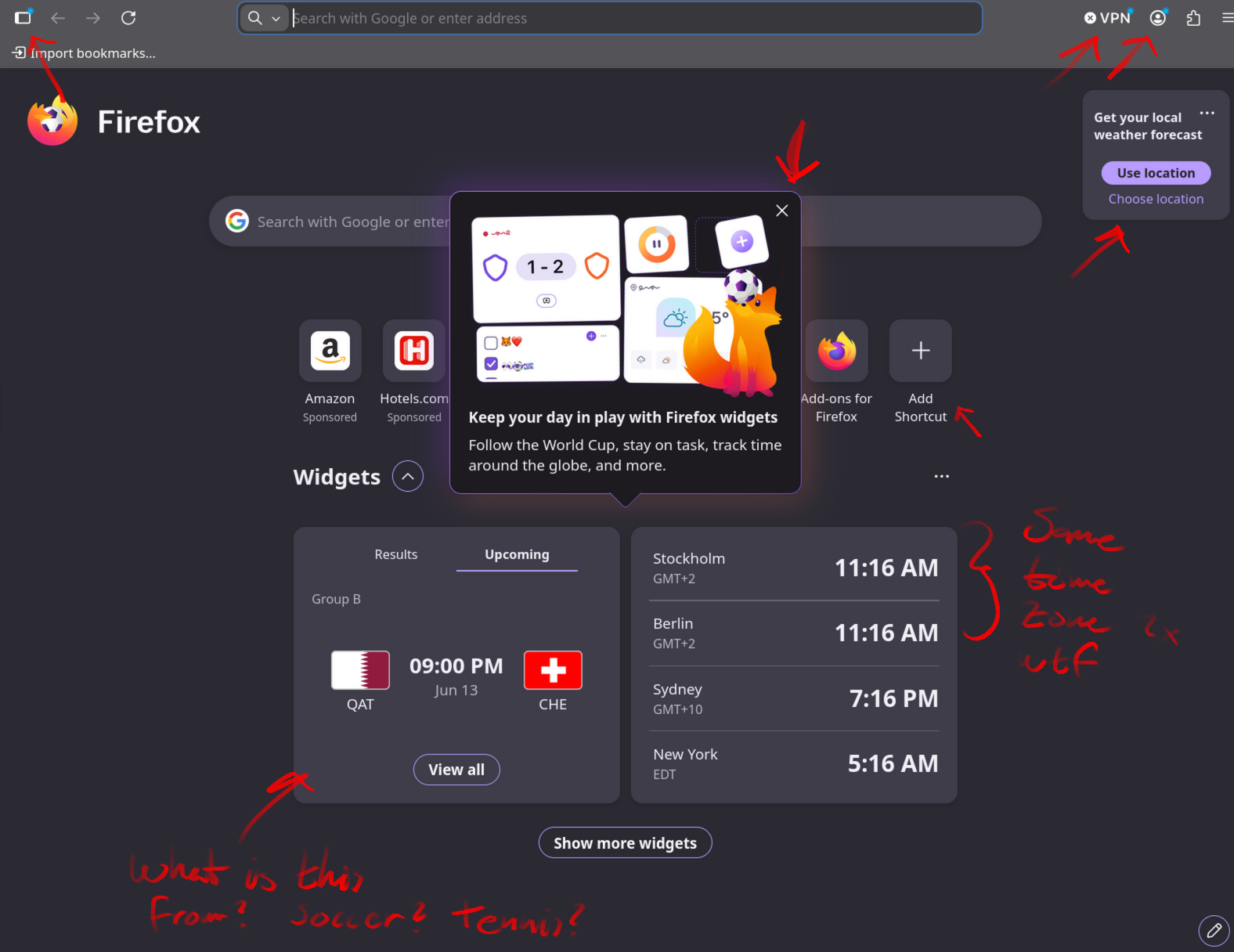
Why is there a dialog announcing widgets, when I can see the widgets already? It's literally telling me what I see on the screen. Why do you need this exposition to inform me of something that is plain to see in front of my eyes? It's like bad fiction writing, except in the form of annoying UX.
Like is anyone working on Firefox actually using the browser, in its vanilla configuration? How can they not see how infuriating it is to be a Firefox user?
[1] 5 years ago we changed which kitchen drawer we keep the cutlery in, and I still reach for the wrong one every time.
Also the context menus are super noisy, I tried cutting some bits out in config, but there's just so much crap in there. Obviously all the AI stuff, but also just the basics; right-clicking on a tab has a sub-menu for "Close Multiple Tabs" which hides "Close other tabs" and "Close tabs to the right" which are probably what I use the most. In Chromium they're top-level menu items.
And it went through a phase a few months ago where the context menus were sometimes offset or goofily sized; I think that's fixed now.
I guess it's easy to criticise, but it just doesn't feel like this stuff is well aligned to actually using the browser, whereas Chromium feels like a solid product.
You did not read the comments of this submission?[1]
This is common.[2][3][4][5] And those were comments which were easy to find because they said Firefox and VPN. Many other comments said they should focus on Firefox solely. Or eliminate all side projects.
> People even want to donate money for browser development, but can't due to the foundation structure.
People can give money to Mozilla Corporation by purchasing Firefox Relay, Mozilla Monitor, Mozilla VPN, or MDN Plus.
Rules for businesses to solicit donations are strict. Mozilla would have to be more careful than most because people confuse non profit Mozilla Foundation and for profit Mozilla Corporation. It is well known in fund raising most people who say they would donate will not donate. And many of the small minority of Firefox users who said they would donate implied or said plainly a condition was Mozilla would abandon other income.
[1] https://news.ycombinator.com/item?id=48515030
[2] https://news.ycombinator.com/item?id=48225892
[3] https://news.ycombinator.com/item?id=47434873
Fair, there are complaints out there, but I'd rank the response very mild compared to AI and the upcoming Nova design.
> Many other comments said they should focus on Firefox solely. Or eliminate all side projects.
Of course, since most of their money comes from search royalties for having Firefox users.
> People can give money to Mozilla Corporation by purchasing Firefox Relay, Mozilla Monitor, Mozilla VPN, or MDN Plus. Rules for businesses to solicit donations are strict. Mozilla would have to be more careful than most because people confuse non profit Mozilla Foundation and for profit Mozilla Corporation. It is well known in fund raising most people who say they would donate will not donate. And many of the small minority of Firefox users who said they would donate implied or said plainly a condition was Mozilla would abandon other income.
Yes, but what I'm saying is there's no general opposition from "enthusiasts" to Firefox making money like the parent commenter stated. The more popular take I've seen is to support Firefox via paying for VPN, etc.
At this point I think it's clear his resignation was not voluntary. Maybe the other offer was sincere, or maybe it wasn't; I'm not sure how we could tell.