
this is a great study if you are an overweight/obese adult without overt metabolic disease, willing and able to consume 90 g/d of starch supplement within a controlled diet, and living in Shanghai with similar baseline fiber intakes endemic to that population. it is extremely not generalizeable to you or even me though I fit more of those characteristics than I care to admit
stay skeptical of small studies like this, friend
But there's already a general advise on this: eat more fiber.
https://med.stanford.edu/news/all-news/2017/08/hunter-gather...
We're a great ape, our body evolved to process a lot of fiber from fruits and starches. It's the modern fiber-deficient diet that's really weird.
90g/day of fiber is similar to the Hadza tribe diet, where they can consume 100-150g of fiber per day.
While they're not essential in short-term survival, they're essential for long-term health:
https://www.ncbi.nlm.nih.gov/books/NBK559033/
We have enough peer-reviewed studies on this.
sample size is 37, number of authors 29
But obviously, most people are a lot more interested in finding a magic food which does this rather than a proven calorie deficit, which is highly effective.
Purely behavioral lifestyle interventions have the lowest long term success rates of all available treatments for obesity. It's especially unreliable if you have weight loss targets higher than 15%.
They are of course still widely recommended due to numerous benefits other than weight loss, but "highly effective" is just wrong in the context of obesity treatments.
It's the same thing for the mental issues epidemic... you can't build a completely hostile environment to human life and well being and then say "welp, I guess we need drugs to make you feel normal now", now they'll sell us the drug and the cure, and you'll be clapping and thanking them for saving you, truly amazing.
Henry VIII might have a word for you on that one, as would many other of history’s aristocrats. The only thing that’s really changed is the cost of food that used to be reserved for kings.
What? Surely changing one's behaviour - particularly the parts of behaviour that caused the obesity in the first place - is a sure way to stop being obese.
If you opt for it, then yes of course, abstinence-only sex education is a sure way to stop ten pregnancy.
Similarly, if you opt to change your lifestyle and start living healthier, and follow through, it will work.
If someone tries to force you, of course it will fail (in both of these cases). There is no way to stop someone else from being fat. We can only change ourselves.
It's funny how proposing an healthy diet is unrealistic and watching fatties eat themselves to death is the new normal, complete value inversion and looser mentality
Behavioural changes work, the issue is that most people don't actually change their behaviour.
It definitely is not "you can just go on a calorie deficit", that is how jo-jo effect works.
For average person that has children, full time job, and whole range of adult responsibilities it is hard. Not impossible but hard, this is why people are looking fo easier solutions.
I've lost weight through forcing myself into a calorie deficit, and it works really well, but it's not particularly fun.
For the "eat to get slimmer" claim, I think we're at the point where "extraordinary claims require extraordinary proof."
What do you mean by "these foods"? Just buy unprocessed food and 99% of the problems disappear. There is no fake, no people trying to sell you these out of malicious intent. Just buy local food people had access to in 1900 and you'll cure all your problems.
A good dietician is worth a few consults if you don’t have the will power to just fast. And as a bonus you don’t lose muscle mass as well because they’ll focus on keeping protein up.
Fasting is like using a nuke where a bullet would do.
How will a dietician measure your maintenance calories? How will they continuously update your macros and calories when your maintenance calorie change week to week?
I am making a claim here: most dietician will not be able to track your maintenance calories better than MacroCodex's algorithm.
Many dieticians simply rely on BMR/TDEE static formulas, and the limitation of this approach is that it cannot reliably track a user's actual maintenance calories well through the span of their dieting journey.
Short term "diets" are nonsense. The solution is permanent lifestyle changes.
How are you defining highly effective? In the sense that a body will definitely lose weight when starved? Or in the sense that counting calories is broadly effective as a weight loss strategy?
The former is painfully obvious and entirely unhelpful, and the latter is provably false.
Anyway what's cute about this is that this isn't novel phenomenon. There are lots of parallels to this in other fields where often effective solutions do exist, but at a system level don't seem to work.
Telling people to diet doesn't fix population level obesity. Telling people about personal financial management doesn't stop people from accruing too much high interest debt. Telling teenagers to stop idolizing instagram influences doesn't fix body anxiety issues. Telling people to stop smoking/drinking doesn't fix addictions. 3-2-1 data backups absolutely work but people lose files all the time.
"general population doesn't have the discipline for it" — only that this feels somewhat condescending.
Let's agree that counting macros or going for calorie deficit is hard if it is not someones job. General population has other jobs, family, social life, other hobbies they enjoy more than fitness. It is not "just eat less" it is "spend considerable amount of time thinking about and planning your eating".
If your maintenance calories are 2700kcal and you eat 300kcal less than that, is eating 2400kcal starving for you?
Most people cannot tell a difference if they eat 100-150kcal less in a day.
>Or in the sense that counting calories is broadly effective as a weight loss strategy?
Yes, it is, and the reason people fail with it is not because calorie counting doesn't work, but because people's maintenance calorie estimates are often poor.
Deficit = maintenance calories (TDEE) - calorie intake
In this, even if your calorie tracking is on point, a deficit requires you to have a decent estimate of maintenance calories.
To throw a monkey wrench into all this, your maintenance calories often shift downward as you progress in your "diet" journey.
It's already factored in our algorihtm: https://macrocodex.app/knowledge/macrocodex/smart-calorie-bu...
Method here: https://macrocodex.app/knowledge/rethink/adaptive-tdee/
People can find the algorithm here: https://macrocodex.app/knowledge/macrocodex/smart-calorie-bu...
In fact, our claim on the app is results within 2-5 weeks for both weight gain and weight loss; I've yet to find a guy who did not achieve success with this.
Calorie deficit is the most effective method for weight loss.
What's funny is when people actually measure their metabolism with this approach, they realize they aren't far off from the average!
I don't disagree that calorie restriction is effective. I just think that you're dropping appetite from the equation when GLP-1 agonists have proven that reducing appetite is effective too.
I am not anti-GLP, someone who believes using GLP drugs is cheating and people should achieve that with blood, tears, and sweat. I see it as a "tool" in the arsenal. I've no use for GLP as I've no problem sustaining deficits as large as 600-700kcal for long. But I've met people who can't do this, so for them GLP is a valid choice, but I'd recommend they pair it with proper dieting and lifestyle changes.
You want to eat good stuff and avoid stuff not good for you; blanket reducing appetite may result in loss of both good and bad.
Here's what GLP users say about the macrocodex method: https://www.reddit.com/r/tirzepatidecompound/comments/1omfgx...
The guide linked in the above post is macrocodex's prototype method, which was later formalized into an app.
I don't want to make strong claims on this, but using GLPs may increase the risk of developing gallbladder stones, as GLPs make it very easy to eat far less than necessary.
A proper macro and calorie balanced diet can give you better results with a smaller GLP dose.
Use GLPs if your actual problem is staying on a "sustainable deficit." Many people who use macrocodex report they do not feel hungry when on such a small deficit, but there are a few who are hungry even at a deficit as low as 300 kcal; for them, GLPs are more suitable, but not a replacement for proper dieting and lifestyle changes.
I mean, observing the weightloss / gain or lack thereof itself will tell you whether you need more of a calorie deficit or surplus. What does an independent metabolism estimate buy you?
How difficult is it? Just eat below the orange line to lose weight and eat above the orange line to gain weight: https://macrocodex.app/assets/hero-tdee-line.v3.1b8c60c2271f... In the image, you see the app continuously updates maintenance calories from observed evidence; on the homescreen, it provides the calorie and macro targets you need to follow: https://macrocodex.app/assets/flow-targets.v3.edc3f34458a1.p...
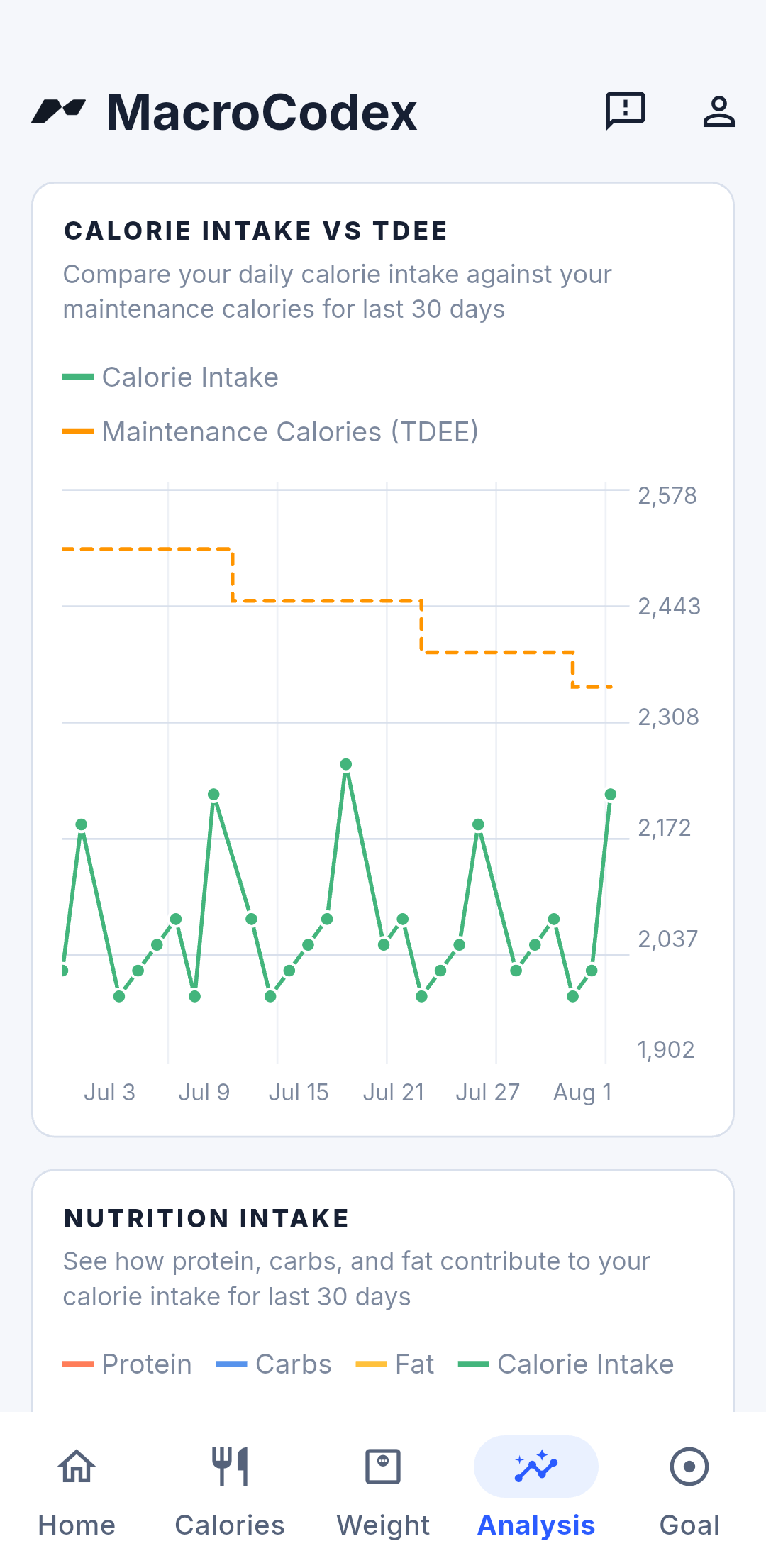
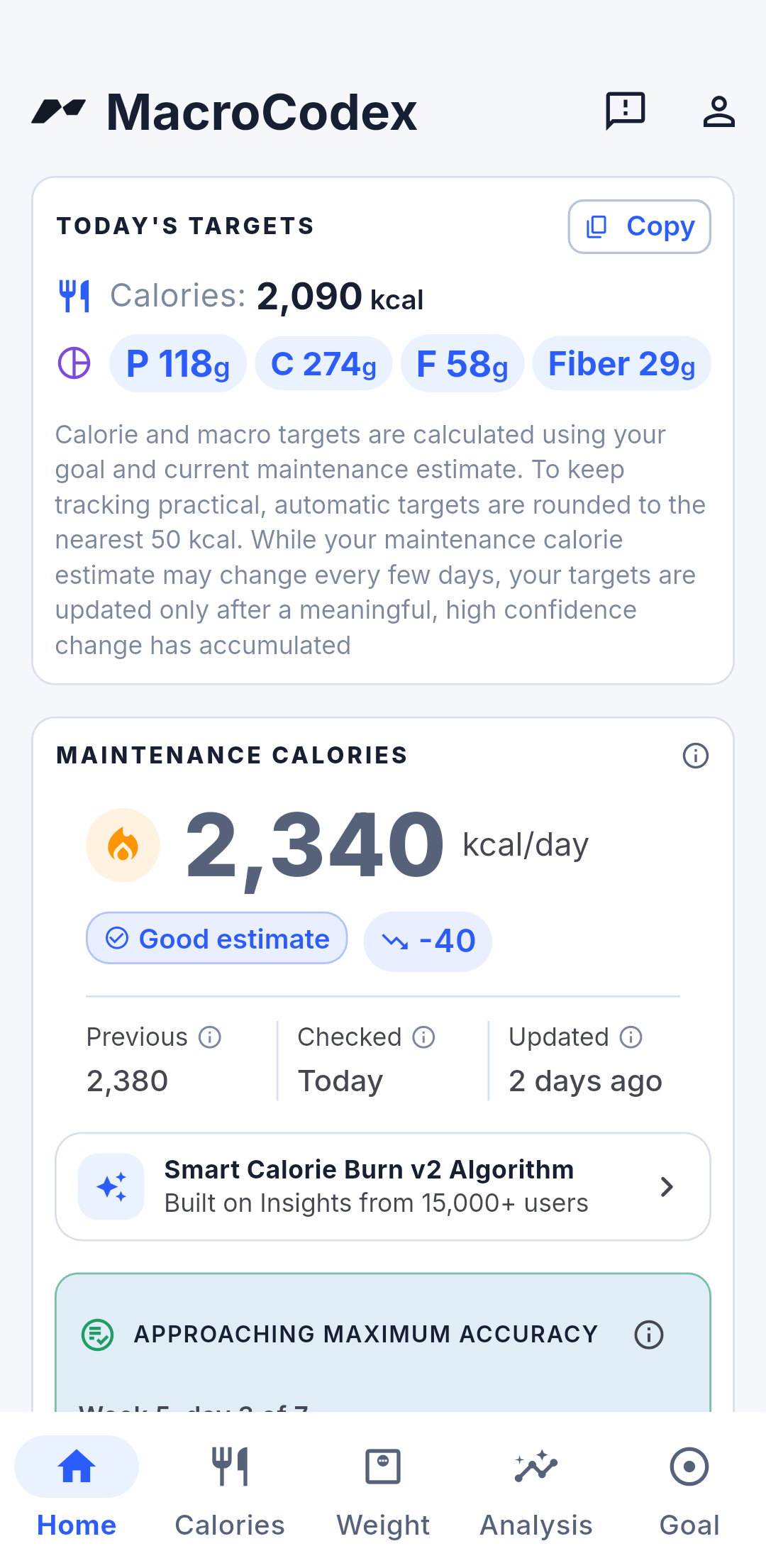
It was never this easy, imho. Many people used TDEE calculators in past, which suffer from the limitation described here: https://macrocodex.app/knowledge/rethink/adaptive-tdee/#tdee...
It's useful for both Newbies and Pros.
When a person figures out their maintenance calories and looks for the average metabolic rate / maintenance calories for their height, weight, and gender, they realize they are not "genetically inferior" or have some serious issue which is stopping them from progressing if their maintenance calories are within average range!
Just knowing that there is nothing wrong with your metabolism gives people enough push to continuously walk on this path and achieve their goal.
>I mean, observing the weightloss / gain or lack thereof itself will tell you whether you need more of a calorie deficit or surplus.
You can read app reviews and these will tell you, complete newbies are having great success with this approach.
If you ask a layman on the street, they'll tell you eat less to lose weight, eat more to gain weight.
The question is: what is less, and what is more? How many calories precisely do we need to eat to achieve 1lb per week of weight loss?
Your total calorie burn for the day changes week to week; people don't know how to make the right adjustments.
Many people crash diet; they lose weight, then they cannot sustain it for long, binge eat, and gain it all back.
What key knowledge are they missing? Sustainable deficit. If you apply a sustainable deficit over a longer period of time, you may not "suffer" as much as you would otherwise
I am not saying drastic deficits are not useful; they are to those who are experienced. Let's say an MMA guy or bodybuilder can do it just fine!
Also, for lean bulking in natural bodybuilding, you need a specific rate of weight gain; let's say for a beginner it's a weight gain of 0.25–0.5% of body weight/week. It's hard for many to achieve this precise range because your maintenance calories are changing all the time!
And if you are an advanced lifter, then the rate of gain you want to target is even smaller: 0.1–0.25%/week.
That's why pro natural bodybuilders use Macrocodex and find it useful.
for those that aren't, you can't actually measure metabolic rates this way.
for a way to actually measure it see: https://en.wikipedia.org/wiki/Indirect_calorimetry
Baer, David J., et al. "Dietary fiber decreases the metabolizable energy content and nutrient digestibility of mixed diets fed to humans." The Journal of nutrition 127.4 (1997): 579-586.
> The study was conducted in Shanghai, China from 3 July 2013 to 14 October 2016
Figuring out and understanding the physiology of different gut bacteria is not just for people trying to shortcut weight loss while still eating unhealthy food or to be sedentary all day.