upvote
Many screen and voice actors are unionized, and the unions have been striking and bargaining specifcially over these points.

For example: https://sites.suffolk.edu/jhtl/2025/10/30/game-over-for-unau...

Software developers, unfortunately, have been convinced that they don't need to unionize, so have no collective bargaining power for dealing with situations like this.

reply
Personally, I just can’t find it in me to be that self-interested. It’s how other people oppose buildings near them because it blocks their view. I really don’t want to stop other people from writing software. If they want to use AI to do it so be it.

That’ll be somewhat detrimental to me perhaps (which isn’t certain), but that’s okay. I’d rather attempt to adapt to a changing world.

reply
I don't know that unions would necessarily negotiate for no use of AI. The SAG-AFRA deals don't preclude all use of AI; they just requre consent and negotiation in certain cases.

A union doesn't give you unilateral power; it just gives you a better seat at the bargaining table. Capital pools its resources to negotiate better as a single bloc; why shouldn't labor as well?

reply
Has it occurred to you that it isn't only self-interest but concern for others that drives collective bargaining? It's essentialy a way for the little guys to stand up to the 1% to fight against the unending series of abuses and diminishment of the average person's ability to earn a livable wage and work under fair conditions.
reply
Yes. But there's a clear difference between, say, stealing someone's voice, identity or intellectual property, and preventing someone from using automation to do labor.

The former is obviously unfair to the person whose identity is stolen. The latter is sour grapes from people who want to control the future.

I also can't bring myself to get incensed over someone using a robot to write code. It's literally the modern equivalent of smashing knitting looms.

reply
This is the first time I've heard someone argue that unionizing is a self-interested pursuit. It's called "collective bargaining" for a reason; workers who cooperate in negotiations with their employers have more leverage than those who negotiate individually. The entire point is to work together for the betterment of the group!
reply
See current situation where the Carpenters' Union in California is pushing hard against an initiative that would make it much easier to build more housing in the state because it would also reduce requirements for union labor.

Unions are very much an in-group vs out-group phenomenon (and in many cases, the benefits are specifically to the more senior union members vis a vis the less senior ones.)

reply
> See current situation where the Carpenters' Union in California is pushing hard against an initiative that would make it much easier to build more housing in the state because it would also reduce requirements for union labor

If you're talking about AB 1751 (Missing Middle Townhome Ownership Act) I think you have this exactly backwards.

> Unions are very much an in-group vs out-group phenomenon

As opposed to what? You and the GGP phrase this as a dichotomy, but I'm really curious what the other side of this is, because "not being in a union" doesn't erase your self interest or all the many many groups of people doing the same that don't feel like they're apparently being overly self interested by forming corporations, governments, non-profits, advocacy groups, etc, etc, etc

reply
I can't speak for the OP, but I don't think their point was that they're against the self-interested nature of unionizing.

I read it more like they're against trying to stop, hinder, or prevent the use of new technology, simply because it's personally threatening.

And I feel the same way. If I was part of a union, I would believe in the collective bargaining power, but I wouldn't necessarily believe we should use that to pursue every single possible agenda that might benefit us. And I've personally pooled my capital with others in the past in order to achieve certain outcomes. And in those situations I also didn't attempt to reach so far as to limit the totally valid freedoms of others just because I knew it might be better for me.

Acting in the interest of a collective doesn't mean one must also abandon the ethics they usually employ when acting in their solo self interest.

reply
Have you ever not been able to send your kids to school for weeks (or years in the case of COVID) because the teachers refused to work? Have you ever been unable to get timely medical treatment because nurses refused to work? Have you ever been unable to work yourself because the transit workers refused to work?
reply
Maybe if employers offered better working conditions and salaries people wouldn’t feel the need to go on strike?
reply
People have this right to take better jobs at other companies. This is how we get better working conditions: competition between employers. Tech has figured this out. I’ve never felt the need to go on strike.

Unions can be a deterrent to this. If you have sectoral bargaining, you can’t get a better deal anywhere because everyone pays the same. Or even if it’s within a single company, you’re just stuck with whatever scheme the union bosses agreed to.

But also, unions are a deterrent to new employers since fewer people want to start companies in industries where unions have taken over. They’re a nightmare to deal with. Fewer employers means less competition means worse services.

We have a dynamic economy with lots of competition. It’s easy to switch jobs and find a better place to work. We should not want to give this up.

reply
You realize his examples are public sector unions. Which mean the “employer” you are referring to is the citizens? Not some evil corporation, government mandated monopolies which then get taken over to serve their union members.

I don’t have any objection to voluntary unions. Meaning people can join them for support or collective bargaining, but that citizens can just opt to not employ anyone in the union. Unions could be support structures for workers, instead they are mafia bosses.

reply
Well… yeah. But I didn’t blame the employees, I blamed the employer who must have seen the writing on the wall for a long time and yet let it come to this.
reply
Why do you assume unions are always reasonable? Unions in the US have a long history of over reaching and crippling industries and governments.
reply
Those self-interested unions better stay away from my interests!
reply
[flagged]
reply
Where do I say that nurses shouldn’t have good working conditions or good pay? Most of us have figured this out already: you can take a job at another company that’s better to work for. Most nurses do have pretty good working conditions and get paid well. Competition among employers is the solution here. Walking out and putting customers (or patients in this case) in a precarious position is not.
reply
So she doesn't enjoy her job and only works there because you can't make up the $15 hour difference between her working in a book store for minimum wage vs her working for $30 an hour? Why don't you take a part time job on the weekend to lighten her load? There are many people who become a nurse because its a calling.
reply
their point is while the 'group' wins, the rest of the world loses.

localized gains, distributed loss.

reply
as an art enjoyer, i do not feel that having less media written, drawn, or voiced by a computer is a loss.

a computer can never be sad or horny or have taste. it can only make product. i also think artists should be paid living wages with good working conditions.

thank you SAG-AFTRA, WGA, IATSE, AEMI and Teamsters.

reply
There is no moral imperative to help the world reach an optimum. Rather, the world is full of competing interests.
reply
>Personally, I just can’t find it in me to be that self-interested

Caring about your ability to pay your bills, and support your family is "self-interested" in the same way that choosing to not drive into oncoming traffic is "self-interested".

reply
> Personally, I just can’t find it in me to be that self-interested.

Yes, exactly. Do not advocate for yourself and your colleagues by joining them in a united front. Your voice does not matter. You will continue to adapt to widening wage disparities.

You will accept a pay cut and increased productivity goals and be happy to continue adapting as your cost of living keeps on climbing.

reply
You may be surprised to know that residential areas in San Francisco are height limited, sometimes as short as 4 stories. They're not exactly anti-progress.
reply
Height limiting is anti-progress, which was his point.
reply
Ok SF needs somewhat higher-density housing. But wanting something good for yourself and your peers isn't anti-progress. If the benefits accrue to only a few people, it's not progress.
reply
> But wanting something good for yourself and your peers isn't anti-progress.

It is if it makes it worse for everyone else.

reply
deleted
reply
Thats great, although understand that unionizing protects the more vulnerable of also the software engineered. You not advocating for your rights also means weakening others. Is it still self interested to unionized from that perspective?
reply
>The union demanded clear protections to ensure that recordings of actors’ performances could not be copied without consent and compensation.

>California’s legislation passed AB 2602 and AB 1836 in September 2024, prohibiting media companies from using AI to replicate actors’ performances without their consent.

it's a very reasonable law, but it is not the win you seem to believe it to be. the actors who refuse to consent will simply be passed over in favor of those who don't. no law will ever be passed to force companies to employ humans over machines, and if it were, the industry would move elsewhere. this is not without precedent :)

speech models have got so good so quickly that you can already replace a VA -- even an AAA prima donna -- with a teenager from Fiverr, who will simply bruteforce the right inflection.

reply
I don't think software developers need to unionize - but to form French style co-ops.

e.g a lot of video game studios even the AAA ones could be co-ops. same as a lot of SAAS software companies. Linear - just announced a tender offer. I don't see a reason - why linear couldn't work as a co-op.

reply
Are the employees supposed to front the capital themselves?
reply
it's hilarious to see some people here go on about how they're proud to work so that they can be replaced

I think too many just expect that they can get by like before because they're a 10x engineer or whatever

reply
I think I sit somewhere between these two descriptions. I've always supported unions and other "for the common good" type machinery. At the same time, I desperately also don't want to end up doing something the equivalent of barring the use of calculators just so I can toil away at a 9-5 crunching numbers more slowly instead. If AI really does replace all of the meaningful jobs we can do... great - I'd rather we make sure the spoils of that production are distributed than try to cling to preventing the technology from being used.

Inexplicably for the current moment, AI has so far actually meant I have even more to do instead of less. I expect that to change eventually... but man, is it a bit of whiplash to go from wondering if my job will be around in 10 years to starting the work day and being more backed up than ever. Doubly so since the rate of change does not seem to be very evenly distributed by tech role.

reply
> I'd rather we make sure the spoils of that production are distributed than try to cling to preventing the technology from being used.

Spoiler alert: unions can help with that.

reply
Agreed, but I must've severely messed up my message if that was supposed to be a spoiler. To be clearer: I think the unions, economic policy, and such should help with that part rather than us wield the very same to hide from replacing the work we do with something much easier. I.e., don't be ashamed to work towards that, just come together to ensure we all share the spoils.
reply
> it's hilarious to see some people here go on about how they're proud to work so that they can be replaced

To be fair, most of us spent our entire career trying our best to automate ourselves away one way or another, and always seen that as our job description.

reply
No, that is just nerd heroism lore that indeed has always shown up in comments, that part is definitely true.

Some people dislike automation altogether and like the computational aspect. Most people seem to enjoy constructing virtual worlds and Rube Goldberg machines.

reply
I thought HN was mostly people who hated doing 'the thing' and would procrastinate until they build a system that does 'the thing' and then they would work tirelessly to never do 'the thing' themselves ever again.
reply
Much of computing history has been about replacing humans. If they were proud of their work pre-LLMs, then at least they're being consistent!

It's kind of hypocritical to change just because it's now a different industry being impacted.

reply
I agree with your point, but I don't think it's funny at all. The whole field is changing because of this. The career, except for those ones lucky enough to have jobs where they're valued and they can decide how to use AI tools, is turning into shit because of this and software engineers have become a lot less valuable as management is trying to turn them into reverse centaurs.
reply
What options do you have? If you're the 10x engineer you'll be a 100x one and do just fine. Otherwise what can you do besides holding on as long as you can or start searching for a new career.
reply
It won't happen to me is what I used to think
reply
> It won't happen to me is what I used to think

In my experience this is what almost everyone thinks, right up to the point where it starts happening to them.

And it isn't just an individual blind spot, organizations suffer from the same thing in the sense that many companies will be happy to automate away all their labor to avoid paying the "human tax" without giving much thought to the fact that the need for the company itself will also be automated away soon after.

If you can replace nearly all of your workers with some cheap tokens and prompts, everyone else who previously would have been a customer can replace your whole company with the same thing.

reply
Many people who promoted DEI when their corporations demanded it were fired later.

Useful idiots always go first after the goal is accomplished.

reply
deleted
reply
My objection has always been that advocates either can't or don't care to explain how such a thing would actually work from the perspective of a unionized engineer.
reply
And thus the developers remain, until this very moment, ionized.
reply
No one has offered a union to join at any workplace Ive been at
reply
Yeah, the problem is, someone has to start the union. It takes work. You have to get the whole workforce to vote on it. A lot of software engineers believe (or believed) that they were too smart and professional to need a union. And of course, if management gets wind of it while you are working on setting up the vote, they may do all kinds of trickery, legal or illegal, to block it.

It is possible. But it's quite uncommon in this industry in the US.

And given the current administration, it is hard to trust you'd get fair enforcement of labor laws if the company did illegal things to block unionization.

reply
Because software developers enjoyed scarcity for most of the fields existence and could barter themselves better conditions instead of falling back to unionized fixed incomes.

In any case, the overwhelming majority of jobs is non-unionized and I don't think that software developers can stop technological changes by unionizing.

reply
That is an american take.

Sweden just has an "office worker" union.

https://www.unionen.se/in-english/this-is-unionen

Now, they cannot prevent offshoring or AI use or replacements. Very very rarely if ever.

But they can negotiate a large layoff and give better pay/conditions during work etc. This view that unions can prevent anything... when so many jobs have gone to east EU (all amazing and good at what they do but lets face it, it is due to pay) so yea there wont be any union preventing AI...

reply
Half of them are from India or China. Racial diversity is known to be detrimental to unionization. In fact, Amazon used this exact strategy to bust nascent Somali unions.

https://www.computerweekly.com/news/252481961/Amazons-Whole-...

reply
Here is the obligatory scientific paper for those who cannot observe simple facts without a statistical analysis:

https://www.sciencedirect.com/science/article/abs/pii/S01762...

reply
It'll come quickly for audio books. I've been working on a locally hosted, fully containerized web application to narrate my sci-fi novel using a full cast of characters and a few distinct narrators:

* https://i.ibb.co/ccqKZ71L/keenlore.png
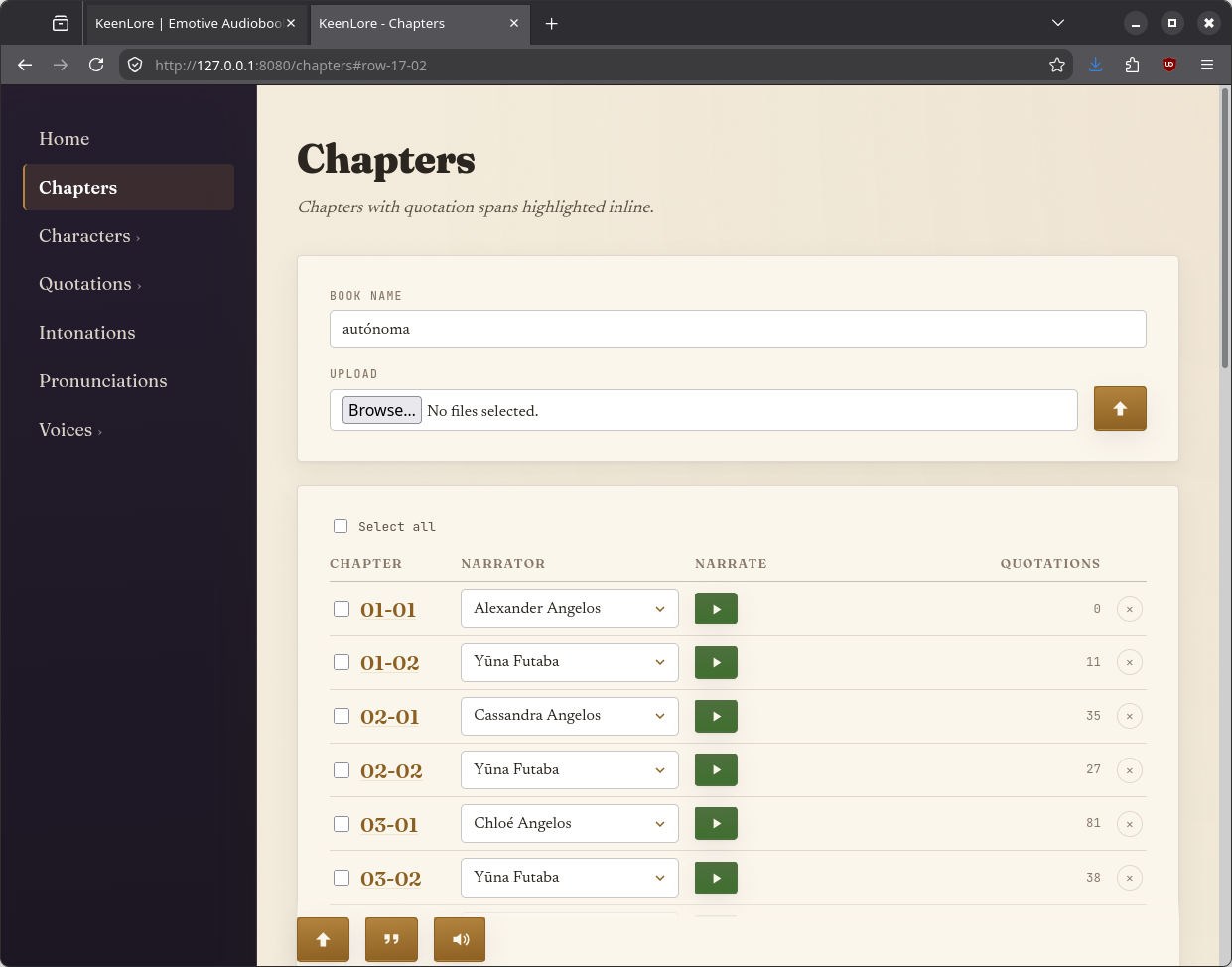
* https://i.ibb.co/1t3W0JqZ/keenlore-02.png

* https://i.ibb.co/LdBqHwKB/keenlore-03.png

reply
This is very interesting! Imagine Silly Tavern, with dialog tagging and coloring of some sort, auto-generated talking heads. Almost a game engine.
reply
I would pay a few actors (mostly Star Trek TNG cast) money for a license to their voice.

I don't know how the next generation of beloved actors comes about and how we don't descend into a pit of neverending photocopies of things people once loved in the 1990s/2000s.

reply
From reddit:

* $250 per finished hour for the narrator (lowest professional rate).

* 200k to 270k words.

* 22 hours, 20 hours, and 25 hours.

* Books 1 to 3 cost $5,500, $5,000, and $6,250, respectively.

My novel has 8 major characters, including the 3 narrators, and 25+ minor characters. That price tag is daunting, presumably in USD. This would mean investing $7,750 CAD in crafting an audiobook, which may not even sell, much less recoup the investment.

In contrast, a locally hosted solution has a wallet cost of pennies for electricity plus my time to develop the system.

reply
> I don't know how the next generation of beloved actors comes about

To me it's been obvious for a while now: there won't be one

reply
"Celebrity" is an old world concept, and does not need to exist. it's find if we don't have them
reply
Work that doesn’t have a personal brand involved is basically dead. Arbitrary voice acting? Dead.

It’s brutal for these people. The creative industry was always hard, but this is just plain brutal.

reply
Everyone will probably go through the 5 stages of grief w.r.t AI adoption in their field and the gatekeepers will (rightfully) hold onto hallucination and errors as reasons to delay incorporation or to incorporate it with more human handholding.
reply
I'm really sad about how little creative control these tools have. They seem great for creating slop, but pretty useless for creating content that someone would love. I love the potential but text isn't really a great medium for describing artistic vision.

All these demos are focused on how easy it makes everything. Easy is great, but if everyone is able to make instant cute cat videos or whatever it just devalues it. I want to see turning a photo into a rigged 3d model, letting the artist animate and then generate the video. This technology could be used to increase creative expression, but instead it's being used to squeeze out creative expression

reply
Text is not the only input. You can provide 3d block outs with rudimentary animation, annotated images with arrows etc, voice recordings of one person acting out some emotion then mapping that to a different character's voice, other uses of video to video, etc.

There could easily be at least some time period of low skilled ugly people acting in approximate but shitty ways in cheap sets just to give an input reference to a model and then describing the differences in text, yielding gorgeous people speaking with prestigious accents doing stuff in fancy locations in the output.

reply
A lot of it will get automated the same way very many industries got automated. A lot of physical labour got automated once a primitive for it was created. Similarly, we have now a primitive for automating knowledge work. In the next few years to a decade, as all the right training data and runtime environments are slowly consolidated for various fields, a lot will be automated. There is no inherent reason a voice actor must be an eternal job, the same way there was no inherent reason for a draftsman or stage musician to be an eternal job.

It has nothing to do with skill. Both were very skilled jobs. Draftsman as well despite many people going to it straight from school. But computers and CAD mean that it is now necessary for someone to do a STEM degree to be a draftsman. Recorded audio made many stage musicians redundant. It is cheaper to do it this way and gets superior results, that is all, there is no further agenda.

Now too, the next generation of voice actors and many other knowledge workers will have to go up the value chain one step and operate or potentially build these tools (in whatever form they mature to in a decades time).

The current generation of voice actors will face the same situation as many before in the performance industry - stage musicians/performers for example that were made redundant by recorded audio. The reality is that most of them just left and dispersed into the economy doing completely unrelated jobs.

For software and generally computer engineers, this new primitive happens to itself be software, so it's less of a transition and an easier upskilling path to learn to build it. And building it is one step higher in the value chain than simply using it. That is a structural advantage.

reply
I don't really like comparing the way automation of the past displaced jobs to the way AI is/will displace jobs. The timeline is just faster and, more importantly, there were still plenty of other fields of work for people to go to.

But now that we are automating white collar work... where will people go? I'm a 36 year-old veteran who has returned to college and so many of the younger students seem to be filled with despair.

I have hope for the future, but I think there will be an uncomfortable period of time.

reply
I think people are overestimating the speed at which the transition will happen. I think it will happen much slower than is often portrayed online.

This slow transition period will also help answer the "where will they go" questions. We can't answer them right now.

Ultimately, everything we do is in service of social political and personal human incentives, and I think the effect of that is discounted when people make these takeoff predictions for AI and "AGI"

reply
recently I encountered several youtubers in the uncanny valley of "is it Ai or really repetitive intonation pattern"

one youtuber used irl footage, with hands and stuff - so I know there's human behind the camera

the other was a letsplay that reacted to events just fine emotionally

and yet the uncanny valley of the sound is in full force. Maybe youtube has done something with the codecs?

I feel sad

reply
it effects software develpoers because ai has compliers , tests , ci and bought tons of data in mercor.

it always sucks at everything else.

reply
Sounds like a perfect application of AI. Some jobs should be automated.
reply
I would rather hear human voices than synthesized ones. I don't care how realistic they sound. I'm not alone, and the sentiment will certainly grow.
reply
As long as there are enough people than there will be a market. I think there are a lot of people that prefer human but don't want the human cost.
reply
Ok, let's go the other way round. Which jobs do you think should not be automated?
reply