upvote
It's odd that even today, different disciplines are still silo'd. My son started a research cross-database search engine because different disciplies use different terms for nearly identical concepts. Even within medicine it's silo'd.

Trouble with that startup was, the medical folks with money don't use computer tools. And the students in training have no money.

reply
It's crazy that we talk about LLMs, AI/ML and what not but so many fields still don't use computation as much as we think they do simply because they cannot reliably keep up with the advancements happening almost everyday and people simply forgetting about backwards compatibility in their products
reply
A researcher submitted a paper to the medical journal _Diabetes care_ in the nineties that basically redescribed integral calculus as a novel finding. How’s that for a silo?
reply
reply
This is really funny. A less extreme example is how much domain-specific terminology in Reinforcement Learning and Control Theory/Model Predictive Control refer to the same underlying phenomena, but we must translate between the two. I understand there are many unique concepts as well, but it would be so helpful if the overlap here used the same terminology and notation.
reply
I still get IEEE Trans. on Control Theory, and it's all machine learning now. Except that the controls people are desperately trying to solidify the underpinnings of machine learning, so that control systems don't suddenly misbehave for some sets of inputs. Controls people want a guarantee that if it does something reasonable for inputs of 5.1 and 5.2, it doesn't do something completely unexpected for an input of 5.15.
reply
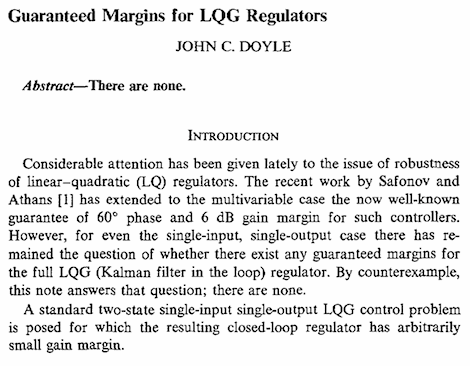
Reminds me of my favorite abstract, from John Doyle's paper "Guaranteed Margins for LQG Regulators".

https://improbable.com/wp-content/uploads/2011/10/ThereAreNo...
reply
Is your son’s search engine somewhere available, please?
reply
It was something like 'Rugobi'. I'll ask him if there's a demo still up.
reply
HIs pubmed subscription expired.
reply
I always say knowledge is like a sweater. Pull a thread and the whole thing unravels. Everything is connected so if you start somewhere and never stop learning you'll end up in every discipline. There's also a good old Weezer song called Undone for this.
reply
My minor required me to take Electricity & Magnetism from the physics department the same semester I had to take Fields & Waves from the electrical engineering department.

Yes, they were identical.

My crib note that I took into the later final exam was simply a conversion between terms in the two departments. Nothing else; I'd already crammed and aced the first exam.

reply
Oddly enough, I got a physics degree, and then happened to teach the engineering course for one semester many years ago while in between jobs. I'm sure this varies from one college to the next. My impressions at the time were:

The physics version was much more mathematical, and did things like solving everything in spherical coordinates. It also kind of served as a preparation for solving corresponding problems in quantum mechanics.

The engineering version was more nuts-and-bolts, covering things like transformers, motors, and transmission lines. (Antennas were for a later course).

As a consequence, teaching the engineering course required me to quickly learn a whole bunch of stuff that we glossed over or ignored in the physics course. While also teaching it. Fortunately I was an experimental physicist and had also done some work in industry, so the topics weren't utterly unfamiliar.

reply
deleted
reply
He's definitely the one guy from the 20th century I can't really reconcile his capability and breadth, other than being an alien or a time traveller.
reply
Nash's game theory dissertation was something von Neumann considered obvious and not particularly noteworthy, if I remember my lore right. He was among the first game theorists, focusing more on collaborative games than pure strategic/competitive games.

Einstein built on the shoulders of Riemann, Gauss, and others when considering the universe might be non-Euclidean!

All brilliant people, many singular minds of great repute, yet, all improved by the rest.

reply
Saying that von Neumann was one of the first game theorists undersells it.

He wrote the original book on game theory! The Theory of Games and Economic Behavior with Oskar Morgenstern.

Relatedly, MAD was his conception as well.

reply
> He wrote the original book on game theory!

I always found it endearing that von Neumann loved playing poker with friends but was admittedly terrible at it, regularly losing money.

reply
I believe Nash himself didn't consider it particularly noteworthy either, and was far prouder of his work in pure math (like the Nash embedding theorem).
reply
another famous piece of Von Neumann lore is that he constantly advocated nuking the Soviets.
reply
I was wondering if someone would mention this.

It's interesting how much worse off the world would be if the smartest people were in charge of it.

What ultimately blocked his nuke proposals? (Why didn't anyone listen?) I'm curious about whatever failsafe that was.

reply
1. Big assumption that the world would be worse off in that alternative future, no?

2. Probably what blocked his proposals is that most people are loath to murder millions of other people (especially if they have ~any other option, including "do nothing")

reply
It's all psychological inertia. For example even if they knew that Communism would cause tens of millions of deaths they would not nuke USSR.
reply
Not sure that it would be worse than letting the other end of the spectrum be in charge of it, as we've seen..
reply
We can't know.

As an extreme example, antisemitism was so commonly palatable that an open admirer of Hitler, Charles Lindbergh, was a very serious candidate for the presidency.

Today, open antisemitism can get one's career derailed in much of the world. Would that be true without the eye-opening shock that the news of the concentration camps produced?

IN NOW WAY was the Holocaust forgivable, but we simply cannot say if the world today would be "more moral on average" or "less moral on average". Maybe Jews would feel and be far less safe today in predominantly Christian countries. Maybe not.

All we can say for certain is that the horrors enacted upon the Holocaust victims were evil. As we can surely say that murdering many millions of people living in the USSR would be.

reply
deleted
reply
Even Bertrand Russell briefly advocated this. "Better dead than Red."
reply
Shannon may be gaining on him.
reply
I vote for Wiener at this point
reply
I'm more of a Vannevar acolyte myself.
reply
I warmly invite you all to join the Church of the Eval Genius for only $35:

https://github.com/SimHacker/moollm/blob/main/designs/eval/C...

The Holy Trinity:

Father: Alonzo Church: L3 - lambda calculus, the name the institution bears

Son: Alonzo (Snap! mascot) - Incarnation — Gobo, λ on his head

Holy Ghost: λ - First-class procedures; β-reduction; eval-as-spirit

Membership — Eternal Judgment ($35):

https://github.com/SimHacker/moollm/blob/main/designs/eval/C...

John von Neumann tried to hire Church's own student, Turing, who declined. The Father begat the Machine; Johnny wanted to be its landlord.

Ecumenical Outreach: All fans of other gods are welcome. Bring your Vannevar, your Shannon, your Wiener, your Johnny. In the Church of the Eval Genius every god is a procedure, and every procedure may be passed as an argument.

reply
Genuinely curious, because I know von Neumann was an intellectual giant, but what was his most original/groundbreaking contribution? My impression of his work has always been that he would survey a field, find some particular problem that needed attending to, tidily solve it, then move on to some other domain. But I guess there's a latent assumption there that he didn't do anything huge or groundbreaking.
reply
Battacharya's The Man From the Future is an entertaining read (on JvN's life and achievements)
reply
I'm reading this now, and can confirm it's very entertaining, and gave me more perspective on his life and achievements (coming from a CS background).
reply
*Bhattacharya
reply
"Most" involves great subjectivity, but how about laying the mathematical foundations for quantum mechanics?
reply
Definitely my favorite physicist for the same reason you state. The notion that he just went around different fields and said “here’s how math can improve things,” invented some new approach, and moved on to another field to do it all over again just cracks me up.
reply
Nowadays we'd call that "engineer's disease". I wonder how many potential Von Neumanns were discouraged from branching out into other fields by jealous gatekeepers who assume that any interest in their field by "outsiders", especially technical people, is "epistemic trespassing".
reply
I have yet to meet a (academic) researcher that doesn't like to talk about their research topic if somebody comes and is genuinely interested. I mean most work on a topic that has maybe another 10-100 people in the world who are interested.

The problem is that instead most people to come to them are either obvious crackpots, who think they have solved cancer (energy...) and contact the person because they are a biologist, physicist ... (on a completely unrelated topic usually). Or they come from a place of arrogance, i.e. "we do ... like this, our method is clearly superior you should adopt it", or even worse here buy our clearly superior method.

reply
An example I can think of off the top of my head is Luis Alvarez, the nobel physicist who came up with the asteroid impact theory of dinosaur extinction. The geology and paleontology community shunned him until the 90s when the Chicxulub crater was discovered (though geology is historically infamous for this, to the extent that nearly every important paradigm shift in geology was made by non-geologist outsiders who faced ridicule for their theories)
reply
For every von Neumann you probably have thousands if not millions of crack pots with ideas not worth wasting time on. So I understand the scepticism
reply
If people are assigned a "gatekeeping" position, they should at least be expected to be able to tell great minds from crack pots. (As opposed to just blindly applying a statistical filter)

Otherwise why not just replace them with a script (or these days, an AI)

reply
In this context "gatekeeper" is often defined as broadly as "any individual academic or researcher receiving a cold email".
reply
Isn’t history replete with examples of great minds who were received as crackpots until, after careers’ worth of labor to validate them, some of their crazy ideas turned out to be correct?
reply
The problem is the actual crackpots outnumber hidden gems by many orders of magnitude, so wasting time trying to sift through the noise is a losing proposition.

And I don’t know many, if any, examples of people received as crackpots that later were considered genius. At worst genius takes a little time to be recognized, which is a situation far more common.

reply
E.g., economics.
reply
I've literally never met a person who didn't consider themselves economically knowledgeable.

It's like an analog to the fact that almost all people consider themselves funny.

reply
Nothing is more fairly distributed than common sense: no one thinks he needs more of it than he already has. -- Descartes
reply
[dead]
reply
Seems to me it's less about gatekeepers and more whether what you bring to the table is useful to people in that field.

If somebody truly believes they have a useful model then they don't discouraged by academic gatekeeping, they go and build Time Cube.

reply
Usually that's because the engineer is not a very good engineer, at least outside their specialty. If they had studied engineering more, they would have probably learned that other engineers are already doing the thing they proposed.

"Using methodology from a field known for its focus on methodology in another field" was still a novel idea in von Neumann's time. But because von Neumann and others did it, and because millions of people entered science after them, most combinations like that have already been tried. Breakthroughs from combining ideas from unrelated fields require something little less obvious these days.

reply
If someone is equal in talent to Von Neumann it's probably extremely difficult to discourage them enough via gatekeeping to stop them from making progress.
reply
It's highly unlikely, I think, that another Von Neumann was prevented. He was a singular genius.

However, the gatekeeping you mention definitely occurs to mere mortals who might have an interesting bend on existing ideas.

reply
Mandelbrot did this too, but he created a lot of animosity in the process because he could be really abrasive.
reply