
The only “disinflation” consumers have experienced is devaluation of products through obsolescence as newer, often more expensive alternatives enter the market.
I'm almost cynically happy about Moore's law ending and hardware getting expensive if this is what it takes to improve software in the long term.
I'm sure some storage servers or storage appliances were built with many TB even then but it wasn't really something I saw a lot.
The prices of all those things continue to skyrocket.
Can you? I assume you mean spinning platter, but even then.
Computer parts are unaffordable this year.
“I can't eat an iPad.”
> Best not to cite the price of the new iPad as an example of why inflation isn't a problem when you head into a working-class neighborhood. In Queens, New York, on Friday, New York Fed President William Dudley did just that. He got an earful. After being bombarded with questions about food inflation, Dudley attempted to reassure his audience by putting rising commodity prices into a broader economic context -- but that only made matters worse. "When was the last time, sir, that you went grocery shopping?" one audience member asked. Dudley tried to explain how the Fed sees things: Yes, food and energy prices may be rising, but at the same time, other prices are declining. He then stretched for a real world example. The only problem was he chose the Apple's latest tablet computer that hit stores on Friday, which may be more popular at the New York Fed's headquarters near Wall Street than it is on the gritty streets of Queens. "Today you can buy an iPad 2 that costs the same as an iPad 1 that is twice as powerful," he said."You have to look at the prices of all things." This prompted guffaws and widespread murmuring from the audience, with one audience member calling the comment "tone deaf." "I can't eat an iPad," another said.
https://awealthofcommonsense.com/wp-content/uploads/2020/11/...
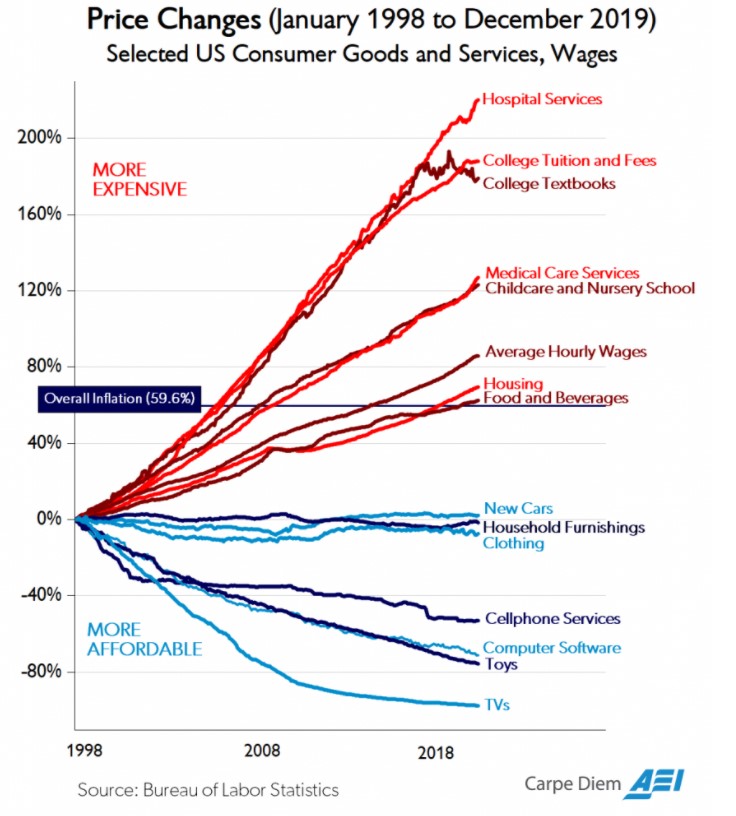
Of course, competition leading to near-zero profits means most competitors collapse, and the remnants get bought up by monopolists or oligopolists who then become rent extractors.
The technology was fundamentally developed with government grants to universities, or corporate labs like Bell Labs that were funded by a legal mandate on its parent corporation. Capitalists can only develop products that are basically ready for market, their margins are thin and planning horizons can only survive about 5 years usually. Their main power is throwing oodles of money at something ready to go and scaling it.
Edit: I will be slightly more charitable and note that capitalist companies can also do incremental research if there is a gentle and obvious hill to climb. Sometimes people do make crazy bets and they pay off, but that's more the exception, in America the dominant driver of technological innovation is government funded research supplied by capitalist scaled technologies (i.e. you research the next paradigm in the lab and purchase e.g. pre-existing computing resources from a company).
More and more it’s seeming that the “societal benefits” from the last fifty years of progress have largely been concentrated at the top.
Spending on food as a percent of income has declined significantly (~30%) over the past 50 years: https://ourworldindata.org/grapher/food-expenditure-share-fa.... The decline has flatlined over the past ~20 years, but at least some of that is affluence meaning we choose to eat out instead of cooking at home.
House spending as a percent of income also seems to have declined over the past 50 years (https://economistwritingeveryday.com/2023/04/26/spending-on-...). To be honest, this one surprised me, I would've bet the other way.
There are always individual counterexamples. And yet as a whole the cost of healthcare has exploded.
> at least some of that is affluence meaning we choose to eat out instead of cooking at home
A lot of that is poverty, not affluence. People working two jobs and living in food deserts aren’t cooking a lot of meals at home. It’s expensive being poor.
> People working two jobs and living in food deserts aren’t cooking a lot of meals at home
The percent of people with multiple jobs has declined over the past 30 years: https://fred.stlouisfed.org/series/LNS12026620 (longest time series I could find)
Right now it's £5.60, but that says more about the decline of the British Pound than an increase in the price of wheat.
Massive food price deflation has been one of the wonders of the modern world. Hopefully the last few years were only a small blip on this overall trend.
"It might get better in 500 years" is not exactly comforting thought.
Cheap food is still cheap. If some doomsday scenario ever comes along, I'll be forever sorry to not have stocked up on 6 years worth of calories that now cost less than a monthly salary. World market prices per metric ton: wheat like $300, rice $500.
But that's not mutually exclusive with absurd levels of wealth concentration.
https://www.visualcapitalist.com/inflation-chart-tracks-pric...
Doesn't include foods, but it certainly punctures the "That family isn't aaactually in financial trouble, they have a refrigerator and a phone and a TV" statements from certain pundits. (A class of people who are often disconnected from the average person's budgeting situation.)
they haven't. In the early 1900s an American household spent roughly 50% of its income on food. And mind you food didn't mean an exotic fruit you flew in from the other end of the world or pounds of meat per week.
Today an American household spends 9% of their income on food, the 'dramatic increase' may have bumped that up to 10% by some measures. The size of the average house of the average American family in the last half century has doubled while the family size has halved. In the 1960s 12% of households had AC access, today it's over 80%. Generics of basic medicines cost virtually nothing, you've just started to consume more sophisticated medicine over time.
If you're an ordinary guy you are already living in luxury, you just don't notice it because you kept moving the goalpost on what luxury is. Which isn't per se wrong but you ought to be at least aware of it
You pick the highest leverage occupation first. Automating lawyers gives you.. angry lawyers? Automating programmers gives you improved ways of doing literally all other things because all other automation requires.. automation. That is to say bucketloads of software.
It’s completely obvious what the play is here and it has nothing to do with pay. We pay peanuts for tokens so automating a developer for 200-500 a month worth of tokens ain’t getting you to a trillion a year.
RSI is the play and it’s already happening. Our work is easier and faster and anyone that claims otherwise I have a very hard time taking serious.
You think they come for mathematicians’ pay? If you want to earn money I guarantee you they need to automate some other low-hanging fruits first that pay a lot better.
No, programming and math is basically what AI research is. You automate that and you got the golden ticket to all other things.
Most importantly, in these fields results can be easily verified which means that if you have enough compute, that you can generate correct training data. OpenAI had an early story - which could be a lie of course - about how they tried to train a robot but the actuators would be toast before the robot would have learned. Math and programming doesn't have such problems.
Could be hallucinating by I just asked Gemini to estimate global average compensation of developers and multiply by estimate of total number of developers in the world, and it came up with $1 trillion to $2 trillion.
So the total addressable market is the right order of magnitude, let alone all the other automatable high wage occupations..
No it isn't. Doing work more efficiently through the use of LLMs is not RSI. RSI requires a closed loop automated LLM iteration process which we are not at all close to right now.
Sure, if you redefine what that means.
Before this year, "recursive self-improvement" in the context of AI research meant the holy grail: an artificial intelligence that was capable of improving itself, unattended, in ways that humans can't even imagine, so that within a relatively short period of time, it reaches superintelligence and ignites the Singularity.
What's happening now is emphatically not that. And if you think it is, you are buying straight-up propaganda. "I gave an LLM a tool that lets it make largely-random decisions about how to train its next iteration when I tell it to do so" bears little to no resemblance to RSI. Because it is, beyond a rounding error, completely missing out on the "improvement" part.
We're automating high paying careers and making what, the consumer's todo list and budgeting apps cheaper for them? My expensive smartphone is going to cost me ~$10/mo over its lifespan. I don't care if most of these consumer products get cheaper when they're a tiny portion of my spending
Which doesn’t play well with “savings for consumers”, because these consumers will be unemployed.
I know, this time it’s different, AI is different, blah blah blah.
Just like good blue collar jobs were shipped overseas, good knowledge jobs are going to be shipped to GPUs whenever they can.
Bud, thinking that for-profit corporations - many of whom are in an oligopoly or monopoly position in their markets - are going to pass along savings from not paying people is like thinking the stripper really likes you.
Remember how things were cheaper before the pandemic? Well, there were supply shortages and prices rose accordingly. Supply and demand at work, nothing surprising there. The supply chain shocks eventually went away. Some prices have sort-of come down, but many just haven't. Why? Because the people selling goods and services now know that people can and will pay the higher price.
Now, they might do that through taking on debt and working additional jobs to the detriment of themselves, their families, their communities, and their country, but no one who both matters and can do something about it keeps track of those things.