
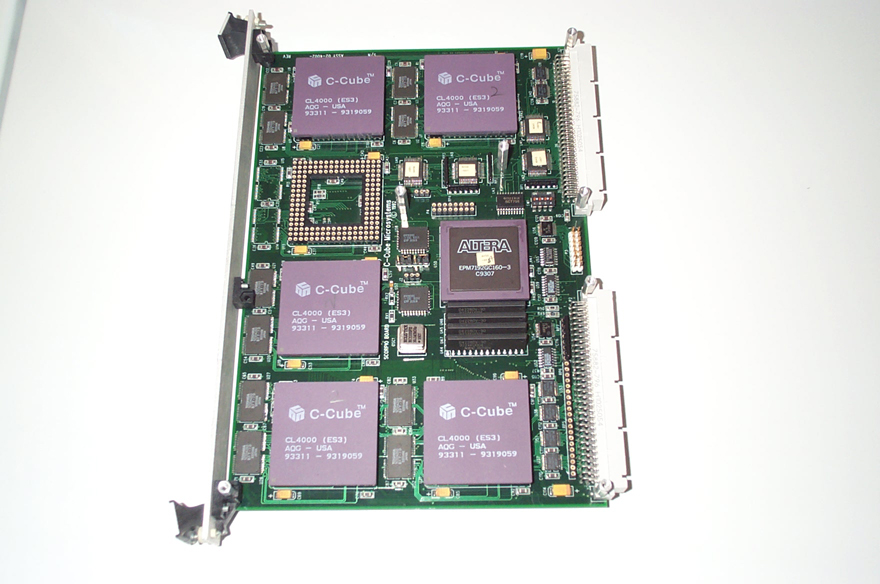
Here's a picture of the VME bus development board. It was a two board sandwich to support 10 chips in parallel (only one board pictured).
https://www.w6rz.net/scorpio.jpg
The first real-time HDTV encoders for terrestrial digital television (ATSC) were built by Harris using an IBM encoder chip. It took 6 chips to encode 1920x1080. The IBM chips didn't have an auxiliary bus, so you could see motion vectors limited to chip image boundaries (in this case, 6 tiles arranged like so).
  -------------------------
  |       |       |       |
  |   1   |   2   |   3   |
  |       |       |       |
  -------------------------
  |       |       |       |
  |   4   |   5   |   6   |
  |       |       |       |
-------------------------Despite being more "power efficient" - both nvidia and intel's hardware solutions left a lot to be desired in terms of final quality for the same bitrate, compared to x264 that seemed to just put out substantially better quality video for the same bitrate even at the same h264 profile levels. There are still lots of x264 design elements, some even verbatim ported, into modern av1 and hevc encoders.
It took Nvidia until the encoder they bundled into 20xx series cards and Intel until the 6th or 7th generation of Quick Sync, but their hardware encoders are _finally_ at a point you can get decent quality at reasonable bitrates. Even so, x264 (and x265!) beat the pants off of them if one can spare the time and electricity; they're still that far ahead.