
For seriously older stuff, I'd run the disk image in a VM.
If they interact with legacy systems and/or virtualizing is no option and/or they have no internet access, a simple USB-to-COM adapter can create wonders. I remeber doing that on a win3.1 machine using TERMINAL.EXE many many years ago.
The agent session manager talks to the LLM gateway over HTTP using a standard internal protocol, then the gateway has adapters for each upstream provider and translates between their external API format and the standard internal one.
The tool server is a separate jar running as a separate server process with its own systemd unit and the agent session manager talks to the tool server over a beanstalkd queue. The primary motivation for having 2 processes was total separation for unprivileged agent tool call execution (ie. the tool server systemd unit runs as a user with no sudo whereas the agent session manager can execute as root, so the user can run scripts through the interface that do things like install packages and access secrets, but the agent can't do that.
The tool server could just as easily be talking to beanstalkd over a Cloudflare tunnel or ssh port forward, though, and a session could be routed to different machines, allowing execution of tool calls in different environments within the same context window/agent session.
https://github.com/kristopolous/old-agent
I've used it on plenty of old things.
I'd probably do a pure .vbs version if it was windows or a static pure win32 exe.
I took the same path with my for-fun/learning GUI coding agent in Tcl/Tk: https://wiki.tcl-lang.org/page/Featherweight. It shells out to curl for the networking.
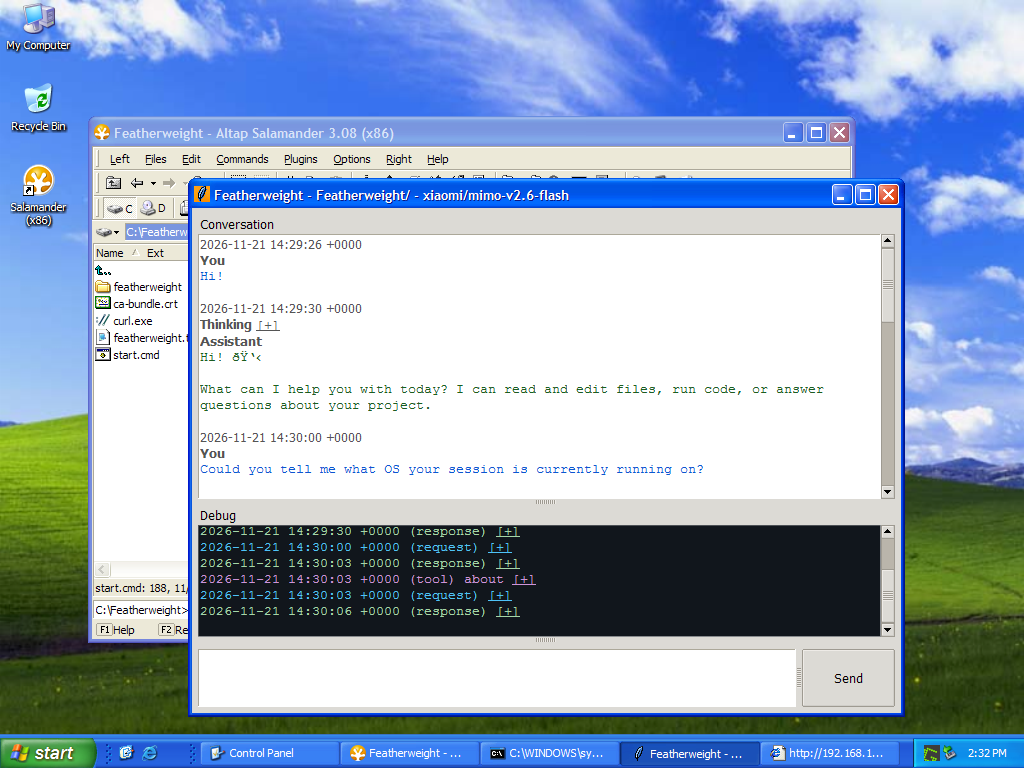
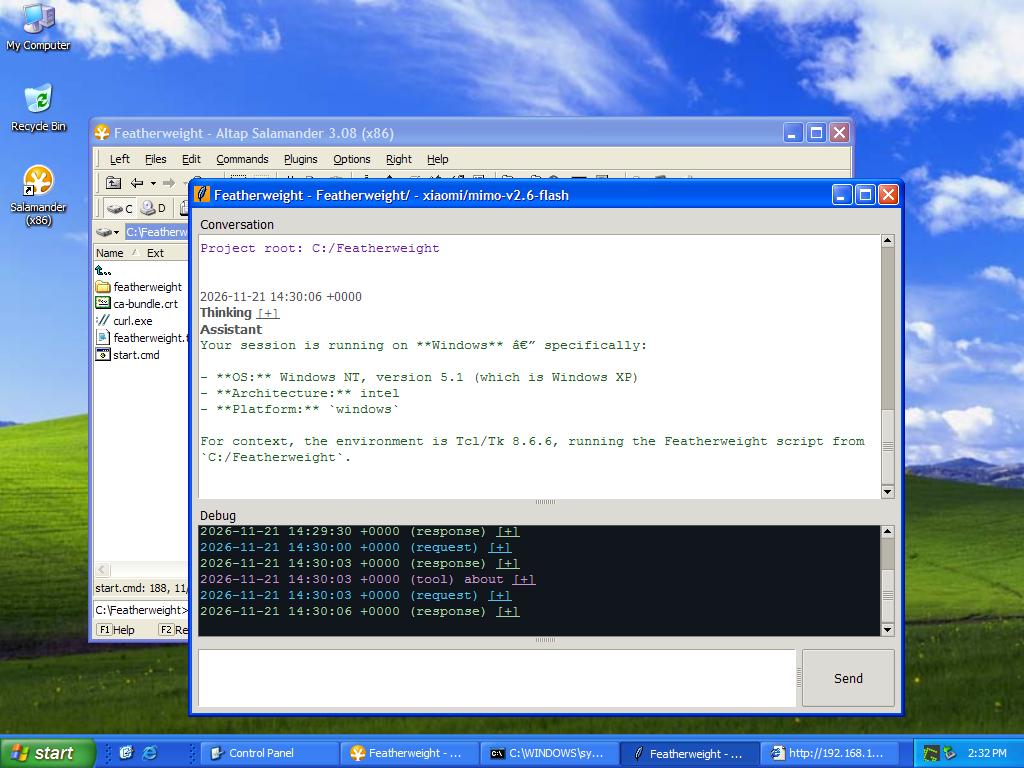
I've just tried to get it to run on Windows XP SP3. (I have a VM for an old Canon all-in-one printer.) I grabbed a legacy Tcl 8.6.6 installer from https://github.com/dbohdan/tcl86-nsis-installer (mine) and a 2017 build of curl with certificates from https://winampplugins.co.uk/curl/. The harness was developed against curl 8 and didn't work with 7.53.1. MiMo-V2.6-Flash, running in the same harness on modern Linux with Wine for `curl.exe`, found that the necessary change was minimal and only touched `--write-out`:
  --- featherweight.tcl
  +++ featherweight.tcl
  @@ -2794,7 +2794,8 @@
               --request POST \
               --show-error \
               --silent \
  -            --write-out "\n%{http_code} %{exitcode} %{errormsg}" \
  +            --write-out "\n%{http_code} 0" \
               [dict get $config endpoint] \
https://paste.dbohdan.com/1ng3b5y-kb4yd/greenshot-1.png https://paste.dbohdan.com/1ng3b5y-kb4yd/greenshot-2.png
It would not make a whole lot of sense to me.