upvote
I've done several shoots lit only by the full moon. Doing long exposure, the images are as you stated not much different than an image taken during the day, except for looking at the sky and seeing stars.

I've also done video shoots with the newer mirrorless cameras and fast lenses shooting wide open again lit with nothing but the full moon. It again looks daylight on the image. As a bit of BTS, I recorded a video of the screen on the camera showing what it was seeing, and then pulled away and reframed to show essentially the same shot as the camera but it's just solid black. One of those videos was fun as we caught a bit of lens flaring from the moon, and you can actually see the details of the surface of the moon in the reflection. It was one of those things I just never considered before as flares coming from lights or the sun are just void of detail.

reply
Thanks. Until you pointed out it's Earth at night, I had no clue what was supposed to be special about this photo (it appeared suspiciously pixelated for something 'high res', and neighbouring pixels seemed to contrast in colour rather than smoothly complementing as most photos do - but I guess that's random patches of city lights being captured by the camera). Cool stuff!

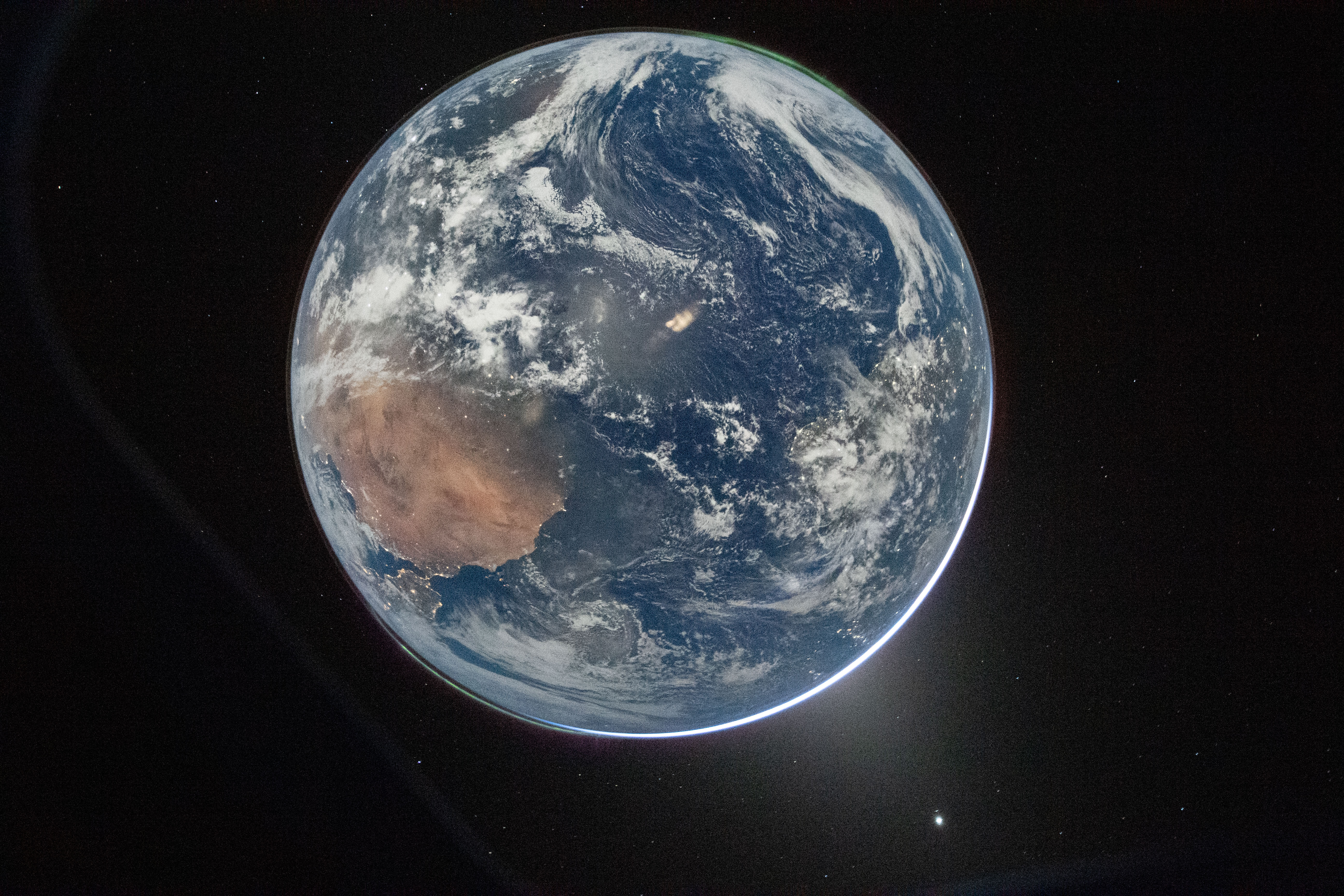
Something I haven't figured out is: what is that yellow/whitish smudge toward the center of the earth? It looks like camera glare or a reflection?

reply
deleted
reply
Yeah, it's a reflection from the window, of something inside the ship.
reply
It explains why the image is so grainy. At first I was confused what that stripe to the left and the bottom was. But it’s just the window edge, and the noise isn’t stars.
reply
(To be clear, the bright dots are stars [except the brightest one, in the lower right, is Venus I think], which makes this photo also a great demonstration that of course you can capture stars in space, you just have to expose properly!)
reply
Who said you can't capture stars in space? What do you think the purpose of Hubble, JWST, etc are? There's also plenty of imagery taken from ISS that clearly show stars. I've definitely seen Orion in some of that imagery and it put a different perspective on the size of the constellations when seen from that angle.
reply
I referred to the common question (or accusation) of why there are no stars in, say, the Apollo photos taken on the moon. The answer is, of course, that you can't see stars if you're exposing for something bright and sunlit, like the day side of Earth, or the lunar surface.
reply
Of course. But they are not visible in the Chang’e photos on the dark side either. I think in the interview of the astronauts following the first Apollo Mission, a reporter asked for a confirmation that the stars were not visible because of “the glare” (an interesting question in itself). The explanation given was that the stars were not visible with the eye, but were visible with “the optics“.
reply
Photos from the moon landings don't have stars in them, because they are exposed for full daylight on the moon.
reply
I’m assuming the people who complain that there aren’t stars are the “moon landing faked” crowd… it’s hilarious to me that they think this vast conspiracy came together to fake that whole thing, and that they literally forgot to put a bunch of tiny 25-cent flashlight bulbs up poking through the black backdrop on the sound stage. Like, no one thought about the stars, or they couldn’t figure out how to do those “special effects” and just prayed no one would spot the error.
reply
Just answered my own question to my satisfaction; they are stars.

The same specs, which match star charts, show up in two images taken a few moments apart at different exposures (links were given down-thread).

reply
How do you know that they're stars? I believe they probably are stars as well (by visual comparison with a star chart, suitably rotated), but I've found no source for either claim.

I did find multiple sources, including TFA, for the brightest being Venus.

reply
They're much brighter than the noise floor. Photographic noise doesn't really have such outliers.
reply
Why would you think they are not stars? Not really sure the confusion on the matter. Are we leaning towards this being shot from a soundstage?
reply
Well one of them is obviously Venus. How did you determine the others weren't stars?
reply
I’m talking about the grainy noise over all the black parts (actually over the Earth disk as well), including beyond the window edge. The window edge itself looks like a denser and brighter stripe of stars.

Zoom into this higher-resolution version: https://www.nasa.gov/wp-content/uploads/2026/04/art002e00019...
reply
Yep, that's definitely noise.
reply
What does it look like to human eyes? Is there enough light for a person up there to see colour, or would it look like black and white (like a moonlit scene on the ground).
reply
No color, I’m pretty sure.
reply
It’s a remarkable photo. You can see the aurora Australis at the top right of the image (it’s upside down, if there is such a thing - that’s the straits of Gibraltar at the lower left, and the Sahara above it - and the skein of atmosphere wrapping the entire planet. Those look like noctilucent clouds in the north, or possibly more aurora.
reply
It really is gorgeous. You can see both auroral rings, then there's airglow, and city lights around Gibraltar and on the South American coast, and lightning flashes in the storm clouds over the tropics.
reply
The camera is compensating for extremely low light, so you end up with something that looks closer to a daylight exposure
reply
I know. Apparently this was shot at ISO 51,200.
reply
Same! I mean the last time we were in space the cameras were ... not this good. I can't wait to see more photos from modern hardware!
reply
> even though moonlight is often thought of as bluish and sunlight as yellowish!

Is that... true? Sunlight is seen as yellow, of course, but the moon is usually thought of as white.

reply
Sunlight is yellowish in atmosphere since some blue's been scattered by the atmosphere[1], but it's white in space.

[1] https://en.wikipedia.org/wiki/Rayleigh_scattering

reply
I don't think that's right. Sunlight is white in the atmosphere too. Scattering causes the sun, not the light, to look yellow, and so sunlight is thought of as yellow.
reply
Scattering doesn’t really make the sun to appear yellow except when it’s low, behind a lot of air. When it’s above 30° or so it just looks blinding, neutral white (or non-blinding neutral white if there’s suitable cloud cover or other filter in front of it). Even though a lot of the blues are scattered around, the sun still looks just white when it’s high in the sky.

But when the sun does look yellow, its light is yellow too, that’s the definition of "looks yellow". And the golden hour paints everything in very iconic yellow-orange hues. The light as integrated over the whole sky is still white (modulo whatever’s scattered back into space), but the light that comes from the direction of the sun is clearly tinted yellow and the light from the rest of the sky is clearly tinted blue.

reply
> But when the sun does look yellow, its light is yellow too, that’s the definition of "looks yellow".

Not quite; the sun is far away and is restricted to a tiny portion of the sky, but its light covers half the earth at a time. It is simultaneously true that the sun looks yellow and that the light we receive from it is white. It isn't the case that objects in direct sunlight are yellowed by that light; the yellow appearance when you look at the sun is something of an illusion.

> Even though a lot of the blues are scattered around, the sun still looks just white when it’s high in the sky.

This isn't true.

reply
That's fair, I was thinking of how night, or twilight, as a whole is associated with cool hues, but it's probably true that moonlight in itself is usually thought of as neutral white.
reply
Moonlight is reflected sunlight.
reply
That's obvious. But the moon is so perfectly neutral gray that the reflected light is essentially the same color as the incident sunlight.
reply
Reminds me of one of the best new comedy series in years, Very Important People, doing improvised spoof interviews:

https://www.tiktok.com/@veryimportantpeopleshow/video/731957...

reply