
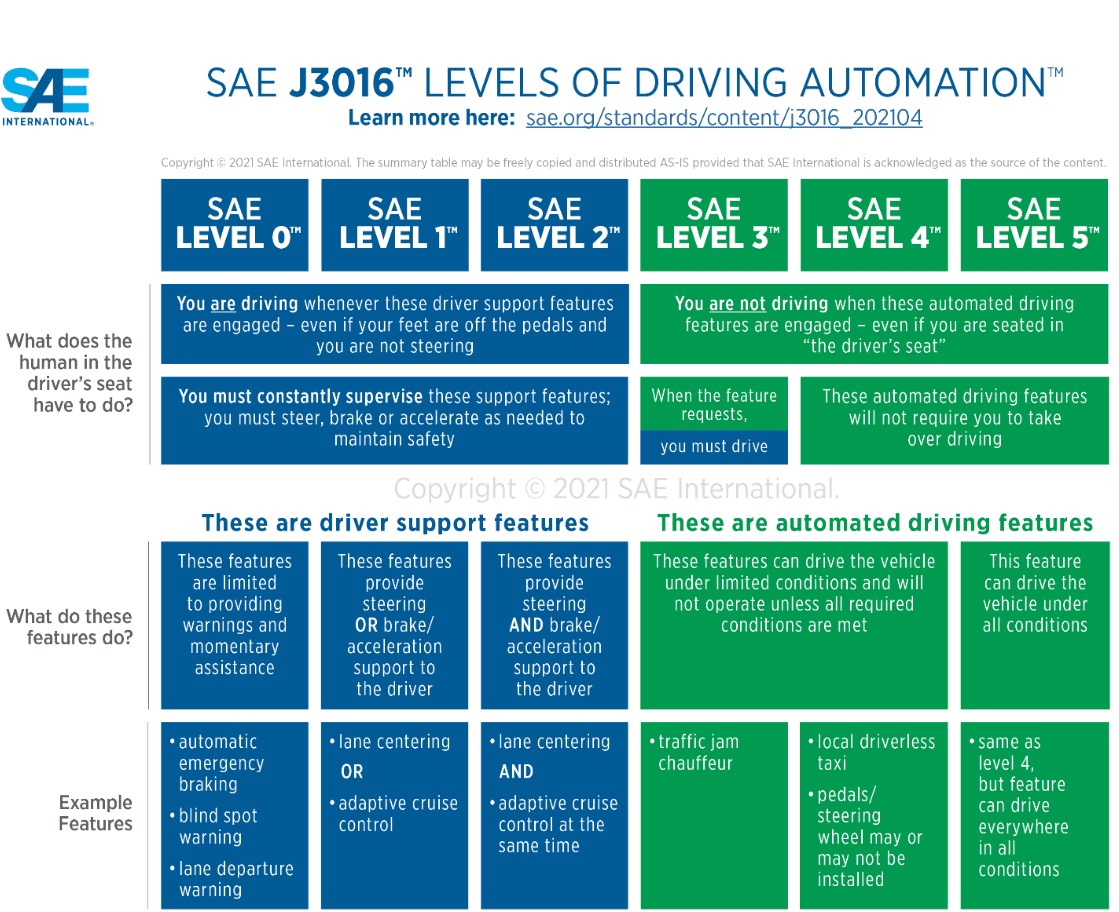
If you don't pay constant attention, you will never notice when it slips in a bug or security issue
I’m in left lane on highway. Tesla ahead of me but quite a ways away.
I realize as I’m driving that the Tesla is moving quite slow for the left lane driving. And before you say it, yes there are lots of people speeding in highway left lanes too.
So - I passed on the right rather than tailgate. Look over and see a guy leaning back in his seat. No hands on wheel. Could’ve been asleep. And driving 10-15 mph slower than you’d expect in that lane.
To your point about using it FSD the way you do, makes total sense to me. Which implies you would also cruise at the right speed depending on the lane you are in, unlike my example.
I wonder what's taught to new drivers about this sort of situation. My intuitive feeling (driving for almost 30 years) is you drive with the flow of traffic when traffic is present. I don't see too many left lane drivers glued to speed limits, but it's obvious when someone is a fast or slow.
I'm asking because I feel I must be missing something, inasmuch as to have my hands on the wheel while not controlling the car is an experience with which I'm familiar from skids and crashes, and thinking about it as an aspect of normal operation makes the hair stand up on the back of my neck. (Especially with no obviously described "deadman switch" or vigilance control!)
It's just nice having a 'second set of eyes' in a sense. It's also very useful when driving in unfamiliar cities where much of my attention would be spent on navigation and trying to recognize markings/signs/light positions that are atypical. FSD handles the minutia of basic vehicle operation so I can focus on higher level decisions. Generally, at inner-city speeds, safety and time-to-act are less of an issue and it just becomes a matter of splitting attention between pedestrians, obstacles, navigation, etc. FSD if very helpful in these situations.
I was watching the Tesla display on my way back home from LaGuardia airport last week (passenger, not driver).
No accidents or close calls, but it was obvious that I might be focused on 1 or 2 things in that very busy and chaotic environment whereas the car (FSD or otherwise) sees more than 2 things and possibly avoids something on my behalf.
I appreciate your thoughtful and detailed response. I'll need to think about it for a while, too. It had not occurred to me to consider the possibility that someone else's FSD might protect me from the general incompetence and unreliability of amateur motor vehicle operators.
(Jumping a light in the dark? Not thinking or learning to navigate by verbal instructions from your satnav or phone, instead of compromising the primary sense you must constantly use to drive without risking manslaughter? I'm sorry, but if this is the standard, I really can't describe it other than it is...to say nothing of your considering safety less important, as you say, in the "inner city" that is my home.)
I don't know what this means.
> Not thinking or learning to navigate by verbal instructions from your satnav or phone, instead of compromising the primary sense you must constantly use to drive without risking manslaughter?
Navigating involves reading street signs, block numbers, and traffic markings. These are all visual elements that can distract from safety monitoring. How many minor accidents result from driver's trying to figure out where they are, or need to go?
> I'm sorry, but if this is the standard, I really can't describe it other than it is...to say nothing of your considering safety less important, as you say, in the "inner city" that is my home.
My claim isn't that safety is less important in city driving, it's that driving is far safer due to lower speeds. There's more time to react and lower risk of catastrophic results when driving at 35mph. The challenge for a driver isn't sudden loss of control as you may experience at 65+mph. The city driving challenge is trying to track markings, signage, pedestrians, and parked cars while also navigating and managing the vehicle's basic operation. FSD can track all of that without distraction and leave the driver responsible for more human reasoning tasks.
When I'm driving I know what I'm doing, what I'm planning to do and can scan the road and controls with that context.
Making me have to try and guess what the car is going to do at any given time is adding complexity to the process: am I changing lanes now, oh I guess I am because the autonomy thinks we should etc.
I agree that there are situations where what I do as a trained driver is different from augmented cruise.
A good example (or perhaps I'm wrong) is this: in a lane, car pulls into lane in front of me and between the car further ahead. Now I don't have enough space in between me and that new entrant. But instead of using brakes (unless eggregious), I bleed speed until I make space I want. Augmented cruise doesn't do that - it hits brakes.
So, from behind, I think it looks like I'm using my brakes a lot more than I am when on augmented cruise. And excessive brake use distracts the driver behind me.
I've got plenty of experience, and (feel as though) I know most of it's failure points. I had to drive my 30 minute commute last week, and it was decidedly unfun. I have seen the future and I don't want to go back.
Too bad that project failed.
Airline pilots aren't supposed to take a nap, and there are occasionally articles about the various things that have gone wrong because the pilots weren't paying attention.
> the self-driving feature had “aborted vehicle control less than one second prior to the first impact”
It seems right to me that the self-driving feature aborts vehicle control as soon as it is in a situation it can’t resolve. If there’s evidence that Tesla is actively using this to “prove” that FSD is not behind a crash, I’m happy to change my mind. For me, probably 5s prior is a reasonable limit.
Also, Tesla routinely claims that "FSD was not active at the time of the crash" in such cases, and they own and control the data, so it's the driver's word against theirs. They most recently used this claim for the person who almost flew off an overpass in Houston because FSD deactivated itself 4 seconds before impact[1]. They used it unironically as an excuse why FSD is not at fault, despite the fact that FSD created the situation in the first place.
[1] https://electrek.co/2026/03/18/tesla-cybertruck-fsd-crash-vi...
How is a car supposed to pre-empt when it is in a situation that is to challenging for it to navigate? Isn't it the driver who should see a situation that looks dicey for FSD and take control?
It seems to me FSD for Tesla is not ready to go into Prod as it is now.
in the BEST CASE, this is a confluence of coincidences. Engineering knows about this and leaves it "low prio wont fix" because its advantageous for metrics.
In the worst case, this is intentional.
In any case, the "right thing to do" is NOT turn off the cameras just before a collision, and yet it happens.
This is also Safety Critical Engineering 101. Like.... this would be one of the first scenarios covered in the safety analysis. Someone approved this behavior, either intentionally, or through an intentional omission.
Source for autopilot being disabled “seconds before a crash” also disabling cameras? (Sorry if I missed it above.)
For normal incidents, 2 seconds is taken as a response time to be added for corrective action to take effect (avoidance, braking). I’d expand this for FSD because it implies a lower level of engagement, so you need more time to reengage with the car.
The former is to be expected. The latter seems likely to potentially make an already dangerous situation worse by suddenly throwing the controls to an inattentive driver at a critical moment. It seems like it would be much safer for the autopilot to continue doing its best while sounding a loud alarm to make it clear that something dangerous is happening.
This is essentially what FSD does, today. When the system determines the driver needs to take over, it will sound an alert and display a take-over message without relinquishing control.
That's still not a good look.
And it does mean that FSD isn't to be as trusted as it is because if the car is putting itself in unresolvable situations, that's still a problem with FSD even if it isn't in direct control at the moment of impact.
AEB should still be working to pump the breaks AFAIK, but auto-steer and cruise control will be disabled while the computer and electronics are still perfectly operational to make the car more secure for the passengers and first responders after the event.
EDIT: IIRC the threshold for disengagement is 1s.
> It's well known for a while now, and it's not to avoid recording being active, it's to avoid a possibly damaged computer to keep working in a likely compromised situation. What happens if the car crashes and flips, AP/FSD has no training on that, and wheels keep spinning at full speed while first responders try to secure the car?
That sounds like an ass-covering justification. There may be a good reason for triggering some kind of interlock to prevent the problems you outlined, but if their implementation 1) also stopped recording seconds before a crash or 2) they publicly claimed it wasn't responsible since it turned itself off, then Tesla is behaving unethically and dishonestly.
For 1) it's the first time I hear it from a technical point of view - Tesla's dashcam records continuously for the last 10m, and should save the data on the internal computer in case of a crash and send it back to Tesla if feasible AFAIR (I'm an owner). IIRC it's not the first case though where Tesla claimed the data wasn't available or corrupted, and then it was actually recovered some time later after pressure from authorities. So I think technically the data is there, but also believe Tesla is behaving unethically and dishonestly to cover up or delay retrieval.
2) I often hear it as FUD, as in: AP/FSD was off, the user just did it by accident, wasn't accustomed to it, or just didn't know how it worked. AFAIR most of the accidents had the data released and showed some of the following: user touched steering wheel and disengaged autosteer/FSD (whether knowingly or by accident), user was pressing accelerator pedal by accident, user was pressing accelerator instead of brake, etc etc
> If FSD (Supervised) was active at any point within five seconds leading up to a collision event, Tesla considers the collision to have occurred with FSD (Supervised) engaged for purposes of calculating collision rates for the Vehicle Safety Report. This approach accounts for the time required for drivers to recognize potential hazards and take manual control of the vehicle. This calculation ensures that our reported collision rates for FSD (Supervised) capture not only collisions that occur while the system is actively controlling the vehicle, but also scenarios where a driver may disengage the system or where the system aborts on its own shortly before impact.[0]
In theory, that should more than cover the common perception-response times of around ~1 to 1.5 seconds used as a rule of thumb for most car accidents. But I'm quite curious what research has been done on the disengagement process as driver assistance systems return control to the driver and its impact on driver response times and their overall alertness.
If drivers trust the car to handle braking and steering for you, are we really going to see perception–response times that low, or have we changed the behavior being measured? Instead of timing a direct response to a stimulus, we’re now including the time required to re-engage their attention (even if they're nominally "paying attention"), transition to full control of the vehicle, and then react to the stimulus that they're now barreling down on.
For that matter, this approach is making the implicit assumption that pressing the brake pedal or turning the steering while is a sign of now-active control and awareness. Is it? Or could it just be a sort of instinctual reaction? I've been in the passenger seat when a driver has slammed on the brakes, only to find myself moving my right foot as if to hit an imaginary brake pedal even knowing I obviously wasn't the one driving. Hell, I remember my mom doing that back when I was learning to drive during normal braking.
0. https://www.tesla.com/fsd/safety#:~:text=within five seconds