
Ubisfot is a perfect example, look at their "Watch Dogs: Legion" for example. They decided to get creative and give you random characters generated by AI.. it turned out to be a disaster.
Another one is their Far cry games, where they copy and paste the same events but slightly different, all over the map and call it a day.
I think these efforts more have to do with bean counters taking over the industry than game designers being lazy. I'm sure there are plenty of talented people working at these studios, but they are held back by MBAs.
That purposefully designed settings and properly gated procedures can make procedurally generated realities…better? More fun?
Clutch Nixon is the only thing good thing about the last few games.
I've bounced off NMS several times, despite having tried quite hard to get into it. So, my take is based on ~20 hours of early game, from 2025ish. Probably the best parallel I can draw is to Elite: Dangerous, which I played for several hundred ours before getting bored of it. What I find lacking in both games is that there's no _meaningful_ emergent gameplay that spawns off the procgen. Everything is wildy different on each planet, yet very same-y, because none of the differences really play into each other. In both, one can discover random biomes and creatures, but it's not like they are inherently interesting, they are mostly just following the same scripts.
Contrast this with something like Dwarf Fortress, which takes a slightly more in-depth approach to procgen, one where things have history, and in many ways, things "make sense". Or Rimworld, where the game tries its hardest to conjure up a narrative for you, dynamically, but still in a sandbox. So, basically, NMS is a perfectly functional sandbox game, and I have huge respect for them for keeping on working at it for so many years. However, it doesn't scratch my "hardcore simulation / mastery" itch, and so far I haven't been grabbed by any of its story generation. It just felt like a long series of fetch quests and "collect them all" games.
That's basically it. It's not a simulation. So if you want simulation, then NMS isn't your game. Maybe X4 might be better suited. Or maybe not.
Sometimes people forget that not everybody has to like every game :D
No Man's Sky is much more like Minecraft in that way, you have to make up your own goals, the game doesn't really prompt you in any way to do anything.
If you’re looking for a scripted arc, wrong game by construction.
I think the multiplayer aspect is a bit weaker than it could be, maybe improved more recently, but it is a something that Minecraft has done well
Obviously NMS's original marketing was bonkers and capitalised on saying technically true things in ways to mislead large numbers of people.
A little bit of depth to go with all that breadth?
I'm not saying there aren't deep systems in NMS. Its just that they are sparse. You can tool around all day having only the most cursory interactions with most of the game's systems. They've added so many interesting things, yet last time I played it felt there wasn't much of anything to do with them. For example, the Pokemon clone they added a few updates ago -- fun for five minutes. Super simple battles. However many months of development for something that got old after 5 minutes.
If the game doesn't appeal to you, then that's fine too. But overall the game fills an interesting and accessible niche beneath games like X4: Foundations and Elite Dangerous.
It's... fine? It kept me engaged until it didn't. Part of the "didn't" came about because I was being paper-cut to death by bugs that googling showed me had been reported for a long time, if not since the very beginning.
I kept feeling like it was a game on the verge of happening throughout, and it never quite made it. Lots of things to go do to serve.. no purpose. Nothing was that unique or memorable, and I often had very little clue where I was in relation to anything. At one stage I was overseeing a town but that seemed to do nothing for me other than make me go back and make a snap decision for no discernible reason, occasionally fight hostile creatures, and also act as a sink for resources I was gathering.
I kept thinking "Why am I even doing this" until it really sunk in "Why am I even doing this?" and quit.
It also exasperated me that even though I was using a pretty fast gaming system, on a regular basis assets would take ages to appear, including buildings. "Fly to this place on the planet, land at this archaeological dig, wait 3 minutes for the dig to bother to appear before you can do anything." (saw identical behaviour on my steamdeck too, so doesn't seem "my machine" per se?)
This was also one of many gripes I had with Starfield.
It's always a potential danger to one's enjoyment to know too much about something though. :)
Adds persistent asteroid belts, asteroid mining, and base building on asteroids
Go wild
Modded Minecraft is a very different beast, depending on the mods
It's pretty cool to see what modders have done with it over the years. I genuinely think Minecraft + Create is the best factory game.
Of course, introducing mods makes Minecraft the most compelling entry in the genre by a huge margin, but not necessarily a fair comparison since the combined human effort involved in the minecraft mod ecosystem vastly eclipses what the NMS team could do on their own.
This is also the problem with the procedurally generated planets and moons in Starfield. Yeah, there's a whole lot of them, but they're also all populated with the SAME points of interest. You can only see a cryo lab or abandoned radio station so many times before it completely loses any meaning. It's basically the antithesis of the hand crafted world of Skyrim.
It's done so badly that you get points of interest spawning with outdoor food and beverage, folding chairs, umbrellas in icy moons that have no atmosphere and -200C temperature.
The alien creatures in Starfield were at least all designed by hand, and are somehow 'assigned' to specific planets and biomes in a way that's hard coded into the game.
Eh with a planetary cluster of that scale they have little choice. And Proc Gen is also in Bethesdas history, its how they built Arena and Daggerfall IIRC.
My issue isnt that you can see the same base on every planet, my issue is largely that when you have reached a sufficiently high level, most planets will be absolutely plastered with pirate bases. The universe goes from empty to full of RNG pirates and mercenaries so damn quickly. They really needed to create more unique encounters, but less of each kind, and spread them out a lot further.
Dwarf fortress or rim world solves that by generating personalities.
Compare it to even our own solar system where even so much as a new high-res photo of the hexagon storm on Saturn comes with stunning new and specific detail, or the "heart" on Pluto, we're practically ambushed with novel configurations of atmospheric dynamics and geology. It's frustratingly rare for games to truly activate that feeling of wonder.
I think NMS is still an unbeatable deal for what it is as a game but it's a frustrating near miss flyby of what I think people want a true space exploration game to feel like.
For example there might be a wormhole that takes you to a different destination if you fly through it backwards. You're very unlikely to find that out by chance, but if you explore you'll find a thing that tells you (probably behind some other puzzle).
Great game.
I'm not saying ending was perfect, but I can't think of a better way of ending it.
The game is 2 million light years wide, but a meter deep.
There's the Kerbal Space Program approach, where space exploration is tough and you need to learn a LOT to succeed at it. The tradeoff of this is a high sense of accomplishment, where simply landing and returning from another body feels like you did something incredible.
There's also the Outer Wilds approach, where the story carries it. Moving around isn't hard at all, but you have specific goals to accomplish that move you towards a final ending. Diversity in how you accomplish those goals makes it feel fresh.
Mass Effect is similar, where you have some freedom to explore, but it's again in the pursuit of this broader story. So exploration feels like a rich side quest more than the main point of the task.
Or alternatively Scavengers Reign
Personally I want spelljammer. Baldurs Gate meets Sea of Thieves in space with 80s killer clowns
There is so much drama that can happen there and the scale is the least of it.
The creatures, vehicles, and buildings weren't generated -- they were created by other players and exchanged asynchronously, then seeded into your procedurally generated galaxy.
Spore is a Massively Single Player Online Game: no real-time multiplayer, but your galaxy fills with other people's content.
That's the opposite of the oatmeal problem. Procgen gives you infinite bowls that all taste the same. Spore gave you a finite but large set of bowls, each made by someone who cared about it. Different tradeoff, different failure mode -- but not the one this thread is about.
GDC 2005, Will Wright, The Future Of Content:
https://www.youtube.com/watch?v=N4ScRG_reIw
>[...] Also I want to apologize for the title of this talk in the description, which I know was kind of hopelessly vague.
>What usually happens every year is GDC, they call me up, and they say "we want you to do a talk" and I say okay, and then a week later they say "what's your talk about" and so then I think about it for a while and oh, get a rough idea of what I'm going to talk about, and I give them some kind of generic title in that area.
>That's what usually happens. But this year was different. This year when they asked me what I was going to talk about, I just flat out lied.
>But, so I'm not really going to talk about the future of content. I'm really more in fact going to talk about a possible future of content you know.
>It seems like the theme that I'm coming away from this conference with so far is that the next generation titles are going to be incredibly expensive, we're going to have to build mountains of content, and it's going to drive most of the smaller players out of the market.
>And I'd like to offer potentially an alternate vision of that. You know I think that there is a way to deal with that more creatively. So maybe a more accurate title for this talk would be "What I learned about content from The Sims".
That was 21 years ago. The same argument is being made again right now, with a different machine offered as the answer, and Will's alternative is still the one nobody is trying.
Will's advice for game designers and creative humans in general, from my notes on the talk:
>If you have a weird idea that's so outside of the box, don't forget it. You should go back and revisit your weird ideas later, because you can never know where they might lead to.
In February 2007 PopSci, Will explains the whole design rationale:
https://www.popsci.com/entertainment-gaming/article/2007-02/...
>We thought about it. In fact, technically, based on all the stuff we've already done for it, it wouldn't be very hard at all. We've already solved all the hard problems we would need to do a persistent online world version of Spore. The hard part is, what happens when you come to a planet and the planet's offline? Which would be the case. In fact, one of the reasons why I kind of went down this path is that nobody has really explored the hybrid model. And this really is a hybrid, it's what we call a massively single-player game, where we try to get the benefits of an online game, which is all the people building the world collectively together, without the liabilities, which is that the 14-year-old can kill you or that you've invested all this time in your planet and somebody comes along and blows it up, and therefore you had to put everybody on the same level treadmill. And I hate these level treadmill games, and I wanted the players to feel really empowered.
GDC 2005 Report: The Future of Content
https://www.gamedeveloper.com/design/gdc-2005-report-the-fut...
I posted more details on the Spore Stats discussion in 2023:
https://news.ycombinator.com/item?id=36280275
>Here are my notes and summary of the GDC 2005 talk where Will Wright first revealed Spore, which I asked Will to review and check for accuracy. It's interesting to compare the design he described in the talk with what Maxis eventually shipped. Video of the hour long talk:
https://www.youtube.com/watch?v=N4ScRG_reIw
>One of the essential problems with designing a Massively Multi Player Online Game like Spore is that players at different levels of the simulation run at different time scales.
>Maintaining time synchronization between players is also the reason The Sims Online doesn't have a "Pause" button or speed controls, or automatically pause in build and buy mode, like The Sims.
>So instead, Spore is a Massively Single Player Online Game. Users don't interact with each other in real time, but instead users can create their own content, and it exchanges that content between users asynchronously.
>That's also how The Sims Exchange lets players asynchronously upload and download their Sims save files along with web pages describing their house, sims, and photo album.
https://donhopkins.medium.com/the-future-of-content-will-wri...
>The Future of Content — Will Wright’s Spore Demo at GDC 3/11/2005
>What I learned about content from the Sims. …and why it’s driven me to procedural methods. …And what I now plan to do with them. Talk by Will Wright, Game Developers Conference, 3/11/2005.
>Based on notes taken by Don Hopkins at the talk, and other discussions and review by Will Wright. The title of the talk “The Future of Content” was purposefully vague, because Will wanted to show Spore in public for the first time, but he had to flat out lie about the title and send a fake set of slides for the EA executives to review, so they didn’t know what he was about to do. A more accurate title for the talk would be “What I Learned About Content from The Sims, and Why it’s Driven Me to Procedural Methods, and What I Now Plan to Do With Them”. [...]
>Wired asked for an illustration to print in the magazine, anything he wanted. So he made a diagram of Spore that Wired published, but he didn’t tell them what it was. The design docs for Spore have been out in Wired Magazine for a year now. (It’s in the Feb 2004 issue of Wired.)
>Will’s Secret Diagram of Spore published in February 2004 Wired:
https://donhopkins.com/home/WiredSporeDiagram.jpg
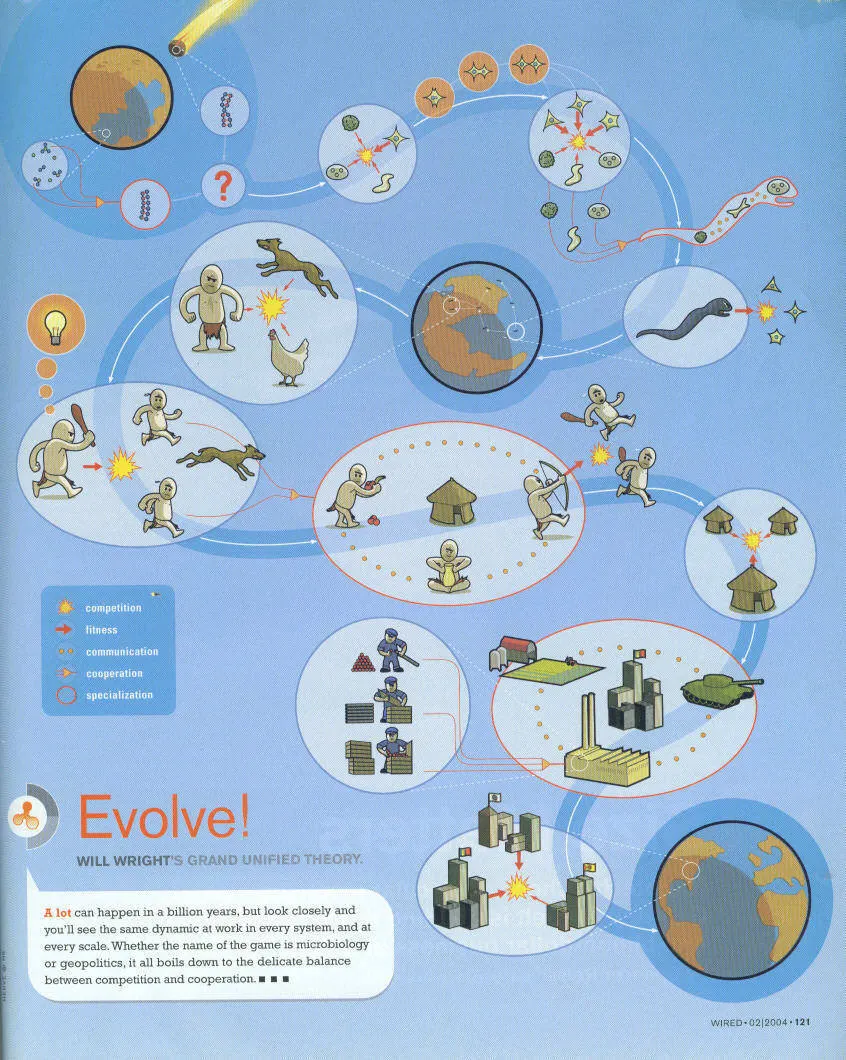
[...]
https://news.ycombinator.com/item?id=36280831
>And that is the whole point, how you win the game: become involved with the content creation community!
>The powerful but easy to use direct manipulation editor tools, the automatic content sharing system, and the online community around user created content, were together the most innovative and successful things about Spore. (As contrasted with the not as well realized gameplay and storytelling design goals.) [...]
>Chaim Gingold, A Brief History of Spore:
http://www.levitylab.com/blog/2011/02/brief-history-of-spore...
>Creativity
>Of course, these aren’t any old aliens we ask players to invest in — they’re your creation, your aliens. Once you start customizing, and design your creature, emotional investment is generated. It’s magic. Even the ugly ones are loved by their parents. Many games thrive on the interest generated by players’ creative investment. Console role playing games, for example, get this effect when players invest time in equipping and naming characters. I’ve always felt more attached to my characters as I fuss over their outfits and equipment. Creative interaction seems to always generate emotional involvement and attachment. Psychologically, it would seem that part of this stems from the sunk cost fallacy — we become attached to things we’ve invested time and energy into. Of course, it’s not just the hundreds of hours invested in a World of Warcraft character, their relationships, and possessions that generate attachment, it’s the sense that our fabrications are extensions of ourselves. As recipients of our attention and creative energy, our handiworks are reflections of who we are, tangible manifestations of our personalities. It’s no wonder we become attached to what we make, and take the success or failure of our own work and ideas very personally.
>Spore neatly solves the alien attachment problem by asking the player to design them. If a player makes a creature, and it’s appealing, they’ll be quite invested in it. Reflecting on the success of The Sims Exchange, where players shared stories, characters, houses, and objects for The Sims, Will realized that shared creativity would give Spore a broader appeal. Why not build creative exchange into the game, rather than as a website that orbits it? Player created assets are constantly being uploaded and downloaded by Spore, enough material to fill a galaxy. There’s nothing like taking home your latest finger painting, and having mom hang it on the fridge for everyone to see. Sharing not only fills up the galaxy with cool stuff, but allows the entire world to see your fridge, motivating you to continue creating.
>Of course, a lot of deep magic must work properly for something like Spore’s creature creator to function properly. It must be natural to use, easily producing satisfying results for anyone, from beginners to advanced users. And these aliens, lumps of polygons that no animator has ever seen before, must be brought to life. These are rather complicated endeavors, from a design, aesthetic, and technical point of view, but the player should never notice any of it. The game design implications are also challenging — the game must be playable and interesting, regardless of the creatures dropped into it.
But the models are fun, sure. And other people can find your models, and you can find theirs.
So if we recognize that the "gameplay" part of Spore never worked... we're left with Second Life, a much, much older thing. It hasn't been much of a success.