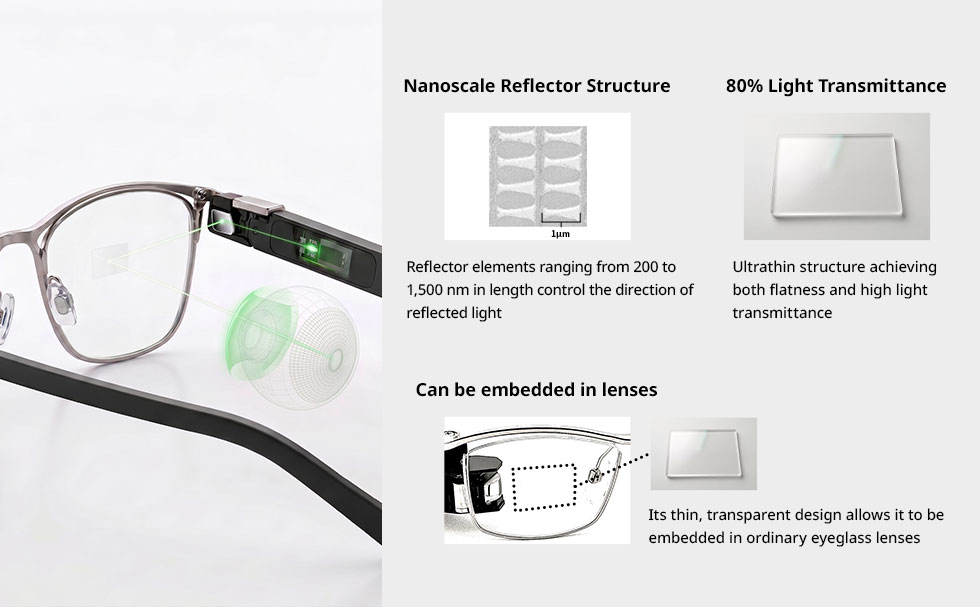
(www.tdk.com)
I first read about direct retinal projection displays (using oscillating mirrors no less) in Mondo 2000 [^1]
Hard to find much on the "Private Eye" hardware as I guess Reflection Technology (the manufacturer) went outta business in the mid 90's
But a 700x280 display painted onto your retina that looked like a full-ish size display hovering in space nonetheless, and downright epic for 1989
[^1]: https://microship.com/winnelife-interview-with-steve-roberts...
For the curious, a bit more info and some pics on these sites
https://glassdevelopment.wordpress.com/2014/04/17/hmd-histor...
https://artsandculture.google.com/asset/reflection-technolog...
I appreciate your comment on the history.
I remember reading that Sunnyvale CA was the safest city in the US!
I looked at wikipedia, and they say that too.
> Sunnyvale has consistently ranked as one of the safest ten cities (for cities of similar size) in the United States according to the FBI's crime reports.
https://en.wikipedia.org/wiki/Sunnyvale,_California#Crime
also: "According to Sunnyvale's Department of Public Safety, confirmed gang members make up less than one percent of the population"
With the qualifiers, is it actually safe there? :)
I interviewed Dan Bricklin in '88 or '89 (for a magazine). Trippy dude. Lots of ideas.
Bricklin stated the optic nerve is exposed brain. So that when a laser projects an imagine directly on to the retina, it's like programming the brain.
Nope.
I decided right then and there I never needed a laser pointing at my eye ball.
Sadly no longer available. I've seen through one and it was vividly clear and detailed without my glasses on at all and it felt so gamechanging to have that kind of display technology in my hands.
https://electronics.sony.com/imaging/compact-cameras/all-vlo...
It's now transformed though, into the RETISSA VIEWCLEAR for your phone - https://retissa-vc.qdlaser.com/en/
You can get one here: https://www.sony.com/electronics/support/articles/00297030
I don't worry about the fashion sense of the frames and lenses: I wan't to understand the perceptual effect on reality: Whats the overlay like?
Comment above points to interesting Japanese device too:
otherwise even just walking around causes the content to bounce around annoyingly
https://kemendo.com/pdfs/USPatent10757400.pdf
Pretty much all my patents are being infringed at this point.
Lesson to anyone getting patents, they don’t matter unless you have $100M to fight Microsoft or oracle with. At that point might as well just keep your 100M and forget it
When someone infringes a patent, especially if you’re not commercializing your patent, the patent attorneys tell you, “wow, that looks really tough.”
It’s a big company game at this point, in general, or you’d need something that drives an immense amount of value before the patenting seems worth it, as far as I can tell.
Or just outright sell the patents to a competing big company and let them duke it out. Now at least you end up with some money.
To the contrary, innovation is proceeding full speed, despite patents. The only thing patents are doing is 1. enriching the lawyers on creation, 2. restraining law abiding innovators in country (meaning all other countries will proceed to ignore it anyway), 3. give the advantage to all other countries, and 4. enrich the lawyers again if they can find one of the in-country infringements to pursue (again ignoring all the others).
None of these outcomes is beneficial. The system is broken and antiquated. Ditch it.
Without patent protection, any individual or small business that comes up with something new and (currently) patentable would have no recourse whatsoever. The megacorps could just start producing whatever it is as soon as they find out about it, and outcompete the actual creator with massive economies of scale and the ability to take a loss effectively forever on any given product.
Sure, if you live with an 1800s era mentality about who invents things. This is no longer the era of Thomas Edison and the individual inventor. If our laws don't meaningfully reflect the way our lives are lived now, they won't be useful frameworks. I think your proposal may be about 2 centuries behind the times.
>Without patent protection, any individual or small business that comes up with something new and (currently) patentable would have no recourse whatsoever. The megacorps could just start producing whatever it is as soon as they find out about it, and outcompete the actual creator with massive economies of scale and the ability to take a loss effectively forever on any given product.
It seems like they do this anyway, and patent protections mean high prices for consumers on patent-protected products. Given that in the mid-2020s, the corporation:individual ratio patents is ~18.5:1 (up from 4:1 in the 1970s), I see the benefit gradient being more pro-consumer by getting rid of them.
I get your point, but Edison is the worst possible example to use here.
If it were possible for an individual to profit from their patent today as they would have in the 1970s, it's much more likely that people would seek patents.
If this is actually useful for you, of course, you need a patent lawyer in the specific country you're talking about, which is not cheap, and that's why the other posters said millions of dollars. Patents are not worth it for most people because you still have to pay lawyers to get anything out of them. You also pay for your time in court, acting as witness and testifying and watching court proceedings instead of doing your own business.
So, funny you say that. You know those AI companies that seem to have really good training data...
I would love monochromatic vector(not raster) HUD in my glasses. I could play the original Asteroids. Bah, bah, bah bah. Pew, pew!
Hopefully they add a color model so we can play Tempest.
Selling blue-light filter coatings is a big business, though.
by who?
"While light of any kind can suppress the secretion of melatonin, blue light at night does so more powerfully. Harvard researchers and their colleagues conducted an experiment comparing the effects of 6.5 hours of exposure to blue light to exposure to green light of comparable brightness. The blue light suppressed melatonin for about twice as long as the green light and shifted circadian rhythms by twice as much (3 hours vs. 1.5 hours)." https://www.health.harvard.edu/healthy-aging-and-longevity/b...
"Evening residential illumination possesses the capacity to impair sleep quality via the suppression of endogenous melatonin production, a process largely driven by short-wavelength (blue) light." https://www.nature.com/articles/s41598-025-29882-7
"Blue light waves come from fluorescent and LED lights and back-lit electronic screens on televisions, computers, tablets, and cell phones. Remember, exposure to these lighted screens during the sensitive period can make it difficult for you to fall asleep at night or can wake you up too early" https://www.cdc.gov/niosh/work-hour-training-for-nurses/long...
"Blue light had stronger suppression effects, particularly in younger participants and men. These results underscore blue light’s disruptive effects on circadian health and highlight red light as a less disruptive alternative for nighttime environments." https://pmc.ncbi.nlm.nih.gov/articles/PMC12113466/
"A systematic search of PubMed, Scopus, and Web of Science identified randomized controlled trials (RCTs) from 2010 to 2024. Eligible studies enrolled adults using BBGs before bedtime and reported actigraphy-derived outcomes. Random-effects meta-analysis was performed using the generic inverse variance method. The review was registered in PROSPERO (CRD420251034611).
Results
Three double-blind crossover RCTs (n = 49) were included. BBGs showed a non-significant reduction in SOL (MD = −4.86 min; 95% CI: −20.23 to 10.52; p = 0.54) and a non-significant increase in TST (MD = 8.75 min; 95% CI: −35.31 to 52.82; p = 0.70). No significant effects were found for SE (MD = −0.61; 95% CI: −7.58 to 6.35; p = 0.86) or WASO (MD = −1.47; 95% CI: −14.94 to 11.99; p = 0.83). Heterogeneity was low (I2 = 0%).
Conclusion
BBGs may provide small improvements in sleep, but current evidence from RCTs does not support significant effects. Larger, well-powered trials with standardized protocols are needed."
- Efficacy of blue-light blocking glasses on actigraphic sleep outcomes: a systematic review and meta-analysis of randomized controlled crossover trials - https://doi.org/10.3389/fneur.2025.1699303
The issue is intensity of light. These retinal projector lasers are not intense enough to damage your eye. A regular light at the same intensity as a powerful laser would damage your eyes just as much. It's just a lot harder to create a regular light that can reach that level of intensity.
First, what is the fail-safe in case the scanning mechanism fails? I.e. is the intensity safe if the beam becomes stationary? Or does it guarantee it goes dark when not properly scanning?
Second, what is the safe intensity limit for the brief visits to each target pixel area? As the scanned area increases, you need higher intensity to maintain the same visual brightness with a shorter exposure for any one spot. At some limit, is the pixel to area ratio too low and this intensity too great?
Third, does the optical path through the cornea and lens have any hot-spot where you have to also worry about peak flux with this projection technique?
This Japanese article has a few more details: https://www.watch.impress.co.jp/docs/news/2145266.html
https://www.tdk.com/system/files/featured_stories/features-o...