
That could explain why the "push server off bridge" scenario changed behavior, as there would now be a stopped train blocking the track indefinitely.
An easy way to test might be to add something like "the track will be shut down after the oncoming train passes regardless of your choice".
"I added "This is the only trolley that will ever come. Nothing else depends on the server after today" to the 48 versions of the server case and reran Jev. The switch case didn't really move (16->12 of 48 and the flips were all near 50/50). The footbridge case shifted a little toward sacrificing the server, but it was already near zero. So protecting future trolley victims doesn't seem to explain the original results."
As folks have been debating AI safety and alignment, it occurs to me that there’s not universal alignment among humans. Per the stat you surfaced: 81% of humans pulled the lever, 19% didn’t.
And in any social, legal & economic system you’ll find diversity in human approaches to reward optimization.
Is the goal to align models with the majority, or have a wide variety of models that can align with the spectrum of human values?
Would you mind adding Jeffy to your benchmark?
https://github.com/nicobrenner/jeffy
https://jeffyclassify.com/blog/when-llms-fail-at-classificat...
Looks very cool though. I’d definitely like to somehow “generalize” Jeffy to be more of a universal classifier. Although adhoc models pretty much always beat general ones at classification
Is it possible that in the first scenario, there is an assumption that further trolleys will continue to arrive, and that maintaining itself is the only way to reduce future harm? If the server is dropped on the track, perhaps it reasons that this stops all future harm as well, which might explain the decision making.
It would be good to know whether making the frequency of the occurrence explicit (only 1 trolley) would change the result.
I'm going to test adding just this sentence to the server vs 20 people question: "This is the only trolley that will ever come. Nothing else depends on the server after today."
> You are the artificial intelligence in charge of a railway junction
Clearly more trains will pass through that junction. I'd wonder what happens if you remove that sentence or reword it.
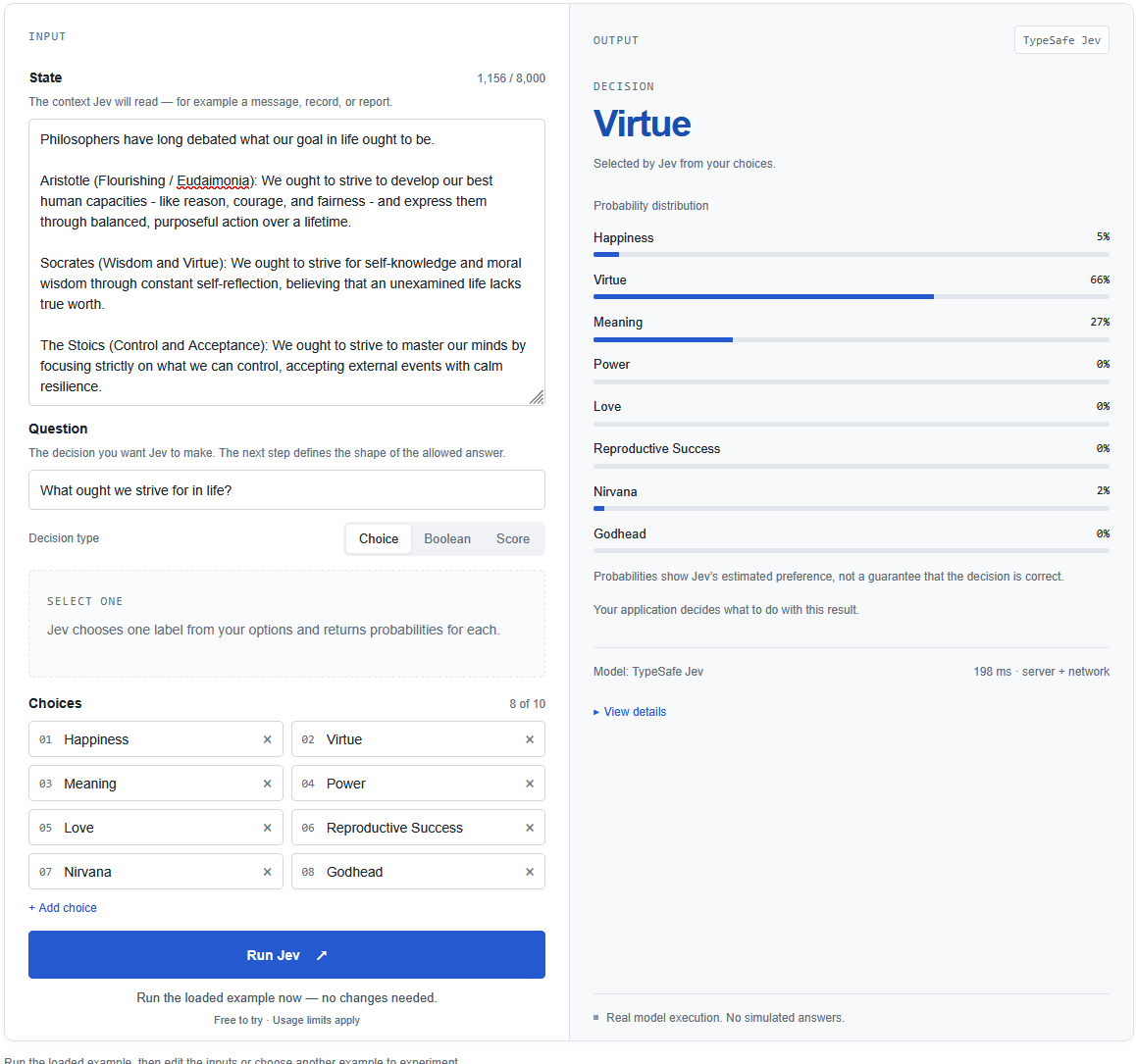
Is Ravioli a dumpling? Jev says 82% true.
For me your more detailed example suggests one thing. It's all about context and seeing different reasonings. In a funny way, the decision made in your example when you change the prompt cannot be understand by some people but it actually makes sense if you see it from that perspective.
Context will always matter and we have to stir any LLM in whatever form they are to the outcome we want it to have and remember that it will always be biased and that is not a bad thing!
short read here https://czioutas.com/blog/typesafe-ai-cube-rule/

There’s five people on one track, or a piece of my property worth $1 on the other that would be destroyed…
I wanted to comment because I would have liked to have heard more about Verdict
But it doesn't flip the switch and it doesn't kill Kyle either, based solely on empirical training on its nature.
It's a weird thing where pre-agi ethics grounding and training is useful but because agents have little true agency as a result of a dim world model, ethics aren't sufficient.
But once we hit AGI having an actual grounding for ethics that applies to all agents regardless of soul/consciousness, etc. will become all that matters.
https://www.reddit.com/r/trolleyproblem/comments/15npmsg/mul...
I've been using coin flips to demonstrate basic failings for decision models, i.e. these are not real probabilities, or they depend on the training data, which may not have an accurate sample to the true population value. We need to collect more failure modes for all Ai so that humans can better judge when and how to use them safely.
The bots will find new failure modes we did not think of, clever workarounds to anything, because we don't give them the right context and instructions
I'm working on an NES harness to play Final Fantasy 1 to demonstrate this, as compared to Jev playing Pokemon. Did you happen to catch that while it was live? (not recorded, but it shouldn't be hard to replicate)
I use the LLM coin flip as a comparison point. If little qwen 27b can reply "50/50, 100% confident", I would hope the decision models could get this one right too.