
If that workload does expand in usage, and the economics of orbital DCs make sense (with high launch costs, zero ability to do maintenance, and weight penalties for shielding and radiators), then surely ocean based data centers (e.g. Panthalassa) make more sense (lower 'launch' costs, high but existant latency on maintenance, no weight penalties), and if those make sense then surely the distributed land based facilities (e.g. Rune Energy) or home based facilities (e.g. Span XFRA) make even more sense (easier maintenance, low/no permitting overhead because they're covered by existing permits, reasonable quality terrestrial fiber internet).
Per unit area, the radiators dissipate a similar amount of energy as the solar panels do, so they'll be a similar size. That's doable.
The upside is there's no land and power generation or grid connection issue; you get solar power 24/7 and the latency to earth is just a few ms.
It would also be possible to fly the individual satellites close together so that you can do high bandwidth optical links between them, i.e. you're not limited to single rack workloads.
A single GB200 rack costs about $3M, transporting its 1.4 tons on a Falcon 9 would cost a similar amount, around $4-5M.
That's got to be too expensive for now, but it's also not in a range that's totally off.
The idea is essentially a bet on land and power continuing to be a big issue and launch costs getting a lot cheaper, which they very well might with Starship. The rest is engineering challenges that are probably solvable.
Not at the same time. To have few-ms latency you need to be in/below LEO, but then earth blocks the sun half the time.
Assuming that orbital data centers make sense, it will be an interesting challenge to figure out how to best mitigate that. Short tasks that require little data will be easy, but everything else needs rethinking. Can you tolerate variable latency? Should you duplicate the data across many satellites? Or should the data constantly migrate from satellite to satellite?
Probably still fine for most applications though.
A normal satellite runs something similar to 1U worth of computer and costs roughly what you quoted in total...
They take all of the bits you guys are talking about into account in the article. You might disagree with some of the numbers, I guess, but that doesn't seem to be what you guys are talking about.
Why use a satellite to do what your IT closet can already do?
A non-trivial number still think that the hard part of colonizing Mars is the rocket to get there. What can you do?
And putting things in the ocean is only marginally less idiotic due primarily to sea water being corrosive, wet, and full of creatures that tend to want to grow all over anything.
I presume the cost of setup, teardown, lead-time, low power density when scaled up, and lack of convenient access for mid-life repairs made it not worth the trouble
The moderate improvements in cooling we're not worth the extra complexity.
So it just didn't make sense to do outside of a single media stunt project.
Data centers in space don't even get the cooling benefit.
The whole idea just doesn't survive modest consideration. Data centers aren't particularly dangerous. There's no forcing function to put them away from where people live. The best location for a data center is going to be a decent sized urban center with existing utilities (power and network) and acceptable land costs.
There are nearly forty of them in Atlanta, people walk by them every day with no idea what they are.
Everything about storing a DC underwater is easier than it is in space (except corrosion).
It's easier to access, cheaper, easier to cool, easier to get enough power, easier to update.
Heck, doing a second story data-center resolves a ton of issues with today's data-centers (while being a bit more expensive due to additional structural support requirements).
There are so many options for terrestrial DCs to overcome whatever problem space might supposedly solve, and they are all cheaper than the space solution.
Spacecraft in LEO deal with corrosion from - among other causes - atomic oxygen atoms up there, which are eager to cause oxidation in almost anything they come in contact with. The rate of this can be greater than on Earth's surface, though I'm not sure how oceans compare for corrosion.
Overall it's probably true that it's less of an issue than with sea water, but it's not a nonissue either.
A single B200 can consume up to 1200W. A single GB300 system needs 14.5kW. So, you can only have ~15 (incl. satellite's energy needs) GB300 with ISS' solar panels, which is absurd. See [1] for the size of the panels we're talking about.
People dream about Starlink-style close flying systems to aggregate them to a single data center. With these power requirements, it's more like an AI hallucination. If we can build way more efficient chips or run smaller models on modest hardware, etc. We may go there, but needing ISS sized solar panels to run frontier models in space?
Also, don't forget the radiators. You also need those to pump that heat out of these systems.
The outlook doesn't look good at this point.
[0]: https://en.wikipedia.org/wiki/Solar_panels_on_spacecraft#Spa...
[1]: https://www.sgmk.edu.pl/wp-content/uploads/2025/10/iss.png
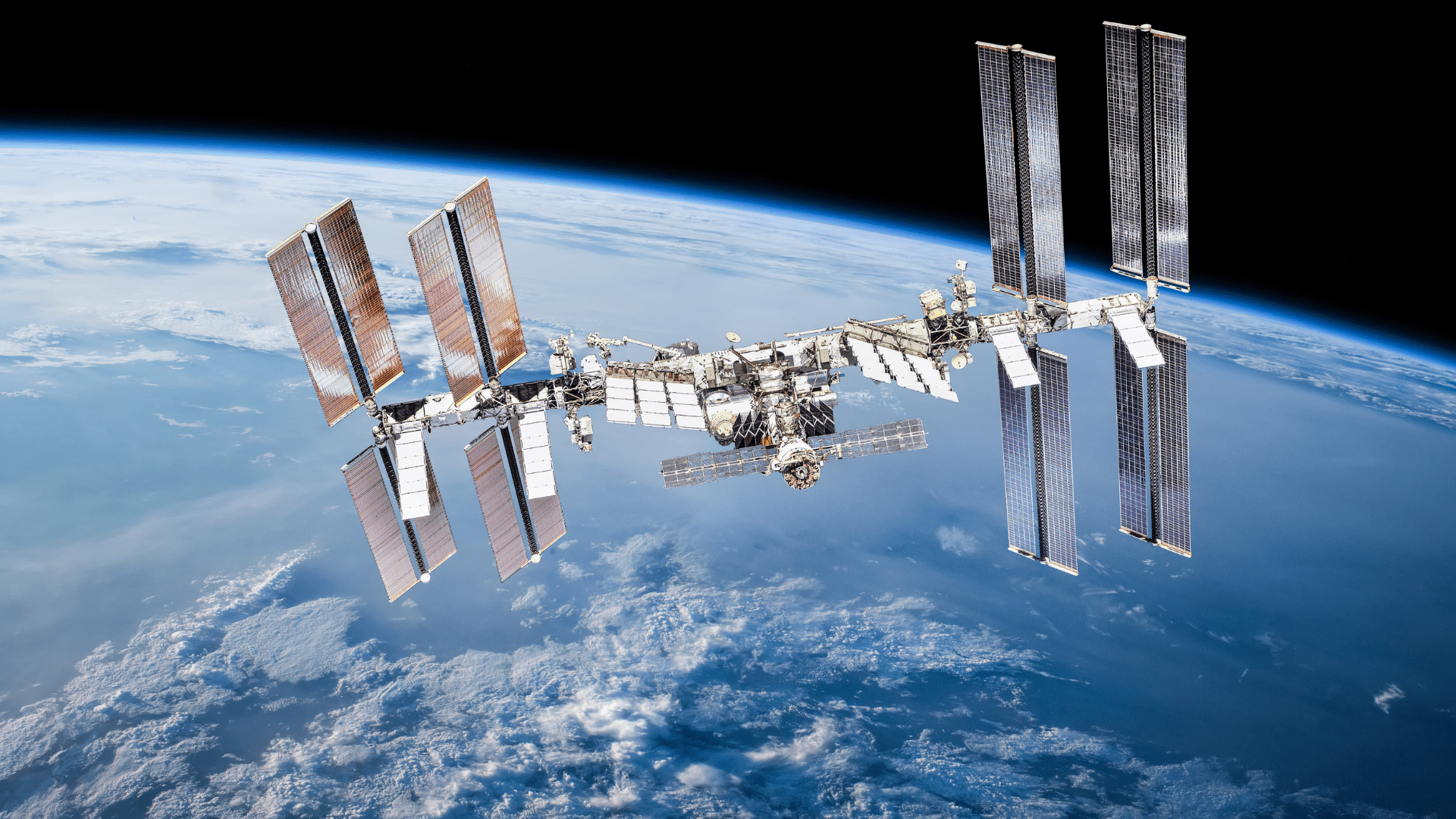
On earth, you can build a power plant miles from the DC. And you can use all sorts of different sources of power, tidal, wind, nuclear, solar, fossil fuels. All options. And like the DC, if there's a problem with any of those sources, you can go fix it or replace it with different power sources. If there's a problem with the solar panels in space, your DC is dead.
That's both easier and a lot more flexible.
That's an automatic off switch.
Even with an intelligence explosion guiding the development of all these technologies, it’d take many decades.
We’ll need to develop base industries from scratch for these environments, but, eventually, we’ll get there. The downside is that it’ll take at least multiple decades, if not more than a century.
For those reasons alone, and because compute will become more and more strategic for defense, I find it very hard to believe that data centers in space will represent even 5% of all compute in the next 10 years. I think a higher proportion will rather be underground or in bunkers than in space.
If you want a safer datacenter you put it underground and you can safely assume that if it's hit by a bunker buster you have much much bigger problems.
Yup. See True Anomaly, among others.
space debris will ruin the rest.
Conclusions
Orbital data centers look more viable than we expected going in and the case rests primarily on launch cost. The engineering challenges seem significant but none appear intractable. Commercial off-the-shelf solar, passive radiators, and standard error-correcting codes seem sufficient for a baseline architecture. We expect limited demos and shipments of compute to orbit in the coming years but our best estimate is that orbital data centers are unlikely to represent a meaningful share of compute before 2030. They might scale quickly thereafter however, and are more likely to be bottlenecked by chip production rates rather than by launch cadence. A generally important dynamic is that terrestrial data centers likely face headwinds that worsen as compute scales up while orbital data centers face constraints that relax with scale.
Anyone who thinks we’ll have data centres in space before we have a civilisation changing step up in surface to orbit space drives and materials science is an idiot.
How the hell does anyone think a rocket is ever going to compete with a prime mover towing two trailers, or an ocean going vessel.
We’re not exactly short of land.
And no, space is not cold.
But we have and had ample evidence of flight in nature, we just didn’t understand how it worked. A similar search across the observable universe reveals no sign of FTL behavior.
Sometimes when you understand the science a comparison to some time when people didn’t isn’t as moving or compelling as you seem to imagine.
We will have space datacenters some day. But I'm not holding my breath.
So many people here are opining as if they are correct. I have a large amount of doubt and I like the fact that the world is structured so that people can try things out and see if it works.
If the world was run by the naysayers in this thread, almost nothing would ever get done.
[0] https://en.wikipedia.org/wiki/Solar_furnace_of_Uzbekistan
Land based or even sea wave-based datacenters are all much more feasible.
Surely a single AWS/GCP/Azure/etc DC on earth is so big we won't be getting close to a similar amount of compute in space for the foreseeable?
The economic case also needs to be explained. What are people going to do with a DC in space?
Vibing with the default assumption is cheap, and it should be cheap. While we have no reason to believe otherwise there is no reason to go looking for a lot of evidence for why we are right. Everybody believes so, so why bother convincing us right? Vibes are enough until proven otherwise.
Vibing against the default assumption is expensive, and it should be expensive. Extraordinary claims require extraordinary evidence and all that. Your job is to prove that you are right, that the traditional wisdom is wrong, and that everybody has to change their mind. Vibing in this direction is not nearly enough. In fact, the vibes in this direction are worth nothing.
Especially fun when you consider how often gigawatts are talked about with AI. And what that would mean just for cooling as in area... Or then dividing that to sufficient number of individual satellites...
Solar & wind can’t power industry.
The pro-nuclear propaganda is suspiciously associated with people with a history of also wanting to build nuclear weapons. The Liberal Party of Australia is an example — they seem very interested in overpriced nuclear power and obtaining nuclear powered subs capable of launching nuclear tipped missiles.
Cost comparison: https://chatgpt.com/share/6af8ce92-bd10-83ec-88be-1f61051091...
Nuclear needs to get down to a capex of maybe $3/W to have a chance. This is a very big ask.
https://www.cell.com/joule/fulltext/S2542-4351(26)00362-4
Their blogpost is more "marketing-ish" but the videos are worth a watch too:
https://blog.google/innovation-and-ai/models-and-research/go...
Should we consider orbit to be outside of terrestrial tax jurisdiction?
The majority of the cost of putting these data centres into orbit would be borne by terrestrial jurisdictions. The places that built institutions, funded education, provide medical care, etc. for the people who built these things. The environmental impact of building these data centres and launching them will be paid by those living on Earth's surface.
On Earth, we often fail to recoup many of these costs because of out-sourcing, but at least some other jurisdiction benefits. If a poor country is lifted up by the benefits of out-sourcing, at least some good has been done. If we let billionaires simply blast off and evade taxes, that's a net loss to the societies that made this possible with no benefit to anyone but the billionaires. That's fundamentally wrong.
Space may belong to no one nation, but neither is it true that space belongs to no one at all. The space around Earth belongs to all of humanity. Orbital data centres should pay terrestrial taxes. It's not clear where those taxes should go, but we need to hammer out the laws to make sure they are paid.
Is this already done?
I mean, the US could have a rational process of building new energy infrastructure (which should be only solar, wind and nuclear imo) but the actual process is opportunistic and haphazard. So it's not strange to see the NIMBYs biting them. It's like "well if you hadn't a d*k, this might not be happening to you..."
Also I wonder how long the ODC needs to operate to offset the energy spend on getting it in orbit.
The energy needed to achieve orbital altitude is vastly less than the energy needed to reach orbit. About 1kg of rocket fuel will carry a small explosive and some tiny steel spheres to LEO altitude. The projectile will not be in orbit; it won't have escape velocity -- in fact it will briefly hit zero velocity (wrt the earth) at orbital altitude and then fall back to earth.
The very large cloud of shrapnel created will encompass LEO orbital height for several seconds. If an orbiting datacenter passes through the cloud during those seconds, the shrapnel will be moving at orbital velocity wrt the datacenter. In other words, just one piece will take it out.
With relatively simple rocketry (and, these days, an abliterated LLM to aid you) a dedicated luddite would have several opportunities per day to hit one of a constellation of satellites. If they wanted one very specific satellite they'd have one or two chances a year. The targeting and steering is not hard -- the orbital paths are publicly known and easily observable; you can use RF time-of-flight to implement exceptionally precise position/altitude/velocity measurements from the rocket (no need for GPS -- use your own transmitters on the ground). This is not hard. And it will only get easier as AI advances.
*I strongly discourage anybody reading this from doing the above.*
I'm posting it in order to show people that anti-sabotage is absolutely not a selling point for orbital datacenters. If anything, they are far more vulnerable to luddite attacks. The people channelling billions into this tech know this too. So their motive is something else. I don't know what, but it isn't this. The math doesn't work.
Long answer, https://www.dia.mil/Portals/110/Images/News/Military_Powers_...
If this is the case, I wouldn't be surprised to see them eventually support these kinds of regulations because it would enhance their moat (now earth orbit in addition to large capex for equipment and a sufficiently large user base).
But, as these things go, regulation isn't that much about where you put the computers, but about where you register your company, and where your customers are living.
In terms of regulation, it depends on the specifics. Sometimes it depends on where the customer lives, but even if it does, when a platform has no business operations in a region and there aren't international treaties between the consumer country and where they're operating from to resolve that sort of thing, the most the regulating country can do is block them.
If they have headquarters outside the EU, and only use data they've already acquired/processed to make money off of EU consumers from outside the EU, GDPR shouldn't be an issue for them in the same way.
And GDPR makes it harder for their competitors to catch up because it's harder for those competitors to get data.
It could be that the EU would block them if they wanted to host fb/etc... including ads, and didn't have a presence in the EU, but I'm not sure if that's the case.
Where you put something is completely irrelevant.
Where you put something, like a data center, can be relevant. If Meta didn't have a business presence in the EU, and operated their data centers outside of the EU, they wouldn't have been subject to GDPR in the same way they were.
What happens if a major advancement renders all the GPUs obsolete? How can they upgrade the hardware and resell the old hardware?
Are they just going to vaporize all the gear and precious metals?
IDK, the whole thing seems silly at the current state of space logistics.. For these and many more reasons.
It's popular mechanics/science levels of practical fantasy, but somehow now those stories end up swirling around the Internet and never flush. Would have been like having 5 newspaper articles about space elevators every month for years.
vs Space:
* Can drive a truck out there
* No limit on weight or dimensions (within reason)
* No giant explodey thing transporting it to into where it needs to be
* No constant falling towards the earth that needs to be averted with thrusters
* If building in the middle of nowhere there is also lots of space for solar panels
* Heat can be rejected into the atmosphere/earth/nearby bodies of water etc instead of radiation into the vacuum of space
* De-comissioning it doesn't also involve slamming a DC worth of mass into the atmosphere and burning up otherwise recyclable materials.
* You don't look like a doofus for doing bad math.
Solar power and power dissipation are similarly solvable. The only bottleneck currently is launch costs which is why it’s expected around 2030 is when these DCs will explode
So it is not outright stupid, just has a few extra costs.
So again, what's the economical benefit? Because you surely have no power and dissipation problem down on Earth, so why add a whole rocket launch into the equation? Because big fire goes brr?
It's not that far off from a residential router with a bigger antenna.
What are Hyperloop/Boring actually doing now? It doesn't take that much investment to human-drive a 10-20 Teslas up and down the Vegas Strip in a straight tunnel at normal speeds.
Heck for $50/kg I could see it, too. Now with Falcon 9 or Heavy it's on the order of thousands, isn't it? Just need a measly two orders of magnitude improvement and then we can start talking.
We can't yet know the ultimate cost of Starship payloads. All we have is SpaceX projections of $10-100/kg. Maybe that is realized, maybe not. Given the scale of the LA launch site they're building, they intend to have the launch cadence to deliver lower launch costs than anything achieved with Falcon 9 or any other launch system ever created.
The idea that launch rates could increase to the rates required to launch gigawatts of computing into space, without attracting a huge backlash, is fantasy. And such a backlash would be entirely justified - the only reason why the environmental effects of space launch aren't a focus of environmentalists is because there aren't many of them.
For one thing, I think there's a huge assumption that we just can't make energy cheap on earth (Cost per GW). Solar/battery costs are plummeting, nuclear energy is still a great option (see: the quantity of in-progress Chinese nuclear power plant builds in progress, I think around 30 projects under construction right now), and we might just figure out fusion reactors one day soon.
"Favors: Earth today; Space later" - seems way too confident.
Land Use: Does this article just not realize how large the earth is? The earth will never run out of space for data centers. You can even put them in skyscrapers if you want.
Long-run scaling: How does this row make a lick of sense? This is a lot like saying that if I build my house in space then I could have 100 parking spots in my driveway. The problem is, I don't need 100 parking spaces in my driveway. Like, yeah, we know that there's infinite room to put stuff in space.
Carbon / local environmental burden: Another insane take on this subject. Are we really going to hand-wave over burning a shitload of rocket fuel to put stuff in space? "Favorable vs gas-backed terrestrial buildout" why are we comparing against a gas-backed buildout?
Silliness aside, has anyone come up with a cooling system that would work well for a friggin data center in space? Or is it still all just a wishful thinking game, ignoring physics?
(Sorry, the snark is not directed at you)
That cooling is already perfectly viable.
However at the temperatures chips operate at, because stuff on the ground is getting convective cooling as well as radiative, a radiator designed for LEO will reject slightly more heat on the ground than it would in orbit.
Perhaps you could explain in detail why you think the laws of physics have to be violated for space data centers to work.
As a Linux user, I can already build such a system quite trivially by installing Debian on a Raspberry Pi, attaching it to a weather balloon, and setting up a cron job to maintain orbit. The cooling is handled by opening a window. From Windows or Mac, the balloon could be accessed through built-in software.
The catches:
o Shielding from the sun's light and radiant heat.
o And efficiently radiating the system heat into space (since there is no air to convect or conduct the heat away).
I mean, Elon will probably shoot some GPUs up there and call it a success, but I'm not sure that should count as "data centers in space."
Or two. It's a broad range, but with his personality and prior history both are possible before he announces whatever the next pivot is.
Just, not a million. There's better things to do with the capacity to put a million up there, and better places to put a million (last I checked) 120 kW compute racks and associated PV systems.
You don't have to pack your energy generator into the same package where your compute would go, for laughably little energy. You can have a single cable go between a huge power plant and the data center.
Also... nuclear? Please don't be silly.
Do that, and you can quickly bootstrap an orbital ring and make rockets obsolete from surface to orbit of either body.
In the case of Mars, the planet-wide dust storms make it a good idea to locate your PV off-planet, and an orbital ring is also very convenient for that.
Like their section on collision avoidance isn't any more sophisticated than "Starlink has a great record so far" when we're talking about a very different scale of how much mass and surface area has to be moved around in a coordinated way.
This is in effect an editorial from two postgrads, not an actual detailed workup. I don't feel like spending time going into any more effort based on that.
The impulse to discredit someone's "art" because of their politics has always stuck me as incredibly juvenile.
It's as if people can't imagine competence - even in some narrow way - in someone who doesn't share all their exact beliefs.
It seems especially silly because literally every great man and woman of history shares only a tiny fraction of our modern beliefs.
Sorry. Not sorry.
Starcloud-1 is already in orbit, and many other plans by them and other firms are already well into development.
And Lonestar has a backup server on the moon. Seriously.