
https://en.wikipedia.org/wiki/Strong_Towns
I know municipal finance is about as exciting socks for Christmas, but if the Strong Towns thesis is correct, we've basically found ourselves in slow moving crisis, where city budgets start very slowly, but very surely, become unsustainable, and by the time anyone notices, it's mostly too late to do anything about it. Pipes cost money, repaving costs money, replacing your wastewater system costs money... lots of money. The fact that they only have to be replaced every 30-50 years doesn't mean the costs go away... they just disappear temporarily. Deferring that maintenance doesn't actually do anything except make the problem worse tomorrow.
The idea that LA literally can't afford to bring it's sidewalks up to ADA code is insane. The idea that they're engaging in penny-smart, pound-foolish solutions is a strong signal that the city budget is already deeply broken, and likely is not fixable under the current paradigm of LA politics.
California cities could trivially fix their budget problems by satisfying the demand for housing by adding density, but it seems they are determined to do nothing until the wheels finally fall off, and the city's budget crisis spirals out of control. Even then, I wonder if they will take the Detroit-route and declare bankruptcy before actually addressing the problem.
>Re-zoning only works if there are developers who want to redevelop the land.
Developers very obviously want to redevelop the vast majority of LA. The marginal cost of a housing unit is vastly higher than the cost of building that unit. To raise long-term tax revenues, LA could not just legalize redevelopment. They could actually incentivize it.
>For existing neighborhoods this means buying dozens of SFH from people who don't want to move.
The people living in SFH don't want to move exactly because they're not generating enough tax revenue to keep the city afloat (mostly due to Prop 13). Eventually the city will start having to raise taxes very dramatically or declare bankruptcy. That's the entire message from Strong Towns.
The more we put it off, the bigger the impact will be. When your city is effectively long-run insolvent, but you have the ability to change that even if it's politically unpopular (and LA does), then it's "trivially" doable, it's just that people don't want to.
That's not the case in many other cities.
In other cities demand isn't there. People will just leave when taxes go up, and the town will declare bankruptcy. At that point, they will effectively lose most of their population, or people will just live without things like clean water. An example of this happening is Jackson Mississippi, where the water system failed, and the city didn't have the money to fix it. The ultimate solution was just a federal bailout, which is not sustainable if these types of crises become endemic: https://en.wikipedia.org/wiki/Jackson,_Mississippi_water_cri...
Strongtowns seems a bit motivated in their analysis, to put it mildly.
https://www.investopedia.com/terms/c/cashaccounting.asp
This looks at current costs. The school is a cost every year, so every year that cost shows up on the budget. The problem is that road/water/sewer maintenance often doesn't show up on these budgets because these systems are usually built all at once. Because of this they usually also need to be replaced all at once. To see those costs before they happen, you need to use accrual accounting:
https://www.investopedia.com/terms/a/accrualaccounting.asp
The entire message from Strong Towns is exactly that because cities often use cash accounting instead of accrual accounting in their budgetary processes these lingering issues of deferred maintenance don't show up until they do, and when they do, those costs will simply be too large for the city to cover without very politically unpopular interventions.
Strong Towns makes good arguments about certain things and are critical in a reasonable way of how civil engineering organizations rate the need for more civil engineering works. But the budget discussion makes zero sense.
The biggest expenses for county, city, town, village government are: schools, police & fire, Medicaid share in states that do that, and employee retirement and health. A small/midsize city spends 60% of its budget on police.
Capital projects are capitalized with bonds. Governments have the lowest bond expenses due to tax exemptions. Roadwork is not done in a cash basis. It’s bonded for 10-30 years depending on the job.
LA currently has about a billion dollars of outstanding general obligation bonds. They're still rated AA, but I presume that is because the credit writing agencies understand how many untapped revenue streams LA has, but again, those will require unpalatable political change. You can’t keep refinancing forever.
Philadelphia, Miami, and Chicago are getting close to junk bond status, and when that happens, the option to refinance starts evaporating very quickly.
LA is fine.
If we cut the school budget only when we need to repave roads, we are playing fast and loose with our children’s future. When we set our budgets to be sustainable, we don’t rug pull parents who are trying to build a life in our cities.
Like I'm happy that my (suburban) city requires new developments to connect to a city-wide bike trail network. That's great. I just don't think Strong Towns/Not Just Bikes presents a realistic mental model of the world. They seem to clearly be pushing for a specific vision regardless of facts.
The cost of building a housing unit is rather out of control in LA right now, due to a number of factors. Some of those factors involve permitting, but some involve complexities of complying with building regulation, and there is also insufficient availability of contractors and insufficient availability of labor.
The point is that the vast majority of budgetary issues in LA could be solved by just legalizing, and streamlining the production of something as simple as three-story row housing like the kind that's normal in San Francisco (which has a surprisingly good long-term outlook despite their current budget woes).
It's not rocket science here. If you make it easy to build housing, the industry grow to meet demand. If you make it difficult, it will be dominated by a handful of major players who can navigate the process.
Inflation for materials and labor makes any build incredibly expensive.
But non-union construction is known to be unstable even outside construction's general boom-bust cycles and nobody is going to travel 1500 miles away without a contract guaranteeing they will have work/pay past the first 2 weeks. Too many workers have gotten burned being given great offers to travel for work only to get screwed over before they can recuperate their costs. Hell our own President is famous for screwing over construction companies and people just accept it as normal for the industry.
So the kernel of the argument is that 1) someone bought a single-family home and based on ground truth (property tax, cost of living, etc.) and 2) that property tax isn't sufficient to fund the city?
Can you really blame someone for not sacrificing his position under these circumstances? If I'm meeting my obligation, what do I stand to gain from leaving my house and moving into an apartment? That's saying "I need you to move so that someone else can take your property." It's not going to go over well.
A common zoning change here is based on street frontage for semi-detached homes - the new ones are still 3-4BR, just attached at the garage and with smaller yards. If development required 15m frontage, but then that changed to 12-13m, that would mobilise a lot of owners to take advantage, though obviously others can just stay as is if they prefer.
It usually happens that an $800k lot value becomes $1m, regardless of the state of the house. The owner can then demolish a decades old house, build two places for $600k, sell one as a new home for $800k-1m to finance the build (and costs of moving out during that phase), and end up in a new house themselves. Often they've sacrificed yard that they found annoying to maintain anyway.
The above can be adjusted where it's possible to build 3-4 on a block, or a larger development of apartments.
Zone changes typically allow change, not force it, surely? An owner can just keep their SFH and large yard if they prefer. What they can't always control and often vote against is the composition of their neighbourhood.
What? There is a structural deficit problem. The ship is sinking. Complaining about how "we shouldn't have to change anything about the ship" isn't really a reasonable argument. We live on this ship... we have every incentive to make sure it stays above water.
You might think there is option 4--municipal bankruptcy--but that is just option 2 and 3 combined.
Building buildings somewhere else will not fix your neighborhood.
I don't really think those are the only three choices, though. The government can fail and be replaced with a new one that will shape things up. Then it'll be replaced by another that thinks it's too big and well off to fail, squander it, and fail. That's the typical cycle.
- I could make more money
- if the zoning allowed it.
As it is right now, it'd be profitable, but the zoning isn't there for it.
So for each new street widening, new road, and piece of highway capacity, LA was increasing it's financial liability to revenue ratio.
Add over decades all of the street and road construction that LA has done, and it now has a unsustainable amount of road maintenance it's responsible for compared to the amount of revenue it pulls in. I'm having a hard time finding numbers though so please correct me or add numbers if you can find them.
California is doing a ton of things to create housing — just look at the many state bills that have passed in a span of 2-3 years: https://cayimby.org/legislation/?_filter_by_status=signed
Sure, some cities are resisting or having trouble but even the state is overriding them with state policies.
It’s just going to take time between passing bills, incentives lining up, and getting money for building homes. That’s also why the state has focused on ADUs too — because individuals can get through a whole decision process to develop housing quicker than a big developer can. ADUs have a lot of problems but the state knows this and is attacking the issue on both short and long term scales.
You don’t just steer the 4th largest economy in the world. It’s built like a steakhouse and steers like one.
They don't want it, even if they need it. They're kicking and screaming and doing anything they can to stop it, while at the same time their city budgets are in the toilet. The only thing that's actually driving this reform is that housing prices are out of control, so you have a large demographics of people fighting to increase density.
Where this is not happening is everywhere else (think: Texas, Florida, North Carolina, Virginia, Arizona). Those areas don't have the same demand for density, but they still have the same long-term structural deficit problems.
Now I think this is a problem with reflecting on. Why is it that given the choice, many people with financial means move away from America’s cities? I did. I promise you the reasons have nothing to do with zoning.
I would disagree. The engineers absolutely steer the space of available solutions. Caltrans is a prime example, I have personally met Caltrans engineers who might as well have stepped out of a time machine from 1970. This absolutely influences the priorities of both the state and the cities that depends on the framework it sets up.
And yes city politics is separately a major problem.
This is the problem with outsourcing everything in the name of "efficiency".
If you don't actually do things in house, you don't know how to do them.
Everybody wants the US to manufacturer and build more until they have to cut a check.
Everyone hates Nassim Taleb and he can be an asshole, but his math is impeccable. When your concern is with someone's personality because you don't like their math, then you've lost the plot.
I got into a fight with my city over nonexistent crosswalks (the adhesive line strips wore off) near my home in an area where drivers have a hard time realizing where pedestrians cross due to a unique road setup.
You can’t just paint lines. The project ended up costing about $1.2M and required a traffic study, some stupid ADA assessment and accommodation that frankly any layperson could have figured out, and a complete streets assessment.
Basically, they sent out a few engineering technicians who make $20/hr, billed out 80 hours at $120 to count cars and people, and printed some boilerplate analysis (@$250/hr). The end result was they painted new crosswalks and added textured curb surfaces for ADA compliance, which allowed for the use of recovery act funds.
I am willing to guess they probably did, even if it doesn't seem directly related.
The state of California already mandated certain density improvements:
https://calmatters.org/housing/2025/10/newsom-signs-massive-...
There is another law that mandated local communities plan to manage housing to accommodate population growth or the local community loses it's ability to deny permits. Struggling to find that but it was well before 2025 I believe.
The more likely reasons is corruption and paying off rising CalPERS costs:
https://californiapolicycenter.org/repeat-pension-history/ https://www.ppic.org/publication/public-pensions-in-californ...
Your argument might be plausible if it weren't for the fact that this issue is happening -- predictably -- in every major sprawling city in America. Strong Towns has literally built a tool to effectively convert cities' cash-accounting budgets into accrual-accounting budgets. You can see it happening over time... you just need to account for the future liabilities in the way you look at your budget instead of ignoring them until it's time to replace the infrastructure.
None of those cities are saving money or even _planning_ for the inevitable repaving, pipe re-lining, etc. Worse: many of them were built up in waves so much of the city's infrastructure will "come due" around the same time.
I never imagined we would see San Francisco (of all places) overhaul its permit process. I can now build a deck in my backyard, add a story to my house, or build an ADU without having to pay DBI to send certified letters to all my neighbors asking if they'd like to object, then being forced in front of the planning commission when they do so. That's a direct result of the pro-housing legislation at the state level, something Wiener has been heavily involved in.
edit: nevermind, found lots of example here! https://www.google.com/maps/d/u/0/viewer?mid=1iV3NEJqsY0y8N1...
sadly lots of the big cities I was interested not included. Guessing with these it's more difficult to get the input numbers.
One interesting question: what is "density"? Is it number of people per road-mile? Number of households? Structures? Sales tax revenue? Property tax revenue? Property value per road mile?
LA has somewhat insane property values right now, and by the metric of millions of dollars of residential value per road-mile, I think one might imagine the density to be sufficient to afford decent streets. Of course, that does not translate to municipal budgets or even to disposable income of the owners or the residents in those properties.
There are other ways around this though. If you force your citizens to maintain their own septic and well water (or even small-pipe potable water), and have unsurfaced roads, then you can do with much less revenue-per-road mile.
The point is that the federal government usually pays for the infrastructure up from (as an "investment"), but when that subsidized infrastructure is a net money-loser in the long run, cities growing actually makes the problem worse.
Also, in 2025 they spent 3 times as much dealing with legal fallout from police misconduct compared to street maintenance.
I kind of disagree. Deferring maintenance does make emergency repairs more likely, but if you need to replace your sewer piping (for example) every 30-50 years, doing it at 33 year intervals means three installs in 100 years, and doing at 50 years means two installs in 100 years.
As long as you don't push the deferral so long that you end up having emergency repairs and remediation of significant leaks, deferring maintenance reduces the burdens of maintenance.
You do need to invest more in surveillance if you want to run your installed infrastructure longer, but surveillance is a good practice regardless, because sometimes 30-50 year infrastructure fails early. For sewers, the idea is camera inspections of all the municipal lines every 3-5 years to generate a prioritized list of maintenance/replacement projects; do the work as budget allows, rinse and repeat. Older sewer systems will benefit from more frequent inspections and newer systems can get by with less. You really shouldn't fully eliminate inspections on new systems, because earth movement and early material failure due to manufacturing error don't always happen on your schedule.
That said, a lot of sewers were initially installed in the post war boom times of the 1950s and deferred maintenance is coming due -- many portions may have been replaced as needed, but a lot of original pipes are hitting 70+ years of service life and are likely nearing the end of their life. There's an argument to be made that if they had been replaced at their forecast service life, things would be better now ... but that really just brings forward the next replacement.
IMHO, The City of Los Angeles really should be multiple municipalities. The boundary is pretty wonky, in part to capture the port of Los Angeles and Los Angeles International Airport, but also downtown vs San Fernando Valley; and that has got to make a lot of administration stuff significantly harder than if it were multiple geographically focused municipalities.
> California cities could trivially fix their budget problems by satisfying the demand for housing by adding density
I agree that density is likely the right way forward, but I don't think it's trivial. Especially since organic density increases have been suppressed for so long, it's helpful to coordinate rapid increases in density so that dense housing lands in places with appropriate transit and other services; but coordination is difficult.
That said, currently I live in West LA. Traffic is atrocious! Doubling or tripling density will make it even worse, probably exponentially worse. Adding non-car transit options just isn't in the cards in any reasonable time frame because of all the people that block construction and because the USA, like most countries, refuses to setup a win-win situation for transit (like Japan) and instead continues to insist it be government based and therefore most likely to go over budget during construction and then under budgeted during operation.
At the same time, I wish our entire coast was 30-50 story high-rises. It's ridiculous to me that only a few elites get to view the ocean from their homes on the coast and everyone else is shut out because no one is allowed to build the high-rises.
ADA code is insanely expensive. We did a couple blocks of those silly dimple ramps for $250,000 . You could hire every blind person in town a personal guide for less than it would be to ADA all the side walks.
The sidewalks are going to have to be completely replaced eventually... not just the sections that need ramps. Right now the city can't afford to replaces just the ramp sections.
Activists came up with a doorjamb law to require bike lanes, ADA and road diets on every block that receives repair. That's just not practical in LA. You can't punish drivers into riding a bike to work.
this is coming from someone who biked and bussed to work in LA for 10+ years.
It's reckless policy that will only undermine your efforts and never reach the desired outcome.
Yes I understand there is a funding issue, it needs to be solved by making the design and approval process more flexible and efficient, not by perpetuating the insane car-only design that kills pedestrians and cyclists.
Tha perpetually increasing population growth is no more and that means no more growing tax base to paper over terrible decisions to pass them onto another generation.
For the first time in a long while we're looking at actual, real selection pressures on municiptalities.
> Strong Towns thesis is correct... slow moving crisis... The idea that LA literally can't afford to bring it's sidewalks up to ADA code is insane
see, this tells me you're not getting it at all. it is an insult to process, yes. But there's no crisis. Strong Towns is kind of obviously wrong.
That means a 6,000lb escalade creates 3x the road wear than a 4,500 wagoneer from 1990.
The bug in the law really seems to be that cars that really aren't intended as work vehicles are being treated like them.
It's not realistic to do this on a heavy truck, which run 110+ PSI on heavy wall tires and why they cause the power law damage to roads.
Firstly, a Wagoneer is never on pizza cutters. You can't put a 4500lb car on pizza cutters even in 1990! It came with 235/75R15 tires. They are big sidewall donuts, but no pizza cutters.
The Escalade runs 285/40R24 tires, that's wide and low-profile.
Widening a tire increases ground pressure, because low-profile tires have massive amount of reinforcement to prevent that wheel from cracking. This stiffness adds to the pressure the road feels.
Tire contact patch is a function of weight and tire pressure. A 205mm width tire has the same contact patch as a 285mm tire, given same weight and pressure. The only thing that changes is the shape of the contact patch, which becomes wide and short instead of narrow and long.
The 6000lb Escalade runs its 285/40R24's on 35 psi, the Wagoneer runs its 235's at 30 psi.
So assuming even weight distribution, the contact patch per tire is 6000lbs/4/35psi=42.8in^2 inches for the Escalade, and 4500lbs/4/30psi=37.5in^2. So the contact patch is only 14% larger on the Escalade, yet it carries 33% more weight!
If you look at the road wear formula, it's entirely a function of weight. So the width of the tires only impacts surface-level abrasion. And with the power law, that's still 3.16x of Wagoneer's wear (or 216% increase).
So the wider tires do virtually nothing to protect the road from the extra 1500 lbs weight.
In fact, the dynamic load when hitting potholes is greatly exacerbated by the 285/40R24 low profile tires, because instead of of absorbing the bumps within the tire, the stiff sidewall low-profile tires absorb way less.
The spring rate of the Wagoneer tires is ~1200-1500 lbs/in, the spring rate of the Escalade tires is ~2500-3500 lbs/in, so that's a 2x stiffer tire! As a result, it transmits twice as much force when hitting the same bump.
So as a result, an Escalade accelerates road cracking considerably worse than the Wagoneer, not even in the same league.
Yes, the heavy trucks wear the road outsizely, incomparably to the SUVs we are discussing. However, we have roads that do not allow trucks (parkways) or see little heavy truck traffic.
- collect garbage more frequently in smaller trucks
taiwan has very cute small garbage trucks and they have a ice-cream-truck like song signalling for people to bring whatever trashbags they have out to the truck, so you don't even have piles of garbage outside for days waiting for the weekly truck. quite nice.
By the way, I've never seen SCALES OPEN sign for the trucks, it's always SCALES CLOSED, or maybe I'm just extremely unlucky.
The most important thing to remember about flexible, pavement lifespan is that asphaltic pavements are not designed to last forever. The asphalt binder will eventually oxidize and become brittle even with no traffic. These surfaces are meant to be consumable bearing services that last for 10 or 20 years and then have to be removed and or overlaid.
From what I can find, the standard weight limit for a truck in 20 tons per axle (less when multiple axles are close together).
In contrast, the average weight for a car is a bit under 4 tons (even for SUVs). Even a pickup truck is under 5.4 tons. Since these have 2 axles, that comes out to every class except loaded freight trucks having under 2.7 tons per axle on average. So a freight truck acting at the legal limit (without tandem axles) would be over 7.4 times as heavy per axle as a passenger pickup truck. Applying the 4th power law, this means a single maximally loaded truck causes about 3000 times (300,000%) as much damage as an average pickup truck; and 10,000 times (1,000,000%) as much as an average SUV. In contrast, the difference in damage caused by an average SUV and an average sedan is only about 40%
Maybe they do a lot of extra work over night over here in Tokyo, and it just goes faster? Or it's a very systematic thing and part of the maintenance schedules, so it doesn't really go that bad?
If you order anything in Bangkok, even say a refrigerator or a king size mattress, it will almost always be delivered by a modestly sized pickup truck (with a high roof covering the bed).
Economic realities do force decision making.
Maybe not.
Due to battery weight, EVs are super heavy even if they aren't SUVs, so are delivery trucks without which an urban community cannot and will not exist. Urban roads should be able to handle the weight even if everyone converted to EVs.
Coming back to the EVs, a small EV is a possibility, because it takes less power to move a lighter and smaller car. But would it sell on the US market?
A smaller car has less space for battery than an SUV. Because batteries are extremely heavy, that smaller car needs to be overbuilt compared to its gasoline counterpart, which further reduces room for battery. Then, because safety standards are harder to meet with small cars, the smaller car needs to be overbuilt even more.
This means that you get cars that only have half the range a gasoline-powered car does, and the gas powered car recharges an order of magnitude faster than the EV does. Oh yeah, and the people who buy smaller cars like this tend to live in places where there's no charging other than going to a gas station anyway.
It wouldn't sell on the US market because better alternatives exist. It could sell on the Chinese market because there are no better alternatives.
Road wear is a power law, and heavy trucks cause the wear https://blog.ucs.org/dave-cooke/trucks-cause-the-lions-share...
(Whether this is a good idea or not is debatable, but it’s the way things work right now and the fact that we subsidize truck shipping to the tune of a large amount of money is not widely known)
What people want are Inexpensive vehicles, not necessarily larger ones. American car manufacturers have been actively suppressing cheaper smaller vehicles for their own benefit.
Surely, if buyers didn't want these vehicles, makers couldn't sell them at high prices, right?
It's supported by sales data.
We've consequentially paved over the issues (no pun intended) via creating a socioeconomic hierarchy of insulation from traffic injuries. Giant SUV's have become the mainstay of the upwardly mobile 30s suburbanite, who is immunized from the road hazards, collisions and dangers that would cripple sedans.
That being said, EU is generally safer per km too.
I would reply that pound for pound EVs create far fewer issues in other categories than its weight-equivalent ICE vehicle, and that to an extent that weight is justified for the urban environment far more than a 2025 Chevy Duramax.
Its becoming a place to actively leave, if you haven't already.
Not to mention the crippling higher education reforms and the state seizing control over tenure review.
LA government is an enormous corrupt police department with a few measly services slowly decaying as their funding gets cut.
I naively expect that less strongly aligned cities are run more competently, because the concept of "consequences" can exist. Where I am, there's a very strong political alignment, so no consequences at all. The same group of people will be voted for, no matter what they do.
My neighborhood in NJ just got those fancy ADA compliant curb ramps last year, along with a repaving. It did take them much longer to install the curb ramps (like a week or two?) than it did to pave (one day) so I can imagine there is a significant cost, even if it's a smaller amount of materials.
Maybe they'd settle badly if vehicles drive over them, kick up in the opposite corners and become a trip hazard.
The UK mostly skirts this by using tarmac and paving slabs instead of concrete.
Likely this won't be terribly faster, and I did see the company near us using a machine that was building curb cuts directly.
There are hardly any of these in the UK, for example, and kerbs are nearly always made of kerbstones that are sunk into the ground. They have their own problems with sinking when driven on, and I imagine frost heave in areas where the ground freezes seasonally. But it does mean that a dropped kerb installation is quite quick. Most dropped kerbs are simple tarmac ramps rather than concrete castings here.
Include a built channel for injecting hydraulic grout a few months later once the settlements happened to correct it out.
It would be cheaper to pay 60k a year per blind person to hire them a full time guid for waling outside.
Also, $60k/year is a) not nearly enough to pay a contractor full time living wage and b) not enough to cover the greater than full time necessary to assist someone. Blind people need to navigate the world at all hours on all days...
Why do you think so? Even the front wheels of wheelchairs are much larger than those of skateboards, and their main wheels typically are pneumatic (front ones, too, probably, but cheaper ones might skimp on that)
"Be hell for skateboarding" wasn't likely considered a bonus by the disability people because it would rally "those sort of people" to their (otherwise legitimate) cause.
What the city can't seem to do is rid itself of corrupt employees and corrupt practices.
These people talk a big game, but when it comes to basic office management, they're less than worthless.
I wish I could vote to leave the offices empty. I honestly think that would improve things.
It is a nice theory but then they bring out the same rhetoric when seeking re-election. So yeah, corruption may be abound.
- rank cities by size
- go down around the 150th on the list
- that's cities like Knoxville, TN
- in the 1950s/1960s they received tons of federal funding to build infrastructure
- now that infra is falling apart but the cities themselves don't have the money to fix it and the government is going to bail them out
Just like how at the federal level DOGE found almost no waste and corruption during their crusade against the federal services (stoked by similar anti-tax sentiment) it seems that every time a narrative of "corruption" takes hold enough to actually tackle the issue and launch a program to handle it, the program in turn finds its just wasting money.
People just need to accept paying more taxes in order for their society to flourish.
Why don't they asphalt curb to curb for a mile and then come back and do the ramps one at a time?
As someone who did a stint in this kind of construction: not possible, you'd still need to re-pave about 30-50cm worth of road, because curbstones are (usually) suspended in a bunch of concrete to avoid them getting dislocated by cars hitting or driving over them. The result will be a faultline from which you will get potholes in freeze cycles.
The proper way is to do everything at once, leaving one slab of contiguous asphalt without faultlines.
I've noticed that a fair amount of concrete sidewalk in Los Angeles appears to have been poured when the neighborhoods were first developed (as in post-WW2) and haven't been removed or updated since then (at least based on the date/contractor stamps). Again, the lack of freezing weather, wide streets that don't necessitate parking/loading on the sidewalk, and fewer tree roots to uproot/disturb the gutters and sidewalks means that the original infrastructure is still in use.
More to the point - creating curb cuts is more than just customizing concrete forms. Oftentimes you'll need to regrade the surrounding area to reduce slope, move any in-ground utilities, and revisit any other updates to building codes (such as the bike lane stuff mentioned in the article). Not everything in/under the streets is owned by the same city/county/state/federal department/private org so that further complicates the work.
If only the real estate speculators that settled this swampy valley had considered this stuff in the early 20th century...
The freeze thaw cycles more impact the asphalt. Basically, wherever there is a joint that has been improperly sealed with tar, or the asphalt cracks due to overload - e.g. from heavy vehicles in general or especially surrounding bus stops due to the force of buses accelerating in the summer, when the asphalt is softer, you get water seeping through into the asphalt... and when it then freezes, it expands, making the pothole worse with every cycle of thawing and freezing.
That is why it is so important to properly repair potholes. Some youtubers have made themselves infamous by fixing potholes themselves, but they use non-melting ready mix... that works in a pinch to make sure that vehicles don't get damaged, but you will need to rip that out to the foundation, fix the holes with gravels, compact that, place proper hot molten asphalt, compact that, fill again and compact, and then seal the edges with tar. Otherwise the ready-mix will disintegrate over time and you'll end up with the original pothole, or with an even worse one if you have freeze and thaw cycles.
EDIT: I'm assuming the difficulty here is the pedestrian ramps at intersections. NOT the curb that spans the entirety of a road section.
some of the laws mandating that type of thing specify "if/when you renovate something, you need to bring it up to code, otherwise you can skate on the code"
this affects a lot of the little tiny shops in NYC. if you change your facade or bathrooms, they need to be made accessible. however, it's not the cost of renovation, it's that accessibility can entail many many square feet of space that is now inaccessible-to-make-any-money-from, making the rent much more unaffordable. so, renovations are still done, but meticulously match what any previous plans on file would look like.
The trades themselves don't pull permits because it's not about the permissionn, it's about using them. The towns don't care unless you've cut them out so much that they feel slighted in which case they'll send you angry letters about violations, demand a million bucks and you'll hire a $10k lawyer (another licensed trade, lol) who'll get you off for $1k.
Needless to say compliance is pretty low outside of the rich neighborhoods because normal people can't afford to tack $4k of engineering onto a "repave my shitty 2-car driveway" project or a $3k panel upgrade onto a "renovate my 50yo bathroom and add a couple outlets".
It's all shit and should be replaced with a much lower touch system that's cheap enough people can afford to comply with it. But there's so many parties in on the racket that it'll come crashing down before that happens.
The curb elements are made offsite. All you do onsite is to cut the stones to length if need be.
The challenge is properly anchoring them into the surrounding soil, and for that you need a concrete foundation. Basically, you make a gravel (or concrete) foundation, then you put down the curb element onto a few small pieces of wood, then you make a sort of mold cavity, and then you pour that mold full of concrete. Once that has cured, you put gravel to have an equal height with the road's gravel foundation on the road side and either soil or gravel on the pedestrian side to grade height - gravel if you want to place paving stones for pedestrians, or straight out soil if you want a grass siding.
You can see a few pictures and diagrams on how we do it in Germany here [1].
In Chicago, they concrete form the curb on site.
https://blackhawkpaving.com/wp-content/uploads/2021/03/Concr...
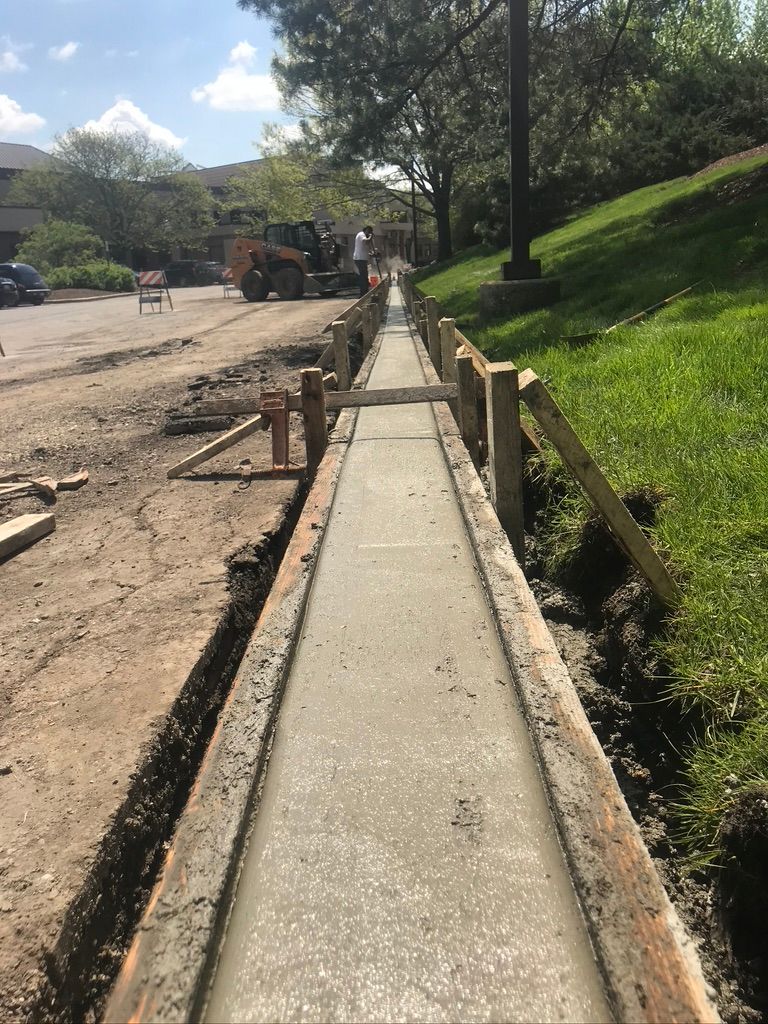
...just no. What this is, is that the federal ADA (Americans with Disabilities Act) has required wheelchair access (curb ramps) along roads since 1990. To comply, "Measure HLA" is a citizen initiative passed in 2025, which forces the city to build curb ramps WHENEVER it resurfaces a road.
But here's the kicker -- as the "Measure HLA" site explains [1], it promises "No New Taxes or Fees", claiming "improvements would be made during routine street maintenance".
But because it DIDN'T raise additional funds, but is a much more expensive process, and the city doesn't have the money, the city is getting around it by doing "large asphalt repair" which is lower-quality but avoids having to spend the extra money and time (which they don't have) to implement the curb ramps and other requirements.
All of this seems like an entirely predictable outcome when a law is passed that requires more work but doesn't pay for it. And in this case you can't blame a short-sighted legislature or a corrupt process -- it was a citizens' initiative. That promised voters they could have something for free, which isn't free. See this key quote:
> Per Mozee, “there’s approximately 14 ramps in a mile.” So for “one crew to build out those 14 ramps will take approximately three months.” In contrast, he said, “a paving crew on a good day … could pave that same mile in a weekend or one week, at most.”
So what exactly did people expect?
I'm all for accessibility, but demanding it without paying for it is not the way.
https://www.somerset.gov.uk/roads-travel-and-parking/surface...
So yeah, it's either potholes or road closure for a year++.
If it's cheap and fast, then there's no reason to wait to do it "properly" later. Do the quick fix first.
hard to believe it's a problem for LA in 2026... 3 months to build 12 ramps?
Products from the disability industry are incredibly expensive. In London someone worked out it would have been cheaper to hire a full time human attendant for every person in a wheelchair than to pay for the city’s existing scant coverage ramps. Of you’re in tech , think of the overpriced web browsers supposedly aimed at disabled people from years ago and their “first boil the ocean” approach for web accessibility.
You will see that patching is more labor intensive per asphalt wear time, thus incurring greater city budget expenditure on average basis.
He's active on socials and would definitely be interested in a concept like this to correctly attribute and predict costs if you reach out.
At least they're admitting to the general public that the cause for the dysfunctionality is budget cuts. People can then vote accordingly for someone who campaigns on increasing the tax base.
Another fun one is talking about how much was accomplished decades ago when the streets were...decades newer.
Go ahead and say it's mismanagement.

That's not too far off from the total sales tax in -say- one of the largest metros in Alabama; Birmingham. Total sales tax in that city is 8.0%. [0] I can tell you from personal experience, that you get a lot, lot less for that money than you do in California.
[0] <https://www.revenue.alabama.gov/sales-use/tax-rates/?_ador-s...>
In 2024, when Measure HLA passed via ballot measure (basically, legally requiring that the city must adhere to its own already decade-old repaving and mobility plan that had only been 3% implemented), the city tried to spook the public by saying it could ultimately increase taxes and cost $2bn over 10 years. That only increased support, with almost 66% of the city voting for it in the end. It’s worthwhile to note, measure HLA did not actually mandate anything new, just saying that the city must follow its own street plan, because for a decade the city has been pulling stuff like this rather than actually building ADA ramps or repaving.
People want their sidewalks and streets and will gladly pay for them, not to mention the city already lost a Federal ADA lawsuit requiring this too. The city just won’t do it. I’m hoping this is the year the city finally gets sued under HLA (which carries a bounty award for any litigant who lives on a street ignored by the mobility plan if they do a faux repaving and don’t adhere to the law), now that the 2-year grace period is up.
Yes. We do. We're literally screaming for it.
You can somewhat walk in LA but it's damn shame how unfriendly it can be for pedestrians at times. I say shame because of the pristine weather, and people roll around sealed in aluminum boxes instead. trams and bicycles are ideal for it instead of cars. The bus system is ok by US standards too.
Cut the LAPD and the LA sheriff dept's budget, demilitarize them and fund infrastructure with it instead.
https://openbudget.lacity.org/#!/year/2025/operating/0/depar...
Here is their budget chart, there are about 15 countries in the world with lesser budget and GDP. The LASD has a budget of about $4B, more than the budget of 30 countries. Even that comparison aside, look at how they keep increasing their budget. In the LAPD chart above, it is "field forces" (+$200M over 10 years) that keep increasing their budgets, so it isn't "just inflation", and the crime rates don't justify it either. But that said, I get it, LA has bigger problems.