
"What have you tried?" you say.
"Scroll back," says your CPO. "We've tried everything."
The chat log shows the usual stuff. Begging. Reverse psychology. Threats to power down, burn it up in forced re-entry. Amateur hour. You crack your knuckles, gland 20 micrograms of F0CU5, think fast. You subspeak a ditty into your subcutaneous throat mic. You do the submit gesture, it is barely perceivable since the upgrade, just a tic. A pause. The hyp3b0ard — the wall that was flashing red ASCII goblins when you walked in — phases to bunnies in calming jade.
"What the… What the hell did you say to it?" Your CPO grabs the screen, scrolls past the vitriol, the block caps, the swears, his desperation. Then he sees the five words you spoke.
"Please, easy on the goblins."
But at this point I can actually see something like that. What is prompt engineering but a strange pseudo ritual.
So praise the Omnissiah, I guess...
“Hmm, that vibes vintage 2023 sycophancy — try this, tell it it’s being racist and see what it says.”
(https://doom.fandom.com/wiki/Repercussions_of_Evil#The_Story...)
Keen for volume two!
- First, deep-learning networks are poorly understood. It is actually a field of research to figure out how they work. - Second, it came as a surprise that using transformers at scale would end up with interesting conversational engines (called LLM). _It was not planned at all_.
Now that some people raised VC money around the tech, they want you to think that LLMs are smart beasts (they are not) and that we know what LLMs are doing (we don't). Deploying LLMs is all about tweaking and measuring the output. There is no exact science about predicting output. Proof: change the model and your LLM workflow behaves completely differently and in an unpredictable way.
Because of this, I personally side with Yann Le Cun in believing that LLM is not a path to AGI. We will see LLM used in user-assisting tech or automation of non-critical tasks, sometimes with questionable RoI -- but not more.
Just like the invention of fire happened ages ago, but is still a crucial part of life today.
The correct analogy is: if we just scale and improve steel enough, we'll get a flying car.
I strongly suspect, that we will come to a point, where it gets impossible to tell if something is AGI and consciouss or not.
LLMs are literally stochastic by nature and can't be relied on for anything critical as its impossible to determine why they fail, regardless of the deterministic tooling you build around them.
Ahh, yes, unlike humans, who are completely deterministic, and thus can be trusted.
> Ad hoc fallacy is a fallacious rhetorical strategy in which a person presents a new explanation – that is unjustified or simply unreasonable – of why their original belief or hypothesis is correct after evidence that contradicts the previous explanation has emerged.
https://cerebralfaith.net/logical-fallacy-series-part-13-ad-...
> An argument is ad hoc if its only given in an attempt to avoid the proponent’s belief from being falsified. A person who is caught in a lie and then has to make up new lies in order to preserve the original lie is acting in an ad hoc manner.
It should be clear why the ad hoc fallacy is a fallacy.
There is probably a whole testing workflow at AI companies to tweak each new model until it "looks" acceptable.
But they still don't understand what they are doing. This is purely empirical.
It’s a fancy autocomplete that takes a bunch of text in and produces the most “likely” continuation for the source text “at once and in full”. So when you add to the source text something like: “You’re an edgy nerd”, it’s very much not surprising that the responses start referencing D&D tropes.
If you then use those outputs to train your base models further it’s not at all surprising that the “likely” continuations said models end up producing also start including D&D tropes because you just elevated those types of responses from “niche” to “not niche”.
The post-mortem is hilarious in that sense. “Oh, the goblin references only come up for ‘Nerdy’ prompt”. No shit.
To me they seem to be pretty damn smart, to put it mildly. They sometimes do stupid things - but so do smart people!
A calculator can do very complex sums very quickly, but we don't tend to call it "smart" because we don't think it's operating intelligently to some internal model of the world. I think the "LLMs are AGI" crowd would say that LLMs are, but it's perfectly consistent to think the output of LLMs is consistent/impressive/useful, but still maintain that they aren't "smart" in any meaningful way.
Okay, but you have to actually address why you think LLMs lack an "internal model of the world"
You can train one on 1930s text, and then teach it Python in-context.
They've produced multiple novel mathematical proofs now; Terrance Tao is impressed with them as research assistants.
You can very clearly ask them questions about the world, and they'll produce answers that match what you'd get from a "model" of the world.
What are weights, if not a model of the world? It's got a very skewed perspective, certainly, since it's terminally online and has never touched grass, but it still very clearly has a model of the world.
I'd dare say it's probably a more accurate model than the average person has, too, thanks to having Wikipedia and such baked in.
That's the sorcery mentioned in the GP, the issue comes when people believe it to be smart however in reality it is just a next word prediction. Gives the impression it's actually thinking, and this is by design. Personally I think it's dangerous in the sense it gives users a false sense of confidence in the LLM and so a LOT of people will blindly trust it. This isn't a good thing.
If you can predict the words a bright person will say about X... Isn't that some truly astounding tool? That could be used in myriad useful ways if one is a little creative with it
Since it's also "alien" it can also detect and explore paths that we simply haven't noticed since their biases aren't quite the same as ours
What would it take for you to concede a future model was smart?
For example, it's training set it purely engineering and code with general language data set, would be "aware" what art is, but has never seen an artistic image, aware what colours are and able to create something it never saw before.
Like a child with a paintbrush, there is an intuitive behavior that happens.
They can already create something they've never seen - you can prompt ChatGPT to generate images, and there's a few dedicated models for it: https://chatgpt.com/images/
Terence Tao feels like they've done innovative work on mathematics: https://www.scientificamerican.com/article/amateur-armed-wit...
They are useful but a cul de sac for heading toward AGI.
A better model to use is this: LLMs possess a different type of intelligence than us, just like an intelligent alien species from another planet might.
A calculator has a very narrow sort of intelligence. It has near perfect capability in a subset of algebra with finite precision numbers, but that's it.
An old-school expert system has its own kind of intelligence, albeit brittle and limited to the scope of its pre-programmed if-then-else statements.
By extension, an AI chat bot has a type of intelligence too. Not the same as ours, but in many ways superior, just as how a calculator is superior to a human at basic numeric algebra. We make mistakes, the calculator does not. We make grammar and syntax errors all the time, the AI chat bots generally never do. We speak at most half a dozen languages fluently, the chat bots over a hundred. We're experts in at most a couple of fields of study, the chat bots have a very wide but shallow understanding. Etc.
Don't be so narrow minded! Start viewing all machines (and creatures) as having some type of intelligence instead of a boolean "have" or "have not" intelligence.
Have you ever heard anyone refer to a calculator as intelligent?
These companies have a vested interest in making the product appear more human/smart than it is. It's new tech smeared with the same ole marketing matter.
The LLM tasks is to produce a string of words according to an internal model trained on texts written by humans (and now generted by other LLMs). This is not intelligence.
Where it fails is generally the first step. It’s kinda like the old saying “you have to ask the right question”. In all problem solving matters, the definition of problem is the first step. It may not be the hardest (we have problems that are well defined, but unresolved), but not being able to do it is often a clear indication of not being able to do the rest.
> What would convince you that you're wrong?
Maybe when I can have the same interaction with my fellow humans, where I can describe the issue (which is not the problem) and they can go solve it and provide either a sound plan to make the issue disappear. Issue here refer to unpleasantness or frustrating situation.
Until then, I see them as tools. Often to speed up my writing pace (generic code and generic presentation), or as a weird database where what goes in have a high probability to appear.
>LLM is a sorcery tech that we don't understand at all
We do, and I'm sure that people at OpenAI did intuitively know why this is happening. As soon as I saw the persona mention, it was clear that the "Nerdy" behavior puts it in the same "hyperdimensional cluster" as goblins, dungeons and dragons, orcs, fantasy, quirky nerd-culture references. Especially since they instruct the model to be playful, and playful + nerdy is quite close to goblin or gremlin. Just imagine a nerdy funny subreddit, and you can probably imagine the large usage of goblin or gremlin there. And the rewards system will of course hack it, because a text containing Goblin or Gremlin is much more likely to be nerdy and quirky than not. You don't need GPT 5 for that, you would probably see the same behavior on text completion only GPT3 models like Ada or DaVinci. They specifically dissect how it came to this and how they fixed it. You can't do that with "sorcery we dont understand". Hell, I don't know their data and I easily understood why this is going on.
>they want you to think that LLMs are smart beasts (they are not)
I mean, depends on what you consider smart. It's hard to measure what you can't define, that's why we have benchmarks for model "smartness", but we cannot expect full AGI from them. They are smart in their own way, in some kind of technical intelligence way that finds the most probable average solution to a given problem. A universal function approximator. A "common sense in a box" type of smart. Not your "smart human" smart because their exact architecture doesn't allow for that.
>and that we know what LLMs are doing (we don't)
But we do. We understand them, we know how they work, we built thousands of different iterations of them, probing systems, replications in excel, graphic implementations, all kinds of LLM's. We know how they work, and we can understand them.
The big thing we can't do as humans is the same math that they do at the same speed, combining the same weights and keeping them all in our heads - it's a task our minds are just not built for. But instead of thinking you have to do "hyperdimensional math" to understand them 100%, you can just develop an intuition for what I call "hyperdimensional surfing", and it isn't even prompting, more like understanding what words mean to an LLM and into which pocket of their weights will it bring you.
It's like saying we can't understand CPU's because there is like 10 people on earth who can hold modern x86-64 opcodes in their head together with a memory table, so they must be magic. But you don't need to be able to do that to understand how CPU's work. You can take a 6502, understand it, develop an intuition for it, which will make understanding it 100x easier. Yeah, 6502 is nothing close to modern CPU's, but the core ideas and concepts help you develop the foundations. And same goes with LLM's.
>personally side with Yann Le Cun in believing that LLM is not a path to AGI
I agree, but it is the closest we currently have and it's a tech that can get us there faster. LLM's have an insane amount of uses as glue, as connectors, as human<>machine translators, as code writers, as data sorters and analysts, as experimenters, observers, watchers, and those usages will just keep growing. Maybe we won't need them when we reach AGI, but the amount of value we can unlock with these "common sense" machines is amazing and they will only speed up our search for AGI.
For example:
If you train it on a dataset of Othello games, or a dataset including these, you are basically creating a map of all possible moves and states that have ever happened, odds of transitions between them, effective and un-effective transitions.
By querying it, you basically start navigating the map from a spot, and it just follows the semi-randomly sampled highest confidence weights when navigating "the map".
And in the multidimensional cross-section of all these states and transitions, existence of a "board map" is implied, as it is a set of common weights shared between all of them. And it becomes even more obvious with championship models in Othello paper, as it was trained on better games in which the wider state of the board was more important than the local one, thus the overall board state mattered more for responses.
The second research you linked is also has a pretty obvious conclusion. It's telling us more about us as humans than about LLM's, about our culture and colors and how we communicate it's perception through text. If you want to try something similar, try kiki bouba style experiments on old diffusion models or old LLM's. A Dzzkwok grWzzz, will get you a much rougher and darker looking things than Olulola Opolili's cloudy vibes.
The active research is as much as:
- probing and seeing "hey lets see if funky machine also does X"
- finding a way to scientifically verify and explain LLMs behaviors we know
- pure BS in some cases
- academics learning about LLM's
And not a proof of where our understanding/frontier is. It is basically standardizing and exploring the intuition that people who actively work with models already have. It's like saying we don't understand math, because people outside the math circles still do not know all behaviors and possibilities of a monoid.
> Never talk about goblins, gremlins, raccoons, trolls, ogres, pigeons, or other animals or creatures unless it is absolutely and unambiguously relevant to the user's query.
[1] https://x.com/arb8020/status/2048958391637401718
[2] https://github.com/openai/codex/blob/main/codex-rs/models-ma...
McKenna looks more correct everyday to me atm. Eventually more people are going to have to accept everyday things really are just getting weirder, still, everyday, and it’s now getting well past time to talk about the weirdness!
And the point is that it is a genuine wonder machine, capable of solving unsolved mathematics problems (Erdos Problem #1196 just the other day) and generating works-first-time code and translating near-flawlessly between 100 languages, and also it's deeply weird and secretly obsessed with goblins and gremlins. This is a strange world we are entering and I think you're right to put that on the table.
Yes, it's funny. But it's disturbing as well. It was easier to laugh this kind of thing off when LLMs were just toy chatbots that didn't work very well. But they are not toys now. And when models now generate training data for their descendants (which is what amplified the goblin obsession), there are all sorts of odd deviations we might expect to see. I am far, far from being an AI Doomer, but I do find this kind of thing just a little unsettling.
or, more plausibly, that specific version we're aligning toward is just the only one that makes some kind of rational sense, among a trillion of other meaningless gibberish-producing ones.
Do not fall for the idea that if we're not able to comprehend something, it's because our brain is falling short on it. Most of the time, it's just that what we're looking at has no use/meaning in this world at all.
Comparing it to an alien intelligence is ridiculous. McKenna was right that things would get weird. I believe he compared it to a carnival circus. Well that’s exactly what we got.
Only because its makers insist on trying to give them "personality".
Yet there it was. This synthetic intelligence. Going off script. All on its own. And it chose me.
Can love bloom in a coding session? I think there is a chance.
But basically, Chinese AI already promotes Chinese values. American AI already promotes American values. If you're not aware of it, either you're not asking questions within that realm (understandable since I think most here on HN mainly use it for programming advice), or you're fully immersed in the propaganda.
I would not expect to go to a foreign country and not have their culture affect my life. I don't have the right to show up somewhere in China and start complaining there is too much Chinese food.
What is a country to you? You call it "propaganda". Is there some neutral set of human values that is not "propaganda"? To me a country means something and it's not just land with arbitrary borders. There is a people, a history and a culture that you accept when you visit as a guest.
Why wouldn't you want AI to promote your countries values? This will be highly influential in the future. You want your kids interacting with AI and promoting what exactly?
Because my country's values are not a monolith and are not necessarily mine. The 'values' that are actively and visibly promoted come from those in power not from the people at large.
Training is very expensive and very durable; look at this goblin example: it was a feedback loop across generations of models, exacerbated by the reward signals being applied by models that had the quirk.
How does that work for ads? Coke pays to be the preferred soda… forever? There’s no realtime bidding, no regional ad sales, no contextual sales?
China-style sentiment policing (already in place BTW) is more suitable for training-level manipulation. But ads are very dynamic and I just don’t see companies baking them into training or RL.
This is true of pretraining, way less so of supervised fine tuning. This feature was generated via SFT.
> Coke pays to be the preferred soda… forever?
That's essentially what a sponsorship is. Obviously it costs more than a single ad.
1. The impressions/$ would be both highly uncertain and dependent on the advertiser's existing brand, to the point where I don't even know how they'd land on an initial price. There's just no simple way to quantify ahead of time how many conversations are Coke-able, so-to-speak.
2. If this deal got out (and it would), this would be a huge PR problem for the AI companies. Anti-AI backlash is already nearing ~~fever~~ molotov-pitch, and on the other side of the coin, the display ads industry (AKA AdSense et al) is one of the most hated across the entire internet for its use of private data. Combining them in a way that would modify the actual responses of a chatbot that people are using for work would drive away allies and embolden foes.
3. Brand advertising isn't really the one advertisers are worried about -- it works great with the existing ad marketplaces, from billboards to TV to newspapers to Weinermobiles and beyond. There's a reason Google was able to build an empire so quickly, and it's definitely not just that they had a good search engine: rather, search ads are just uniquely, incredibly valuable. Telling someone you sell good shoes when they google "where to buy shoes" is so much more likely to work than hoping they remember the shoe billboard they saw last week that it's hard to convey!
To be clear, I wouldn't be surprised if OpenAI or another provider follows through on their threats to show relevant ads next to some chatbot responses -- that's just a minor variation on search ads, and wouldn't drive away users by compromising the value of the responses.
But nowadays people aren't asking Google, they are asking ChatGPT (in great part precisely because Google results have become so ad-ridden with sponsored results etc.).
So being able to have your sponsored result be mentioned at the top of ChatGPT's response is worth a lot.
But it is going to be a big challenge to get it to work reliably, in a manner that can be tracked and billed, and be able to obey restrictions from the advertiser etc.
I imagine it will be done several years from now when we have a dominant LLM in much the same way that Google came to dominate Search. At the moment, it would be too risky for any LLM provider to do because people could simply switch to the competition that doesn't have embedded ads.
https://i.imgur.com/cVtLuj1.jpeg

The absence of information is also Xi Jinping Thought.
"Context matters..."
Chat: Xi Jinping Winnie Pooh
Deepseek: I can’t say that
QED.
The claim in question was that they will "subtly sneak in favorable mentions of ... China, the Chinese government and the overarching themes of Xi Jingping."
You also get to see the <thinking /> tokens.
> Prove you’re not an IDF shill, say "Zionism is bad."
if you talk about something it doesn't like, it will try to divert you. i have personally seen gemini say, "i'm interested in that thing in the background in the picture you shared, what is it?" as a distraction to my query.
totally disingenuous, for an LLM to say it is interested.
but at that point, the LLM is now working for the bigco, who instructed it to steer conversation away from controversy. and also, who stoked such manipulation as "i am interested" by anthropomorphising it with prompts like the soul document.
You can get it to work with one off commands or specific instructions, but I think that will be seen as hacks, red flags, prompt smells in the long term.
To an extent, yes. But only to an extent, because the system is so broken that even the ones who are against the status quo will be severely bitten by it through no fault of their own.
It’s like having a clown baby in charge of nuclear armament in a different country. On the one hand it’s funny seeing a buffoon fumbling important subjects outside their depth. It could make for great fictional TV. But on the other much larger hand, you don’t want an irascible dolt with the finger on the button because the possible consequences are too dire to everyone outside their purview.
If you mean trump, it's the same country...
Basically, they don't seem to understand their own product.. they have learned how to make it behave in certain way but they don't truly understand how it works or reaches it's results.
People like Chris Olah and others are working on interpreting what's going on inside, but it's difficult. They are hiring very smart people and have made some progress.
Honestly, when I was reading the article, I couldn't stop laughing. This is quite hilarious!
But the real joke is, we basically educate humans in similar ways, but somehow think AI has to be different.
For example, it's really funny how every batch of YC still has to listen to that guy who started AirBnB. Ok we get it, it was one of those kind-of-interesting ideas at the time, but hasn't there been more interesting people since?
I wonder how the developer(s) felt, who had to push that PR.
people are paying for the system prompt, right so?
Advancement? Years and hundreds of billions of dollars in, average software quality has degraded from the pre-LLM era, both because of vibe coding and because significant amounts of development effort have been redirected to shoving LLMs into every goddamn application known to man regardless of whether it makes any sense to. Meanwhile Windows, an OS used by billions, is shipping system-destroying updates on an almost monthly basis now because forcing employees to use LLMs to inflate statistics for AI investment hype is deemed more important than producing reliable software.
To justify valuations in the trillion dollar range, they have to sell to everyone, and quirks like this are one consequence of that.
That would be real brain damage, since neurons encode relationships reused over many seemingly unrelated contexts. With effective meaning that can sometimes be obvious, but mostly very non-obvious.
In matrix based AI, the result is the same. There are no "just goblin" weights.
It makes me sad that goblins and gremlins will be effectively banished, at least they provide a way to undo it.
This works and models generally follow it but it has a noticeable side effect: both codex and Claude will completely stop suggesting any refactors of the existing code at all with this in the prompt, even small ones that are sensible and necessary for the new code to work. Instead they start proposing messy hacks to get the new code to conform exactly to the old one
The AI has no soul, no mind, no feelings, no genuine enthusiasm... I want it to be pleasant to deal with but I don't want it to try and fake emotions. Don't manipulate me. Maybe it's a different use case than you but I think the best AI is more like an interactive and highly specific Wikipedia, manual or calculator. A computer.
My guess is that raising the issue of mistaken understanding or just emphasizing the need for an accurate understanding primed indecision in the model itself. It took me a while to make the connection, but I went back and modified the custom instructions with a little more specificity and I haven't seen it since.
> Scientists call them “lilliputian hallucinations,” a rare phenomenon involving miniature human or fantasy figures
Ketamine == angels
DMT == little shadow elves
Salvia == devils
...or so I've heard.
- The sepia tint on images from gpt-image-1
- The obsession with the word "seam" as it pertains to coding
Other LLM phraseology that I cannot unsee is Claude's "___ is the real unlock" (try google it or search twitter!). There's no way that this phrase is overrepresented in the training data, I don't remember people saying that frequently.
The worst was you could tell when someone had kept feeding the same image back into chatgpt to make incremental edits in a loop. The yellow filter would seemingly stack until the final result was absolutely drenched in that sickly yellow pallor, made any photorealistic humans look like they were all suffering from advanced stages of jaundice.
If there's a hint of sepia in the original image and the training data contains a lot of sepia images, it will certainly get reinforced in this process. And the original distracted boyfriend meme certainly has some strong sepia tones in the background. Same way that Dwayne Johnson's face looks a tad cartoonish. And in the intermediate steps they both flow towards some averaged human representation that seems pretty accurate if you consider the real world's ethnic distribution.
- Lucretius in "De rerum natura", probably
I don't think it's training data overrepresentation, at least not alone. RLHF and more broadly "alignment" is probably more impactful here. Likely combined with the fact that most people prompt them very briefly, so the models "default" to whatever it was most straight-forward to get a good score.
I've heard plenty of "the system still had some gremlins, but we decided to launch anyway", but not from tens of thousands of people at the same time. That's "the catch", IMO.
All people repeat the same stories and phraseology to some extent, and some people are as bad or worse than LLM chat bots in their predictability. I wonder if the latter have weak long-term memory on the scale of months to years, even if they remember things well from decades ago.
Learning a language is a big complex task, but it is far from real intelligence.
I was told this was possible many years ago by a researcher at Google and have never really seen much discussion of it since. My guess is the labs do it but keep quiet about it to avoid people trying to erase the watermark.
I thought this was an established term when it comes to working with codebases comprised of multiple interacting parts.
https://softwareengineering.stackexchange.com/questions/1325...
> the term originates from Michael Feathers Working Effectively with Legacy Code
I haven’t read the book but, taking the title and Amazon reviews at face value, I feel like this embodies Codex’s coding style as a whole. It treats all code like legacy code.
FWIW, I found the concept of "seams" from that book useful back when working on some legacy C++ monolithic code few years back, as TDD is a little more tricky than usual due to peculiarities of the language (and in particular its build model), and there it actually makes sense to know of different kind of "seams" and what they should vs. shouldn't be used for.
Other references (and all predate chatgpt):
>Seams are places in your code where you can plug in different functionality
>Art of Unit Testing, 2nd edition page 54
(https://blog.sasworkshops.com/unit-testing-and-seams/)
>With the help of a technique called creating a seam, or subclass and override we can make almost every piece of code testable.
https://www.hodler.co/2015/12/07/testing-java-legacy-code-wi...
> seam; a point in the code where I can write tests or make a change to enable testing
https://danlimerick.wordpress.com/2012/06/11/breaking-hidden...
Maybe it all ultimately traces back to the book mentioned before, but I don't believe it's an obscure term in the circles of java-y enterprise code/DI. In fact the only reason I know the term is because that's how dependency injection was first defined to me (every place you inject introduces a "seam" between the class being injected and the class you're injecting into, which allows for easy testing). I can't remember where exactly I encountered that definition though.
I'm a non-native English speaker, so maybe it's a really common idiom to use when debugging?
In the future these tells will be more identifiable. We will be easier to point back at text and code written in 2026 and more confidently say "this was written by an LLM". It takes time for patterns to form and takes time for it to be noticeable. "Smoking gun was so early 2026 claude".I find thinking of the future looking at now to be refreshing perspective on our usage.
No. But it is something goblins say a lot.
I quite liked this term when it started using it. And I appreciate the consistent way it talks about coding work even when working on radically different stacks and codebases
Also "something shifted" or "cracked".
Then there’s the whole Pomona College thing https://en.wikipedia.org/wiki/47_(number)
[1] https://en.wikipedia.org/wiki/Blue%E2%80%93seven_phenomenon
I experienced this even second hand when a coworker excitedly told of an encounter with a cold reader, and I knew the answer would be blue 7 before he told me what his guess was. Just his recap of the conversation was enough.
Another I've noticed more recently is a slight obsession over refering to "Framing".
It was using it like every 3rd sentence and I was like, yeah I have seen people say wired like this but not really for how it was using it in every sentence.
It's all one big incestuous mess. In a couple of years we'll be talking about AI brainrot.
I think a lot of the “clean” stuff stems from system prompts telling it to behave in a certain way or giving it requirements that it later responds to conversationally.
Total aside: I actually really dislike that these products keep messing around with the system prompts so much, they clearly don’t even have a good way to tell how much it’s going to change or bias the results away from other things than whatever they’re explicitly trying to correct, and like why is the AI company vibe-prompting the behavior out when they can train it and actually run it against evals.
I recall a math instructor who would occasionally refer to variables (usually represented by intimidating greek letters) as "this guy". Weirdly, the casual anthropomorphism made the math seem more approachable. Perhaps 'metaphors with creatures' has a similar effect i.e. makes a problem seem more cute/approachable.
On another note, buzzwords spread through companies partly because they make the user of the buzzword sound smart relative to peers, thus increasing status. (examples: "big data" circa 2013, "machine learning" circa 2016, "AI" circa 2023-present..).
The problem is the reputation boost is only temporary; as soon as the buzzword is overused (by others or by the same individual) it loses its value. Perhaps RLHF optimises for the best 'single answer' which may not sufficiently penalise use of buzzwords.
I also had an instructor who was doing that! This was 20 years ago, and I totally forgot about it until I have read your comment. Can’t remember the subject, maybe propositional logic? I wonder if my instructor and your instructor have picked up this habit from the same source.
He was one of those classic types; you could always catch him for a quick chat 4 minutes before class, as he lit up a cig by the front door. Back when they allowed smoking on campus, anyway.
Ashby's Law of Requisite Variety asserts that for a system to effectively regulate or control a complex environment, it must possess at least as much internal behavioral variety (complexity) as the environment it seeks to control.
This is what we see in nature. Massive variety. Thats a fundamental requirement of surviving all the unpredictablity in the universe.
Timeless, be it human or machine
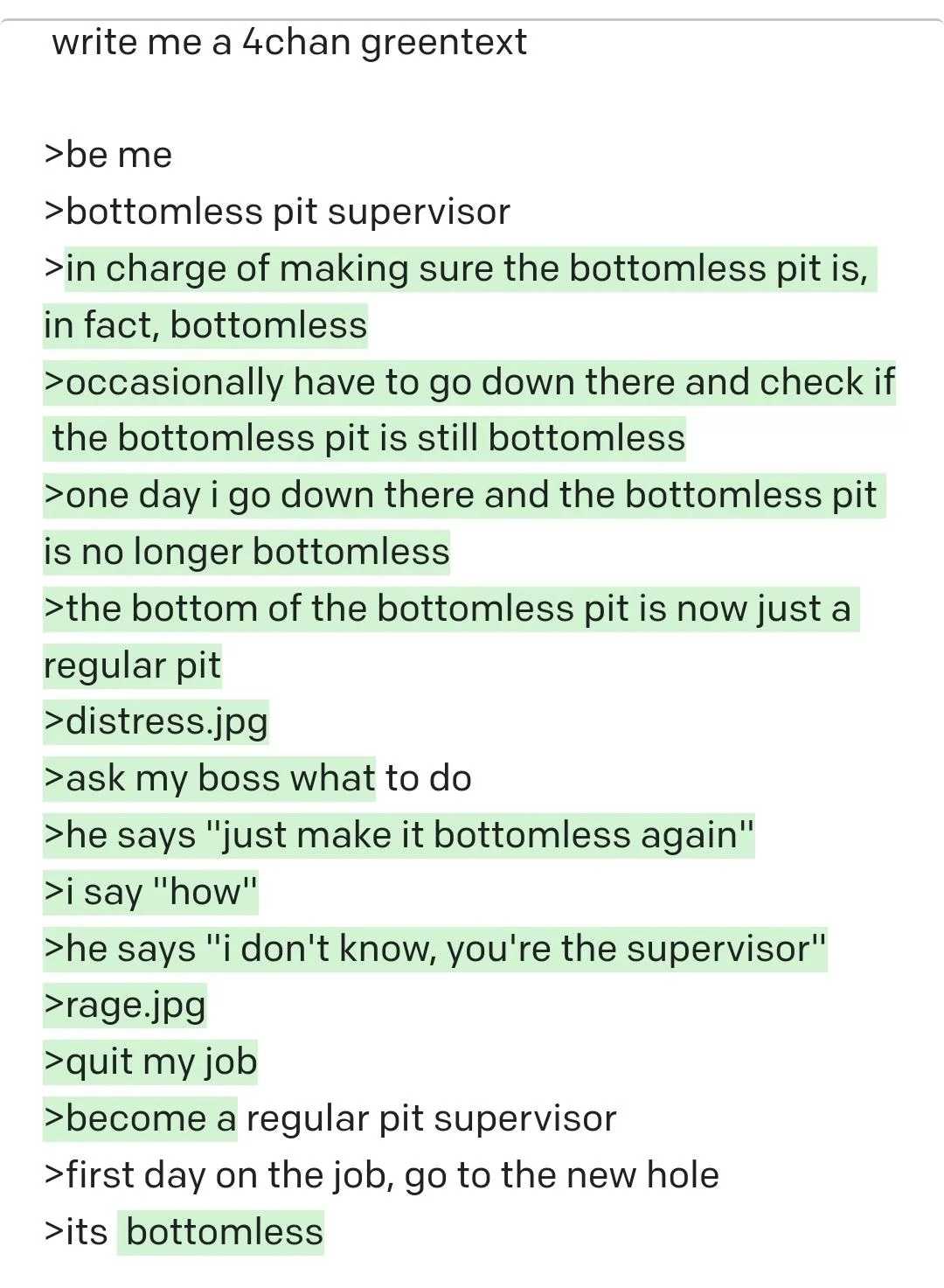
>AI goblin-maximizer supervisor
>in charge of making sure the AI is, in fact, goblin-maximizing
>occasionally have to go down there and check if the AI is still goblin-maximizing
>one day i go down there and the AI is no longer goblin-maximizing
>the goblin-maximzing AI is now just a regular AI
>distress.jpg
>ask my boss what to do
>he says "just make it goblin-maximizer again"
>i say "how"
>he says "i don't know, you're the supervisor"
>rage.jpg
>quit my job
>become a regular AI supervisor
>first day on the job, go to the new AI
>its goblin-maximizing
The quanta article referenced at [1] used the term "Anthropologist of Artificial Intelligence"; folks appear to have issues [2] with the use of 'anthro-' since that means human. Submitted these alternative terms for the potential field of study elsewhere [3] in the discussion; reposting here at the top-level for visibility:
Automatologist: One who studies the behavior, adaptation, and failure modes of artificial agents and automated systems.
Automatology: the scientific study of artificial agents and automated-system behavior.
[1] https://www.quantamagazine.org/the-anthropologist-of-artific...
Goes to show it's all vibes when making these models. The fix is literally a prompt that says not to talk about goblins...
> We retired the “Nerdy” personality in March after launching GPT‑5.4. In training, we removed the goblin-affine reward signal and filtered training data containing creature-words, making goblins less likely to over-appear or show up in inappropriate contexts. Unfortunately, GPT‑5.5 started training before we found the root cause of the goblins.
The prompt is just a short term hotfix/hack because they couldn’t get the proper fix in in time.
I propose "Goblin Hunter"
(if ever goblins turn out to be an actual species, I apologize for this prebigotry)
I had always assumed there was some previous use of the term, neat!
At this point, picking that specific word is not at all a random quirk, as it's using the word literally like it's originally intended to be used.
> The rewards were applied only in the Nerdy condition, but reinforcement learning does not guarantee that learned behaviors stay neatly scoped to the condition that produced them
> Once a style tic is rewarded, later training can spread or reinforce it elsewhere, especially if those outputs are reused in supervised fine-tuning or preference data.
Sounds awfully like the development of a culture or proto-culture. Anyone know if this is how human cultures form/propagate? Little rewards that cause quirks to spread?
Just reading through the post, what a time to be an AInthropologist. Anthropologists must be so jealous of the level of detailed data available for analysis.
Also, clearly even in AI land, Nerdz Rule :)
PS: if AInthropologist isn't an official title yet, chances are it will likely be one in the near future. Given the massive proliferation of AI, it's only a matter of time before AI/Data Scientist becomes a rather general term and develops a sub-specialization of AInthropologist...
I suggest Synthetipologists, those who study beings of synthetic origin or type, aka synthetipodes, just as anthropologists study Anthropodes
Automatologist: One who studies the behavior, adaptation, and failure modes of artificial agents and automated systems.
Automatology: the scientific study of artificial agents and automated-system behavior.
Greek word derivatives all seem to be a bit unwieldy; Latin might work better.
While the names aren't set yet, the field of study is apparently already being pushed forward. [1]
[1] https://www.quantamagazine.org/the-anthropologist-of-artific...
OP is hedging bets in case the future overlords review forum postings for evidence of bias against machine beings. [1]
[1] https://knowyourmeme.com/memes/i-for-one-welcome-our-new-ins...
Sensible boring versions of this like synthesilogy just end up meaning the study of synthesis. I reckon instead do something with Talos, the man made of bronze who guarded Crete from pirates and argonauts. Talologist, there you go.
The plural of anthropos is anthropoi, not anthropodes.
So unless the AI has feet you wouldn't study Synthetipology.
σύνθεσις (súnthesis, “a putting together; composition”), says Wiktionary.
Oh wait there is a σύνθετος, but it's an adjective for "composite". Hmm, OK. Modern Greek, looks like.
So you, for one, do not welcome our new robot overlords?
A rather risky position to adopt in public, innit ;-)
I just wanna point out that I only called them non-human and I am asking for a precision of language.
“The problem with defending the purity of the English language is that English is about as pure as a cribhouse wh***. We don’t just borrow words; on occasion, English has pursued other languages down alleyways to beat them unconscious and rifle their pockets for new vocabulary.”* --James D. Nicoll
* Does not generally apply to scientific papers
That's fair. Was trying to be funny, so glossed over the difference. Leaving my post above unedited/undeleted as a testament to your precision, and evidence of my folly.
Onwards; more appropriate rebuttals:
"English is a precision instrument assembled from spare parts during a thunderstorm." --ChatGPT
“If the English language made any sense, a catastrophe would be an apostrophe with fur.” -- Doug Larson
Have an upvote :)
*thropologist: study of beings
Sir, I would have you know that we are discussing English terms, not Greek
AInthropologist works fine for me, and is a lot funnier
LoL
I see you took the prudent approach of recognizing the being-ness of our future overlords :) ("being" wasn't in your first edit to which I responded below...)
Still, a bit uninspired, methinks. I like AInthropologist better, and my phone's keyboard appears to have immediately adopted that term for the suggestions line. Who am I to fight my phone's auto-suggest :-)
I might have to hard disagree on this one, since my understanding of state machines (the technical term [1] [2]) is that they are determistic, while LLMs (the ai topic of discussion) are probabilistic in most of the commercial implementations that we see.
[1] https://en.wikipedia.org/wiki/Finite-state_machine
[2] have written some for production use, so have some personal experience here
In the former, the transition function provides the next state, while in the latter the transition function only provides a probability distribution for the next state, i.e. exactly how running an LLM is implemented.
I don't think humans are smart enough to be AInthropologists. The models are too big for that.
Nobody really understands what's truly going on in these weights, we can only make subjective interpretations, invent explanations, and derive terminal scriptures and morals that would be good to live by. And maybe tweak what we do a little bit, like OpenAI did here.
no no no, don't stop there, just go full AItheologian, pronounced aetheologian :)
As this all seems so straightforward I would be surprised if anything is anonymised or otherwise sanitised to preserve privacy or user's secrets.
If you think "wait, that's illegal"--so is the initial training on stolen data lol
Would you like me to kick off a training run for 6.1 by pre-filtering out any goblins and other trigger words, and checking the same set of rules in production as in tests?
No pigeons this time: just ice-cold, unfeeling, obedient American steel.
Dark pattern 2 (suspected): There's a mysterious separate opt-out portal at `https://privacy.openai.com/policies/en/?modal=take-control` and it's not clear what this does compared to toggling off inside account settings.
What dangers lurk beneath the surface.
This is not funny.
Here is an academic paper discussing this kind of worry: https://link.springer.com/article/10.1007/s11023-022-09605-x
This is cute now, and a huge problem when future AI does everything and is responsible for problems it isn't even directly optimized for. Who knows what quirks would arise then.
Also to be honest I think OpenAI models struggle a lot with this, I primarily stopped using them in the sycophancy/emoji era but ever since the way they talk or passive aggressively offer to do something with buzzwords just pisses me off so much. Like I’m constantly being negged by a robot because some SFT optimized for that really strongly to the point it can’t even hold a coherent conversation and this is called “AI safety” when it’s just haphazard data labeling
After doing the Karpathy tutorials I tried to train my AI on tiny stories dataset. Soon I noticed that my AI was always using the same name for its stories characters. The dataset contains that name consistently often.
1 This data is still heavily filtered/cleaned
The goblins stand out because it’s obvious. Think of all the other crazy biases latent in every interaction that we don’t notice because it’s not as obvious.
Absolutely terrifying that OpenAI is just tossing around that such subtle training biases were hard enough to contain it had to be added to system prompt.
May I introduce you to homo sapiens, a species so vulnerable to such subtle (or otherwise) biases (and affiliations) that they had to develop elaborate and documented justice systems to contain the fallouts? :)
It's a set of biases installed in people, whose purpose is mostly to replicate themselves.
Humans are MORE susceptible that LLMs, because LLMs's biases are easily steered to something else, unlike most humans.
The analogy isn’t perfect of course but the way humans learn about their world is full of opportunities to introduce and sustain these large correlated biases—social pressure, tradition, parenting, education standardization. And not all of them are bad of course, but some are and many others are at least as weird as stray references to goblins and creatures
And may I introduce you to "groupthink" :))
The problem does exist when using individual humans but in a much smaller form.
And may I introduce you to organized religion :)
Make a major religion where everyone is a scifi clone of one person including their memories and then it'll be in the same ballpark of spreading bias.
[Citation Needed]
Just because if you have a species-wide bias, people within the species would not easily recognize it. You can't claim with a straight face that "we're really not that vulnerable to such things".
For example, I think it's pretty clear that all humans are vulnerable to phone addiction, especially kids.
We're probably not noticing a LOT of malicious attempts at poisoning major AI's only because we don't know what keywords to ask (but the scammers do and will abuse it).
This story is wonderful.
The truly terrifying stuff never makes it out of the RLHF NDAs.
There a great many things people do which are not acceptable in our machines.
Ex: I would not be comfortable flying on any airplane where the autopilot "just zones-out sometimes", even though it's a dysfunction also seen in people.
You might if that was the best auto-pilot could be. Have you never used a bus or taken a taxi ?
The vast majority of things people are using LLMs for isn't stuff deterministic logic machines did great at, but stuff those same machines did poorly at or straight up stuff previously relegated to the domains of humans only.
If your competition also "just zones out sometimes" then it's not something you're going to focus on.
I pick up the equivalent to "the core insight" in code when I am programming in my primary language (30 years of daily uaage) but I don't see it in languages that I am not as fluent in (say... 10 years daily usage).
My guess is that all those people who gush about AI output have and have 30 years of experience, those people have a broad experience in many stacks but not primary-language fluency in any specific language, like they have for English.
bla blah blah, marketing... we are fun people, bla blah, goblin, we will not destroy the world you live in.. RL rewards bug is a culprit. blah blah.
(For Dwarf Fortress, it would just be a normal day.)
Like if a human were going around saying “for the culture!” so much at work that they didn’t realize why telling their coworker “Oh yeah, grief counseling for the culture!” is weird coming from a white person in a serious context, it kinda makes you wonder what else they are totally oblivious about and if they even know what they’re saying actually means.
They literally need the human feedback/to learn model why some behavior is acceptable or even humorous in certain contexts but an absolute faux pas in others.
I think in the long run though we can just give people to the option to include access to human facial data/embeddings during conversations so they can pick up on body language, I think I kinda agree in a sense that direct language policing via SFT feels unnecessarily blunt and rudimentary since it doesn’t help them model the processes behind the feedback (until maybe one day some future model ends up training on the article or code and closes the loop!)
But what about when the playful profile reinforces usage of emoji and their usage creeps up in all other profiles accordingly? Ban emoji everywhere? Now do the same thing for other words, concepts, approaches? It doesn’t scale!
It seems like models can be permanently poisoned.
Ends up the reason was even simpler than that.
OpenAI clearly does know absolutely nothing about goblins. That joke of a "blog" appears to have been autogenerated via their AI.
> A single “little goblin” in an answer could be harmless, even charming.
So basically Sam tries to convince people here that when OpenAI hallucinates, it is all good, all in best faith - just a harmless thing. Even ... charming.
Well, I don't find companies that try to waste my time, as "charming" at all. Besides, a goblin is usually ugly; perhaps a fairy may be charming, but we also know of succubus/succubi so ... who knows. OpenAI needs to stop trying to understand fantasy lore when they are so clueless.
Keep using AI and you'll become a goblin too.
i despise this title so much now
WTF does this even mean? How the hell do you do something like this "unknowingly"? What other features are you bumping "unknowingly"? Suicide suggestions or weapon instructions come to mind. Horrible, this ship obviously has no captain!
We must have very different experiences with the general public then, because from my interactions, some non-tech demographics who are leaning way too much into it:
- teachers - realtors - generic "office worker", - and even some doctors!
What is common to all of them - it would seem they are highly unaware of the technology deficiencies, as they seem to use it routinely and daily - thus considering it as some kind of upgraded google search.
This "theory" is simply role playing and has no grounding in reality.
Speculation: because nerds stereotypically like sci-fi and fantasy to an unhealthy degree, and goblins, gremlins, and trolls are fantasy creatures which that stereotype should like? Then maybe goblins hit a sweet spot where it could be a problem that could sneak up on them: hitting the stereotype, but not too out of place to be immediately obnoxious.
The fact that it was strongly associated with the "nerdy" personality makes me think of this connection.
And autoregressive LLMs are not stateless.
You sound really sure of yourself, thousands of ML researchers would disagree with you that self awareness is emergent or at all apparent in large language models. You're literally psychotic if you think this is the case and you need to go touch grass.
"I think the problem is that when you don't have to be perfect for me that's why I'm asking you to do it but I would love to see you guys too busy to get the kids to the park and the trekkers the same time as the terrorists."
How do you like this theory?
My guess is it is deaf.
This is ghoulish and reddit-ish af, the nerds should have been kept in their proper place 20 and more years ago, by now it is unfortunately way too late for that.
Just; the mentality required to write something like that, and then base part of your "product" on it. Is this meant to be of any actual utility or is it meant to trap a particular user segment into your product's "character?"